Spatial data retrieval
 Remote sensing measurements of
surface characteristics
 surface hydrology
 soil-vegetation-atmosphere transfer
 large area assessment
 spatial data
 temporal repetition
Parameter retrieval for
Hydrology
State variables
 surface temperature
 surface soil moisture
Other spatial data
 land use categories
 vegetation biomass
 surface roughness
 DEM
Secondary parameters
 regions of varying ET
 ground water recharge
and discharge zones
 storm runoff
contribution
 hydrologic properties of
soils
 spatial pollution
Available remote sensing systems
I
Optical scanners
spectrometers
and
altimeters
Sensor System Global
Coverage
Spatial
Resolution
Temporal
Resolution
[days]
Frequency/Wavelength Parameter examples
LANDSAT-TM multi-spectral
scanner
y 30m 17 450 – 520 nm
520 – 600 nm
630 – 690 nm
760 – 900 nm
1550 – 1740 nm
10400 – 12500 nm
2080 – 2350 nm
land use
NDVI, LAI, biomass
http://geo.arc.nasa.gov/s
ge/landsat/landsat.html
SPOT HRV XS multispectral and
panchromatic
scanner
y 5m PAN
10m XS
26 500 – 590 nm
610 – 680 nm
790 – 890 nm
DEM from stereoscopic
data
land use
plant parameters
http://www.spot.com
IRC-1C LISS-3
WIFS
y 23m, 70m
188m
24 520 - 590 nm
620 - 680 nm
770 - 860 nm
1550 - 1700 nm
WIFS:
620 – 680 nm
770-860
land use
NDVI, LAI, biomass
http://www.euromap.de/
doc_004.htm
NOAA/AVHRR advanced very high
resolution
radiometer
y 1.1km 12 580 - 680 nm
725 - 1100 nm
3550 - 3930 nm
10300 - 11300 nm
11500 - 12500 nm
NDVI
clouds
http://www.ncdc.noaa.go
v/ol/satellite/satellitereso
urces.html
Earth
Probe/TOMS
total ozone imaging
spectrometer
y 39km x
39km
1 360.0 nm
331.2 nm
322.3 nm
317.5 nm
312.5 nm
308.6 nm
aerosol, ozone, UV
Radiation, atmospheric
chemistry
http://jwocky.gsfc.nasa.go
v/index.html
GOES imaging
spectrometer
y 1 km 2 550 - 750 nm
3800 - 4000 nm
6500 - 7000 nm
10200 - 11200 nm
11500 - 12500 nm
clouds,
rainfall rates
http://www5.ncdc.noaa.g
ov/plwebapps/plsql/goesb
rowser.goesbrowsemain
TOPEX/
Poseidon
2 Altimeters + /- 60 1.6 - 3 km
(ALT)
7 km
(SSALT)
10 ALT: 13.6 GHz
SSALT: 16.6 GHz
sea surface altimetry
river and lake level
altimetry
http://www-
ccar.colorado.edu/researc
Available remote sensing systems
II
Sensor System Global
Coverage
Spatial
Resolution
Temporal
Resolution
[days]
Frequency/Wavelength Parameter examples
and web-page
SSM/I Radiometer y 70 x 45
60 x 40
38 x 30
16 x 14
1 19.35 GHz, HV
22.24 GHz, V
37.00 GHz, HV
85.50 GHz, HV
soil moisture
snow cover
sea ice
ocean surface wind speed
http://www.ncdc.noaa.gov
/ol/satellite/ssmi/ssmiprod
ucts.html
ERS-2 ATSR along track
scanning
radiometer:
MW sounder
and
IR Radiometer
y 20 km
1 km
3 MW Sounder:
23.8 GHz
36.5 GHz
IRR:
1600 nm
3700 nm
11000 nm
12000 nm
atmospheric water vapor,
liquid water, sea state, sea
surface temperature
http://www.esa.esrin.it
ERS-2 RA radar altimeter mostly
oceans
16 – 20 km 3 330 MHz Ocean
82.5 MHz Ice
ocean level
ice, sea ice level
http://www.esa.esrin.it
ERS-2
AMI-SAR
Windscatterometer
mode
y 50 km 17 5.3 GHz, VV wind speed, ocean waves,
sea ice
RADARSAT Scan SAR mode y e.g. 50 x
50 m
24 5.3 GHz, VV wind speed, ocean waves,
sea ice
http://radarsat.space.gc.ca
Future remote sensing systems
Sensor System Global
Coverage
Spatial
Resolution
Temporal
Resolution
[days]
Frequency/Wavelength Parameter examples
SRTM
(1999)
Shuttle Radar
Topography Mission
y 5x 5 a 10 day
period
5.3 GHz DEM,
surface roughness
http://www-
radar.jpl.nasa.gov/srtm/
ENVISAT
A-SAR
(2000)
Advanced Synthetic
Aperture Radar
y 30 – 75m < 17 5.3 GHz, VV surface roughness
snow water equivalent
freeze/thaw cycles
http://envisat.estec.esa.nl/
EOS MODIS
(2000)
Spectrometer y 0.25 km
0.5 km
1 km
1-2 app. 19 optical
channels
land surface temperat.
land/cloud boundaries
land/cloud properties
atmosph. water vapor
http://ltpwww.gsfc.nasa.gov/
MODIS/MODIS.html
http://ltpwww.gsfc.nasa.gov/
MODIS/MAS/index.html
EOS ASTER
(2000)
Advance Space-
borne Thermal
Emission and
Reflection
Radiometer
y 15 m VIS
30 m SWIR
90 m TIR
16 app. 14 optical
channels
evaporation
vegetation stress
soil moisture
http://eos-
am.gsfc.nasa.gov/aster.html
EOS MISR
(2000)
Multi-angle Imaging
Spectro-radiometer
y 0.275 km 9 443 nm
555 nm
670 nm
865 nm
vegetation parameters
vegetation indices
http://eos-
am.gsfc.nasa.gov/misr.html
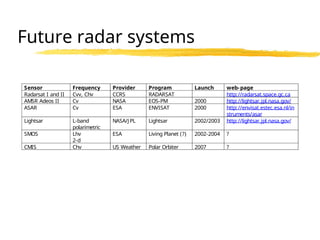
Future radar systems
Sensor Frequency Provider Program Launch web-page
Radarsat I and II Cvv, Chv CCRS RADARSAT http://radarsat.space.gc.ca
AMSR Adeos II Cv NASA EOS-PM 2000 http://lightsar.jpl.nasa.gov/
ASAR Cv ESA ENVISAT 2000 http://envisat.estec.esa.nl/in
struments/asar
Lightsar L-band
polarimetric
NASA/JPL Lightsar 2002/2003 http://lightsar.jpl.nasa.gov/
SMOS Lhv
2-d
ESA Living Planet (?) 2002-2004 ?
CMIS Chv US Weather Polar Orbiter 2007 ?
Data exchange with GIS
 decision for raster or vector GIS or hybrid systems
 data quantization and volume
 full exchange of geometry (e.g. regions) and
attribute table?
 handling of complex data formats (HDF, CDF)?
Image processing software and
portability of formats
 ARC/Info GRID various basic raster formats, tif, sun, gis, lan, img, bil,
bip, bsq, grass, adrg, rlc
 Arcview ERDAS lan, img, grid, tif
 ERDAS IMAGINE Arc/info live link, no conversion needed
 PCI EASI PACE Arc/Info GeoGateway for multiple formats
 ENVI/IDL imports shapefiles, e00, dxf, USGS, SDTS, dlg,
exportsArcView grid, uses own vector format
 ERMAPPER various raster formats, import of dxf and
SeisWorks, uses own vector format
 other packages: TNT, IDRISI, ILWIS...
Image processing steps
 geometric and radiometric correction
 atmospheric correction
 subsetting, mosaic, enhancement
 geo-coding (map projection, spheroid, units)
 parameter extraction (multivariate statistics,
regression model, physical model etc.)
 post-processing (filtering, grouping, data reduction)
 Raster GIS: focal or global operations
 hybrid GIS: zonal/region-based operations, spatial
statistics
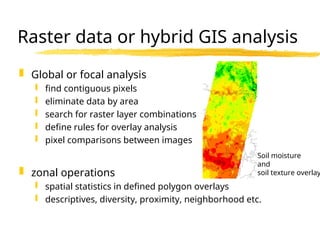
Raster data or hybrid GIS analysis
 Global or focal analysis
 find contiguous pixels
 eliminate data by area
 search for raster layer combinations
 define rules for overlay analysis
 pixel comparisons between images
 zonal operations
 spatial statistics in defined polygon overlays
 descriptives, diversity, proximity, neighborhood etc.
Soil moisture
and
soil texture overlay
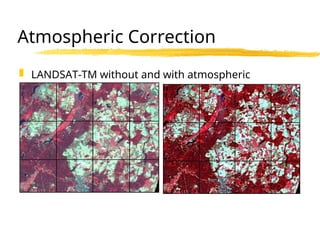
Atmospheric Correction
 LANDSAT-TM without and with atmospheric
correction
Soil moisture retrieval from
SAR
Image processing steps
 slant range correction
 speckle reduction (multi-
looking)
 inversion modeling (physical
model) to obtain soil dielectric
constant 
 conversion of  into %Vol with
3rd order polynomial (e.g.
Topp et al. 1991)
 grouping into 5% classes
 raster-to-vector conversion or
raster use in GIS
In v e rsio n M o d e l D u b o is e t a l. (1 9 9 5 )




 
h h A k h


c o s
sin
( sin )
.
. ta n .
1 5
5
0 2 8 1 4
1 0




 
v v k h


c o s
sin
( sin )
. ta n .
3
3
0 4 6 1 1
1 0
0
5
10
15
20
25
30
0.05 0.10 0.15 0.20 0.25 0.30 0.35 0.40
soil water content [cm^3/cm^3]
Realpart
of
Dielectric
Constant
Sand Loam sand Sand loam
Loam organic matter Topp et al.
%Vol
Processing level of remote
sensing data
 raw data from the satellite
 system corrected, calibrated, geo-coded, terrain corrected
 atmospheric correction for optical data
 thematic evaluations (land use, NDVI, rainfall etc.)
 EXA-Byte tape, CD-ROM
 most commercial data formats are read by software
 generic binary format BSQ, BIL
Data providers
 EROS Data Center, edcwww.cr.usgs.gov
 RADARSAT Int., www.rsi.ca
 EOSAT, www.eosat.com
 ESA/ESRIN, www.esrin.esa.it
 EURIMAGE, www.eurimage.com
 NCDC, www2.ncdc.noaa.gov:80
 ...
3-D Visualization and analysis
 ERDAS IMAGINE Virtual GIS, www.erdas.com
 ESRI ArcView 3D Analyst, www.esri.com
 CLR PolyTRIM Polygonal Toolkit for Representation, Interaction and
Modelling, www.clr.utoronto.ca/POLYTRIM/polytrim.html
 Wooleysoft Visual Explorer 98 www.woolleysoft.co.uk/main.html
 CIRAD AMAP Advanced Modeler of the Architecture of Plants for SGI,
GrowthEngine, Texture, Terrain, Landmaker, Animation,
www.cirad.fr/logiciels/amap/amap.html
 TerraVision Artificial Intelligence Center, www.atsi.com/indexprod.html
 INTERGRAPH MGE Terrain Modeler, MGE Geologic Analyst, MGE Kriging
Modeler, MGE Voxel Analyst, MGE ModelView,
www.intergraph.com/iss/products/mapping/gis/msm.htm
 Questar Productions World Construction Set,
www.questarproductions.com
 ERMapper, www.ermapper.com
 Konrad Zuse Center for Informationtechnology Berlin Amira, www.zib.de
Summary
 Remote sensing data provide large area
spatial data for GIS analysis and modeling
 basic thematic products are available
 image processing and model coupling is
often needed to retrieve quantitative data
 commercial software for combined
evaluation is widely available
 data merge should be done carefully

remote sensing data types for soil mapping.ppt

  • 1.
    Spatial data retrieval Remote sensing measurements of surface characteristics  surface hydrology  soil-vegetation-atmosphere transfer  large area assessment  spatial data  temporal repetition
  • 2.
    Parameter retrieval for Hydrology Statevariables  surface temperature  surface soil moisture Other spatial data  land use categories  vegetation biomass  surface roughness  DEM Secondary parameters  regions of varying ET  ground water recharge and discharge zones  storm runoff contribution  hydrologic properties of soils  spatial pollution
  • 3.
    Available remote sensingsystems I Optical scanners spectrometers and altimeters Sensor System Global Coverage Spatial Resolution Temporal Resolution [days] Frequency/Wavelength Parameter examples LANDSAT-TM multi-spectral scanner y 30m 17 450 – 520 nm 520 – 600 nm 630 – 690 nm 760 – 900 nm 1550 – 1740 nm 10400 – 12500 nm 2080 – 2350 nm land use NDVI, LAI, biomass http://geo.arc.nasa.gov/s ge/landsat/landsat.html SPOT HRV XS multispectral and panchromatic scanner y 5m PAN 10m XS 26 500 – 590 nm 610 – 680 nm 790 – 890 nm DEM from stereoscopic data land use plant parameters http://www.spot.com IRC-1C LISS-3 WIFS y 23m, 70m 188m 24 520 - 590 nm 620 - 680 nm 770 - 860 nm 1550 - 1700 nm WIFS: 620 – 680 nm 770-860 land use NDVI, LAI, biomass http://www.euromap.de/ doc_004.htm NOAA/AVHRR advanced very high resolution radiometer y 1.1km 12 580 - 680 nm 725 - 1100 nm 3550 - 3930 nm 10300 - 11300 nm 11500 - 12500 nm NDVI clouds http://www.ncdc.noaa.go v/ol/satellite/satellitereso urces.html Earth Probe/TOMS total ozone imaging spectrometer y 39km x 39km 1 360.0 nm 331.2 nm 322.3 nm 317.5 nm 312.5 nm 308.6 nm aerosol, ozone, UV Radiation, atmospheric chemistry http://jwocky.gsfc.nasa.go v/index.html GOES imaging spectrometer y 1 km 2 550 - 750 nm 3800 - 4000 nm 6500 - 7000 nm 10200 - 11200 nm 11500 - 12500 nm clouds, rainfall rates http://www5.ncdc.noaa.g ov/plwebapps/plsql/goesb rowser.goesbrowsemain TOPEX/ Poseidon 2 Altimeters + /- 60 1.6 - 3 km (ALT) 7 km (SSALT) 10 ALT: 13.6 GHz SSALT: 16.6 GHz sea surface altimetry river and lake level altimetry http://www- ccar.colorado.edu/researc
  • 4.
    Available remote sensingsystems II Sensor System Global Coverage Spatial Resolution Temporal Resolution [days] Frequency/Wavelength Parameter examples and web-page SSM/I Radiometer y 70 x 45 60 x 40 38 x 30 16 x 14 1 19.35 GHz, HV 22.24 GHz, V 37.00 GHz, HV 85.50 GHz, HV soil moisture snow cover sea ice ocean surface wind speed http://www.ncdc.noaa.gov /ol/satellite/ssmi/ssmiprod ucts.html ERS-2 ATSR along track scanning radiometer: MW sounder and IR Radiometer y 20 km 1 km 3 MW Sounder: 23.8 GHz 36.5 GHz IRR: 1600 nm 3700 nm 11000 nm 12000 nm atmospheric water vapor, liquid water, sea state, sea surface temperature http://www.esa.esrin.it ERS-2 RA radar altimeter mostly oceans 16 – 20 km 3 330 MHz Ocean 82.5 MHz Ice ocean level ice, sea ice level http://www.esa.esrin.it ERS-2 AMI-SAR Windscatterometer mode y 50 km 17 5.3 GHz, VV wind speed, ocean waves, sea ice RADARSAT Scan SAR mode y e.g. 50 x 50 m 24 5.3 GHz, VV wind speed, ocean waves, sea ice http://radarsat.space.gc.ca
  • 5.
    Future remote sensingsystems Sensor System Global Coverage Spatial Resolution Temporal Resolution [days] Frequency/Wavelength Parameter examples SRTM (1999) Shuttle Radar Topography Mission y 5x 5 a 10 day period 5.3 GHz DEM, surface roughness http://www- radar.jpl.nasa.gov/srtm/ ENVISAT A-SAR (2000) Advanced Synthetic Aperture Radar y 30 – 75m < 17 5.3 GHz, VV surface roughness snow water equivalent freeze/thaw cycles http://envisat.estec.esa.nl/ EOS MODIS (2000) Spectrometer y 0.25 km 0.5 km 1 km 1-2 app. 19 optical channels land surface temperat. land/cloud boundaries land/cloud properties atmosph. water vapor http://ltpwww.gsfc.nasa.gov/ MODIS/MODIS.html http://ltpwww.gsfc.nasa.gov/ MODIS/MAS/index.html EOS ASTER (2000) Advance Space- borne Thermal Emission and Reflection Radiometer y 15 m VIS 30 m SWIR 90 m TIR 16 app. 14 optical channels evaporation vegetation stress soil moisture http://eos- am.gsfc.nasa.gov/aster.html EOS MISR (2000) Multi-angle Imaging Spectro-radiometer y 0.275 km 9 443 nm 555 nm 670 nm 865 nm vegetation parameters vegetation indices http://eos- am.gsfc.nasa.gov/misr.html
  • 6.
    Future radar systems SensorFrequency Provider Program Launch web-page Radarsat I and II Cvv, Chv CCRS RADARSAT http://radarsat.space.gc.ca AMSR Adeos II Cv NASA EOS-PM 2000 http://lightsar.jpl.nasa.gov/ ASAR Cv ESA ENVISAT 2000 http://envisat.estec.esa.nl/in struments/asar Lightsar L-band polarimetric NASA/JPL Lightsar 2002/2003 http://lightsar.jpl.nasa.gov/ SMOS Lhv 2-d ESA Living Planet (?) 2002-2004 ? CMIS Chv US Weather Polar Orbiter 2007 ?
  • 7.
    Data exchange withGIS  decision for raster or vector GIS or hybrid systems  data quantization and volume  full exchange of geometry (e.g. regions) and attribute table?  handling of complex data formats (HDF, CDF)?
  • 8.
    Image processing softwareand portability of formats  ARC/Info GRID various basic raster formats, tif, sun, gis, lan, img, bil, bip, bsq, grass, adrg, rlc  Arcview ERDAS lan, img, grid, tif  ERDAS IMAGINE Arc/info live link, no conversion needed  PCI EASI PACE Arc/Info GeoGateway for multiple formats  ENVI/IDL imports shapefiles, e00, dxf, USGS, SDTS, dlg, exportsArcView grid, uses own vector format  ERMAPPER various raster formats, import of dxf and SeisWorks, uses own vector format  other packages: TNT, IDRISI, ILWIS...
  • 9.
    Image processing steps geometric and radiometric correction  atmospheric correction  subsetting, mosaic, enhancement  geo-coding (map projection, spheroid, units)  parameter extraction (multivariate statistics, regression model, physical model etc.)  post-processing (filtering, grouping, data reduction)  Raster GIS: focal or global operations  hybrid GIS: zonal/region-based operations, spatial statistics
  • 10.
    Raster data orhybrid GIS analysis  Global or focal analysis  find contiguous pixels  eliminate data by area  search for raster layer combinations  define rules for overlay analysis  pixel comparisons between images  zonal operations  spatial statistics in defined polygon overlays  descriptives, diversity, proximity, neighborhood etc. Soil moisture and soil texture overlay
  • 11.
    Atmospheric Correction  LANDSAT-TMwithout and with atmospheric correction
  • 12.
    Soil moisture retrievalfrom SAR Image processing steps  slant range correction  speckle reduction (multi- looking)  inversion modeling (physical model) to obtain soil dielectric constant   conversion of  into %Vol with 3rd order polynomial (e.g. Topp et al. 1991)  grouping into 5% classes  raster-to-vector conversion or raster use in GIS In v e rsio n M o d e l D u b o is e t a l. (1 9 9 5 )       h h A k h   c o s sin ( sin ) . . ta n . 1 5 5 0 2 8 1 4 1 0       v v k h   c o s sin ( sin ) . ta n . 3 3 0 4 6 1 1 1 0 0 5 10 15 20 25 30 0.05 0.10 0.15 0.20 0.25 0.30 0.35 0.40 soil water content [cm^3/cm^3] Realpart of Dielectric Constant Sand Loam sand Sand loam Loam organic matter Topp et al. %Vol
  • 13.
    Processing level ofremote sensing data  raw data from the satellite  system corrected, calibrated, geo-coded, terrain corrected  atmospheric correction for optical data  thematic evaluations (land use, NDVI, rainfall etc.)  EXA-Byte tape, CD-ROM  most commercial data formats are read by software  generic binary format BSQ, BIL
  • 14.
    Data providers  EROSData Center, edcwww.cr.usgs.gov  RADARSAT Int., www.rsi.ca  EOSAT, www.eosat.com  ESA/ESRIN, www.esrin.esa.it  EURIMAGE, www.eurimage.com  NCDC, www2.ncdc.noaa.gov:80  ...
  • 15.
    3-D Visualization andanalysis  ERDAS IMAGINE Virtual GIS, www.erdas.com  ESRI ArcView 3D Analyst, www.esri.com  CLR PolyTRIM Polygonal Toolkit for Representation, Interaction and Modelling, www.clr.utoronto.ca/POLYTRIM/polytrim.html  Wooleysoft Visual Explorer 98 www.woolleysoft.co.uk/main.html  CIRAD AMAP Advanced Modeler of the Architecture of Plants for SGI, GrowthEngine, Texture, Terrain, Landmaker, Animation, www.cirad.fr/logiciels/amap/amap.html  TerraVision Artificial Intelligence Center, www.atsi.com/indexprod.html  INTERGRAPH MGE Terrain Modeler, MGE Geologic Analyst, MGE Kriging Modeler, MGE Voxel Analyst, MGE ModelView, www.intergraph.com/iss/products/mapping/gis/msm.htm  Questar Productions World Construction Set, www.questarproductions.com  ERMapper, www.ermapper.com  Konrad Zuse Center for Informationtechnology Berlin Amira, www.zib.de
  • 16.
    Summary  Remote sensingdata provide large area spatial data for GIS analysis and modeling  basic thematic products are available  image processing and model coupling is often needed to retrieve quantitative data  commercial software for combined evaluation is widely available  data merge should be done carefully