Interoperability and Data Networking
                Facilitated by the
     GEO Air Quality Community of Practice


                   Contact: Rudolf Husar, rhusar@wustl.edu

GEO Interoperability (Virtual) Workshop III: A Look Into the Future of GEOSS
                        October 18-19, 2011, Webex
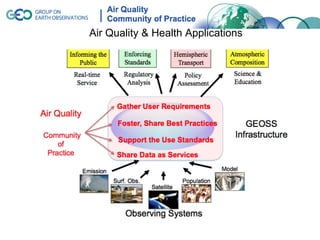
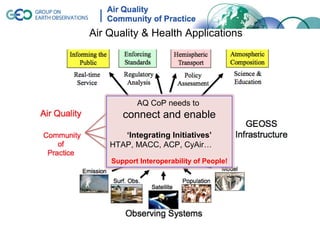
Air Quality & Health Applications
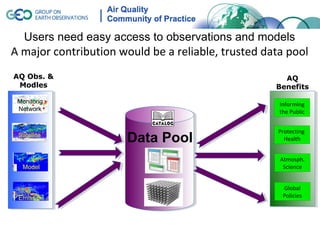
Users need easy access to observations and models
A major contribution would be a reliable, trusted data pool
AQ Obs. &                                             AQ
 Modles                                             Benefits

 Monitorig                                           Informing
 Network                                             the Public


                                                     Protecting
 Satellite
                       Data Pool                       Health


                                                     Atmosph.
  Model                                               Science


                                                      Global
 Emission                                             Policies
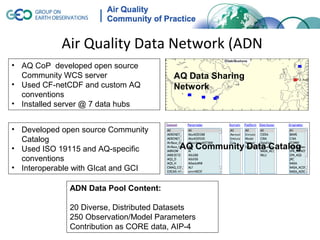
Air Quality Data Network (ADN
• AQ CoP developed open source
  Community WCS server                  AQ Data Sharing
• Used CF-netCDF and custom AQ          Network
  conventions
• Installed server @ 7 data hubs


• Developed open source Community
  Catalog
• Used ISO 19115 and AQ-specific         AQ Community Data Catalog
  conventions
• Interoperable with GIcat and GCI

              ADN Data Pool Content:

              20 Diverse, Distributed Datasets
              250 Observation/Model Parameters
              Contribution as CORE data, AIP-4
Summary

• AQ Data Network (ADN) demonstrates the application of
  GEO principles and GEOSS infrastructure

• ADN is still too fragile and incomplete for ‘real’ applications

• The road toward integrated data systems will be long,
  bumpy and littered with wrecks of well-intended attempts

• The main impediments appear to be human factors; the
  solutions will have to deal with turf, trust, jealousy…
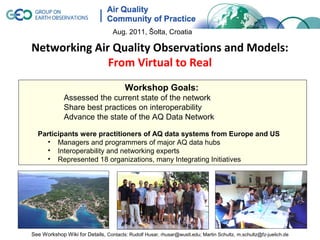
Aug. 2011, Šolta, Croatia

Networking Air Quality Observations and Models:
              From Virtual to Real
                                        Workshop Goals:
              Assessed the current state of the network
              Share best practices on interoperability
              Advance the state of the AQ Data Network

  Participants were practitioners of AQ data systems from Europe and US
    • Managers and programmers of major AQ data hubs
    • Interoperability and networking experts
    • Represented 18 organizations, many Integrating Initiatives


See Workshop Wiki for Details, Contacts: Rudolf Husar, rhusar@wustl.edu; Martin Schultz, m.schultz@fz-juelich.de
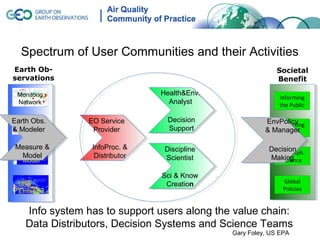
Spectrum of User Communities and their Activities
Earth Ob-                                                   Societal
servations                                                  Benefit

 Monitorig                      Health&Env.
                                                            Informing
 Network                          Analyst                   the Public

Earth Obs.      EO Service       Decision               EnvPolicy
                                                           Protecting
& Satellite
  Modeler        Provider        Support                & Manager
                                                             Health

 Measure &       InfoProc. &     Discipline              Decision
                                                            Atmosph.
  Model           Distributor    Scientist               Making
   Model                                                     Science

                                Sci & Know
                                 Creation                     Global
  Emission                                                    Policies


    Info system has to support users along the value chain:
    Data Distributors, Decision Systems and Science Teams
                                              Gary Foley, US EPA
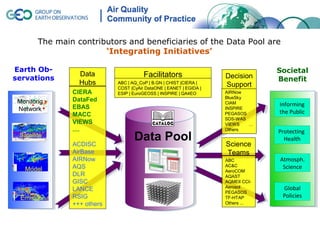
The main contributors and beneficiaries of the Data Pool are
                        ‘Integrating Initiatives’

Earth Ob-                                                                          Societal
servations
                  Data                  Facilitators                 Decision
                  Hubs       ABC | AQ_CoP | B.GN | CHIST |CIERA |
                                                                                   Benefit
                             COST |CyAir DataONE | EANET | EGIDA |
                                                                     Support
                CIERA        ESIP | EuroGEOSS | INSPIRE | QA4EO      AIRNow
                                                                     BlueSky
 Monitorig      DataFed
                EBAS
                                                                     CIAM          Informing
 Network                                                             INSPIRE
                                                                                   the Public
                MACC                                                 PEGASOS
                                                                     SDS-WAS
                VIEWS                                                VIEWS   …
                ....                                                 Others
                                                                                   Protecting
 Satellite
                ACDISC
                                    Data Pool                        Science
                                                                                     Health

                AirBase                                              Teams
                AIRNow                                               ABC           Atmosph.
   Model        AQS                                                  AC&C           Science
                                                                     AeroCOM
                DLR                                                  AQAST
                GISC                                                 AQMEII CCI-
                LANCE                                                Aerosol        Global
                                                                     PEGASOS
  Emission      RSIG                                                 TF-HTAP        Policies
                +++ others                                           Others ...
Air Quality & Health Applications


           AQ CoP needs to
       connect and enable
       ‘Integrating Initiatives’
    HTAP, MACC, ACP, CyAir…

    Support Interoperability of People!
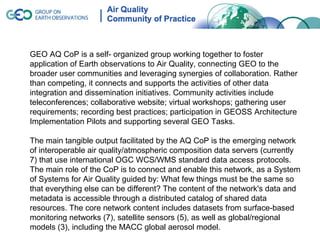
GEO AQ CoP is a self- organized group working together to foster
application of Earth observations to Air Quality, connecting GEO to the
broader user communities and leveraging synergies of collaboration. Rather
than competing, it connects and supports the activities of other data
integration and dissemination initiatives. Community activities include
teleconferences; collaborative website; virtual workshops; gathering user
requirements; recording best practices; participation in GEOSS Architecture
Implementation Pilots and supporting several GEO Tasks.

The main tangible output facilitated by the AQ CoP is the emerging network
of interoperable air quality/atmospheric composition data servers (currently
7) that use international OGC WCS/WMS standard data access protocols.
The main role of the CoP is to connect and enable this network, as a System
of Systems for Air Quality guided by: What few things must be the same so
that everything else can be different? The content of the network's data and
metadata is accessible through a distributed catalog of shared data
resources. The core network content includes datasets from surface-based
monitoring networks (7), satellite sensors (5), as well as global/regional
models (3), including the MACC global aerosol model.

111018 geo sif_aq_interop

  • 1.
    Interoperability and DataNetworking Facilitated by the GEO Air Quality Community of Practice Contact: Rudolf Husar, rhusar@wustl.edu GEO Interoperability (Virtual) Workshop III: A Look Into the Future of GEOSS October 18-19, 2011, Webex
  • 2.
    Air Quality &Health Applications
  • 3.
    Users need easyaccess to observations and models A major contribution would be a reliable, trusted data pool AQ Obs. & AQ Modles Benefits Monitorig Informing Network the Public Protecting Satellite Data Pool Health Atmosph. Model Science Global Emission Policies
  • 4.
    Air Quality DataNetwork (ADN • AQ CoP developed open source Community WCS server AQ Data Sharing • Used CF-netCDF and custom AQ Network conventions • Installed server @ 7 data hubs • Developed open source Community Catalog • Used ISO 19115 and AQ-specific AQ Community Data Catalog conventions • Interoperable with GIcat and GCI ADN Data Pool Content: 20 Diverse, Distributed Datasets 250 Observation/Model Parameters Contribution as CORE data, AIP-4
  • 5.
    Summary • AQ DataNetwork (ADN) demonstrates the application of GEO principles and GEOSS infrastructure • ADN is still too fragile and incomplete for ‘real’ applications • The road toward integrated data systems will be long, bumpy and littered with wrecks of well-intended attempts • The main impediments appear to be human factors; the solutions will have to deal with turf, trust, jealousy…
  • 6.
    Aug. 2011, Šolta,Croatia Networking Air Quality Observations and Models: From Virtual to Real Workshop Goals: Assessed the current state of the network Share best practices on interoperability Advance the state of the AQ Data Network Participants were practitioners of AQ data systems from Europe and US • Managers and programmers of major AQ data hubs • Interoperability and networking experts • Represented 18 organizations, many Integrating Initiatives See Workshop Wiki for Details, Contacts: Rudolf Husar, rhusar@wustl.edu; Martin Schultz, m.schultz@fz-juelich.de
  • 7.
    Spectrum of UserCommunities and their Activities Earth Ob- Societal servations Benefit Monitorig Health&Env. Informing Network Analyst the Public Earth Obs. EO Service Decision EnvPolicy Protecting & Satellite Modeler Provider Support & Manager Health Measure & InfoProc. & Discipline Decision Atmosph. Model Distributor Scientist Making Model Science Sci & Know Creation Global Emission Policies Info system has to support users along the value chain: Data Distributors, Decision Systems and Science Teams Gary Foley, US EPA
  • 8.
    The main contributorsand beneficiaries of the Data Pool are ‘Integrating Initiatives’ Earth Ob- Societal servations Data Facilitators Decision Hubs ABC | AQ_CoP | B.GN | CHIST |CIERA | Benefit COST |CyAir DataONE | EANET | EGIDA | Support CIERA ESIP | EuroGEOSS | INSPIRE | QA4EO AIRNow BlueSky Monitorig DataFed EBAS CIAM Informing Network INSPIRE the Public MACC PEGASOS SDS-WAS VIEWS VIEWS … .... Others Protecting Satellite ACDISC Data Pool Science Health AirBase Teams AIRNow ABC Atmosph. Model AQS AC&C Science AeroCOM DLR AQAST GISC AQMEII CCI- LANCE Aerosol Global PEGASOS Emission RSIG TF-HTAP Policies +++ others Others ...
  • 9.
    Air Quality &Health Applications AQ CoP needs to connect and enable ‘Integrating Initiatives’ HTAP, MACC, ACP, CyAir… Support Interoperability of People!
  • 10.
    GEO AQ CoPis a self- organized group working together to foster application of Earth observations to Air Quality, connecting GEO to the broader user communities and leveraging synergies of collaboration. Rather than competing, it connects and supports the activities of other data integration and dissemination initiatives. Community activities include teleconferences; collaborative website; virtual workshops; gathering user requirements; recording best practices; participation in GEOSS Architecture Implementation Pilots and supporting several GEO Tasks. The main tangible output facilitated by the AQ CoP is the emerging network of interoperable air quality/atmospheric composition data servers (currently 7) that use international OGC WCS/WMS standard data access protocols. The main role of the CoP is to connect and enable this network, as a System of Systems for Air Quality guided by: What few things must be the same so that everything else can be different? The content of the network's data and metadata is accessible through a distributed catalog of shared data resources. The core network content includes datasets from surface-based monitoring networks (7), satellite sensors (5), as well as global/regional models (3), including the MACC global aerosol model.

Editor's Notes

  • #3 The vision is to have these data available through an interoperability framework that allows them to be used via various subsets and combinations to support specific research and decision applications There are numerous Earth Observations that are available and in principle useful for air quality applications such as informing the public and enforcing AQ standards. However, connecting a user to the right observations or models is accompanied by an array of hurdles. The GEOSS Common Infrastructure allows the reuse of observations and models for multiple purposes Even in the narrow application of Wildfire smoke, observations and models can be reused.
  • #6 There are numerous Earth Observations that are available and in principle useful for air quality applications such as informing the public and enforcing AQ standards. However, there are a multitude of interoperability hurdles hurdles facing this community (can be extended to broader Earth science community) that users face – finding, accessing, quality and data fusion issues. It is redundant for each project to figure out the same things. Coordinating acr Therefore the AQ community has come together to work toward a single interoperability framework that allows them to be used via various subsets and combinations to support specific research and decision applications
  • #7 At the end of August 2011, the GEO Air Quality Community of Practice organized a small topical workshop on the Networking of Air Quality Observations and Models where data system practitioners from Europe and North America will discuss interoperability challenges, and share best practices. The central theme of the workshop will be on the implementation of the network, that is turning the current fragile and virtual network into a real network that benefits many organizations. Accordingly, the bulk of the time during the three-day workshop was devoted to the technical issues on the realization of AQ Network. The 30 or so workshop participants represent major data hubs, science teams, AQ decision support systems and other integrating initiatives with common interest in the realization of AQ data networking. The workshop venue is Stomorska, adjacent to Split, Croaotia. The workshop was able to attract the participation of the managers and programmers of the major air quality data hubs in Europe and US, as well as experts on interoperability and networking. Thus the group was quite competent the handle the AQ data networking topic. The meeting allowed the participants to learn about each other's data systems and general perspectives. This was a necessary step toward a shared understanding and for building trust for future inter-dependent data networking. During the open discussion-oriented sessions, the participants were willing and able to articulate the key impediments to networked AQ data systems at their respective organizations. With this, remedies can be pursued. At the end of the meeting the managers and programmers of the major data hubs made a remarkable set of commitments toward making the AQ Data Network happen
  • #10 The vision is to have these data available through an interoperability framework that allows them to be used via various subsets and combinations to support specific research and decision applications There are numerous Earth Observations that are available and in principle useful for air quality applications such as informing the public and enforcing AQ standards. However, connecting a user to the right observations or models is accompanied by an array of hurdles. The GEOSS Common Infrastructure allows the reuse of observations and models for multiple purposes Even in the narrow application of Wildfire smoke, observations and models can be reused.