http://www.youtube.com/watch?v=TN3MR18uCoU

http://www.mentalhealthscreening.org/military/index.aspx
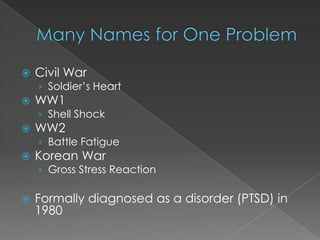
   Civil War
    › Soldier’s Heart
   WW1
    › Shell Shock
   WW2
    › Battle Fatigue
   Korean War
    › Gross Stress Reaction

   Formally diagnosed as a disorder (PTSD) in
    1980
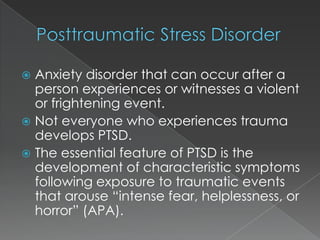
 Anxiety disorder that can occur after a
  person experiences or witnesses a violent
  or frightening event.
 Not everyone who experiences trauma
  develops PTSD.
 The essential feature of PTSD is the
  development of characteristic symptoms
  following exposure to traumatic events
  that arouse “intense fear, helplessness, or
  horror” (APA).
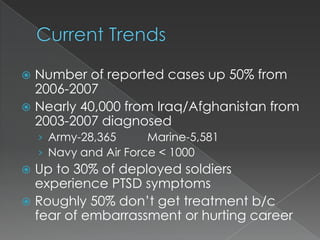
 Number of reported cases up 50% from
  2006-2007
 Nearly 40,000 from Iraq/Afghanistan from
  2003-2007 diagnosed
    › Army-28,365      Marine-5,581
    › Navy and Air Force < 1000
 Up to 30% of deployed soldiers
  experience PTSD symptoms
 Roughly 50% don’t get treatment b/c
  fear of embarrassment or hurting career
   Self Reports - a study completed by
    › 2,275 Operation Iraqi Freedom soldiers
    › 1,814 Operation Enduring Freedom soldiers
   44% clinically significant levels of depression and/or
    PTSD (LaPierre, 2007)
   Experts Estimate
    ›   15% of Vietnam Vets currently, several years after war
    ›   8-10% of Desert Storm
    ›   6-11% of Enduring Freedom
    ›   12-20% of Iraqi Freedom
         Problems?
           7-9% of general public suffers from PTSD (5.2 million 18-54)
           30% of combat veterans develop PTSD
             Strong link between PTSD and violence but violence alone does not
              cause PTSD (APA)
   121 Veterans have committed murder since their return to
    the States
    › Most victims were their spouses or children
        1/3 were spouses, girlfriends, children or other relatives
    › Trauma and stress of deployment along with alcohol
      abuse, family discord and other problems set the stage
    › 75% were still in military when killed relative
    › 50% involved guns
        Rest were stabbings, beatings, strangulation, and bathtub
         drownings
    › 25 face homicide charges for fatal crashes from
      drunken, reckless, or suicidal driving (Sontag, 2008)
 Felony El Paso county jail bookings for service members
  jumped from 295 in 2005 to 471 in 2006
 Reports of theft and domestic violence for soldiers
  increased in 2006
 Crime ring in Ft. Carson of Iraqi War Veterans were
  responsible for the deaths of two GIs
   May occur soon after trauma or can be
    delayed for more than 6 months after
    › When occurs right after trauma, usually gets
      better after 3 months
    › Some may have long term PTSD which can last
      for many years
    › Approximately 50% of cases remit within 1 year
   Psychological, genetic, physical and social
    factors involved but no exact cause
    › Changes the body’s response to stress
    › There may be a personal predisposition
      necessary for symptoms to develop after trauma
   Being female
   Having learning disability
   Physical and/or sexual abuse
   Existence of mental disorder prior to event
   Low education levels and poor SES
   Some ethnic differences due to how pain and anxiety are
    expressed (Hispanics, African Americans, Native
    Americans)
   Duration of traumatic event*
   Traumatic events inflicted by a person*
   Violence associated with trauma*
   Negative life events*

    › *most likely to effect soldiers*
   Disaster Preparedness training
    › Firefighters, police and paramedics receive this
   Strong support systems
    › Positive paternal relationship
    › Social support
   Positive life events
   Stress management training
   Psychological preparedness
   Older age at entry to war
   Higher level of education
   Higher SES
   Currently no tests to diagnose PTSD
    › The diagnosis is made based on a certain set of
      symptoms that continue after the trauma has
      occurred.
    › Psychiatric and physical exams performed to rule out
      other illnesses
    › Usually must have at least one re-experiencing
      symptom for diagnosis
   Mental Health Self-Assessment Program
    ›   Military personnel and their families
    ›   Online or over the phone test
    ›   Identify symptoms
    ›   Access assistance before problems becomes serious
   Repeatedly “reliving” of the event, which disturbs
    day-to-day activities
    › Flashbacks, recurring distressing memories
    › Repeated dreams
    › Physical reactions to situations that remind of event
   Avoidance
    ›   Emotional numbing, feelings of detachment
    ›   Inability to remember important parts of trauma
    ›   Lack of interest in normal activities
    ›   Less expression of moods
    ›   Staying away from anything that is a reminder
    ›   Sense of having no future
   Arousal
    ›   Difficulty concentrating, sleeping difficulties
    ›   Exaggerated response when startled
    ›   Hyper vigilance
    ›   Irritability or outbursts of anger
   Charles W Hoge (2004)
   4 US Combat Infantry Units
    › 3 Army         1 Marine
    › Iraq-2530      Afghanistan-3671
   Combat duty in Iraq and Afghanistan- Levels of PTSD
    › Before combat in Iraq 9.3%
    › After Iraq 15.6-17.1%
    › After Afghanistan 11.2%
   Only 23-40% sought mental health care
   2x as likely to report concern about possible
    stigmatization and other barriers to seeking mental
    health care
    › Feared seeking treatment b/c would make them appear
      weak or cause their peers to treat them differently
 Michelle D. Sherman (2006)
 Veterans with PTSD have higher rates
  than the general population of abuse
 17 couples seeking therapy were studied
    › PTSD and depression diagnosed Veterans
     perpetrated more violence
       Much higher than found in previous research
    › 81% engaged in at least one act of violence
     toward their partner in a year
       > than 6x the general population
 Cynthia A Leardmann (2009)
 If baseline functional health status can
  predict PTSD after combat
    › 5410 participants
       Baseline and follow-up questionnaires
       7.3% had new onset symptoms of PTSD
       Those whose baseline mental component
        summary scores were below the 15th centile
        had 2-3x the risk of symptoms of PTSD by
        follow-up compared to those in the 15th-85th
        centile.
    › Low mental or physical health prior to combat
     significantly increased risk of PTSD
   Traditional Treatments (Last 3-6months up to 1-2yrs+)
    › CBT
       Behavioral therapy can be used to treat avoidance
        symptoms
    › Supportive patient education
       Support groups with people who had experienced similar
        traumas
    › Psychopharmacology
       Antidepressants (SSRIs) can be effective in treating PTSD
       Sedatives for sleep disturbances
   Immersion Therapy Video Game
    › Simulates sights, sounds & smells of combat
    › Gradually re-enter a traumatic event
    › “Virtual Iraq”
   Side Issues
    › May need to treat side symptoms such as depression and
      alcohol/drug abuse before addressing the PTSD
   8 phases of treatment
    › 1: History taking and treatment plan
    › 2: Does client have adequate methods developing
      good coping skills and dealing with emotional
      distress-self calming exercises
    › 3-6: Client identifies most vivid memories from event,
      intensity of negative emotions and positive personal
      beliefs
    › 7: Closure-client keeps a journal during the week to
      document any related material
    › 8: Re-evaluation of the previous session
   After EMDR clients typically report that the
    emotional distress related to the memories is
    significantly decreased or gone
 Research into how to prevent PTSD is
  currently ongoing
 Possibilities
    › Trauma debriefing immediately after event
    › Early intervention
    › Injection of Cortisol shortly after exposure
        (currently in animal testing phase)
        (Navert, 2008)
   Fort Carson Units
    › Every soldier and hundreds of family members
      are trained to spot signs of PTSD and brain injury
    › Every returning soldier is screened repeatedly
      and those who need help get it quickly since the
      earlier they find something, the easier it is to treat
   Training program
    › Soldiers learn how to deal with people who have
      PTSD issues
    › Use verbal judo to take person down so no harm
      is caused
 Difficulty fitting into the society they went
  to war to defend
 Hard to turn off some of the reactions
  that saved life in combat
    › May lead to grief in bar
 No drug addictions, alcoholism, or
  criminal behavior until after war
 War assignments basically 14months of
  testosterone build-up
 Abuse
 Tension
 Marital strain
 Violence
 Secondary PTSD for wives
   Increased crime rates
   Lost lives
    › Risk of suicide and/or homicide
   High medical costs
    › Costs of untreated trauma, related alcohol/drug
      abuse about $160 Billion/yr
   Legal woes
    › Criminal Behavior
   Poor work performance
    › Lost jobs-US loses $3 Billion every year due to work
      place problems caused by PTSD
   Family troubles
      (Kedem, 2007)
 Relationships of soldiers and prisoners of
  war before and after combat
  experience
 Ways to assess PTSD properly so it is not
  misdiagnosed
 Studies of long term treatment
  effectiveness
   The National Center for PTSD
    › http://ncptsd.va.gov/ncmain/index.jsp
    › 802-296-6300
   PTSD Self Test
    › http://www.patss.com
   Anxiety/Stress News, (2008, May 29). Reported cases of PTSD in soldiers up 50%, according to defense officials. Retrieved June 15,
    2009, from Medical News Today: http://www.medicalnewstoday.com/articles/109094.php

   APA, (2009). PTSD facts and statistics. Retrieved June 15, 2009, from APA help Center http://www.apa.org/topics/topicsptsd/html

   Barrish, I.S. (2008). Military Veterans PTSD Reference Manual. Bryn Mawr, PA: Infinity.

   Basoglo, M. (1997). Psychological preparedness for traumas a protective factor in survivors of torture. Psychological Medicine 27: 1421-
    1433

   Goulston, Mark (2008). PTSD for Dummies. Hoboken, NJ: Wiley.

   Hoge, C.W. (2004). Combat duty in Iraq and Afghanistan, mental health problems, and barriers to care. New England Journal of Medicine
    351: 13-22

   LaPierre, C.B. (2007). Posttraumatic stress and depression symptoms in soldiers returning from combat operations in Iraq and
    Afghanistan. Journal of Traumatic Stress 20: 933-943

   LeardMann, C. A. (2009). Baseline self reported functional health and vulnerability to post-traumatic stress disorder after combat
    deployment: prospective US military cohort study. BMJ 338: 1273-1273

   Lilly, David (2000). Preventing PTSD. Retrieved June 15, 2009, from Sonnet Psychology
    http://www.sonnetpsych.com/Sonnet_Psychological_Freeport_Maine_psychology_preventing_ptsd.htm

   MHSAP, (2009). Mental Health self-assessment program. Retrieved June 15, 2009, from Screening for Mental Health
    http://www.mentalhealthscreening.org/ military/ index.aspx

   Navert, Rick (2008, Dec 2). New treatment may prevent PTSD. Retrieved June 15, 2009, from Psych Central
    http://psychcentral.com/news/2008/12/02/new-treatment-may- prevent-ptsd/3428.html

   NCPTSD, (2007, Aug 2). PTSD Information Center. Retrieved June 15, 2009, from National Center for PTSD
    http://ncptsd.va.gov/ncmain/index.jsp
   Psychiatric Disorders, (2009). PTSD. Retrieved June 15, 2009, from MoreFocus Groups: http://www.psychiatric-
    disorders.com/articles/ptsd/overview/common-ptsd-sufferers.php

   Reeves, R. R. (2007). Diagnosis and Management of Posttraumatic Stress Disorder in Returning Veterans. Journal of the
    American Osteopathic Association 107: 181-189

   Ridder, K. (2007, December 25). War stresses linked to soldier's crimes . Retrieved June 15, 2009, from Military.com:
    http://www.military.com/NewsContent/0,13319, 158912,00.html

   Rogge, T. A. (2008, May 21). PTSD Health. Retrieved June 15, 2009, from Healthline ADAM:
    http://www.healthline.com/adamcontent/post-traumatic-stress-disorder?
    utm_medium=ask&utm_source=smart&utm_campaign=article_toc&utm_term=Post-traumatic+stress+disorder+risk+factor

   Shapiro, F (2004). A brief description of EMDR. Retrieved June 18, 2009, from EMDR Institute
    http://www.emdr.com/briefdes.htm

   Sherman, M.D. (2006). Domestic Violence in veterans with PTSD who seek couples therapy. Journal of Marital and
    Family Therapy 32: 479-490

   Solomon, Zahava. (1990). Life events and combat related PTSD; the intervening role of locus of control and social support.
    Military Psychology 2: 241-256

   Solomon, Zahava. (1988). Negative life events, coping response and combat-related psychopathology: A prospective study.
    Journal of Abnormal Psychology 97: 302-307

   Sontag, Deborah (2008, Jan 13). Across America, Deadly echoes of foreign battles. New York Times, War Torn Part 1.

Post traumatic stress disorder

  • 2.
  • 3.
    Civil War › Soldier’s Heart  WW1 › Shell Shock  WW2 › Battle Fatigue  Korean War › Gross Stress Reaction  Formally diagnosed as a disorder (PTSD) in 1980
  • 4.
     Anxiety disorderthat can occur after a person experiences or witnesses a violent or frightening event.  Not everyone who experiences trauma develops PTSD.  The essential feature of PTSD is the development of characteristic symptoms following exposure to traumatic events that arouse “intense fear, helplessness, or horror” (APA).
  • 5.
     Number ofreported cases up 50% from 2006-2007  Nearly 40,000 from Iraq/Afghanistan from 2003-2007 diagnosed › Army-28,365 Marine-5,581 › Navy and Air Force < 1000  Up to 30% of deployed soldiers experience PTSD symptoms  Roughly 50% don’t get treatment b/c fear of embarrassment or hurting career
  • 6.
    Self Reports - a study completed by › 2,275 Operation Iraqi Freedom soldiers › 1,814 Operation Enduring Freedom soldiers  44% clinically significant levels of depression and/or PTSD (LaPierre, 2007)  Experts Estimate › 15% of Vietnam Vets currently, several years after war › 8-10% of Desert Storm › 6-11% of Enduring Freedom › 12-20% of Iraqi Freedom  Problems?  7-9% of general public suffers from PTSD (5.2 million 18-54)  30% of combat veterans develop PTSD  Strong link between PTSD and violence but violence alone does not cause PTSD (APA)
  • 7.
    121 Veterans have committed murder since their return to the States › Most victims were their spouses or children  1/3 were spouses, girlfriends, children or other relatives › Trauma and stress of deployment along with alcohol abuse, family discord and other problems set the stage › 75% were still in military when killed relative › 50% involved guns  Rest were stabbings, beatings, strangulation, and bathtub drownings › 25 face homicide charges for fatal crashes from drunken, reckless, or suicidal driving (Sontag, 2008)  Felony El Paso county jail bookings for service members jumped from 295 in 2005 to 471 in 2006  Reports of theft and domestic violence for soldiers increased in 2006  Crime ring in Ft. Carson of Iraqi War Veterans were responsible for the deaths of two GIs
  • 8.
    May occur soon after trauma or can be delayed for more than 6 months after › When occurs right after trauma, usually gets better after 3 months › Some may have long term PTSD which can last for many years › Approximately 50% of cases remit within 1 year  Psychological, genetic, physical and social factors involved but no exact cause › Changes the body’s response to stress › There may be a personal predisposition necessary for symptoms to develop after trauma
  • 9.
    Being female  Having learning disability  Physical and/or sexual abuse  Existence of mental disorder prior to event  Low education levels and poor SES  Some ethnic differences due to how pain and anxiety are expressed (Hispanics, African Americans, Native Americans)  Duration of traumatic event*  Traumatic events inflicted by a person*  Violence associated with trauma*  Negative life events* › *most likely to effect soldiers*
  • 10.
    Disaster Preparedness training › Firefighters, police and paramedics receive this  Strong support systems › Positive paternal relationship › Social support  Positive life events  Stress management training  Psychological preparedness  Older age at entry to war  Higher level of education  Higher SES
  • 11.
    Currently no tests to diagnose PTSD › The diagnosis is made based on a certain set of symptoms that continue after the trauma has occurred. › Psychiatric and physical exams performed to rule out other illnesses › Usually must have at least one re-experiencing symptom for diagnosis  Mental Health Self-Assessment Program › Military personnel and their families › Online or over the phone test › Identify symptoms › Access assistance before problems becomes serious
  • 12.
    Repeatedly “reliving” of the event, which disturbs day-to-day activities › Flashbacks, recurring distressing memories › Repeated dreams › Physical reactions to situations that remind of event  Avoidance › Emotional numbing, feelings of detachment › Inability to remember important parts of trauma › Lack of interest in normal activities › Less expression of moods › Staying away from anything that is a reminder › Sense of having no future  Arousal › Difficulty concentrating, sleeping difficulties › Exaggerated response when startled › Hyper vigilance › Irritability or outbursts of anger
  • 13.
    Charles W Hoge (2004)  4 US Combat Infantry Units › 3 Army 1 Marine › Iraq-2530 Afghanistan-3671  Combat duty in Iraq and Afghanistan- Levels of PTSD › Before combat in Iraq 9.3% › After Iraq 15.6-17.1% › After Afghanistan 11.2%  Only 23-40% sought mental health care  2x as likely to report concern about possible stigmatization and other barriers to seeking mental health care › Feared seeking treatment b/c would make them appear weak or cause their peers to treat them differently
  • 14.
     Michelle D.Sherman (2006)  Veterans with PTSD have higher rates than the general population of abuse  17 couples seeking therapy were studied › PTSD and depression diagnosed Veterans perpetrated more violence  Much higher than found in previous research › 81% engaged in at least one act of violence toward their partner in a year  > than 6x the general population
  • 15.
     Cynthia ALeardmann (2009)  If baseline functional health status can predict PTSD after combat › 5410 participants  Baseline and follow-up questionnaires  7.3% had new onset symptoms of PTSD  Those whose baseline mental component summary scores were below the 15th centile had 2-3x the risk of symptoms of PTSD by follow-up compared to those in the 15th-85th centile. › Low mental or physical health prior to combat significantly increased risk of PTSD
  • 16.
    Traditional Treatments (Last 3-6months up to 1-2yrs+) › CBT  Behavioral therapy can be used to treat avoidance symptoms › Supportive patient education  Support groups with people who had experienced similar traumas › Psychopharmacology  Antidepressants (SSRIs) can be effective in treating PTSD  Sedatives for sleep disturbances  Immersion Therapy Video Game › Simulates sights, sounds & smells of combat › Gradually re-enter a traumatic event › “Virtual Iraq”  Side Issues › May need to treat side symptoms such as depression and alcohol/drug abuse before addressing the PTSD
  • 17.
    8 phases of treatment › 1: History taking and treatment plan › 2: Does client have adequate methods developing good coping skills and dealing with emotional distress-self calming exercises › 3-6: Client identifies most vivid memories from event, intensity of negative emotions and positive personal beliefs › 7: Closure-client keeps a journal during the week to document any related material › 8: Re-evaluation of the previous session  After EMDR clients typically report that the emotional distress related to the memories is significantly decreased or gone
  • 18.
     Research intohow to prevent PTSD is currently ongoing  Possibilities › Trauma debriefing immediately after event › Early intervention › Injection of Cortisol shortly after exposure  (currently in animal testing phase)  (Navert, 2008)
  • 19.
    Fort Carson Units › Every soldier and hundreds of family members are trained to spot signs of PTSD and brain injury › Every returning soldier is screened repeatedly and those who need help get it quickly since the earlier they find something, the easier it is to treat  Training program › Soldiers learn how to deal with people who have PTSD issues › Use verbal judo to take person down so no harm is caused
  • 20.
     Difficulty fittinginto the society they went to war to defend  Hard to turn off some of the reactions that saved life in combat › May lead to grief in bar  No drug addictions, alcoholism, or criminal behavior until after war  War assignments basically 14months of testosterone build-up
  • 21.
     Abuse  Tension Marital strain  Violence  Secondary PTSD for wives
  • 22.
    Increased crime rates  Lost lives › Risk of suicide and/or homicide  High medical costs › Costs of untreated trauma, related alcohol/drug abuse about $160 Billion/yr  Legal woes › Criminal Behavior  Poor work performance › Lost jobs-US loses $3 Billion every year due to work place problems caused by PTSD  Family troubles  (Kedem, 2007)
  • 23.
     Relationships ofsoldiers and prisoners of war before and after combat experience  Ways to assess PTSD properly so it is not misdiagnosed  Studies of long term treatment effectiveness
  • 24.
    The National Center for PTSD › http://ncptsd.va.gov/ncmain/index.jsp › 802-296-6300  PTSD Self Test › http://www.patss.com
  • 25.
    Anxiety/Stress News, (2008, May 29). Reported cases of PTSD in soldiers up 50%, according to defense officials. Retrieved June 15, 2009, from Medical News Today: http://www.medicalnewstoday.com/articles/109094.php  APA, (2009). PTSD facts and statistics. Retrieved June 15, 2009, from APA help Center http://www.apa.org/topics/topicsptsd/html  Barrish, I.S. (2008). Military Veterans PTSD Reference Manual. Bryn Mawr, PA: Infinity.  Basoglo, M. (1997). Psychological preparedness for traumas a protective factor in survivors of torture. Psychological Medicine 27: 1421- 1433  Goulston, Mark (2008). PTSD for Dummies. Hoboken, NJ: Wiley.  Hoge, C.W. (2004). Combat duty in Iraq and Afghanistan, mental health problems, and barriers to care. New England Journal of Medicine 351: 13-22  LaPierre, C.B. (2007). Posttraumatic stress and depression symptoms in soldiers returning from combat operations in Iraq and Afghanistan. Journal of Traumatic Stress 20: 933-943  LeardMann, C. A. (2009). Baseline self reported functional health and vulnerability to post-traumatic stress disorder after combat deployment: prospective US military cohort study. BMJ 338: 1273-1273  Lilly, David (2000). Preventing PTSD. Retrieved June 15, 2009, from Sonnet Psychology http://www.sonnetpsych.com/Sonnet_Psychological_Freeport_Maine_psychology_preventing_ptsd.htm  MHSAP, (2009). Mental Health self-assessment program. Retrieved June 15, 2009, from Screening for Mental Health http://www.mentalhealthscreening.org/ military/ index.aspx  Navert, Rick (2008, Dec 2). New treatment may prevent PTSD. Retrieved June 15, 2009, from Psych Central http://psychcentral.com/news/2008/12/02/new-treatment-may- prevent-ptsd/3428.html  NCPTSD, (2007, Aug 2). PTSD Information Center. Retrieved June 15, 2009, from National Center for PTSD http://ncptsd.va.gov/ncmain/index.jsp
  • 26.
    Psychiatric Disorders, (2009). PTSD. Retrieved June 15, 2009, from MoreFocus Groups: http://www.psychiatric- disorders.com/articles/ptsd/overview/common-ptsd-sufferers.php  Reeves, R. R. (2007). Diagnosis and Management of Posttraumatic Stress Disorder in Returning Veterans. Journal of the American Osteopathic Association 107: 181-189  Ridder, K. (2007, December 25). War stresses linked to soldier's crimes . Retrieved June 15, 2009, from Military.com: http://www.military.com/NewsContent/0,13319, 158912,00.html  Rogge, T. A. (2008, May 21). PTSD Health. Retrieved June 15, 2009, from Healthline ADAM: http://www.healthline.com/adamcontent/post-traumatic-stress-disorder? utm_medium=ask&utm_source=smart&utm_campaign=article_toc&utm_term=Post-traumatic+stress+disorder+risk+factor  Shapiro, F (2004). A brief description of EMDR. Retrieved June 18, 2009, from EMDR Institute http://www.emdr.com/briefdes.htm  Sherman, M.D. (2006). Domestic Violence in veterans with PTSD who seek couples therapy. Journal of Marital and Family Therapy 32: 479-490  Solomon, Zahava. (1990). Life events and combat related PTSD; the intervening role of locus of control and social support. Military Psychology 2: 241-256  Solomon, Zahava. (1988). Negative life events, coping response and combat-related psychopathology: A prospective study. Journal of Abnormal Psychology 97: 302-307  Sontag, Deborah (2008, Jan 13). Across America, Deadly echoes of foreign battles. New York Times, War Torn Part 1.