PTSD  "soldier's  heart "
defini t ion
Anxiety disorder after exposure to  terrifying  event in which grave physical harm was threatened definition
Fear triggers  split-second changes  in body to defend against danger or avoid it definition
This “fight-or-flight” response is  healthy  meant to protect person from harm definition
In PTSD, reaction is changed or  damaged  - one may feel stressed or frightened even when no longer in danger definition
Complex Posttraumatic Stress Disorder (C-PTSD) prolonged exposure  to traumatic event; long-lasting problems of emotional & social functioning definition
f a cts
Women  sexually abused  at earlier ages more likely to develop C-PTSD facts
Up to  100%  of children who endured sexual abuse tend to develop facts
Women  twice  as likely as men to develop facts
Approximately  7%-8% of US  likely develop in lifetime facts
symp t oms
Persistent  frightening  thoughts and memories of ordeal symptoms
Feel emotionally  numb , especially with people once close to symptoms
Children and teens can have  extreme  reactions to trauma, symptoms may not be the same as adults symptoms
Re-experiencing… problems in everyday routine can start from own thoughts, feelings, words, objects, or situations flashbacks - reliving trauma over and over, including physical symptoms like a racing heart or sweating; bad dreams symptoms
Avoidance… avoiding places, events, or objects reminders of experience strong guilt, depression, or worry losing interest in activities enjoyable in past trouble remembering event symptoms
Hyper Arousal… easily startled feeling “on edge” difficulty sleeping angry outbursts usually constant symptoms
C-PTSD… Problems regulating feelings Suicidal thoughts Passive aggressive behaviors Feel detached from one's life (dissociation) or body (depersonalization) Persistent feelings of helplessness, shame, guilt Feeling completely different from others symptoms
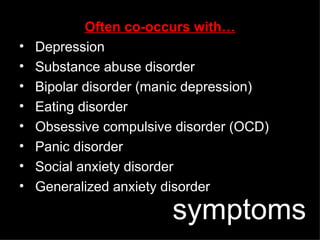
Often co-occurs with… Depression Substance abuse disorder Bipolar disorder (manic depression) Eating disorder Obsessive compulsive disorder (OCD) Panic disorder Social anxiety disorder Generalized anxiety disorder symptoms
diagn o sis
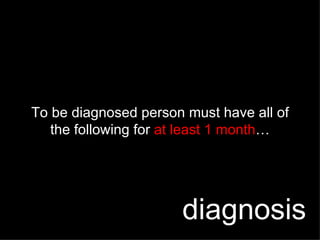
To be diagnosed person must have all of the following for  at least 1 month … diagnosis
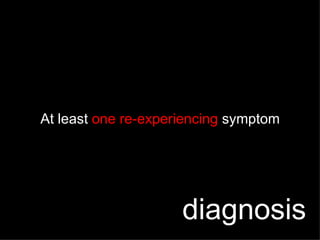
At least  one re-experiencing  symptom diagnosis
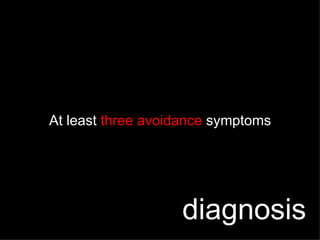
At least  three avoidance  symptoms diagnosis
At least  two hyperarousal  symptoms diagnosis
Not everyone who lives through a dangerous event gets PTSD - in fact,  most  will not get the disorder diagnosis
fac t ors
Risk factors  make a person more likely to get PTSD factors
Resilience factors  reduce risk of the disorder factors
Factors present  before  trauma and others become important during and after traumatic event factors
factors Risk factors include… Living through dangerous trauma History of mental illness Feeling helplessness or extreme fear Little or no social support after event Dealing with extra stress after event
factors Resilience factors include… Seeking out support from others Support group after traumatic event Feeling good about actions in face of danger Having coping strategy and learning from it Being able to act and respond effectively despite feeling fear
treat m ent
Main Treatments… Psychotherapy (“talk” therapy) Medications Or both treatment
Psychotherapy can occur  one-on-one  or in  group treatment
Talk therapy usually lasts  6 to 12 weeks  or more treatment
Research shows  support  from family and friends an important part of therapy treatment
Exposure Therapy… Helps face and control fear Exposes to trauma in safe way Mental imagery, writing, or visits to place where event happened treatment
Cognitive Restructuring… Helps make sense of bad memories Sometimes remember event differently than how happened May feel guilt or shame about what is not fault treatment
Stress Inoculation Training… Teaches how to reduce anxiety Helps look at memories in healthy way treatment
hel p ing
To help a friend… Offer emotional support, understanding, patience, and encouragement Talk and listen carefully Be understanding of situations that trigger symptoms helping
To help a friend… Invite friend to positive distractions (walks, outings, fishing) Remind friend, with time and treatment, she can get better Never ignore comments about harming herself and report comments to doctor helping
To help yourself… Talk to doctor Engage in activity Set realistic goals Break large tasks into small ones helping
To help yourself… Spend time with people, confide in trusted friend  Tell others about symptom triggers Expect symptoms to improve gradually Identify & seek comforting situations, places, & people helping
Mental Health Resources… psychiatrist – psychologist - social worker - counselor - community mental health center - outpatient clinic - universities - family service or social agency - peer support group - private clinic - employee assistance - local medical or psychiatric society - National Alliance for Mentally Ill - National Mental Health Assoc - PTSD Info Hotline - PTSD Sanctuary - Rape, Abuse and Incest National Network Resources
For more information… National Library of Medicine National Institute of Mental Health “ PTSD in Children & Adolescents: A National Center for PTSD Fact Sheet” “ Meta-analysis of risk factors for posttraumatic stress disorder in trauma-exposed adults” “ Psychobiological mechanisms of resilience & vulnerability: implications for successful adaptation to extreme stress” “ Clinical response & risk for reported suicidal ideation & suicide attempts in pediatric antidepressant treatment, a meta-analysis of randomized controlled trials” “ Journal of the American Medical Association” “ Trends in mental illness & suicidality after Hurricane Katrina” “ Social, psychological, & psychiatric interventions following terrorist attacks: recommendations for practice & research” “ Neuropsychopharmacology” “ Assessment and treatment of adult acute responses to traumatic stress following mass traumatic events” “ Psychological debriefing for preventing post traumatic stress disorder (PTSD)” “ Cochrane Database” “ A Randomized, Controlled Proof-of-Concept Trial of an Internet-Based, Therapist-Assisted Self-Management Treatment for Posttraumatic Stress Disorder” Resources
PTSD  "soldier's  heart "

PTSD

  • 1.
    PTSD "soldier's heart "
  • 2.
  • 3.
    Anxiety disorder afterexposure to terrifying event in which grave physical harm was threatened definition
  • 4.
    Fear triggers split-second changes in body to defend against danger or avoid it definition
  • 5.
    This “fight-or-flight” responseis healthy meant to protect person from harm definition
  • 6.
    In PTSD, reactionis changed or damaged - one may feel stressed or frightened even when no longer in danger definition
  • 7.
    Complex Posttraumatic StressDisorder (C-PTSD) prolonged exposure to traumatic event; long-lasting problems of emotional & social functioning definition
  • 8.
  • 9.
    Women sexuallyabused at earlier ages more likely to develop C-PTSD facts
  • 10.
    Up to 100% of children who endured sexual abuse tend to develop facts
  • 11.
    Women twice as likely as men to develop facts
  • 12.
    Approximately 7%-8%of US likely develop in lifetime facts
  • 13.
  • 14.
    Persistent frightening thoughts and memories of ordeal symptoms
  • 15.
    Feel emotionally numb , especially with people once close to symptoms
  • 16.
    Children and teenscan have extreme reactions to trauma, symptoms may not be the same as adults symptoms
  • 17.
    Re-experiencing… problems ineveryday routine can start from own thoughts, feelings, words, objects, or situations flashbacks - reliving trauma over and over, including physical symptoms like a racing heart or sweating; bad dreams symptoms
  • 18.
    Avoidance… avoiding places,events, or objects reminders of experience strong guilt, depression, or worry losing interest in activities enjoyable in past trouble remembering event symptoms
  • 19.
    Hyper Arousal… easilystartled feeling “on edge” difficulty sleeping angry outbursts usually constant symptoms
  • 20.
    C-PTSD… Problems regulatingfeelings Suicidal thoughts Passive aggressive behaviors Feel detached from one's life (dissociation) or body (depersonalization) Persistent feelings of helplessness, shame, guilt Feeling completely different from others symptoms
  • 21.
    Often co-occurs with…Depression Substance abuse disorder Bipolar disorder (manic depression) Eating disorder Obsessive compulsive disorder (OCD) Panic disorder Social anxiety disorder Generalized anxiety disorder symptoms
  • 22.
  • 23.
    To be diagnosedperson must have all of the following for at least 1 month … diagnosis
  • 24.
    At least one re-experiencing symptom diagnosis
  • 25.
    At least three avoidance symptoms diagnosis
  • 26.
    At least two hyperarousal symptoms diagnosis
  • 27.
    Not everyone wholives through a dangerous event gets PTSD - in fact, most will not get the disorder diagnosis
  • 28.
  • 29.
    Risk factors make a person more likely to get PTSD factors
  • 30.
    Resilience factors reduce risk of the disorder factors
  • 31.
    Factors present before trauma and others become important during and after traumatic event factors
  • 32.
    factors Risk factorsinclude… Living through dangerous trauma History of mental illness Feeling helplessness or extreme fear Little or no social support after event Dealing with extra stress after event
  • 33.
    factors Resilience factorsinclude… Seeking out support from others Support group after traumatic event Feeling good about actions in face of danger Having coping strategy and learning from it Being able to act and respond effectively despite feeling fear
  • 34.
  • 35.
    Main Treatments… Psychotherapy(“talk” therapy) Medications Or both treatment
  • 36.
    Psychotherapy can occur one-on-one or in group treatment
  • 37.
    Talk therapy usuallylasts 6 to 12 weeks or more treatment
  • 38.
    Research shows support from family and friends an important part of therapy treatment
  • 39.
    Exposure Therapy… Helpsface and control fear Exposes to trauma in safe way Mental imagery, writing, or visits to place where event happened treatment
  • 40.
    Cognitive Restructuring… Helpsmake sense of bad memories Sometimes remember event differently than how happened May feel guilt or shame about what is not fault treatment
  • 41.
    Stress Inoculation Training…Teaches how to reduce anxiety Helps look at memories in healthy way treatment
  • 42.
  • 43.
    To help afriend… Offer emotional support, understanding, patience, and encouragement Talk and listen carefully Be understanding of situations that trigger symptoms helping
  • 44.
    To help afriend… Invite friend to positive distractions (walks, outings, fishing) Remind friend, with time and treatment, she can get better Never ignore comments about harming herself and report comments to doctor helping
  • 45.
    To help yourself…Talk to doctor Engage in activity Set realistic goals Break large tasks into small ones helping
  • 46.
    To help yourself…Spend time with people, confide in trusted friend Tell others about symptom triggers Expect symptoms to improve gradually Identify & seek comforting situations, places, & people helping
  • 47.
    Mental Health Resources…psychiatrist – psychologist - social worker - counselor - community mental health center - outpatient clinic - universities - family service or social agency - peer support group - private clinic - employee assistance - local medical or psychiatric society - National Alliance for Mentally Ill - National Mental Health Assoc - PTSD Info Hotline - PTSD Sanctuary - Rape, Abuse and Incest National Network Resources
  • 48.
    For more information…National Library of Medicine National Institute of Mental Health “ PTSD in Children & Adolescents: A National Center for PTSD Fact Sheet” “ Meta-analysis of risk factors for posttraumatic stress disorder in trauma-exposed adults” “ Psychobiological mechanisms of resilience & vulnerability: implications for successful adaptation to extreme stress” “ Clinical response & risk for reported suicidal ideation & suicide attempts in pediatric antidepressant treatment, a meta-analysis of randomized controlled trials” “ Journal of the American Medical Association” “ Trends in mental illness & suicidality after Hurricane Katrina” “ Social, psychological, & psychiatric interventions following terrorist attacks: recommendations for practice & research” “ Neuropsychopharmacology” “ Assessment and treatment of adult acute responses to traumatic stress following mass traumatic events” “ Psychological debriefing for preventing post traumatic stress disorder (PTSD)” “ Cochrane Database” “ A Randomized, Controlled Proof-of-Concept Trial of an Internet-Based, Therapist-Assisted Self-Management Treatment for Posttraumatic Stress Disorder” Resources
  • 49.
    PTSD "soldier's heart "