POST-TERM PREGNANCYPOST-TERM PREGNANCY
Dr Max Mongelli
Women & Childrens’ Health
Nepean Hospital
Sydney, Australia
Max Mongelli 2011
DefinitionsDefinitions
Pregnancy has extended to or beyond 42
weeks from LMP
“Post-dates” applies to pregnancy over 40
and less than 42 weeks
Critically dependent on accurate pregnancy
dating
Max Mongelli 2011
PrevalencePrevalence
Prevalence of post-term pregnancy highly
dependent on local policies for induction.
preterm delivery rates, complicated
pregnancy rates
In the USA about 6% of pregnancies are
post-term
Using 1st
trimester scans for dating results in
only 2% of pregnancies going post-term
Max Mongelli 2011
Risk FactorsRisk Factors
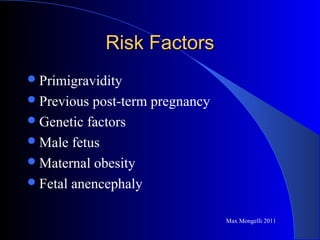
Primigravidity
Previous post-term pregnancy
Genetic factors
Male fetus
Maternal obesity
Fetal anencephaly
Max Mongelli 2011
PathophysiologyPathophysiology
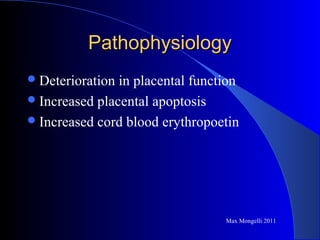
Deterioration in placental function
Increased placental apoptosis
Increased cord blood erythropoetin
Max Mongelli 2011
Risks to the FetusRisks to the Fetus
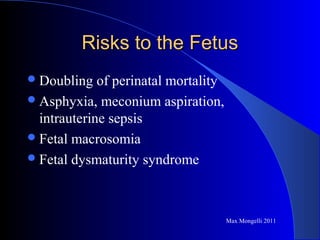
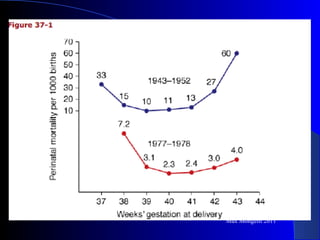
Doubling of perinatal mortality
Asphyxia, meconium aspiration,
intrauterine sepsis
Fetal macrosomia
Fetal dysmaturity syndrome
Max Mongelli 2011
Max Mongelli 2011
Risks to the MotherRisks to the Mother
Increased risk of labor abnormalities
Third and fourth degree perineal tears
Increased risk of cesarean delivery
Max Mongelli 2011
ManagementManagement
Induction of labor
Membrane sweeping
Conservative management
Max Mongelli 2011
Induction of LaborInduction of Labor
This is the preferred course of management
Most units induce labor from 41 weeks
onwards
Strong evidence from meta-analysis to
support reduced perinatal mortality,
morbidity and cesarean section rates
Shown to be cost-effective
Max Mongelli 2011
Membrane SweepingMembrane Sweeping
Membrane sweeping (or “stripping”) may
be used to prevent post-term pregnancy
Reduces the percentage of patients going
postterm from 41% to 23%
Can be repeated if required
Max Mongelli 2011
Conservative ManagementConservative Management
 Reserved for women who decline induction or
labor or have a contraindication
 Optimal gestational age for beginning monitoring
is unknown, usually 41-42 weeks
 Monitoring should include amniotic fluid
assessment, CTG’s
 Immediate delivery if these become abnormal
Max Mongelli 2011
Intrapartum ManagementIntrapartum Management
Continuous electronic fetal monitoring is
required
Greater risk of fetal distress or meconium
aspiration
Max Mongelli 2011
PrognosisPrognosis
No detectable differences in children born
postterm regarding IQ, physical milestones
or intercurrent illnesses, when tested at 1-2
years of age.
Max Mongelli 2011
Further ReadingFurther Reading
Williams’ Obstetrics
Max Mongelli 2011

Post- term pregnancy