Post-term pregnancy
an evidence-based approach
Osama M Warda MD
Prof. of OBS/GYN
Mansoura University
Definition
!  Post term pregnancy refers to a
pregnancy that has reached or
extended beyond 42 0/7 weeks of
gestation from the 1st day of the last
menstrual period (LMP)
(ACOG 2014)
4/27/17 O Warda 2
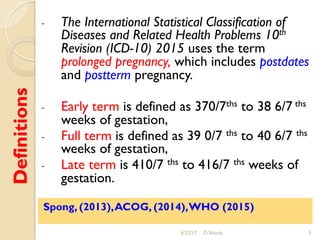
Definitions -  The International Statistical Classification of
Diseases and Related Health Problems 10th
Revision (ICD-10) 2015 uses the term
prolonged pregnancy, which includes postdates
and postterm pregnancy.
-  Early term is defined as 370/7ths to 38 6/7 ths
weeks of gestation,
-  Full term is defined as 39 0/7 ths to 40 6/7 ths
weeks of gestation,
-  Late term is 410/7 ths to 416/7 ths weeks of
gestation.
4/27/17 O Warda 3
Spong, (2013),ACOG, (2014),WHO (2015)
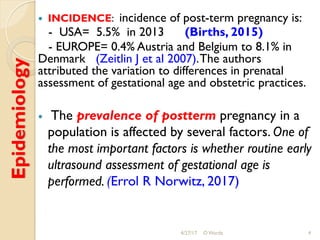
Epidemiology !  INCIDENCE: incidence of post-term pregnancy is:
- USA= 5.5% in 2013 (Births, 2015)
- EUROPE= 0.4% Austria and Belgium to 8.1% in
Denmark (Zeitlin J et al 2007).The authors
attributed the variation to differences in prenatal
assessment of gestational age and obstetric practices.
!  The prevalence of postterm pregnancy in a
population is affected by several factors. One of
the most important factors is whether routine early
ultrasound assessment of gestational age is
performed. (Errol R Norwitz, 2017)
4/27/17 O Warda 4
ETIOLOGY 1-Excluding miscalculation (error in dating), the
etiology of most pregnancies that are late-term
or postterm is unknown (ACOG 2014).
2-Maternal or fetal genetic influence on the initiation
of parturition in 30-50% of cases (Oberg et al 2013)
3-Defects in fetal production of hormones involved in
parturition in rare cases (Errol R Norwitz, 2017).
4-In the past, anencephaly was a cause of postterm
pregnancy in the absence of polyhydramnios, but these
pregnancies are now routinely detected antepartum
and terminated or induced.
5- X-linked ichthyosis, which is associated with
placental sulfatase deficiency and low levels of
circulating estradiol ( Taylor NF, 1982)
4/27/17 O Warda 5
RiskFactors 1.  Prior post-term pregnancy; After one
postterm pregnancy, the risk of a second
postterm birth is increased 2-4 fold ; the risk of
recurrence is higher after two prior postterm
pregnancies ( Kortekaas et al 2015)
2.  Nulliparity
3.  Old maternal age
4.  Maternal Obesity
5.  Male fetus
6.  Long (> 28 days) cycles without early ultrasound
7.  Maternal race/ethnicity ( white women > non-
white )
(Errol R Norwitz, 2017)
4/27/17 O Warda 6
MorbidityandMortality Postterm pregnancy is associated with fetal,
neonatal, and maternal risks (Olesen et al 2003).
Fetal – Neonatal
1- Macrosomia 2- Dysmaturity syndrome
3- Meconium aspiration, 4- Intrauterine infection,
5- Oligohydramnios, 6- Abnormal CTG,
7- Low umbilical artery pH,
8- Low 5-minute Apgar score .
9- Perinatal mortality (fetal and neonatal deaths) is twice as
high at ≥ 42 weeks and 6 times as high at ≥ 43 weeks
compared with 39–40 weeks. ( De Los Santos et al 2011)
4/27/17 O Warda 7
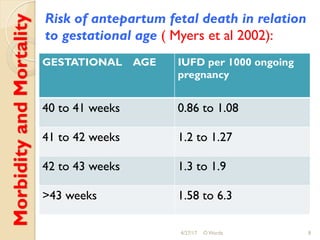
MorbidityandMortality Risk of antepartum fetal death in relation
to gestational age ( Myers et al 2002):
4/27/17 O Warda 8
GESTATIONAL AGE IUFD per 1000 ongoing
pregnancy
40 to 41 weeks 0.86 to 1.08
41 to 42 weeks 1.2 to 1.27
42 to 43 weeks 1.3 to 1.9
>43 weeks 1.58 to 6.3
MorbidityandMortality Perinatal mortality increases as pregnancy
extends beyond full term, particularly after 41
weeks, due to increases in both non-
anomalous stillbirths and early neonatal
deaths (Joseph KS 2011).
Intrauterine infection, placental insufficiency
and cord compression leading to fetal
hypoxia, asphyxia, and meconium aspiration
are thought to contribute to the excess
perinatal deaths (Divon et al 1998)
4/27/17 O Warda 9
Morbidity;perinatal !  Macrosomia : ( EFW ≥ 4500 g)
-  Incidence of macrosomia (2.5 to 10 percent
versus 0.8 to 1 percent at term), because of
the longer duration of intrauterine growth
( LuY et al 2011).
-  Complications of macrosomia include
protraction and arrest disorders of labor
and shoulder dystocia, all of which increase
the risk of birth injury.
4/27/17 O Warda 10
Morbidity;perinatal Dysmaturity Syndrome:
-  Affects about 20% of postterm babies.
-  It describes infants with characteristics of
chronic intrauterine malnutrition ( Mannino F
1988)
-  These fetuses are at increased risk of umbilical
cord compression due to oligohydramnios, and
abnormal antepartum or intrapartum fetal heart
rate patterns due to placental insufficiency or
cord compression.
-  Meconium passage is common and may be
related to physiological maturation of the gut or
fetal hypoxia.
4/27/17 O Warda 11
Morbidity;perinatal Dysmaturity Syndrome: (continued)
-  Affected neonates have a long thin body, long
nails, and are small for gestational age.
-  Their skin is dry (vernix caseosa is
decreased or absent), meconium-stained,
parchment-like, and peeling; it appears loose,
especially over the thighs and buttocks, and
has prominent creases; lanugo hair is sparse
or absent, while scalp hair is increased.
-  These fetuses and neonates are at risk for
the short- and long-term morbidity typically
associated with IUGR.
4/27/17 O Warda 12
Morbidity;maternal Women giving birth post-term are at increased
risk of:
1.  Labor dystocia & failed induction
2.  Perineal injury, (3rd, 4th degree tears)
3.  Cesarean deliveries with their complications.
4.  Postpartum hemorrhage
5.  Puerperal infections
( Caughey et al 2007)
4/27/17 O Warda 13
DIAGNOSIS !  The diagnosis of pregnancy ≥ 420/7ths weeks
of gestation is based on the clinician's most
accurate estimate of the patient's delivery
date (EDD). EDD is based on LNMP for
some patients using Naegele’s formula and
on ultrasound dating for others. (ACOG
2014)
!  The best method of estimating the EDD is a
combined approach in which US is used to
confirm reliable menstrual dating (SOGC
2014)
4/27/17 O Warda 14
Diagnosis Gestational Age Determination:
!  Accurate gestational age determination decreases the
incidence of the diagnosis of late-term and postterm
pregnancies (ACOG 2014).
!  Using the date of the LMP alone to assign gestational
age and the estimated date of delivery has been
proved to be unreliable by several studies and often
leads to the incorrect classification of a pregnancy as
late term or postterm (Gardosi 1997, Saviz et al
2002)
!  Inaccurate maternal recall and variation in the timing of
ovulation may contribute to the inaccuracy of LMP-
based pregnancy dating (Creinin et al 2004)
4/27/17 O Warda 15
Diagnosis
!  Several studies also have demonstrated that
when ultrasonography is used to confirm
menstrual dating, the incidence of late- term
and postterm pregnancies is reduced, as will as
the need for obstetric intervention (Whitworth
et al 2010).
!  For example, the rates of postterm
pregnancies decreased from 9.5% to 1.5%
when ultrasonography was used to confirm
LMP dating (Caughey et al 2008).
4/27/17 O Warda 16
Gestational age determination
DIAGNOSIS: ULTRASOUND BIOMETERY
Guidelines of SOGC 2014 ( No 303):
1- First-trimester CRL is the best parameter
for determining GA and should be used
whenever appropriate. (I-A).
2-If there is more than one first-trimester
scan with a mean GSD or CRL , the earliest
ultrasound with a CRL equivalent to at least
7 weeks (or10 mm) should be used to
determine the gestational age. (III-B)
4/27/17 O Warda 17
DIAGNOSIS: ULTRASOUND BIOMETERY
Guidelines of SOGC 2014 ( No 303):
3- Between the 12th and 14th weeks, CRL and BPD
are similar in accuracy. It is recommended that
CRL be used up to 84 mm, and the BPD be used
for measurements > 84 mm. (II-1A)
4-Although TVS may better visualize early
embryonic structures than a TAS , it is not more
accurate in determining gestational age. CRL
measurement from either TAS or TVS may be
used to determine gestational age (II-1C)
-------------
TVS= transvaginal ultrasound
TAS= transabdominal ultrasound
4/27/17 O Warda 18
DIAGNOSIS: ULTRASOUND BIOMETERY
Guidelines of SOGC 2014 ( No 303):
5- If a second- or third-trimester scan is used to
determine gestational age, a combination of
multiple biometric parameters (BPD, HC,AC, FL)
should be used to determine gestational age,
rather than a single parameter. (II-1A)
6- When the assignment of GA is based
on a third-trimester ultrasound, it is difficult to
confirm an accurate due date. Follow-up of interval
growth is suggested 2 to 3 weeks following the
ultrasound. (III-C)
4/27/17 O Warda 19
DIAGNOSIS: ULTRASOUND BIOMETERY
Guidelines of SOGC 2014 ( No 303):
Best Method for Assigning GA:
1.When performed with quality and precision,
ultrasound alone is more accurate than a
“certain” menstrual date for determining
gestational age in the 1st and 2nd trimesters (≤ 23
weeks) in spontaneous conceptions, and it is the
best method for estimating the delivery date. (II)
2. In the absence of better assessment of
gestational age, routine ultrasound in the 1st or
2nd trimester reduces inductions for post-term
pregnancies. (I)
4/27/17 O Warda 20
DIAGNOSIS: Guidelines of SOGC 2014 ( No 303):
Best Method for Assigning GA:
3- Ideally, every pregnant woman should be
offered a 1st trimester dating ultrasound;
however, if the availability of obstetrical
ultrasound is limited, it is reasonable to use a
2nd trimester scan to assess gestational age. (I)
4/27/17 O Warda 21
Management
!  Pre-conceptual Counseling
!  Work-up
!  Preventive management
!  Antepartum testing (surviellance )
!  Intervention (induction of labor)
4/27/17 O Warda 22
The following management refers to the
singleton, cephalic fetus of an otherwise
uncomplicated pregnancy that reaches 410/7ths
weeks of gestation. Multiple gestations, non-
cephalic presentations, and complicated
pregnancies are generally delivered before 41
weeks
Management ! Preconception counseling ;Women with
prior post-term pregnancy are at
increased risk for recurrent post-term
pregnancy. Prevention strategies should
be discussed (ACOG 2014)
!  Work-up : Early ultrasound < 20 weeks
of gestation can prevent post- term
pregnancy, and therefore the need for
induction(ACOG 2014)
!  .
4/27/17 O Warda 23
Management Prevention
1- Routine early ultrasound to reduce post-
term pregnancies :
!  Compared with no routine early ultrasound,
routine early pregnancy (< 20 weeks) ultrasound
reduces by 32–39% the incidence of post-term
pregnancy and of induction for post-term
pregnancy (Neilson 2007 & Crowley 2007)
!  Accurate assessment of gestational age is
extremely important in improving perinatal
morbidity and mortality.
4/27/17 O Warda 24
Management
Prevention
2- Stripping of membranes:
- Compared with no sweeping (stripping), sweeping
of the membranes, performed weekly as a general
policy in women at term (e.g. weekly starting at 38
weeks), is associated with reduced duration of
pregnancy and reduced frequency of pregnancy
continuing beyond 41 weeks and 42 weeks.
( Boulvain et al 2007).
4/27/17 O Warda 25
Management Prevention
2- Stripping of membranes (cont.,):
-  Serial sweeping of membranes starting at 41
weeks every 48 hours also decreases the risk
of post-term pregnancy from 41% to 23%, with
efficacy both in nulliparous and multiparous
women( de Miranda et al 2006)
-  Discomfort during vaginal examination and
other adverse effects (bleeding, irregular
contractions) are more frequently reported
by women allocated to sweeping, but are not
associated with complications.
4/27/17 O Warda 26
Management
Prevention
3- Breast and nipple stimulation to reduce post-
term pregnancies :
!  Breast and nipple stimulation daily starting at
39 weeks has not been sufficiently studied
to ascertain safety, but it does appear to
reduce the incidence of post-term pregnancy
by 48%. (Elliot JP & Flaherty 1984) , ( Kadar N et
al 1990
4/27/17 O Warda 27
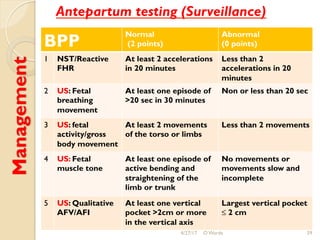
Management :
Antepartum testing (Surveillance)
!  There are several options for fetal
surveillance, including the nonstress test
(NST), contraction stress test, biophysical
profile (BPP), and modified BPP (NST and
amniotic fluid assessment).
!  Although antepartum fetal surveillance may
be indicated for pregnancies at or beyond
41 0/7 weeks of gestation, there are
insufficient data to define the optimal type or
frequency of testing. (ACOG 2014)
4/27/17 O Warda 28
BPP
Normal
(2 points)
Abnormal
(0 points)
1 NST/Reactive
FHR
At least 2 accelerations
in 20 minutes
Less than 2
accelerations in 20
minutes
2 US: Fetal
breathing
movement
At least one episode of
>20 sec in 30 minutes
Non or less than 20 sec
3 US: fetal
activity/gross
body movement
At least 2 movements
of the torso or limbs
Less than 2 movements
4 US: Fetal
muscle tone
At least one episode of
active bending and
straightening of the
limb or trunk
No movements or
movements slow and
incomplete
5 US: Qualitative
AFV/AFI
At least one vertical
pocket >2cm or more
in the vertical axis
Largest vertical pocket
≤ 2 cm
4/27/17 O Warda 29
Management
Antepartum testing (Surveillance)
4/27/17 O Warda 30
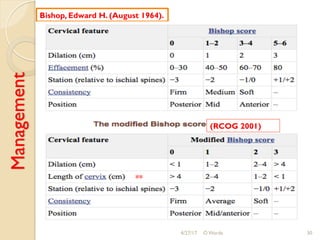
Bishop, Edward H. (August 1964).
Management
(RCOG 2001)
**
Management
Antepartum testing: Bishop score
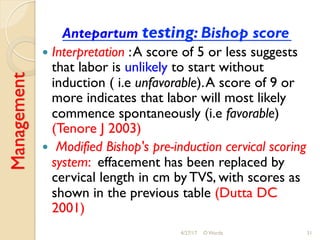
!  Interpretation :A score of 5 or less suggests
that labor is unlikely to start without
induction ( i.e unfavorable).A score of 9 or
more indicates that labor will most likely
commence spontaneously (i.e favorable)
(Tenore J 2003)
!  Modified Bishop's pre-induction cervical scoring
system: effacement has been replaced by
cervical length in cm by TVS, with scores as
shown in the previous table (Dutta DC
2001)
4/27/17 O Warda 31
Management
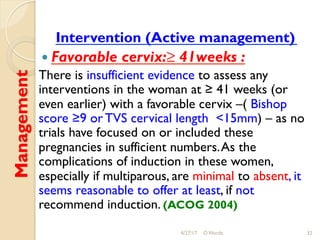
Intervention (Active management)
! Favorable cervix:≥ 41weeks :
There is insufficient evidence to assess any
interventions in the woman at ≥ 41 weeks (or
even earlier) with a favorable cervix –( Bishop
score ≥9 or TVS cervical length <15mm) – as no
trials have focused on or included these
pregnancies in sufficient numbers.As the
complications of induction in these women,
especially if multiparous, are minimal to absent, it
seems reasonable to offer at least, if not
recommend induction. (ACOG 2004)
4/27/17 O Warda 32
Management Intervention
!  Unfavorable cervix: routine induction of
labor at ≥ 41 weeks :
-  Compared with expectant management, routine
induction of labor at ≥ 41 weeks reduces perinatal
mortality by 80%.This benefit is from the effect of
induction of labor after 41 weeks and the decrease
in fetal deaths.About 500 inductions must be
performed to prevent one perinatal death.
-  The use of analgesia, NRFHT, operative vaginal or
cesarean delivery rates, and other neonatal outcome
measures are similar with induction or expectant
management. (ACOG 2004)
4/27/17 O Warda 33
Management Intervention
!  Unfavorable cervix: routine induction of
labor at ≥ 41 weeks (cont.,) :
-Routine induction of labor is associated with a
decrease in the incidence of cesarean
delivery in women who are nulliparous, ≥ 41
weeks, induced with prostaglandins.
-Routine induction is more cost-effective than
expectant management.Women at ≥ 41weeks
are more satisfied with induction than expectant
management.
(Hannah et al 1992)
4/27/17 O Warda 34
Management
Intervention
!  Unfavorable cervix: routine induction of labor at ≥ 41
weeks (cont.,) :
-A trial of labor after cesarean delivery (TOLAC) is a
reasonable option in the management of uncomplicated
postterm pregnancies (ACOG 2014).
-No increase in the risk of uterine rupture associated with
TOLAC attempted at or beyond the estimated date of
delivery. (Coassolo et al 2005) .
- Women with prior cesarean and no previous vaginal
delivery and want TOLAC should be counseled about the risk
of failure of induction that increase with gestational age , and
the risk of uterine rupture (ACOG 2014)
4/27/17 O Warda 35
Summary
and
Conclusion
4/27/17 O Warda 36
ACOG recommendations (2014)
!  Level (A) recommendations:
1-Late-term and postterm pregnancies are
associated with an increased risk of perinatal
morbidity and mortality.
2-Induction of labor after 42 0/7 weeks and by
42 6/7 weeks of gestation is recommended,
given evidence of an increase in perinatal
morbidity and mortality.
4/27/17 O Warda 37
Takeahomemessage
ACOG recommendations (2014)
Level (B) recommendations
1- Membrane sweeping is associated with a
decreased risk of late-term and postterm
pregnancies.
2-Induction of labor between 41 0/7 weeks
and 42 0/7 weeks of gestation can be
considered.
4/27/17 O Warda 38
Takeahomemessage
ACOG recommendations (2014)
Level (C) recommendations :
1- Initiation of antepartum fetal surveillance
at or beyond 41 0/7 weeks of gestation may
be indicated.
2- A trial of labor after cesarean delivery is a
reasonable option in the management of
uncomplicated postterm pregnancies.
4/27/17 O Warda 39
Takeahomemessage
! THANK
! YOU
4/27/17 O Warda 40
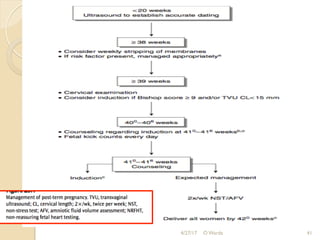
4/27/17 O Warda 41
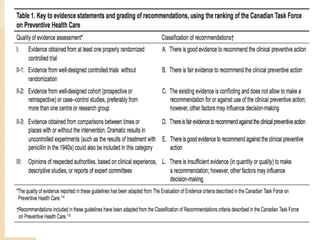
4/27/17 O Warda 42

Posterm EBM- warda

  • 1.
    Post-term pregnancy an evidence-basedapproach Osama M Warda MD Prof. of OBS/GYN Mansoura University
  • 2.
    Definition !  Post termpregnancy refers to a pregnancy that has reached or extended beyond 42 0/7 weeks of gestation from the 1st day of the last menstrual period (LMP) (ACOG 2014) 4/27/17 O Warda 2
  • 3.
    Definitions -  TheInternational Statistical Classification of Diseases and Related Health Problems 10th Revision (ICD-10) 2015 uses the term prolonged pregnancy, which includes postdates and postterm pregnancy. -  Early term is defined as 370/7ths to 38 6/7 ths weeks of gestation, -  Full term is defined as 39 0/7 ths to 40 6/7 ths weeks of gestation, -  Late term is 410/7 ths to 416/7 ths weeks of gestation. 4/27/17 O Warda 3 Spong, (2013),ACOG, (2014),WHO (2015)
  • 4.
    Epidemiology !  INCIDENCE:incidence of post-term pregnancy is: - USA= 5.5% in 2013 (Births, 2015) - EUROPE= 0.4% Austria and Belgium to 8.1% in Denmark (Zeitlin J et al 2007).The authors attributed the variation to differences in prenatal assessment of gestational age and obstetric practices. !  The prevalence of postterm pregnancy in a population is affected by several factors. One of the most important factors is whether routine early ultrasound assessment of gestational age is performed. (Errol R Norwitz, 2017) 4/27/17 O Warda 4
  • 5.
    ETIOLOGY 1-Excluding miscalculation(error in dating), the etiology of most pregnancies that are late-term or postterm is unknown (ACOG 2014). 2-Maternal or fetal genetic influence on the initiation of parturition in 30-50% of cases (Oberg et al 2013) 3-Defects in fetal production of hormones involved in parturition in rare cases (Errol R Norwitz, 2017). 4-In the past, anencephaly was a cause of postterm pregnancy in the absence of polyhydramnios, but these pregnancies are now routinely detected antepartum and terminated or induced. 5- X-linked ichthyosis, which is associated with placental sulfatase deficiency and low levels of circulating estradiol ( Taylor NF, 1982) 4/27/17 O Warda 5
  • 6.
    RiskFactors 1.  Priorpost-term pregnancy; After one postterm pregnancy, the risk of a second postterm birth is increased 2-4 fold ; the risk of recurrence is higher after two prior postterm pregnancies ( Kortekaas et al 2015) 2.  Nulliparity 3.  Old maternal age 4.  Maternal Obesity 5.  Male fetus 6.  Long (> 28 days) cycles without early ultrasound 7.  Maternal race/ethnicity ( white women > non- white ) (Errol R Norwitz, 2017) 4/27/17 O Warda 6
  • 7.
    MorbidityandMortality Postterm pregnancyis associated with fetal, neonatal, and maternal risks (Olesen et al 2003). Fetal – Neonatal 1- Macrosomia 2- Dysmaturity syndrome 3- Meconium aspiration, 4- Intrauterine infection, 5- Oligohydramnios, 6- Abnormal CTG, 7- Low umbilical artery pH, 8- Low 5-minute Apgar score . 9- Perinatal mortality (fetal and neonatal deaths) is twice as high at ≥ 42 weeks and 6 times as high at ≥ 43 weeks compared with 39–40 weeks. ( De Los Santos et al 2011) 4/27/17 O Warda 7
  • 8.
    MorbidityandMortality Risk ofantepartum fetal death in relation to gestational age ( Myers et al 2002): 4/27/17 O Warda 8 GESTATIONAL AGE IUFD per 1000 ongoing pregnancy 40 to 41 weeks 0.86 to 1.08 41 to 42 weeks 1.2 to 1.27 42 to 43 weeks 1.3 to 1.9 >43 weeks 1.58 to 6.3
  • 9.
    MorbidityandMortality Perinatal mortalityincreases as pregnancy extends beyond full term, particularly after 41 weeks, due to increases in both non- anomalous stillbirths and early neonatal deaths (Joseph KS 2011). Intrauterine infection, placental insufficiency and cord compression leading to fetal hypoxia, asphyxia, and meconium aspiration are thought to contribute to the excess perinatal deaths (Divon et al 1998) 4/27/17 O Warda 9
  • 10.
    Morbidity;perinatal !  Macrosomia: ( EFW ≥ 4500 g) -  Incidence of macrosomia (2.5 to 10 percent versus 0.8 to 1 percent at term), because of the longer duration of intrauterine growth ( LuY et al 2011). -  Complications of macrosomia include protraction and arrest disorders of labor and shoulder dystocia, all of which increase the risk of birth injury. 4/27/17 O Warda 10
  • 11.
    Morbidity;perinatal Dysmaturity Syndrome: - Affects about 20% of postterm babies. -  It describes infants with characteristics of chronic intrauterine malnutrition ( Mannino F 1988) -  These fetuses are at increased risk of umbilical cord compression due to oligohydramnios, and abnormal antepartum or intrapartum fetal heart rate patterns due to placental insufficiency or cord compression. -  Meconium passage is common and may be related to physiological maturation of the gut or fetal hypoxia. 4/27/17 O Warda 11
  • 12.
    Morbidity;perinatal Dysmaturity Syndrome:(continued) -  Affected neonates have a long thin body, long nails, and are small for gestational age. -  Their skin is dry (vernix caseosa is decreased or absent), meconium-stained, parchment-like, and peeling; it appears loose, especially over the thighs and buttocks, and has prominent creases; lanugo hair is sparse or absent, while scalp hair is increased. -  These fetuses and neonates are at risk for the short- and long-term morbidity typically associated with IUGR. 4/27/17 O Warda 12
  • 13.
    Morbidity;maternal Women givingbirth post-term are at increased risk of: 1.  Labor dystocia & failed induction 2.  Perineal injury, (3rd, 4th degree tears) 3.  Cesarean deliveries with their complications. 4.  Postpartum hemorrhage 5.  Puerperal infections ( Caughey et al 2007) 4/27/17 O Warda 13
  • 14.
    DIAGNOSIS !  Thediagnosis of pregnancy ≥ 420/7ths weeks of gestation is based on the clinician's most accurate estimate of the patient's delivery date (EDD). EDD is based on LNMP for some patients using Naegele’s formula and on ultrasound dating for others. (ACOG 2014) !  The best method of estimating the EDD is a combined approach in which US is used to confirm reliable menstrual dating (SOGC 2014) 4/27/17 O Warda 14
  • 15.
    Diagnosis Gestational AgeDetermination: !  Accurate gestational age determination decreases the incidence of the diagnosis of late-term and postterm pregnancies (ACOG 2014). !  Using the date of the LMP alone to assign gestational age and the estimated date of delivery has been proved to be unreliable by several studies and often leads to the incorrect classification of a pregnancy as late term or postterm (Gardosi 1997, Saviz et al 2002) !  Inaccurate maternal recall and variation in the timing of ovulation may contribute to the inaccuracy of LMP- based pregnancy dating (Creinin et al 2004) 4/27/17 O Warda 15
  • 16.
    Diagnosis !  Several studiesalso have demonstrated that when ultrasonography is used to confirm menstrual dating, the incidence of late- term and postterm pregnancies is reduced, as will as the need for obstetric intervention (Whitworth et al 2010). !  For example, the rates of postterm pregnancies decreased from 9.5% to 1.5% when ultrasonography was used to confirm LMP dating (Caughey et al 2008). 4/27/17 O Warda 16 Gestational age determination
  • 17.
    DIAGNOSIS: ULTRASOUND BIOMETERY Guidelinesof SOGC 2014 ( No 303): 1- First-trimester CRL is the best parameter for determining GA and should be used whenever appropriate. (I-A). 2-If there is more than one first-trimester scan with a mean GSD or CRL , the earliest ultrasound with a CRL equivalent to at least 7 weeks (or10 mm) should be used to determine the gestational age. (III-B) 4/27/17 O Warda 17
  • 18.
    DIAGNOSIS: ULTRASOUND BIOMETERY Guidelinesof SOGC 2014 ( No 303): 3- Between the 12th and 14th weeks, CRL and BPD are similar in accuracy. It is recommended that CRL be used up to 84 mm, and the BPD be used for measurements > 84 mm. (II-1A) 4-Although TVS may better visualize early embryonic structures than a TAS , it is not more accurate in determining gestational age. CRL measurement from either TAS or TVS may be used to determine gestational age (II-1C) ------------- TVS= transvaginal ultrasound TAS= transabdominal ultrasound 4/27/17 O Warda 18
  • 19.
    DIAGNOSIS: ULTRASOUND BIOMETERY Guidelinesof SOGC 2014 ( No 303): 5- If a second- or third-trimester scan is used to determine gestational age, a combination of multiple biometric parameters (BPD, HC,AC, FL) should be used to determine gestational age, rather than a single parameter. (II-1A) 6- When the assignment of GA is based on a third-trimester ultrasound, it is difficult to confirm an accurate due date. Follow-up of interval growth is suggested 2 to 3 weeks following the ultrasound. (III-C) 4/27/17 O Warda 19
  • 20.
    DIAGNOSIS: ULTRASOUND BIOMETERY Guidelinesof SOGC 2014 ( No 303): Best Method for Assigning GA: 1.When performed with quality and precision, ultrasound alone is more accurate than a “certain” menstrual date for determining gestational age in the 1st and 2nd trimesters (≤ 23 weeks) in spontaneous conceptions, and it is the best method for estimating the delivery date. (II) 2. In the absence of better assessment of gestational age, routine ultrasound in the 1st or 2nd trimester reduces inductions for post-term pregnancies. (I) 4/27/17 O Warda 20
  • 21.
    DIAGNOSIS: Guidelines ofSOGC 2014 ( No 303): Best Method for Assigning GA: 3- Ideally, every pregnant woman should be offered a 1st trimester dating ultrasound; however, if the availability of obstetrical ultrasound is limited, it is reasonable to use a 2nd trimester scan to assess gestational age. (I) 4/27/17 O Warda 21
  • 22.
    Management !  Pre-conceptual Counseling ! Work-up !  Preventive management !  Antepartum testing (surviellance ) !  Intervention (induction of labor) 4/27/17 O Warda 22 The following management refers to the singleton, cephalic fetus of an otherwise uncomplicated pregnancy that reaches 410/7ths weeks of gestation. Multiple gestations, non- cephalic presentations, and complicated pregnancies are generally delivered before 41 weeks
  • 23.
    Management ! Preconception counseling;Women with prior post-term pregnancy are at increased risk for recurrent post-term pregnancy. Prevention strategies should be discussed (ACOG 2014) !  Work-up : Early ultrasound < 20 weeks of gestation can prevent post- term pregnancy, and therefore the need for induction(ACOG 2014) !  . 4/27/17 O Warda 23
  • 24.
    Management Prevention 1- Routineearly ultrasound to reduce post- term pregnancies : !  Compared with no routine early ultrasound, routine early pregnancy (< 20 weeks) ultrasound reduces by 32–39% the incidence of post-term pregnancy and of induction for post-term pregnancy (Neilson 2007 & Crowley 2007) !  Accurate assessment of gestational age is extremely important in improving perinatal morbidity and mortality. 4/27/17 O Warda 24
  • 25.
    Management Prevention 2- Stripping ofmembranes: - Compared with no sweeping (stripping), sweeping of the membranes, performed weekly as a general policy in women at term (e.g. weekly starting at 38 weeks), is associated with reduced duration of pregnancy and reduced frequency of pregnancy continuing beyond 41 weeks and 42 weeks. ( Boulvain et al 2007). 4/27/17 O Warda 25
  • 26.
    Management Prevention 2- Strippingof membranes (cont.,): -  Serial sweeping of membranes starting at 41 weeks every 48 hours also decreases the risk of post-term pregnancy from 41% to 23%, with efficacy both in nulliparous and multiparous women( de Miranda et al 2006) -  Discomfort during vaginal examination and other adverse effects (bleeding, irregular contractions) are more frequently reported by women allocated to sweeping, but are not associated with complications. 4/27/17 O Warda 26
  • 27.
    Management Prevention 3- Breast andnipple stimulation to reduce post- term pregnancies : !  Breast and nipple stimulation daily starting at 39 weeks has not been sufficiently studied to ascertain safety, but it does appear to reduce the incidence of post-term pregnancy by 48%. (Elliot JP & Flaherty 1984) , ( Kadar N et al 1990 4/27/17 O Warda 27
  • 28.
    Management : Antepartum testing(Surveillance) !  There are several options for fetal surveillance, including the nonstress test (NST), contraction stress test, biophysical profile (BPP), and modified BPP (NST and amniotic fluid assessment). !  Although antepartum fetal surveillance may be indicated for pregnancies at or beyond 41 0/7 weeks of gestation, there are insufficient data to define the optimal type or frequency of testing. (ACOG 2014) 4/27/17 O Warda 28
  • 29.
    BPP Normal (2 points) Abnormal (0 points) 1NST/Reactive FHR At least 2 accelerations in 20 minutes Less than 2 accelerations in 20 minutes 2 US: Fetal breathing movement At least one episode of >20 sec in 30 minutes Non or less than 20 sec 3 US: fetal activity/gross body movement At least 2 movements of the torso or limbs Less than 2 movements 4 US: Fetal muscle tone At least one episode of active bending and straightening of the limb or trunk No movements or movements slow and incomplete 5 US: Qualitative AFV/AFI At least one vertical pocket >2cm or more in the vertical axis Largest vertical pocket ≤ 2 cm 4/27/17 O Warda 29 Management Antepartum testing (Surveillance)
  • 30.
    4/27/17 O Warda30 Bishop, Edward H. (August 1964). Management (RCOG 2001) **
  • 31.
    Management Antepartum testing: Bishopscore !  Interpretation :A score of 5 or less suggests that labor is unlikely to start without induction ( i.e unfavorable).A score of 9 or more indicates that labor will most likely commence spontaneously (i.e favorable) (Tenore J 2003) !  Modified Bishop's pre-induction cervical scoring system: effacement has been replaced by cervical length in cm by TVS, with scores as shown in the previous table (Dutta DC 2001) 4/27/17 O Warda 31
  • 32.
    Management Intervention (Active management) ! Favorablecervix:≥ 41weeks : There is insufficient evidence to assess any interventions in the woman at ≥ 41 weeks (or even earlier) with a favorable cervix –( Bishop score ≥9 or TVS cervical length <15mm) – as no trials have focused on or included these pregnancies in sufficient numbers.As the complications of induction in these women, especially if multiparous, are minimal to absent, it seems reasonable to offer at least, if not recommend induction. (ACOG 2004) 4/27/17 O Warda 32
  • 33.
    Management Intervention !  Unfavorablecervix: routine induction of labor at ≥ 41 weeks : -  Compared with expectant management, routine induction of labor at ≥ 41 weeks reduces perinatal mortality by 80%.This benefit is from the effect of induction of labor after 41 weeks and the decrease in fetal deaths.About 500 inductions must be performed to prevent one perinatal death. -  The use of analgesia, NRFHT, operative vaginal or cesarean delivery rates, and other neonatal outcome measures are similar with induction or expectant management. (ACOG 2004) 4/27/17 O Warda 33
  • 34.
    Management Intervention !  Unfavorablecervix: routine induction of labor at ≥ 41 weeks (cont.,) : -Routine induction of labor is associated with a decrease in the incidence of cesarean delivery in women who are nulliparous, ≥ 41 weeks, induced with prostaglandins. -Routine induction is more cost-effective than expectant management.Women at ≥ 41weeks are more satisfied with induction than expectant management. (Hannah et al 1992) 4/27/17 O Warda 34
  • 35.
    Management Intervention !  Unfavorable cervix:routine induction of labor at ≥ 41 weeks (cont.,) : -A trial of labor after cesarean delivery (TOLAC) is a reasonable option in the management of uncomplicated postterm pregnancies (ACOG 2014). -No increase in the risk of uterine rupture associated with TOLAC attempted at or beyond the estimated date of delivery. (Coassolo et al 2005) . - Women with prior cesarean and no previous vaginal delivery and want TOLAC should be counseled about the risk of failure of induction that increase with gestational age , and the risk of uterine rupture (ACOG 2014) 4/27/17 O Warda 35
  • 36.
  • 37.
    ACOG recommendations (2014) ! Level (A) recommendations: 1-Late-term and postterm pregnancies are associated with an increased risk of perinatal morbidity and mortality. 2-Induction of labor after 42 0/7 weeks and by 42 6/7 weeks of gestation is recommended, given evidence of an increase in perinatal morbidity and mortality. 4/27/17 O Warda 37 Takeahomemessage
  • 38.
    ACOG recommendations (2014) Level(B) recommendations 1- Membrane sweeping is associated with a decreased risk of late-term and postterm pregnancies. 2-Induction of labor between 41 0/7 weeks and 42 0/7 weeks of gestation can be considered. 4/27/17 O Warda 38 Takeahomemessage
  • 39.
    ACOG recommendations (2014) Level(C) recommendations : 1- Initiation of antepartum fetal surveillance at or beyond 41 0/7 weeks of gestation may be indicated. 2- A trial of labor after cesarean delivery is a reasonable option in the management of uncomplicated postterm pregnancies. 4/27/17 O Warda 39 Takeahomemessage
  • 40.
  • 41.
  • 42.