05/17/2025
Tesloach James
Postdatism ispregnancy lasting beyond
the estimated due date at 40 weeks.
“Postmature” is reserved for the
pathologic syndrome in which the fetus
experiences placental insufficiency and
resultant IUGR .
DEFINITION
5.
05/17/2025
Tesloach James
POST-MATURITY SYNDROME
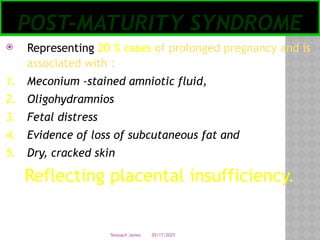
Representing 20 % cases of prolonged pregnancy and is
associated with :
1. Meconium -stained amniotic fluid,
2. Oligohydramnios
3. Fetal distress
4. Evidence of loss of subcutaneous fat and
5. Dry, cracked skin
Reflecting placental insufficiency.
6.
05/17/2025
Tesloach James
ETIOLOGIC FACTORS
Themost frequent cause is an error in
dating.
When truly exists, the cause usually is
unknown.
Primiparity and prior postterm pregnancy
are the most common identifiable risk
factors.
7.
05/17/2025
Tesloach James
ETIOLOGIC FACTORS
Rarely,it may be associated with
placental sulfatase deficiency or fetal
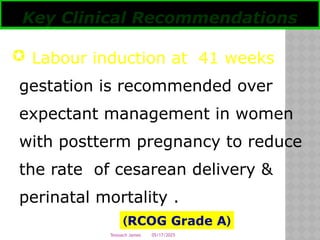
anencephaly.
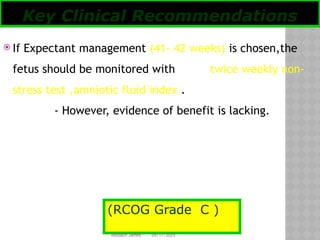
Male sex also has been associated.
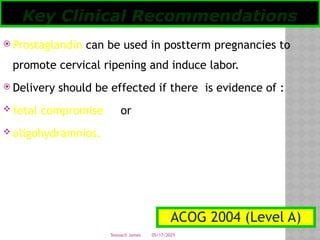
Genetic predisposition may play a role .
05/17/2025
Tesloach James
RISKS TOTHE FETUS
In some cases, the risks appear to be due to
uteroplacental insufficiency, resulting in fetal hypoxia ,
meconium aspiration, growth restriction, and
oligohydramnios .
Fetal distress and meconium release were twice as
common (at or after 42 weeks) than at term.
There was an eight-fold increase in meconium aspiration
11.
05/17/2025
Tesloach James
- Inother cases, continued growth of the fetus leads to
macrosomia, increasing the risk of labor
abnormalities, shoulder dystocia with resultant risks
of orthopedic or neurologic injury.
- Macrosomia is far more common in postterm than term
pregnancies .
Macrosomia
12.
05/17/2025
Tesloach James
OLIGOHYDRAMNIOS
Itis a marker for fetal compromise and it puts the fetus
at risk for cord accidents.
U/S diagnosis :
No vertical pocket > 2 cm or
Amniotic fluid index (AFI) 5 cm or less .
It is considered an indication for delivery.
13.
05/17/2025
Tesloach James
Fetusesborn postterm also are at increased risk
of :Sudden infant death syndrome
(death within the first year of life).
Some of these deaths clearly result from peripartum
complications (such as
meconium aspiration syndrome), but most have no
known cause.
Risks to the Fetus
14.
05/17/2025
Tesloach James
MATERNAL RISKS
1)Labor dystocia
2) Severe perineal injury
related to macrosomia
3) Doubling in the rate of cesarean
delivery.
4) A source of extreme anxiety for the
pregnant woman.
15.
05/17/2025
Tesloach James
Gest.age must be assessed carefully to avoid delivery
of a preterm infant.
Women who attend late for ANC may be of uncertain
gestation and may be over-represented in populations of
postterm pregnancies.
Dating by the last menstrual period (LMP) alone has a
tendency to overestimate the gestational age.
Gestational age calculation
16.
05/17/2025
Tesloach James
GESTATIONAL AGECALCULATION
Because actual dates of conception are rarely
known,the LMP is used as the reference point.
This can make the accuracy of gest. age determination
unreliable because of :
1. Irregular menses .
2. Recent cessation of birth control pills.
3. Inconsistent ovulation times.
17.
05/17/2025
Tesloach James
Routine earlypregnancy ultrasound
♣ Reduces the number of women who
require induction of labour for apparent
postterm pregnancy .
♣ It is recommended that all pregnant
ladies (and certainly those who do not
have regular menses),should have an
ultrasound examination for gestational
age determination, prior to 20 weeks
RCOG,COCHRANE
18.
05/17/2025
Tesloach James
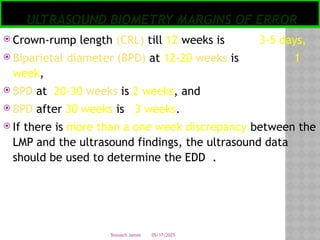
ULTRASOUND BIOMETRYMARGINS OF ERROR
Crown-rump length (CRL) till 12 weeks is 3-5 days,
Biparietal diameter (BPD) at 12-20 weeks is 1
week,
BPD at 20-30 weeks is 2 weeks, and
BPD after 30 weeks is 3 weeks.
If there is more than a one week discrepancy between the
LMP and the ultrasound findings, the ultrasound data
should be used to determine the EDD .
19.
05/17/2025
Tesloach James
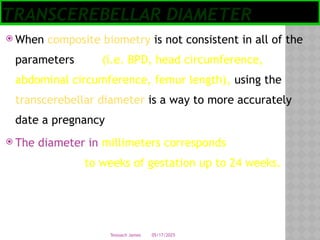
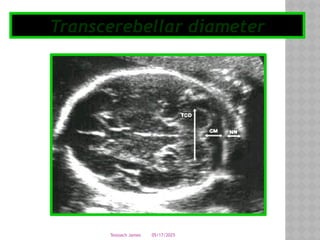
TRANSCEREBELLAR DIAMETER
When composite biometry is not consistent in all of the
parameters (i.e. BPD, head circumference,
abdominal circumference, femur length), using the
transcerebellar diameter is a way to more accurately
date a pregnancy
The diameter in millimeters corresponds
to weeks of gestation up to 24 weeks.
05/17/2025
Tesloach James
The availableevidences are
strongly in support that dating
by Early ultrasonography alone
is the
most accurate method for
predicting EDD.
RCOG (GRADE A)
22.
05/17/2025
Tesloach James
The useof early ultra
sound alone to
calculate the rate of postterm pregnancy
in women who delivered spontaneously
significantly reduced the postterm rate
from 10 % to 1.5 %.
Routine early pregnancy ultrasound
RCOG (GRADE A)
23.
05/17/2025
Tesloach James
ARE THEREINTERVENTIONS THAT DECREASE
THE RATE OF POSTTERM PREGNANCY?
Accurate dating on the basis of ultrasonography
performed early in pregnancy .
Breast and nipple stimulation at term have not been
shown to affect the incidence of postterm pregnancy.
Sweeping of the membranes at term :
the data are still conflicting .
ACOG Guidelines 2004
24.
05/17/2025
Tesloach James
1) Gestationalage,
2) Absence/presence of maternal risk factors and / or
3) Evidence of fetal compromise, and
4) Maternal preferences .
Successful management depends on effective
counseling of women and their full involvement in the
decision making process.
Management options depend on:
25.
05/17/2025
Tesloach James
a. Inducinglabour at 41-42 weeks gestation
or
b. Awaiting the onset of spontaneous labour, while
monitoring the fetal wellbeing .
The decision is difficult and should not be taken
lightly.
Historically, prolonged pregnancy has
been managed in 2 ways , either :
26.
05/17/2025
Tesloach James
ROUTINE INDUCTIONOF LABOUR
AT 41 WEEKS
Although postterm pregnancy is defined as a pregnancy of
42 weeks or more of gestation, several large multicenter
randomized studies reported favorable outcomes with
routine induction as early as the beginning of 41 weeks
of gestation.
Cochrane 2006
27.
05/17/2025
Tesloach James
ROUTINE INDUCTIONOF LABOUR
AT 41 WEEKS
A recent review in the Cochrane Library concluded that
routine induction in low-risk
pregnancies at or after 41 weeks' gestation is associated
with :
1. A reduction in perinatal mortality,
2. No increase in the rate of instrumental or cesarean
delivery.
RCOG Grade A
28.
05/17/2025
Tesloach James
Contraryto what many obstetricians believe,
induction of labor for prolonged pregnancy does not
increase the rate of cesarean section, rather, it
decreases it.
The risk of fetal distress from uteroplacental
insufficiency due to prolonged pregnancy can be
reduced by induction of labor, even to the point of
preventing perinatal death from asphyxia.
Routine induction of labour
at 41 weeks
29.
05/17/2025
Tesloach James
Thereis insufficient evidence to indicate whether routine
antenatal surveillance of low-risk patients between 40
and 42 weeks of gestation improves perinatal outcome
but it is often
performed during this period.
ANTEPARTUM FETAL
SURVEILLANCE
30.
05/17/2025
Tesloach James
ANTEPARTUM FETALSURVEILLANCE
The condition of the fetus can change quickly and thus,
monitoring should be at frequent intervals, and that none
of the tests are immune from false positives, false
negatives
Boehm et al, demonstrated that twice-weekly testing of
patients at risk for fetal distress was superior to weekly
testing.
31.
05/17/2025
Tesloach James
FETAL SURVEILLANCE
Amodified biophysical profile consisting of
a:
non stress test and an
amniotic fluid index
have been shown to be as
sensitive as a full biophysical profile.
RCOG Grade A
32.
05/17/2025
Tesloach James
INDUCTION OFLABOUR OR
EXPECTANT MANAGEMENT?
Favorable cervix : Labor generally is induced because the
risk of failed induction and subsequent cesarean delivery
is low.
Unfavorable cervix :a small advantage to labor induction
using cervical ripening agents (prostaglandins), when
indicated, regardless of parity or method
of induction.
ACOG 2004 (Level C)
33.
05/17/2025
Tesloach James
A .Healthy,uncomplicated pregnancy and
fetal growth/ amniotic fluid normal:
No evidence to support elective
induction of labour
No evidence to support use of serial
antenatal monitoring :
non stress test (NST) or
amniotic fluid index (AFI) .
Management from 40-41 weeks gestation
34.
05/17/2025
Tesloach James
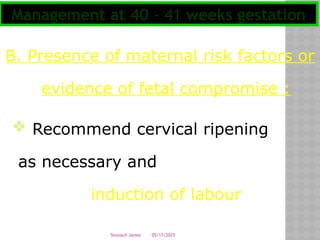
B. Presenceof maternal risk factors or
evidence of fetal compromise :
Recommend cervical ripening
as necessary and
induction of labour
Management at 40 - 41 weeks gestation
35.
05/17/2025
Tesloach James
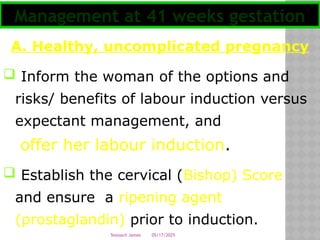
A. Healthy,uncomplicated pregnancy
Inform the woman of the options and
risks/ benefits of labour induction versus
expectant management, and
offer her labour induction.
Establish the cervical (Bishop) Score
and ensure a ripening agent
(prostaglandin) prior to induction.
Management at 41 weeks gestation
36.
05/17/2025
Tesloach James
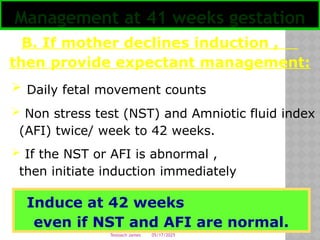
B. Ifmother declines induction ,
then provide expectant management:
Daily fetal movement counts
Non stress test (NST) and Amniotic fluid index
(AFI) twice/ week to 42 weeks.
If the NST or AFI is abnormal ,
then initiate induction immediately
Management at 41 weeks gestation
Induce at 42 weeks
even if NST and AFI are normal.
37.
05/17/2025
Tesloach James
۞
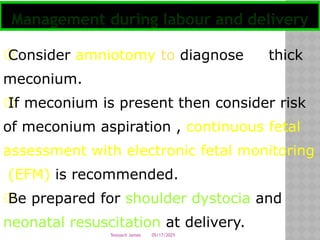
Consider amniotomyto diagnose thick
meconium.
۞
If meconium is present then consider risk
of meconium aspiration , continuous fetal
assessment with electronic fetal monitoring
(EFM) is recommended.
۞
Be prepared for shoulder dystocia and
neonatal resuscitation at delivery.
Management during labour and delivery
38.
05/17/2025
Tesloach James
Labourinduction at 41 weeks
gestation is recommended over
expectant management in women
with postterm pregnancy to reduce
the rate of cesarean delivery &
perinatal mortality .
Key Clinical Recommendations
(
RCOG Grade A
)
39.
05/17/2025
Tesloach James
IfExpectant management (41- 42 weeks) is chosen,the
fetus should be monitored with twice weekly non-
stress test ,amniotic fluid index .
- However, evidence of benefit is lacking.
Key Clinical Recommendations
(RCOG Grade C )
40.
05/17/2025
Tesloach James
Prostaglandincan be used in postterm pregnancies to
promote cervical ripening and induce labor.
Delivery should be effected if there is evidence of :
fetal compromise or
oligohydramnios.
ACOG 2004 (Level A)
Key Clinical Recommendations





![PERI-PROSTHETIC FRACTURE NAIL-PLATE CONSTRUCT [NPC].pptx](https://cdn.slidesharecdn.com/ss_thumbnails/drarunkumardrmohamedashrafperiprostheticfrasturenail-plateconstructnpc-260209164459-7e9d15a1-thumbnail.jpg?width=640&height=640&fit=bounds)

![CTEV [ clubfoot] DR ARUN LAL ,DR MOHAMED ASHRAF travancore medical college k...](https://cdn.slidesharecdn.com/ss_thumbnails/ctevclubfootdrarunlaldrmohamedashraftravancoremedicalcollegekollamkeralaindia-260208063247-18fc466c-thumbnail.jpg?width=640&height=640&fit=bounds)


