BY
M. ZEESHAN KHAN
RIZWAN ANWER
ZEESHAN LODHI
PRETERM AND POST-TERM
LABOUR
CONTENTS
 PRETERM LABOUR
 DEFINITION
 RISK FACTORS
 DIAGNOSIS
 INVESTIGATIONS
 PREDICITON AND PREVENTIONS
 TOCOLYTIC AGENTS
 MANAGEMENT
 PPROM(INTRODUCTION, DIAGNOSIS,MANAGEMENT)
 POST-TERM LABOUR
 INTRODUCTION
 SIGNIFICANCE
 CLINICAL APPROACH
 MANAGEMENT
DEFINITIONS
 PRE TERM PREGNANCY
 DELIVERY BEFORE 37 WEEKS OF GESTATION
 TERM PREGNANACY
 GP FROM 37 TO 41 + 6 days WEEKS
 POSTERM PREGNANCY
 GP FROM 42 WEEKS ONWARDS
PRETERM LABOUR
 Preterm labour is defined by WHO as Onset of
labour prior to the completion of 37 weeks of
gestation, in a pregnancy beyond 20 wks of
gestation.
 Preterm labour is considered to be established if
regular uterine contractions can be documented
atleast 4 in 20 minutes or 8 in 60 minutes with
progressive change in the cervical score in the form
of effacement of 80% or more and cervical
dialatation >1cm.
CONT’
 This condition tends to be over diagnosed and over
treated.
 Nearly 50-60% of preterm births occur following
spontaneous labour.
 30% due to preterm premature rupture of
membranes
 Rest are iatrogenic terminations for maternal or fetal
benefit.
 Half of all neonatal morbidity occurs in preterm
infants.
 Inspite of all major advances in obstetric and
neonatal care, there has been no decrease in
incidence of preterm labour over half a century.
 On the contrary , it has been increasing in the
developed countries as more and more high risk
mothers dare to get pregnant.
Incidence
 Preterm birth occurs in 5-12% of all pregnancies and
accounts for majority of neonatal deaths and nearly
half of all cases of congenital neurological disability,
including cerebral palsy.
 A neonate weighing 1000- 1500 g today has ten
times greater chance of surival then what it had in
1960s.
 The focus is hence shifting to early preterm
births(<32 weeks) which account for 1-2% of all
births but contribute to 60% of perinatal mortality
and nearly all neurological morbidity.
 One of the major reasons for increase in incidence of
premature births is the increase in numbers of
multiple pregnancies , particularly higher order
pregnancies, resulting from the use of fertility drugs
and assisted reproduction.
PRETERM LABOUR
5 -> 4 -> 4
 Mildly preterm 32 – 36 weeks
 Very preterm 28 – 31 days weeks
 Extremely preterm 24 – 27 weeks
AETIOLOGY
 INFECTIONS
 OVER-DISTENSION
 VASCULAR
 SURGICAL PROCEDURES AND INTERCURRENT
ILLNESS
 ABNORMAL UTERINE CAVITY
 CERVICAL WEAKNESS
 IDIOPATHIC
NON MODIFIABLE(MAJOR AND
MINOR)
MODIFIABLE
RISK FACTORS
RISK FACTORS
 MAJOR NON MODIFIABLE
 Last birth preterm: 20% risk
 Last two birth preterm : 40%risk
 Twin pregnancy: 50% risk
 Uterine abnormalities
 Cervical Anomalies
 Factors in current pregnancy
 Non modifiable , Minor
 Parity 0 or >5
 Ethnicity(Black)
 Poor socioeconomic status
 Education
 Teenagers having second or subsequent babies
 Modifiable
 Smoking :2x risk of PPROM
 Drug abuse : especially cocaine
 BMI <20
 Inter Pregnancy interval: <1year
DIAGNOSIS
 SYMPTOMS WITH CERVICAL WEAKNESS
 Increased vaginal discharge
 Mild Lower abdominal pain
 Bulging membranes on examination
 SYMPTOMS WITH INFECTION, ABRUPTION
 Lower abdominal pain
 Painful uterine contraction
DIGNOSTIC CRITERIA
1. GESTATIONAL AGE : 24-37 WEEKS
2. UTERINE CONTRACATION: ATLEAST 3
CONTRACTIONS IN 30 MINUTES
3. CERVICAL CHANGE: CHANGE IN CERVICAL
DIALTATION OR 2CM DILATED CERVIX
DIFFERNTIAL DIAGNOSIS
 UTI
 RED DEGERATION OF FIBROID
 PLACENTAL ABRUPTION
 CONSTIPATION
 GASTROENTERITIS
DIAGNOSTIC APPROACH
 HX
 EXAMINATIONS
 INVESTIGATIONS
 FBC
 CRP
 MID STREAM URINE SAMPLE
 U/S
 TVS
 FETAL FIBRONECTIN
PREVENTION
 Rx of BV
 Cervical Cerclage
 Selective Reduction of pregnancy numbers
 Progesterone ?
PREDICITON
 Cervical length
 TVS improves diagnostic accuracy
 Normal length 35 mm
 In asymptomatic women with singleton pregnancy
 Cervix <15 mm long : risk of delivering before 32 weeks is 4%
 Cervix <5 mm long: risk of delivering before 32 weeks is 78%
 In symptomatic woman with singleton pregnancy
 Cervix <15mm long : risk of delivering within 7 days is 50%
 Cervix >15 mm long: risk of delivery within 7 days is <1%
cont
 Fetal Fibronectin(fFn)- glue like protein at
choriodecidual interface
 fFN test offers rapid assessment of risk in symptomatic women
with minimal cervical dilatation,
 fFN is protein not usually present in cervicovaginal secretions
at 22-36weeks
 fFN positive test indicates that women is likely to deliver
 fFN predicts preterm birth within 7 – 10 days of testing
 Implying disruption of choriodecidual interface
TOCOLYTIC AGENTS AND STEROIDS
 Used to prevent labour and delivery
 May prolong pregnancy but not more than 72 hours
 Useful for fetal lung maturity by maternal IM steroids
 Transportation of mother to a facility with neonatal intensive
care
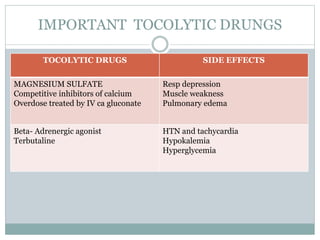
IMPORTANT TOCOLYTIC DRUNGS
TOCOLYTIC DRUGS SIDE EFFECTS
MAGNESIUM SULFATE
Competitive inhibitors of calcium
Overdose treated by IV ca gluconate
Resp depression
Muscle weakness
Pulmonary edema
Beta- Adrenergic agonist
Terbutaline
HTN and tachycardia
Hypokalemia
Hyperglycemia
cont
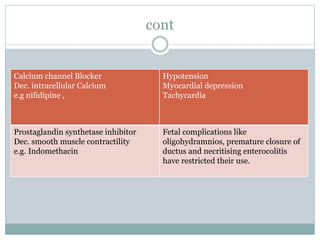
Calcium channel Blocker
Dec. intracellular Calcium
e.g nifidipine ,
Hypotension
Myocardial depression
Tachycardia
Prostaglandin synthetase inhibitor
Dec. smooth muscle contractility
e.g. Indomethacin
Fetal complications like
oligohydramnios, premature closure of
ductus and necritising enterocolitis
have restricted their use.
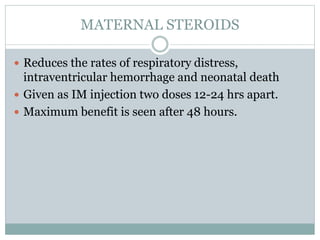
MATERNAL STEROIDS
 Reduces the rates of respiratory distress,
intraventricular hemorrhage and neonatal death
 Given as IM injection two doses 12-24 hrs apart.
 Maximum benefit is seen after 48 hours.
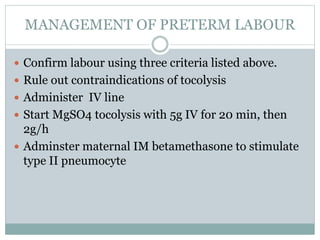
MANAGEMENT OF PRETERM LABOUR
 Confirm labour using three criteria listed above.
 Rule out contraindications of tocolysis
 Administer IV line
 Start MgSO4 tocolysis with 5g IV for 20 min, then
2g/h
 Adminster maternal IM betamethasone to stimulate
type II pneumocyte
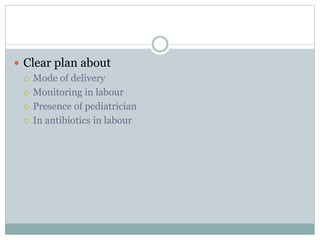
 Clear plan about
 Mode of delivery
 Monitoring in labour
 Presence of pediatrician
 In antibiotics in labour
PRETERM PRELABOUR OF MEMBRANES
(PPROM)
 Rupture of fetal membranes occurring before 37 wks
of gestation.
 It complicates about 3 % of pregnancies and
contributes to one third of preterm births
RISK FACTORS
 Ascending infection of lower genital tract-most
common
 Multiple pregnancy
 Polyhydramnios
 Antepartum hemorrhage
 Placental abruption
 Cervical weakness
 Idiopathic
Diagnosis of PPROM
 History of sudden escape of watery amnoitic fluid.
 Oligohydramnios on US
 Pooling of amniotic fluid in posterior vagina
 A sterile speculum examination confirms that the fluid is
coming through the os.
 Nitrazine test: turns blue from yellow if amniotic fluid leak.
 Fern test
 Ultrasound examination shows oligohydramnios
 Amnisure test(immunochromatographic method) detects trace
amounts of placental microglobulin (PAMG-1)
Differential diagnosis
 It needs to be differentiated from stress urinary incontinence
 and profuse normal vaginal discharge.
 UTI
 Vaginal Infection
Management of PPROM
 Correct and prompt diagnosis is imperative for
optimum management.
PPROM remote from term: Conservative management
is advisable, provided acute cord complications like
prolapse and compression, placental abruption and
fetal distress have been excluded. Oligohydramnios is
not an indication.
 Antibiotics: help to prolong latency and improve perinatal
outcomes.
 Corticosteroids: should be given to patients between 24 and 34
weeks of gestation.
PPROM nearer to term(34-36 wks):
 It is preferable to induce labour unless fetal lung
maturity or gestational age is doubtful
 Serial transabdominal amnioinfusions in<26 wks
pregnancies with PPROM and severe
oligohydramnios in selected women reduce the risk
of pulmonary hypoplasia and improve neonatal
survival.
POST-TERM PREGNANCY
 Any pregnancy that exceeds 42 weeks from the first
day of last menstrual period in women with regular
28 day cycles
 Aka Postdate pregnancy and prolonged pregnancy
INCIDENCE
 The generally quoted incidence of PT pregnancy is
10%
 Incidence is decreasing b/c of better estimation of
duration of gestation and timely induction of labour.
RISK FACTORS
 Past history of prolonged pregnancy
 Family history
 Race (White>black)
 Anencephaly
 Congenital adrenal hyperplasia
 Extra uterine pregnancy
COMPLICATION
 FETAL COMPLICATION
 Macrosomia Syndrome
 Dysmaturity Syndrome
 MATERNAL COMPLICATION
 Anxiety
 Prolonged labour
 C-section
Fetal Complications
 Macrosomia Syndrome
 Occurs when placental function is maintained(80% cases)
 Results in healthy but large fetus
 Amniotic fluid is normal
 Inc risk of C-section b/c of prolonged and arrested labour
 Shoulder dystocia
 Dysmaturity syndrome
 When placental function deteriorates (20% cases)
 Placental insufficiency results in reduction of metabolic and
respiratory support to fetus
 Amniotic fluid is decreased
 Inc risk of C-section b/c of non reassuring fetal heart rate
patterns
 Oligohydramnios results in umbilical cord compression
MATERNAL COMPLICATIONS
 Anxiety
 Is commonly seen postdate pregnancy b/c of worry of inc. in
gestation period from the EDD
 Prolonged labour
 Chances increases significantly and also the risk of
instrumental delivery
 C-section
 Risk of C-section is also greatly increased
MANAGEMENT
 It depends on the
 Confirmation of gestational age
 Favorability of cervix
CONFIRAMTION OF GESTATIONAL AGE
 In a booked case confirmation of gestational age is
easily determined
 In an unbooked case , diagnosis of post term
pregnancy poses a major challenge.
DETERMINATION OF GESTATIONAL AGE
 HISTORY
 LMP
 EARLY U/S
 FAMILY HISTORY
 HX OF NTDs
 EXAMINATION
 SFH
 BISHOP SCORING
INVESTIGATIONS
 U/S
 NST
 AFI
After confirmation of gestational age management
plan is decided
CONSERVATIVE MANAGEMENT
 50% women going beyond 42 weeks of gestation
experience spontaneous labour in 4-5 days
 Poor bishop score
 Good fetal health + adequate placental function
INDUCTION OF LABOUR
1. Favorable cervix
2. Oligohydramnios
3. Fetal macrosomia
4. Non reactive NST
FOR YOUR PATIENCE 
Thanks

preterm and postterm labour

  • 1.
    BY M. ZEESHAN KHAN RIZWANANWER ZEESHAN LODHI PRETERM AND POST-TERM LABOUR
  • 2.
    CONTENTS  PRETERM LABOUR DEFINITION  RISK FACTORS  DIAGNOSIS  INVESTIGATIONS  PREDICITON AND PREVENTIONS  TOCOLYTIC AGENTS  MANAGEMENT  PPROM(INTRODUCTION, DIAGNOSIS,MANAGEMENT)  POST-TERM LABOUR  INTRODUCTION  SIGNIFICANCE  CLINICAL APPROACH  MANAGEMENT
  • 3.
    DEFINITIONS  PRE TERMPREGNANCY  DELIVERY BEFORE 37 WEEKS OF GESTATION  TERM PREGNANACY  GP FROM 37 TO 41 + 6 days WEEKS  POSTERM PREGNANCY  GP FROM 42 WEEKS ONWARDS
  • 4.
    PRETERM LABOUR  Pretermlabour is defined by WHO as Onset of labour prior to the completion of 37 weeks of gestation, in a pregnancy beyond 20 wks of gestation.  Preterm labour is considered to be established if regular uterine contractions can be documented atleast 4 in 20 minutes or 8 in 60 minutes with progressive change in the cervical score in the form of effacement of 80% or more and cervical dialatation >1cm.
  • 5.
    CONT’  This conditiontends to be over diagnosed and over treated.  Nearly 50-60% of preterm births occur following spontaneous labour.  30% due to preterm premature rupture of membranes  Rest are iatrogenic terminations for maternal or fetal benefit.
  • 6.
     Half ofall neonatal morbidity occurs in preterm infants.  Inspite of all major advances in obstetric and neonatal care, there has been no decrease in incidence of preterm labour over half a century.  On the contrary , it has been increasing in the developed countries as more and more high risk mothers dare to get pregnant.
  • 7.
    Incidence  Preterm birthoccurs in 5-12% of all pregnancies and accounts for majority of neonatal deaths and nearly half of all cases of congenital neurological disability, including cerebral palsy.  A neonate weighing 1000- 1500 g today has ten times greater chance of surival then what it had in 1960s.  The focus is hence shifting to early preterm births(<32 weeks) which account for 1-2% of all births but contribute to 60% of perinatal mortality and nearly all neurological morbidity.
  • 8.
     One ofthe major reasons for increase in incidence of premature births is the increase in numbers of multiple pregnancies , particularly higher order pregnancies, resulting from the use of fertility drugs and assisted reproduction.
  • 9.
    PRETERM LABOUR 5 ->4 -> 4  Mildly preterm 32 – 36 weeks  Very preterm 28 – 31 days weeks  Extremely preterm 24 – 27 weeks
  • 10.
    AETIOLOGY  INFECTIONS  OVER-DISTENSION VASCULAR  SURGICAL PROCEDURES AND INTERCURRENT ILLNESS  ABNORMAL UTERINE CAVITY  CERVICAL WEAKNESS  IDIOPATHIC
  • 11.
  • 12.
    RISK FACTORS  MAJORNON MODIFIABLE  Last birth preterm: 20% risk  Last two birth preterm : 40%risk  Twin pregnancy: 50% risk  Uterine abnormalities  Cervical Anomalies  Factors in current pregnancy
  • 13.
     Non modifiable, Minor  Parity 0 or >5  Ethnicity(Black)  Poor socioeconomic status  Education  Teenagers having second or subsequent babies
  • 14.
     Modifiable  Smoking:2x risk of PPROM  Drug abuse : especially cocaine  BMI <20  Inter Pregnancy interval: <1year
  • 15.
    DIAGNOSIS  SYMPTOMS WITHCERVICAL WEAKNESS  Increased vaginal discharge  Mild Lower abdominal pain  Bulging membranes on examination  SYMPTOMS WITH INFECTION, ABRUPTION  Lower abdominal pain  Painful uterine contraction
  • 16.
    DIGNOSTIC CRITERIA 1. GESTATIONALAGE : 24-37 WEEKS 2. UTERINE CONTRACATION: ATLEAST 3 CONTRACTIONS IN 30 MINUTES 3. CERVICAL CHANGE: CHANGE IN CERVICAL DIALTATION OR 2CM DILATED CERVIX
  • 17.
    DIFFERNTIAL DIAGNOSIS  UTI RED DEGERATION OF FIBROID  PLACENTAL ABRUPTION  CONSTIPATION  GASTROENTERITIS
  • 18.
    DIAGNOSTIC APPROACH  HX EXAMINATIONS  INVESTIGATIONS  FBC  CRP  MID STREAM URINE SAMPLE  U/S  TVS  FETAL FIBRONECTIN
  • 19.
    PREVENTION  Rx ofBV  Cervical Cerclage  Selective Reduction of pregnancy numbers  Progesterone ?
  • 20.
    PREDICITON  Cervical length TVS improves diagnostic accuracy  Normal length 35 mm  In asymptomatic women with singleton pregnancy  Cervix <15 mm long : risk of delivering before 32 weeks is 4%  Cervix <5 mm long: risk of delivering before 32 weeks is 78%  In symptomatic woman with singleton pregnancy  Cervix <15mm long : risk of delivering within 7 days is 50%  Cervix >15 mm long: risk of delivery within 7 days is <1%
  • 21.
    cont  Fetal Fibronectin(fFn)-glue like protein at choriodecidual interface  fFN test offers rapid assessment of risk in symptomatic women with minimal cervical dilatation,  fFN is protein not usually present in cervicovaginal secretions at 22-36weeks  fFN positive test indicates that women is likely to deliver  fFN predicts preterm birth within 7 – 10 days of testing  Implying disruption of choriodecidual interface
  • 22.
    TOCOLYTIC AGENTS ANDSTEROIDS  Used to prevent labour and delivery  May prolong pregnancy but not more than 72 hours  Useful for fetal lung maturity by maternal IM steroids  Transportation of mother to a facility with neonatal intensive care
  • 23.
    IMPORTANT TOCOLYTIC DRUNGS TOCOLYTICDRUGS SIDE EFFECTS MAGNESIUM SULFATE Competitive inhibitors of calcium Overdose treated by IV ca gluconate Resp depression Muscle weakness Pulmonary edema Beta- Adrenergic agonist Terbutaline HTN and tachycardia Hypokalemia Hyperglycemia
  • 24.
    cont Calcium channel Blocker Dec.intracellular Calcium e.g nifidipine , Hypotension Myocardial depression Tachycardia Prostaglandin synthetase inhibitor Dec. smooth muscle contractility e.g. Indomethacin Fetal complications like oligohydramnios, premature closure of ductus and necritising enterocolitis have restricted their use.
  • 25.
    MATERNAL STEROIDS  Reducesthe rates of respiratory distress, intraventricular hemorrhage and neonatal death  Given as IM injection two doses 12-24 hrs apart.  Maximum benefit is seen after 48 hours.
  • 26.
    MANAGEMENT OF PRETERMLABOUR  Confirm labour using three criteria listed above.  Rule out contraindications of tocolysis  Administer IV line  Start MgSO4 tocolysis with 5g IV for 20 min, then 2g/h  Adminster maternal IM betamethasone to stimulate type II pneumocyte
  • 27.
     Clear planabout  Mode of delivery  Monitoring in labour  Presence of pediatrician  In antibiotics in labour
  • 28.
    PRETERM PRELABOUR OFMEMBRANES (PPROM)  Rupture of fetal membranes occurring before 37 wks of gestation.  It complicates about 3 % of pregnancies and contributes to one third of preterm births
  • 29.
    RISK FACTORS  Ascendinginfection of lower genital tract-most common  Multiple pregnancy  Polyhydramnios  Antepartum hemorrhage  Placental abruption  Cervical weakness  Idiopathic
  • 30.
    Diagnosis of PPROM History of sudden escape of watery amnoitic fluid.  Oligohydramnios on US  Pooling of amniotic fluid in posterior vagina  A sterile speculum examination confirms that the fluid is coming through the os.  Nitrazine test: turns blue from yellow if amniotic fluid leak.  Fern test  Ultrasound examination shows oligohydramnios  Amnisure test(immunochromatographic method) detects trace amounts of placental microglobulin (PAMG-1)
  • 31.
    Differential diagnosis  Itneeds to be differentiated from stress urinary incontinence  and profuse normal vaginal discharge.  UTI  Vaginal Infection
  • 32.
    Management of PPROM Correct and prompt diagnosis is imperative for optimum management. PPROM remote from term: Conservative management is advisable, provided acute cord complications like prolapse and compression, placental abruption and fetal distress have been excluded. Oligohydramnios is not an indication.  Antibiotics: help to prolong latency and improve perinatal outcomes.  Corticosteroids: should be given to patients between 24 and 34 weeks of gestation.
  • 33.
    PPROM nearer toterm(34-36 wks):  It is preferable to induce labour unless fetal lung maturity or gestational age is doubtful  Serial transabdominal amnioinfusions in<26 wks pregnancies with PPROM and severe oligohydramnios in selected women reduce the risk of pulmonary hypoplasia and improve neonatal survival.
  • 34.
    POST-TERM PREGNANCY  Anypregnancy that exceeds 42 weeks from the first day of last menstrual period in women with regular 28 day cycles  Aka Postdate pregnancy and prolonged pregnancy
  • 35.
    INCIDENCE  The generallyquoted incidence of PT pregnancy is 10%  Incidence is decreasing b/c of better estimation of duration of gestation and timely induction of labour.
  • 36.
    RISK FACTORS  Pasthistory of prolonged pregnancy  Family history  Race (White>black)  Anencephaly  Congenital adrenal hyperplasia  Extra uterine pregnancy
  • 37.
    COMPLICATION  FETAL COMPLICATION Macrosomia Syndrome  Dysmaturity Syndrome  MATERNAL COMPLICATION  Anxiety  Prolonged labour  C-section
  • 38.
    Fetal Complications  MacrosomiaSyndrome  Occurs when placental function is maintained(80% cases)  Results in healthy but large fetus  Amniotic fluid is normal  Inc risk of C-section b/c of prolonged and arrested labour  Shoulder dystocia
  • 39.
     Dysmaturity syndrome When placental function deteriorates (20% cases)  Placental insufficiency results in reduction of metabolic and respiratory support to fetus  Amniotic fluid is decreased  Inc risk of C-section b/c of non reassuring fetal heart rate patterns  Oligohydramnios results in umbilical cord compression
  • 40.
    MATERNAL COMPLICATIONS  Anxiety Is commonly seen postdate pregnancy b/c of worry of inc. in gestation period from the EDD  Prolonged labour  Chances increases significantly and also the risk of instrumental delivery  C-section  Risk of C-section is also greatly increased
  • 41.
    MANAGEMENT  It dependson the  Confirmation of gestational age  Favorability of cervix
  • 42.
    CONFIRAMTION OF GESTATIONALAGE  In a booked case confirmation of gestational age is easily determined  In an unbooked case , diagnosis of post term pregnancy poses a major challenge.
  • 43.
    DETERMINATION OF GESTATIONALAGE  HISTORY  LMP  EARLY U/S  FAMILY HISTORY  HX OF NTDs  EXAMINATION  SFH  BISHOP SCORING
  • 44.
    INVESTIGATIONS  U/S  NST AFI After confirmation of gestational age management plan is decided
  • 45.
    CONSERVATIVE MANAGEMENT  50%women going beyond 42 weeks of gestation experience spontaneous labour in 4-5 days  Poor bishop score  Good fetal health + adequate placental function
  • 46.
    INDUCTION OF LABOUR 1.Favorable cervix 2. Oligohydramnios 3. Fetal macrosomia 4. Non reactive NST
  • 47.