By-
Dr.RAGHUVEER
(BAMS)
DEFINITION:-
 The normal length of pregnancy is from 37-41
weeks(281 days). The baby born after this
period i.e.,after 42 weeks(294 days) past the
first day of the mother’s LMP.
Usually Postterm = EDD + 14 days.
SYNONYMS
 Post-term
 Post maturity
 Prolonged pregnancy
 Post-dates pregnancy
 Post mature birth
INTRODUCTION
Post-mature births do not have any harmful effects on
the mother; however, the fetus can begin to suffer
from malnutrition.
 After the 42nd week of gestation, the placenta, which
supplies the baby with nutrients and oxygen from the
mother, starts aging and will eventually fail.
Cont....
 A number of key morbidities are greater in
infants born to postterm pregnancies including
meconium and meconium aspiration,
neonatal academia, low Apgar scores,
macrosomia, and, in turn, birth injury.
Incidence-
 Range - 4-19%,
 Average incidence- 10%
AETIOLOGY
 The causes of post-term births is
unknown.
 But post-mature births are more
likely when the mother has
experienced a previous
post- mature birth.
 Due dates are easily
miscalculated when the
mother is unsure of her last
menstrual period, so in reality
the baby is not technically
post-mature ( MOST
LIKELY )
 Post-mature births can also be
attributed to irregular
menstrual cycles.
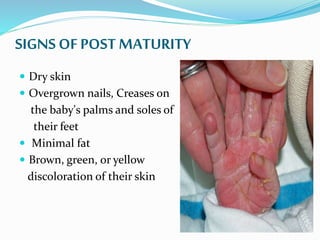
SIGNS OFPOSTMATURITY
 Dry skin
 Overgrown nails, Creases on
the baby's palms and soles of
their feet
 Minimal fat
 Brown, green, or yellow
discoloration of their skin
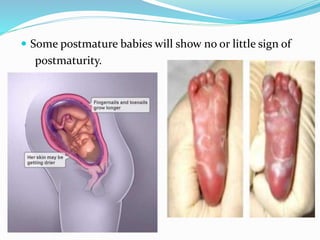
 Some postmature babies will show no or little sign of
postmaturity.
COMPLICATIONS OF POST DATES
FETAL RISKS
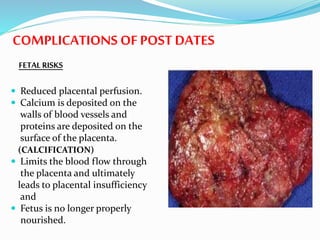
 Reduced placental perfusion.
 Calcium is deposited on the
walls of blood vessels and
proteins are deposited on the
surface of the placenta.
(CALCIFICATION)
 Limits the blood flow through
the placenta and ultimately
leads to placental insufficiency
and
 Fetus is no longer properly
nourished.
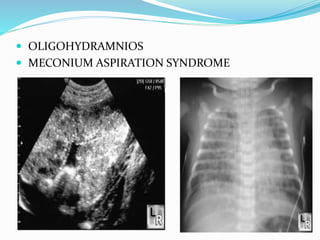
 OLIGOHYDRAMNIOS
 MECONIUM ASPIRATION SYNDROME
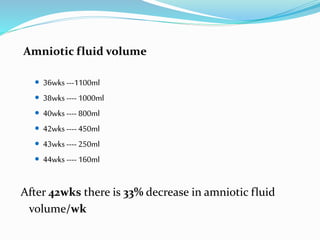
Amniotic fluid volume
 36wks ---1100ml
 38wks ---- 1000ml
 40wks ---- 800ml
 42wks ---- 450ml
 43wks ---- 250ml
 44wks ---- 160ml
After 42wks there is 33% decrease in amniotic fluid
volume/wk
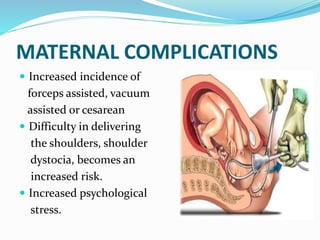
MATERNAL COMPLICATIONS
 Increased incidence of
forceps assisted, vacuum
assisted or cesarean
 Difficulty in delivering
the shoulders, shoulder
dystocia, becomes an
increased risk.
 Increased psychological
stress.
Cont.....
Cephalopelvic disproportion- post term babies
sometimes be larger than normal babies, thus increasing the
length of labor. Due to ossification of sutures and fontanellae
the head cannot mould and the labor is increased because
the baby’s head is too big to pass through the mother’s pelvis.
This is called cephalopelvic disproportion.
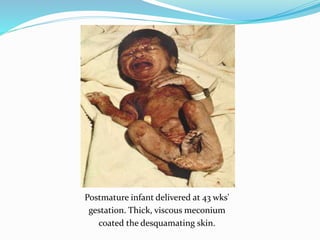
Postmature infant delivered at 43 wks'
gestation. Thick, viscous meconium
coated the desquamating skin.
METHODS OF MONITORING
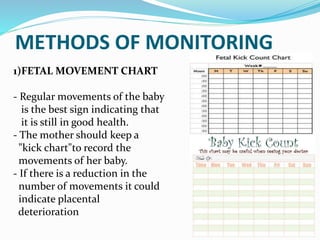
1)FETAL MOVEMENT CHART
- Regular movements of the baby
is the best sign indicating that
it is still in good health.
- The mother should keep a
"kick chart"to record the
movements of her baby.
- If there is a reduction in the
number of movements it could
indicate placental
deterioration
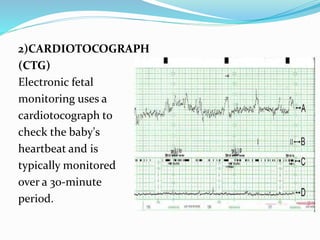
2)CARDIOTOCOGRAPH
(CTG)
Electronic fetal
monitoring uses a
cardiotocograph to
check the baby's
heartbeat and is
typically monitored
over a 30-minute
period.
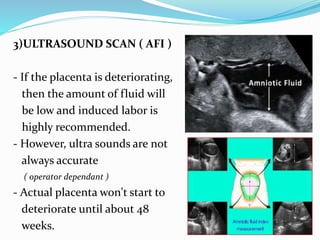
3)ULTRASOUND SCAN ( AFI )
- If the placenta is deteriorating,
then the amount of fluid will
be low and induced labor is
highly recommended.
- However, ultra sounds are not
always accurate
( operator dependant )
- Actual placenta won't start to
deteriorate until about 48
weeks.
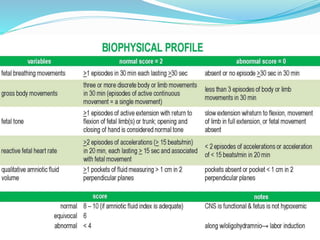
4)BIOPHYSICAL
PROFILE(BPP)
A biophysical profile
checks for the baby's
heart rate, muscle tone,
movement, breathing,
and the amount of
amniotic fluid
surrounding the baby.
5)DOPPLER FLOW STUDY
Doppler flow study is a type of
ultrasound that measures the
amount of blood flowing in
and out of the placenta.
MANAGEMENT
- Labor induction (process where uterine contractions
are initiated by medical or surgical means)is
recommended over expectant management in women
with pregnancy to reduce rates of caserean delivery.
-If expectant management is choosen then fetus is
monitered to check non-stress testing(how the fetal
heart responds to fetal activity),Amniotic Fluid
Index(AFI), and Biophysical Profile should be done.
Post mature labor

Post mature labor

  • 1.
  • 2.
    DEFINITION:-  The normallength of pregnancy is from 37-41 weeks(281 days). The baby born after this period i.e.,after 42 weeks(294 days) past the first day of the mother’s LMP. Usually Postterm = EDD + 14 days.
  • 3.
    SYNONYMS  Post-term  Postmaturity  Prolonged pregnancy  Post-dates pregnancy  Post mature birth
  • 4.
    INTRODUCTION Post-mature births donot have any harmful effects on the mother; however, the fetus can begin to suffer from malnutrition.  After the 42nd week of gestation, the placenta, which supplies the baby with nutrients and oxygen from the mother, starts aging and will eventually fail. Cont....
  • 5.
     A numberof key morbidities are greater in infants born to postterm pregnancies including meconium and meconium aspiration, neonatal academia, low Apgar scores, macrosomia, and, in turn, birth injury.
  • 6.
    Incidence-  Range -4-19%,  Average incidence- 10%
  • 7.
    AETIOLOGY  The causesof post-term births is unknown.  But post-mature births are more likely when the mother has experienced a previous post- mature birth.  Due dates are easily miscalculated when the mother is unsure of her last menstrual period, so in reality the baby is not technically post-mature ( MOST LIKELY )  Post-mature births can also be attributed to irregular menstrual cycles.
  • 8.
    SIGNS OFPOSTMATURITY  Dryskin  Overgrown nails, Creases on the baby's palms and soles of their feet  Minimal fat  Brown, green, or yellow discoloration of their skin
  • 9.
     Some postmaturebabies will show no or little sign of postmaturity.
  • 10.
    COMPLICATIONS OF POSTDATES FETAL RISKS  Reduced placental perfusion.  Calcium is deposited on the walls of blood vessels and proteins are deposited on the surface of the placenta. (CALCIFICATION)  Limits the blood flow through the placenta and ultimately leads to placental insufficiency and  Fetus is no longer properly nourished.
  • 11.
  • 12.
    Amniotic fluid volume 36wks ---1100ml  38wks ---- 1000ml  40wks ---- 800ml  42wks ---- 450ml  43wks ---- 250ml  44wks ---- 160ml After 42wks there is 33% decrease in amniotic fluid volume/wk
  • 13.
    MATERNAL COMPLICATIONS  Increasedincidence of forceps assisted, vacuum assisted or cesarean  Difficulty in delivering the shoulders, shoulder dystocia, becomes an increased risk.  Increased psychological stress.
  • 14.
    Cont..... Cephalopelvic disproportion- postterm babies sometimes be larger than normal babies, thus increasing the length of labor. Due to ossification of sutures and fontanellae the head cannot mould and the labor is increased because the baby’s head is too big to pass through the mother’s pelvis. This is called cephalopelvic disproportion.
  • 15.
    Postmature infant deliveredat 43 wks' gestation. Thick, viscous meconium coated the desquamating skin.
  • 16.
    METHODS OF MONITORING 1)FETALMOVEMENT CHART - Regular movements of the baby is the best sign indicating that it is still in good health. - The mother should keep a "kick chart"to record the movements of her baby. - If there is a reduction in the number of movements it could indicate placental deterioration
  • 17.
    2)CARDIOTOCOGRAPH (CTG) Electronic fetal monitoring usesa cardiotocograph to check the baby's heartbeat and is typically monitored over a 30-minute period.
  • 18.
    3)ULTRASOUND SCAN (AFI ) - If the placenta is deteriorating, then the amount of fluid will be low and induced labor is highly recommended. - However, ultra sounds are not always accurate ( operator dependant ) - Actual placenta won't start to deteriorate until about 48 weeks.
  • 19.
    4)BIOPHYSICAL PROFILE(BPP) A biophysical profile checksfor the baby's heart rate, muscle tone, movement, breathing, and the amount of amniotic fluid surrounding the baby.
  • 21.
    5)DOPPLER FLOW STUDY Dopplerflow study is a type of ultrasound that measures the amount of blood flowing in and out of the placenta.
  • 22.
    MANAGEMENT - Labor induction(process where uterine contractions are initiated by medical or surgical means)is recommended over expectant management in women with pregnancy to reduce rates of caserean delivery. -If expectant management is choosen then fetus is monitered to check non-stress testing(how the fetal heart responds to fetal activity),Amniotic Fluid Index(AFI), and Biophysical Profile should be done.