Dr. HARSH AMIN
Introduction 
 
 Before 1940s hypovolemic 
shock was the leading cause 
of death after burn injury 
 Now the mortality due to 
hypovolemic shock is 
decreased after use of various 
fluid resuscitation formulas. 
 But still 50% burn deaths 
occurring in first 10 days are 
mainly due to inadequate and 
inappropriate fluid 
resuscitation management.
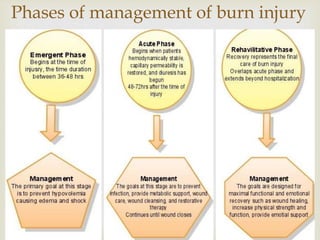
Phases of management of burn injury
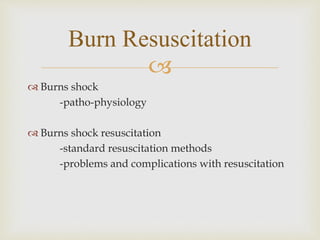
Burn Resuscitation 
 
 Burns shock 
-patho-physiology 
 Burns shock resuscitation 
-standard resuscitation methods 
-problems and complications with resuscitation
Burn shock 
 
Mechanism is still not clear
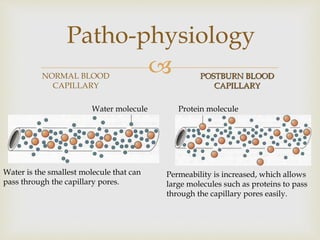
Patho-physiology 
 
NORMAL BLOOD 
CAPILLARY 
POSTBURN BLOOD 
CAPILLARY 
Water molecule 
Water is the smallest molecule that can 
pass through the capillary pores. 
Protein molecule 
Permeability is increased, which allows 
large molecules such as proteins to pass 
through the capillary pores easily.
Resuscitation 
 
It begins with arrival of patient
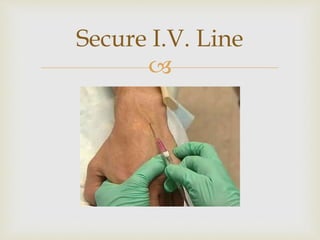
Secure I.V. Line 

Weight of Patient 

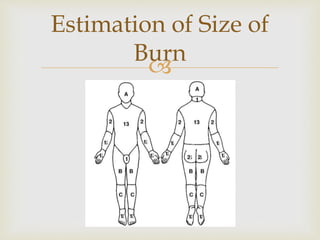
Estimation of Size of 
Burn 

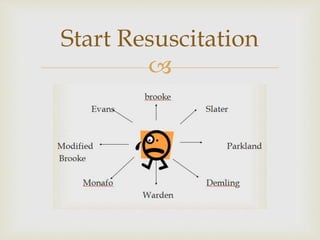
Start Resuscitation 

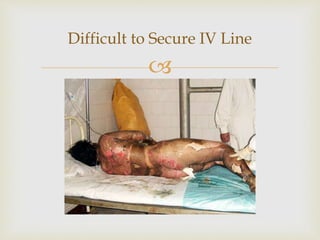
Secure an IV Line 
 
A challenging task in burns patient
Difficult to Secure IV Line 

Maximal Sterile Barriers 

Peripheral Line 

Peripherally inserted 
central catheter 

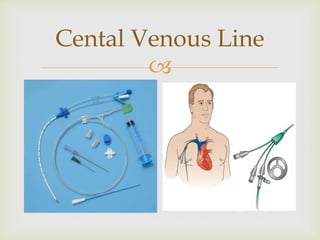
Cental Venous Line 

Venous Cut-Down 

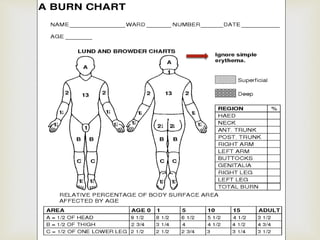
Estimation of Size of 
Burn 
 
Overestimated in inexperienced hand
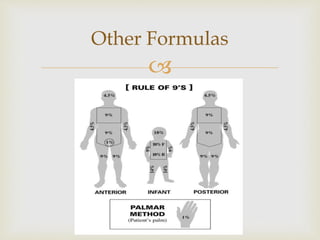
Other Formulas 

Fluid Resuscitation Protocol 
 
Goal: Restore and Preserve tissue perfusion to avoid 
ischemia
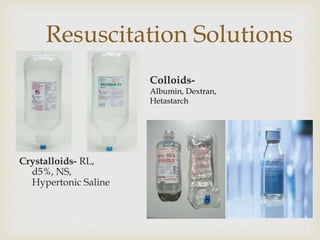
Resuscitation Solutions 
Crystalloids- RL, 
d5%, NS, 
Hypertonic Saline 
Colloids- 
Albumin, Dextran, 
Hetastarch
Most Preferred Solution 
 
 Most Preferred Fluid → Ringer Lactate( RL ) 
Na+ conc most free of converted 
130mEq/L physiological Glucose to HCO3
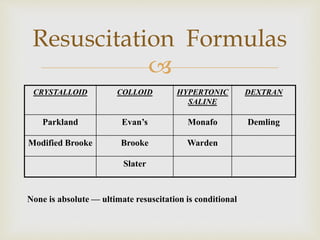
Resuscitation Formulas 
 
CRYSTALLOID C O L L O I D H Y P E R T O N I C 
SALINE 
DEXTRAN 
Parkland Evan’s Monafo Demling 
Modified Brooke Brooke Warden 
Slater 
None is absolute — ultimate resuscitation is conditional
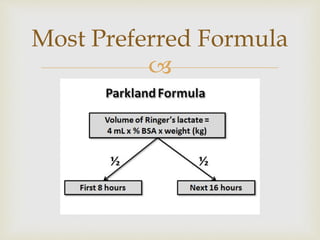
Most Preferred Formula 

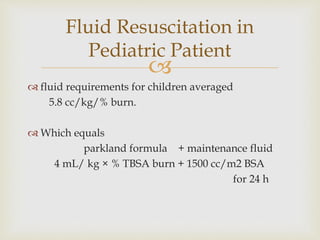
Fluid Resuscitation in 
 
 fluid requirements for children averaged 
5.8 cc/kg/% burn. 
 Which equals 
parkland formula + maintenance fluid 
4 mL/ kg × % TBSA burn + 1500 cc/m2 BSA 
for 24 h 
Pediatric Patient
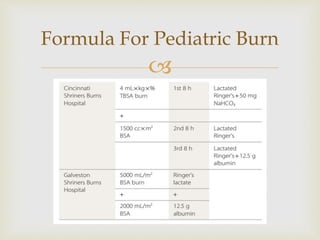
Formula For Pediatric Burn 

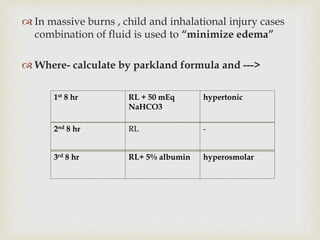
 In massive burns , child and inhalational injury cases 
combination of fluid is used to “minimize edema” 
 Where- calculate by parkland formula and ---> 
1st 8 hr RL + 50 mEq 
NaHCO3 
hypertonic 
2nd 8 hr RL - 
3rd 8 hr RL+ 5% albumin hyperosmolar
Monitoring 
 
No resuscitation formula is a license to put the burns 
patient on AUTO PILOT
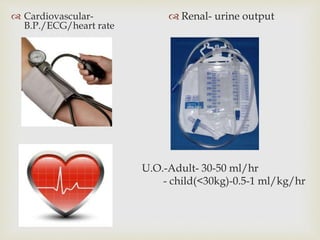
 Cardiovascular- 
B.P./ECG/heart rate 
 Renal- urine output 
U.O.-Adult- 30-50 ml/hr 
- child(<30kg)-0.5-1 ml/kg/hr
When does resuscitation 
complete ??? 
 
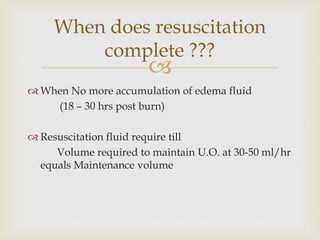
 When No more accumulation of edema fluid 
(18 – 30 hrs post burn) 
 Resuscitation fluid require till 
Volume required to maintain U.O. at 30-50 ml/hr 
equals Maintenance volume
“Fluid Creep”-over resuscitation 
 
Most common disadvantage with parkland’s 
formula 
Sequelae: 
 Skin edema 
 Compartment syndrome 
 Pulmonary & Cerebral edema 
 ARDS / MOD 
 ↑ costs, ↑mortality
Avoiding “the creep” 
 
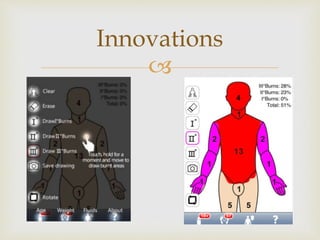
Avoid early over resuscitation (accurate initial 
burn estimation) 
Early institution of colloid ( colloid rescue ) 
Changing Resuscitation protocols
Failure of Resuscitation 
 
 Extreme age 
 Extensive burns 
 Major electrical injury 
 Major inhalational injury 
 Initial delay in initializing fluid 
 Underlying disease that limits metabolic or cardiac 
reserve
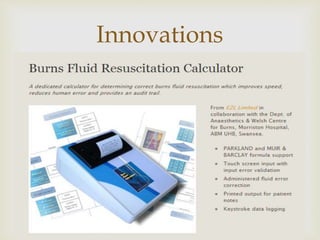
Innovations 

Innovations 

Thank  
you 
for your 
attention

Fluid resuscitation in burn - HARSH AMIN (plastic & cosmetic surgeon)