
Español I

SHOWING POSSESSION & RELATIONSHIPS
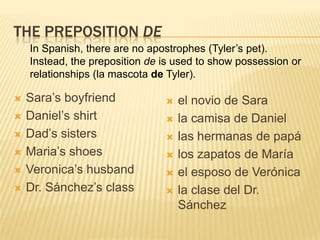
THE PREPOSITION DE
    In Spanish, there are no apostrophes (Tyler’s pet).
    Instead, the preposition de is used to show possession or
    relationships (la mascota de Tyler).

   Sara’s boyfriend               el novio de Sara
   Daniel’s shirt                 la camisa de Daniel
   Dad’s sisters                  las hermanas de papá
   Maria’s shoes                  los zapatos de María
   Veronica’s husband             el esposo de Verónica
   Dr. Sánchez’s class            la clase del Dr.
                                    Sánchez
POSSESSIVE ADJECTIVES
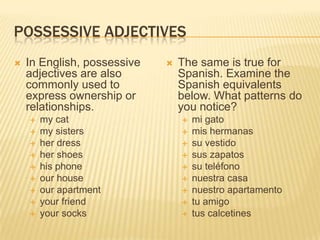
   In English, possessive      The same is true for
    adjectives are also          Spanish. Examine the
    commonly used to             Spanish equivalents
    express ownership or         below. What patterns do
    relationships.               you notice?
       my cat                      mi gato
       my sisters                  mis hermanas
       her dress                   su vestido
       her shoes                   sus zapatos
       his phone                   su teléfono
       our house                   nuestra casa
       our apartment               nuestro apartamento
       your friend                 tu amigo
       your socks                  tus calcetines
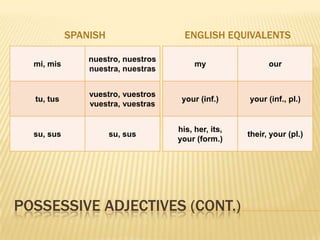
SPANISH                   ENGLISH EQUIVALENTS

                nuestro, nuestros
  mi, mis                                my                our
                nuestra, nuestras


                vuestro, vuestros
  tu, tus                            your (inf.)     your (inf., pl.)
                vuestra, vuestras


                                    his, her, its,
  su, sus             su, sus                        their, your (pl.)
                                    your (form.)


POSSESSIVE ADJECTIVES (CONT.)
USING POSSESSIVE ADJECTIVES
   Possessive adjectives are adjectives. Therefore, they must agree in
    number and gender with the nouns that they describe!
   Unlike other adjectives, possessive adjectives are placed before the
    nouns that they describe.
   You must consider the following three things:
        Who is the owner (of the object)?
        What is the number (of the object)? (One, or more than one?)
        What is the gender (of the object)? (Masculine or feminine? … for
         nuestro/vuestro only)
   my uncle
        mi tío
   my grandparents
        mis abuelos
   her notebook
        su cuaderno
   our sister
        nuestra hermana
   our cousins
        nuestros primos
ALTERNATIVES TO SU
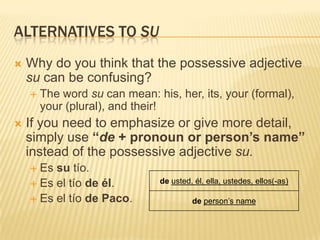
   Why do you think that the possessive adjective
    su can be confusing?
       The word su can mean: his, her, its, your (formal),
        your (plural), and their!
   If you need to emphasize or give more detail,
    simply use “de + pronoun or person’s name”
    instead of the possessive adjective su.
     Es su tío.
     Es el tío de él.          de usted, él, ella, ustedes, ellos(-as)

     Es el tío de Paco.                 de person’s name

Possessive adjectives

  • 1.
  • 2.
    THE PREPOSITION DE In Spanish, there are no apostrophes (Tyler’s pet). Instead, the preposition de is used to show possession or relationships (la mascota de Tyler).  Sara’s boyfriend  el novio de Sara  Daniel’s shirt  la camisa de Daniel  Dad’s sisters  las hermanas de papá  Maria’s shoes  los zapatos de María  Veronica’s husband  el esposo de Verónica  Dr. Sánchez’s class  la clase del Dr. Sánchez
  • 3.
    POSSESSIVE ADJECTIVES  In English, possessive  The same is true for adjectives are also Spanish. Examine the commonly used to Spanish equivalents express ownership or below. What patterns do relationships. you notice?  my cat  mi gato  my sisters  mis hermanas  her dress  su vestido  her shoes  sus zapatos  his phone  su teléfono  our house  nuestra casa  our apartment  nuestro apartamento  your friend  tu amigo  your socks  tus calcetines
  • 4.
    SPANISH ENGLISH EQUIVALENTS nuestro, nuestros mi, mis my our nuestra, nuestras vuestro, vuestros tu, tus your (inf.) your (inf., pl.) vuestra, vuestras his, her, its, su, sus su, sus their, your (pl.) your (form.) POSSESSIVE ADJECTIVES (CONT.)
  • 5.
    USING POSSESSIVE ADJECTIVES  Possessive adjectives are adjectives. Therefore, they must agree in number and gender with the nouns that they describe!  Unlike other adjectives, possessive adjectives are placed before the nouns that they describe.  You must consider the following three things:  Who is the owner (of the object)?  What is the number (of the object)? (One, or more than one?)  What is the gender (of the object)? (Masculine or feminine? … for nuestro/vuestro only)  my uncle  mi tío  my grandparents  mis abuelos  her notebook  su cuaderno  our sister  nuestra hermana  our cousins  nuestros primos
  • 6.
    ALTERNATIVES TO SU  Why do you think that the possessive adjective su can be confusing?  The word su can mean: his, her, its, your (formal), your (plural), and their!  If you need to emphasize or give more detail, simply use “de + pronoun or person’s name” instead of the possessive adjective su.  Es su tío.  Es el tío de él. de usted, él, ella, ustedes, ellos(-as)  Es el tío de Paco. de person’s name