LES ADJECTIF
POSSESIF
By:Radhika Manchanda
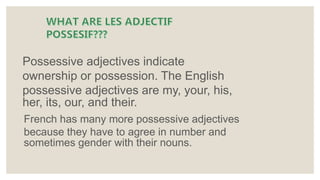
Possessive adjectives indicate
ownership or possession. The English
possessive adjectives are my, your, his,
her, its, our, and their.
French has many more possessive adjectives
because they have to agree in number and
sometimes gender with their nouns.
Make sure that the possessive adjective always agrees
in number and gender with the noun that is given.
•Par exemple
•mon frère (my brother)
•ma soeur (my sister)
•mes fréres (my brothers)
•The possessive adjective must be repeated before each
noun.
Mon fils, ma fille et mes petits-enfants. – My son,
daughter, and grandchildren
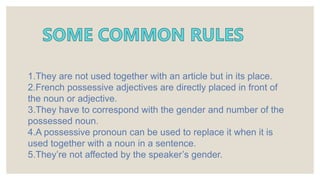
1.They are not used together with an article but in its place.
2.French possessive adjectives are directly placed in front of
the noun or adjective.
3.They have to correspond with the gender and number of the
possessed noun.
4.A possessive pronoun can be used to replace it when it is
used together with a noun in a sentence.
5.They’re not affected by the speaker’s gender.
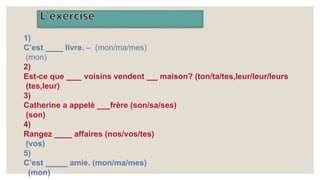
1)
C’est livre. – (mon/ma/mes)
(mon)
2)
Est-ce que voisins vendent maison? (ton/ta/tes,leur/leur/leurs
(tes,leur)
3)
Catherine a appelé frère (son/sa/ses)
(son)
4)
Rangez affaires (nos/vos/tes)
(vos)
5)
C’est amie. (mon/ma/mes)
(mon)
Le s adjectif possesif

Le s adjectif possesif

  • 1.
  • 2.
    Possessive adjectives indicate ownershipor possession. The English possessive adjectives are my, your, his, her, its, our, and their. French has many more possessive adjectives because they have to agree in number and sometimes gender with their nouns.
  • 4.
    Make sure thatthe possessive adjective always agrees in number and gender with the noun that is given. •Par exemple •mon frère (my brother) •ma soeur (my sister) •mes fréres (my brothers) •The possessive adjective must be repeated before each noun. Mon fils, ma fille et mes petits-enfants. – My son, daughter, and grandchildren
  • 5.
    1.They are notused together with an article but in its place. 2.French possessive adjectives are directly placed in front of the noun or adjective. 3.They have to correspond with the gender and number of the possessed noun. 4.A possessive pronoun can be used to replace it when it is used together with a noun in a sentence. 5.They’re not affected by the speaker’s gender.
  • 6.
    1) C’est livre. –(mon/ma/mes) (mon) 2) Est-ce que voisins vendent maison? (ton/ta/tes,leur/leur/leurs (tes,leur) 3) Catherine a appelé frère (son/sa/ses) (son) 4) Rangez affaires (nos/vos/tes) (vos) 5) C’est amie. (mon/ma/mes) (mon)