Positive guidance & NAEYC
                Code of Ethics
Staff Development Presentation
Susan Parsons, Jennifer Hill, & Mary Fowler
April 5, 2011
Session One
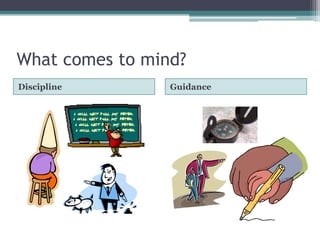
What comes to mind?
Discipline       Guidance
Positive Guidance Definitions
• Discipline- punishment inflicted by way of
  correction and training; to bring to a state of
  order and obedience by training and control
• Guidance- a type of framework in which children
  can learn acceptable social practices and ways to
  express their feelings
• Problem Solving- a set of principles and
  concepts that equip an adult to help and support
  children as they solve their own problems
The Problem Solving Approach
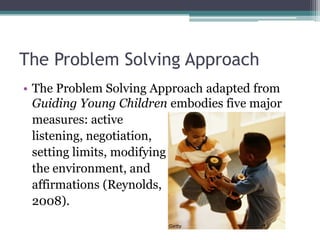
• The Problem Solving Approach adapted from
  Guiding Young Children embodies five major
  measures: active
  listening, negotiation,
  setting limits, modifying
  the environment, and
  affirmations (Reynolds,
  2008).
Active Listening
• The first step in most problem solving activities,
  active listening is the teacher’s tool for
  interpreting a child’s feelings. A child will be
  better able to face his feelings regarding the
  problem if he feels he is able to express them
  and “someone will understand and accept him”
  (Reynolds, 2008). Active listening is the process
  of listening for feelings, interpreting them, and
  reflecting them back to the child.
Negotiation
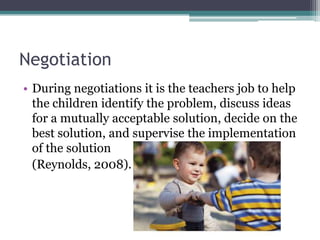
• During negotiations it is the teachers job to help
  the children identify the problem, discuss ideas
  for a mutually acceptable solution, decide on the
  best solution, and supervise the implementation
  of the solution
  (Reynolds, 2008).
Setting Limits
• Limits are flexible boundaries that can be
  negotiable, in contrast to rules which are absolute
  and rigid. Limits are set based on four major
  considerations.
  1. “To ensure the safety of each child and adult.”
  2. “To prohibit the destruction of nondisposable
     materials and equipment.”
  3. “To ensure that children accept responsibility for
     their own actions.”
  4. “To ensure equal and respectful treatment of all
     people” (Reynolds, 2008).
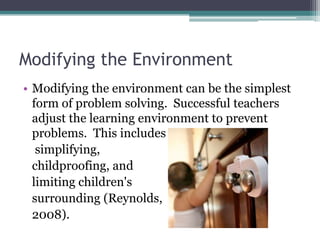
Modifying the Environment
• Modifying the environment can be the simplest
  form of problem solving. Successful teachers
  adjust the learning environment to prevent
  problems. This includes
   simplifying,
  childproofing, and
  limiting children's
  surrounding (Reynolds,
  2008).
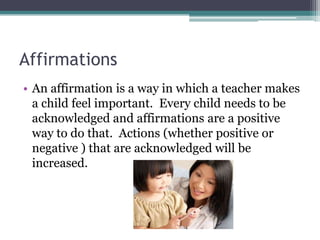
Affirmations
• An affirmation is a way in which a teacher makes
  a child feel important. Every child needs to be
  acknowledged and affirmations are a positive
  way to do that. Actions (whether positive or
  negative ) that are acknowledged will be
  increased.
Other Positive Guidance Techniques
• Redirecting- Redirecting a child’s attention to
  another toy or activity that is more acceptable.
• Reasoning- Explain to the children the
  consequences of their actions on other people
  and the purpose for obeying rules.
• Modeling- It is vital that adults model the type of
  behaviors they desire in children. This teaches
  children how to deal with conflicts, cooperate,
  etc.
• Offer Choices- Children like to have some
  control over what happens to them. Offer
  children good choices that are appropriate and
  then accept their decision.
• Acceptable Outlets for Expressing Feelings-
  Children need to express strong feelings, but
  help them find safe ways to do this.
• Avoid Overstimulation- Too many choices and
  options overwhelm children. Allow them an
  appropriate number of choices.
• Avoid Unrealistic Expectations- It is important
  that the teacher understand the skills and
  abilities of children.
• Natural and Logical Consequences- Actions
  result in consequences whether negative or
  positive. If the consequences are not too sever,
  let natural consequences happen. If not, create a
  consequence that is logical and appropriate for
  the behavior.
• Age Appropriate Activities- Activities and
  equipment that are relevant and safe for the age
  of the child promote growth and development
  (Crapo, 2003).
Solutions to Misbehavior
Session Two
About the Code
• The National Association for the Education of
  Young Children developed a code, that was
  revised in 2005, to help guide the thinking of
  professionals in the field of Early Childhood.
• The Code of Ethical Conduct outlines both ideals
  and principles for professionals working with
  four primary service groups: children, families,
  colleagues, and the community (Morrison,
  2009).
• The body of the code is hemmed in by core
  values and a statement of commitment.
Section I: Responsibilities to Children
• A professional in the field must value childhood as a
  unique stage in life in which children need healthy,
  responsive, nurturing care (Morrison, 2009).
• The following are a few examples of ideas and
  principles in this section:
  ▫ I-1.3: To recognize and respect the unique qualities,
    abilities, and potential of each child.
  ▫ P-1.2: We shall care for and educate children in
    positive emotional and social environments that are
    cognitively stimulating and that support each child’s
    culture, language, ethnicity, and family structure.
Section II: Responsibilities to Families
• Families have a large influence in a child’s
  development. Professionals must work closely
  with the family towards a mutual goal of
  providing good, quality childcare (Morrison,
  2009).
• The following are a few examples of ideas and
  principles in this section:
  ▫ I-2.2: To develop relationships of mutual trust and
    create partnerships with the families we serve.
  ▫ P-2.3: We shall inform families of and, when
    appropriate, involve them in policy decisions.
Section III: Responsibilities to
Colleagues
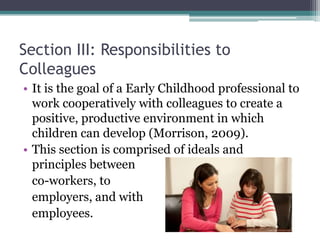
• It is the goal of a Early Childhood professional to
  work cooperatively with colleagues to create a
  positive, productive environment in which
  children can develop (Morrison, 2009).
• This section is comprised of ideals and
  principles between
  co-workers, to
  employers, and with
  employees.
Section III: Cont.
• The following are a few examples of ideas and
  principles in this section:
  ▫ I-3A.1: To establish and maintain relationships of
    respect, trust, confidentiality, collaboration, and
    cooperation with co-workers.
  ▫ P-3A.1: We shall recognize the contributions of
    colleagues to our program and not participate in
    practices that diminish their reputations or impair
    their effectiveness in working with children and
    families.
  ▫ I-3B.1:To assist the program in providing the highest
    quality of service.
Section III: Cont.
 ▫ P-3B.1:We shall follow all program policies. When
   we do not agree with program policies, we shall
   attempt to effect change through constructive
   action within the organization.
 ▫ I-3C.4: To encourage and support continual
   development of employees in becoming more
   skilled and knowledgeable practitioners.
 ▫ P-3C.1: In decisions concerning children and
   programs, we shall draw upon the education,
   training, experience, and expertise of staff
   members.
Section IV: Responsibility to
Community and Society
• Programs operate within the context of a larger
  community. It is the professionals job to offer
  services that meet the needs of the community
  members (Morrison, 2009).
• This section is divided in to individual and
  collective (group) ideals and principles.
Section IV: Cont.
• The following are a few examples of ideas and
  principles in this section:
 ▫ I-4.: To provide the community with high-quality
   early childhood care and education programs and
   services.
 ▫ P-4.1: We shall communicate openly and
   truthfully about the nature and extent of services
   that we provide.
The Finishing Touch
• The core values outline the foundational beliefs of
  the code.
• The code is concluded with a Statement of
  Commitment which reads as a oath to be taken by
  professionals in the field.
• NAEYC includes a glossary of terms that are used
  throughout the document for clarification.
• The NAEYC Code of Ethical Conduct can be found at
  the following website:
  http://faculty.weber.edu/tlday/2610/code05.pdf
Ethical Conduct Scenarios
Bibliography
Crapo, Wendy. (2003, June 27). Positive
 Guidance. Retrieved from
 http://www.uen.org/Lessonplan/preview.cgi?L
 Pid=4948
Morrison, George. (2009). Early Childhood
 Education Today. Upper Saddle River, New
 Jersey: Pearson.
Reynolds, Eleanor. (2008). Guiding Young
 Children. New York, New York: McGraw Hill.

Positive Guidance & NAEYC Code of Ethics Presentation

  • 1.
    Positive guidance &NAEYC Code of Ethics Staff Development Presentation Susan Parsons, Jennifer Hill, & Mary Fowler April 5, 2011
  • 2.
  • 3.
    What comes tomind? Discipline Guidance
  • 4.
    Positive Guidance Definitions •Discipline- punishment inflicted by way of correction and training; to bring to a state of order and obedience by training and control • Guidance- a type of framework in which children can learn acceptable social practices and ways to express their feelings • Problem Solving- a set of principles and concepts that equip an adult to help and support children as they solve their own problems
  • 5.
    The Problem SolvingApproach • The Problem Solving Approach adapted from Guiding Young Children embodies five major measures: active listening, negotiation, setting limits, modifying the environment, and affirmations (Reynolds, 2008).
  • 6.
    Active Listening • Thefirst step in most problem solving activities, active listening is the teacher’s tool for interpreting a child’s feelings. A child will be better able to face his feelings regarding the problem if he feels he is able to express them and “someone will understand and accept him” (Reynolds, 2008). Active listening is the process of listening for feelings, interpreting them, and reflecting them back to the child.
  • 7.
    Negotiation • During negotiationsit is the teachers job to help the children identify the problem, discuss ideas for a mutually acceptable solution, decide on the best solution, and supervise the implementation of the solution (Reynolds, 2008).
  • 8.
    Setting Limits • Limitsare flexible boundaries that can be negotiable, in contrast to rules which are absolute and rigid. Limits are set based on four major considerations. 1. “To ensure the safety of each child and adult.” 2. “To prohibit the destruction of nondisposable materials and equipment.” 3. “To ensure that children accept responsibility for their own actions.” 4. “To ensure equal and respectful treatment of all people” (Reynolds, 2008).
  • 9.
    Modifying the Environment •Modifying the environment can be the simplest form of problem solving. Successful teachers adjust the learning environment to prevent problems. This includes simplifying, childproofing, and limiting children's surrounding (Reynolds, 2008).
  • 10.
    Affirmations • An affirmationis a way in which a teacher makes a child feel important. Every child needs to be acknowledged and affirmations are a positive way to do that. Actions (whether positive or negative ) that are acknowledged will be increased.
  • 11.
    Other Positive GuidanceTechniques • Redirecting- Redirecting a child’s attention to another toy or activity that is more acceptable. • Reasoning- Explain to the children the consequences of their actions on other people and the purpose for obeying rules. • Modeling- It is vital that adults model the type of behaviors they desire in children. This teaches children how to deal with conflicts, cooperate, etc.
  • 12.
    • Offer Choices-Children like to have some control over what happens to them. Offer children good choices that are appropriate and then accept their decision. • Acceptable Outlets for Expressing Feelings- Children need to express strong feelings, but help them find safe ways to do this. • Avoid Overstimulation- Too many choices and options overwhelm children. Allow them an appropriate number of choices. • Avoid Unrealistic Expectations- It is important that the teacher understand the skills and abilities of children.
  • 13.
    • Natural andLogical Consequences- Actions result in consequences whether negative or positive. If the consequences are not too sever, let natural consequences happen. If not, create a consequence that is logical and appropriate for the behavior. • Age Appropriate Activities- Activities and equipment that are relevant and safe for the age of the child promote growth and development (Crapo, 2003).
  • 14.
  • 15.
  • 16.
    About the Code •The National Association for the Education of Young Children developed a code, that was revised in 2005, to help guide the thinking of professionals in the field of Early Childhood. • The Code of Ethical Conduct outlines both ideals and principles for professionals working with four primary service groups: children, families, colleagues, and the community (Morrison, 2009). • The body of the code is hemmed in by core values and a statement of commitment.
  • 17.
    Section I: Responsibilitiesto Children • A professional in the field must value childhood as a unique stage in life in which children need healthy, responsive, nurturing care (Morrison, 2009). • The following are a few examples of ideas and principles in this section: ▫ I-1.3: To recognize and respect the unique qualities, abilities, and potential of each child. ▫ P-1.2: We shall care for and educate children in positive emotional and social environments that are cognitively stimulating and that support each child’s culture, language, ethnicity, and family structure.
  • 18.
    Section II: Responsibilitiesto Families • Families have a large influence in a child’s development. Professionals must work closely with the family towards a mutual goal of providing good, quality childcare (Morrison, 2009). • The following are a few examples of ideas and principles in this section: ▫ I-2.2: To develop relationships of mutual trust and create partnerships with the families we serve. ▫ P-2.3: We shall inform families of and, when appropriate, involve them in policy decisions.
  • 19.
    Section III: Responsibilitiesto Colleagues • It is the goal of a Early Childhood professional to work cooperatively with colleagues to create a positive, productive environment in which children can develop (Morrison, 2009). • This section is comprised of ideals and principles between co-workers, to employers, and with employees.
  • 20.
    Section III: Cont. •The following are a few examples of ideas and principles in this section: ▫ I-3A.1: To establish and maintain relationships of respect, trust, confidentiality, collaboration, and cooperation with co-workers. ▫ P-3A.1: We shall recognize the contributions of colleagues to our program and not participate in practices that diminish their reputations or impair their effectiveness in working with children and families. ▫ I-3B.1:To assist the program in providing the highest quality of service.
  • 21.
    Section III: Cont. ▫ P-3B.1:We shall follow all program policies. When we do not agree with program policies, we shall attempt to effect change through constructive action within the organization. ▫ I-3C.4: To encourage and support continual development of employees in becoming more skilled and knowledgeable practitioners. ▫ P-3C.1: In decisions concerning children and programs, we shall draw upon the education, training, experience, and expertise of staff members.
  • 22.
    Section IV: Responsibilityto Community and Society • Programs operate within the context of a larger community. It is the professionals job to offer services that meet the needs of the community members (Morrison, 2009). • This section is divided in to individual and collective (group) ideals and principles.
  • 23.
    Section IV: Cont. •The following are a few examples of ideas and principles in this section: ▫ I-4.: To provide the community with high-quality early childhood care and education programs and services. ▫ P-4.1: We shall communicate openly and truthfully about the nature and extent of services that we provide.
  • 24.
    The Finishing Touch •The core values outline the foundational beliefs of the code. • The code is concluded with a Statement of Commitment which reads as a oath to be taken by professionals in the field. • NAEYC includes a glossary of terms that are used throughout the document for clarification. • The NAEYC Code of Ethical Conduct can be found at the following website: http://faculty.weber.edu/tlday/2610/code05.pdf
  • 25.
  • 26.
    Bibliography Crapo, Wendy. (2003,June 27). Positive Guidance. Retrieved from http://www.uen.org/Lessonplan/preview.cgi?L Pid=4948 Morrison, George. (2009). Early Childhood Education Today. Upper Saddle River, New Jersey: Pearson. Reynolds, Eleanor. (2008). Guiding Young Children. New York, New York: McGraw Hill.

Editor's Notes

  • #5 Before we begin to discuss positive guidance we need to become familiar with the terms and how they are used in relation to our profession. While the term discipline does not a negative connotation, it has been corrupted by years of misuse. It is not the word, but rather the idea behind it, that we are attempting to combat. So whether you discipline or guide children, it should be with their best interest in mind. It should be used to teach children rather than punish them for their behaviors.
  • #9 Once again this is a case of terms that can be interchanged. The purpose of limits is to flexible and allow for individual consideration. Limits or rules, whichever you choose, should be used with the child/children’s best interest in mind.
  • #21 3A is responsibilities to co-workers. 3B is responsibilities to employers. 3C is responsibilities to employees.