The Concept Of Developmental
Tasks
The term developmental task was introduced
by Robert Havighurst in 1950’s.
R.H.havighhurst (1953) has stated: “a
development task is a task which arise at or
about a certain period in the life of the
individual, successful achievement of which leads
to his happiness and to success with later tasks,
while failure leads to unhappiness and difficulty
with later task.
Characteristics Of Developmental
Task
 Developmental tasks are based on the aspirations
and need of the society.
 Every society or culture has certain norms.
 Every society expects its members to follow
these norms. These norms are in terms of certain
essential skills. Mastery over these skills leads to
happiness and failure leads to unhappiness.
 Some tasks are same for everyone, regardless of
where he lives as they are about human biology.
(continue)
Characteristics Of Developmental
Tasks
Example : learning to crawl and walk.
 Some tasks are different in different
societies. Example: tasks of getting
occupation in some cultures at very
young stage.
 The tasks in different age levels depend
up on the person and the society he lives
in.
HAVIGHURST HAS IDENTIFIED SIX
MAJOR AGE PERIODS:
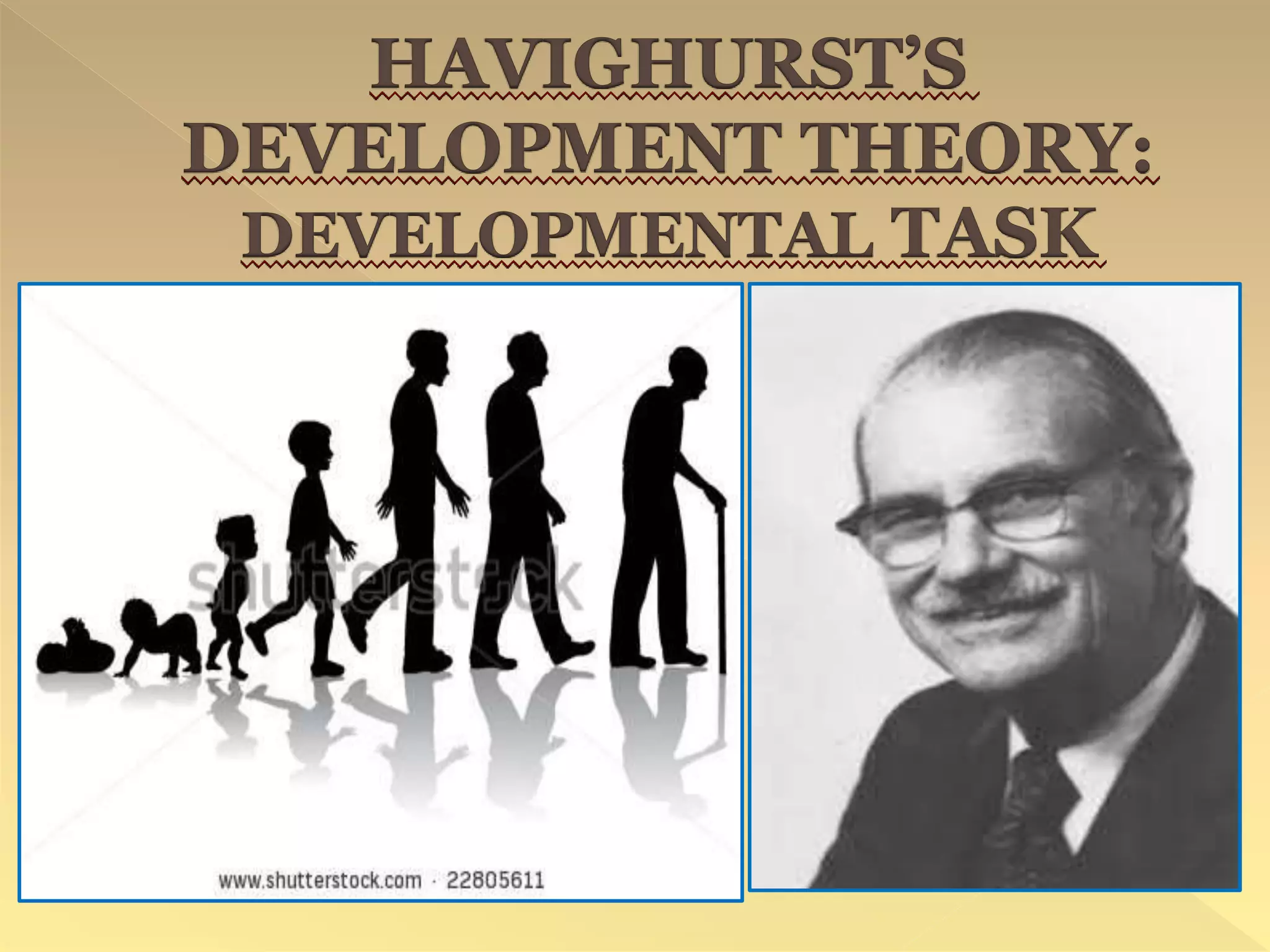
 Infancy and Early childhood(0-5 years)
 Middle childhood(6-12 years)
 Adolescence (13-18 years)
 Early adulthood(19-29 years)
 Middle age(30-60 years)
 Later maturity(61 years and above)
Developmental Tasks In Various
Stages
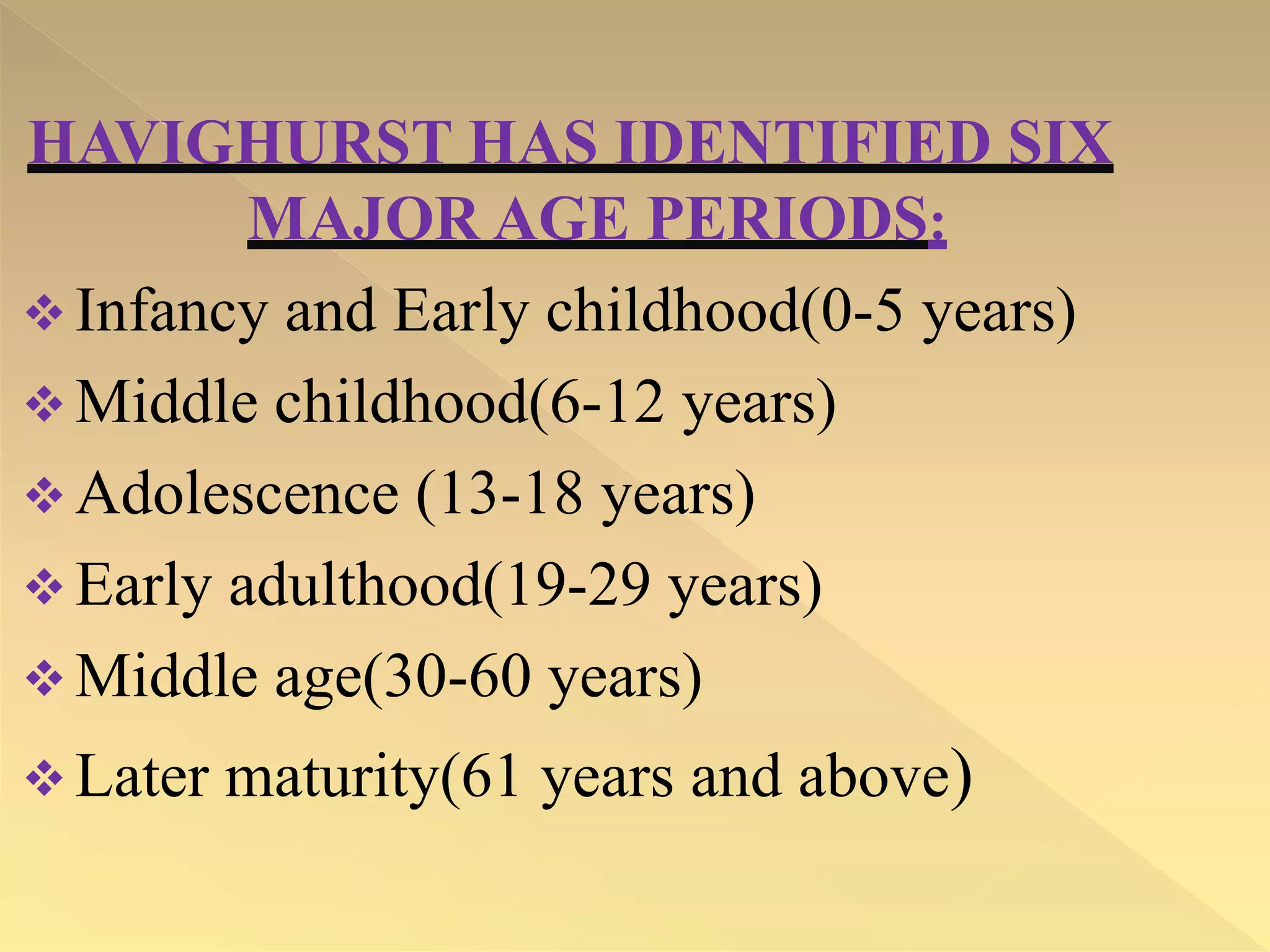
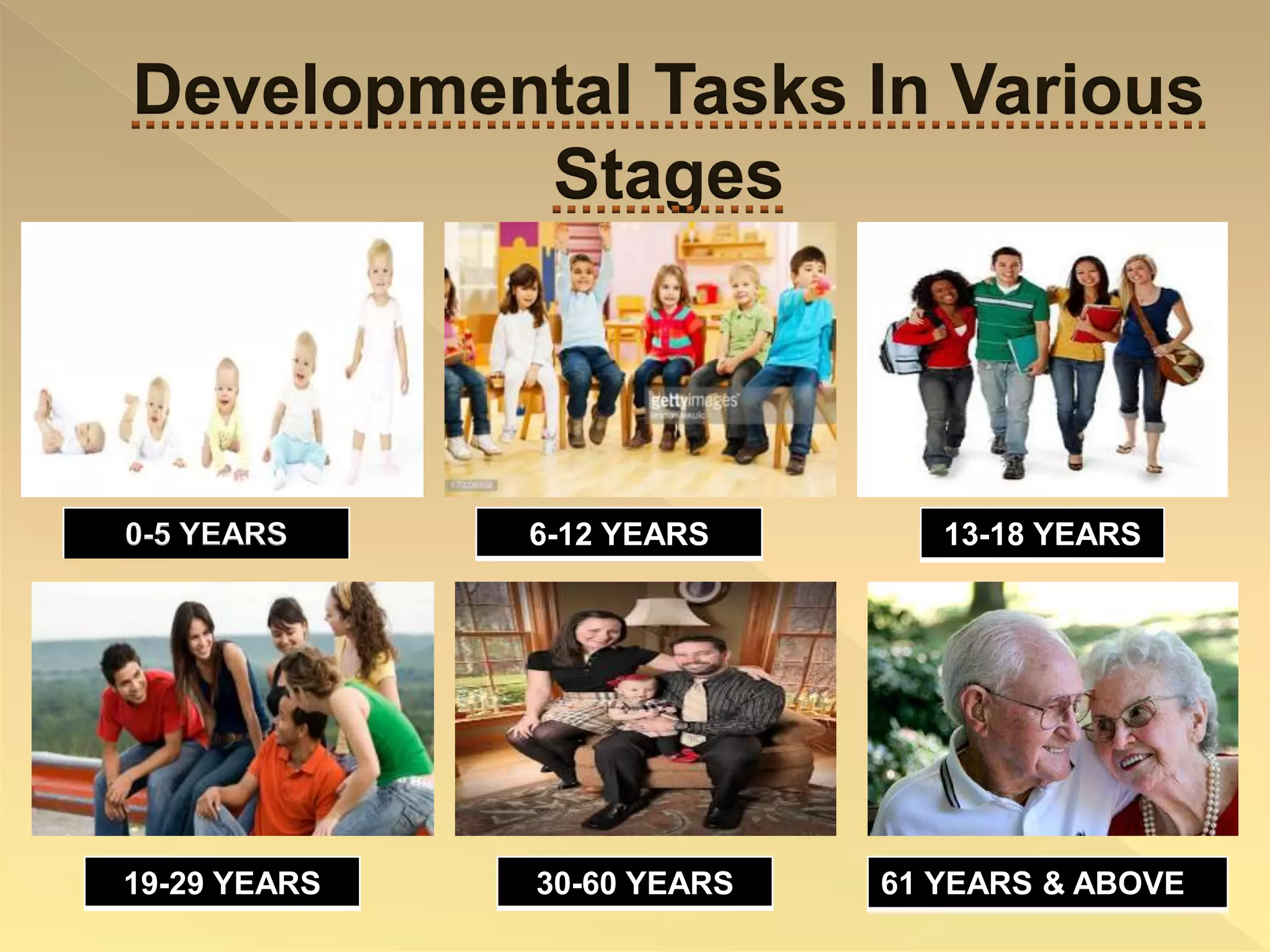
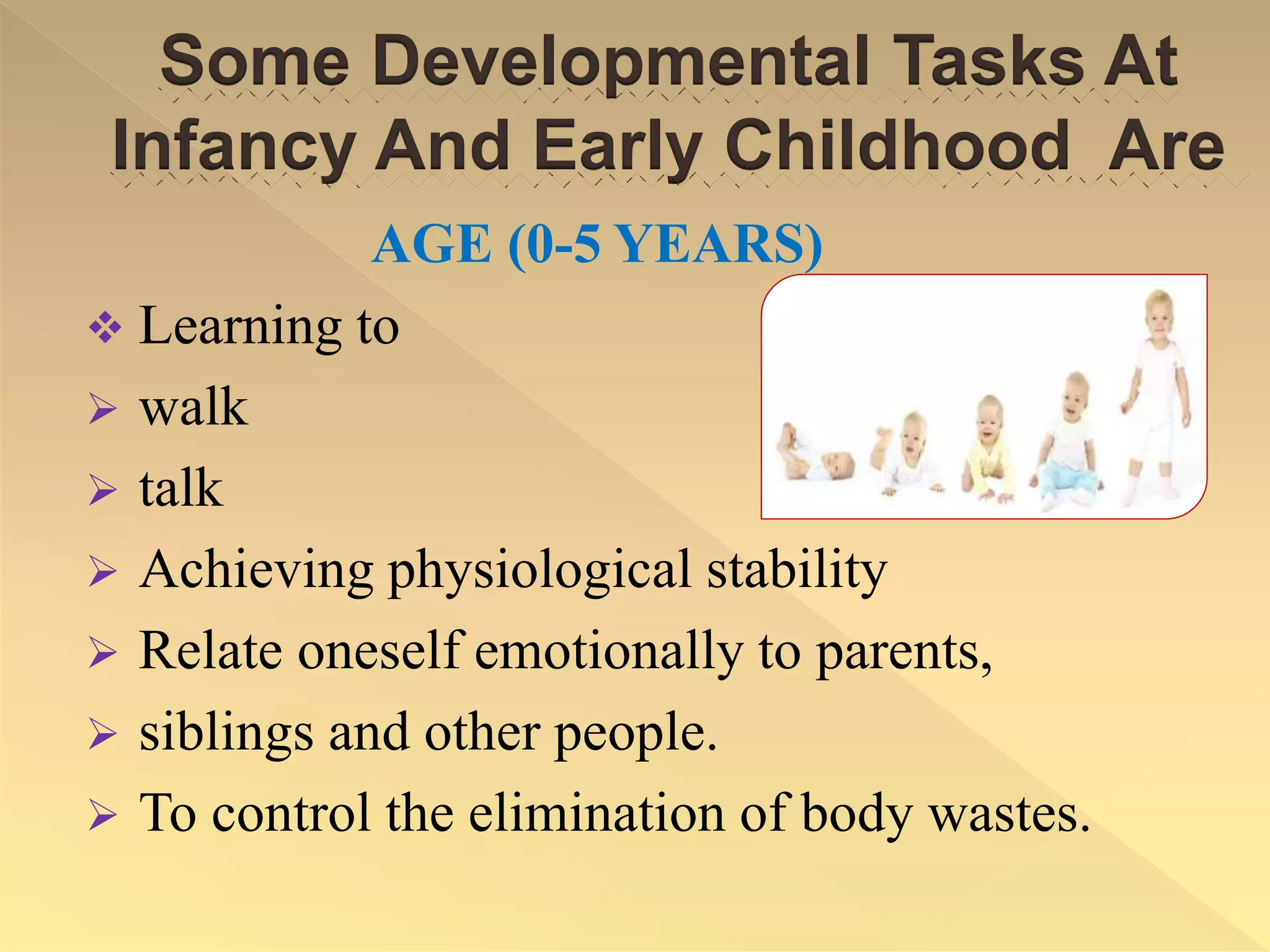
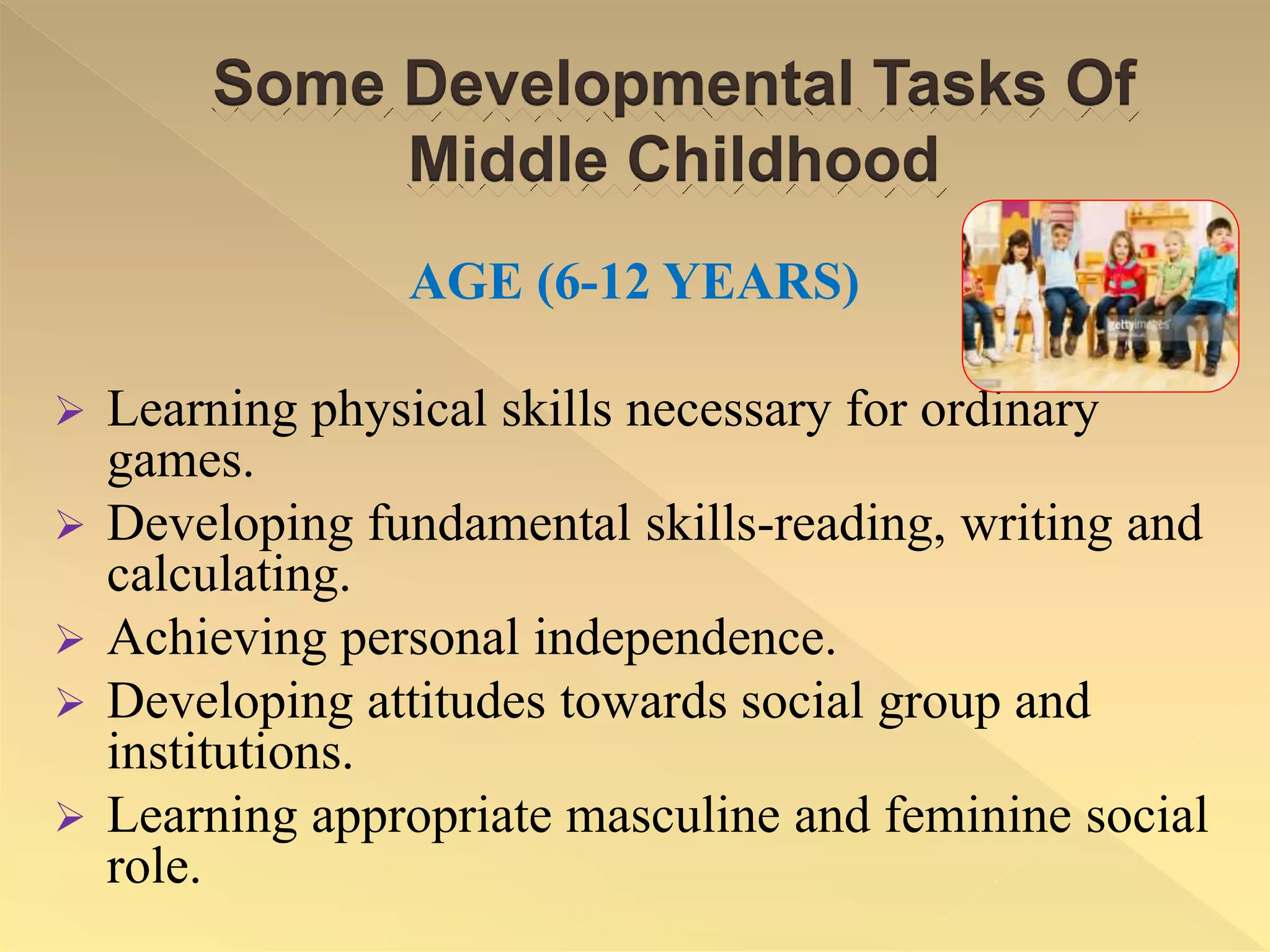
0-5 YEARS 6-12 YEARS 13-18 YEARS
19-29 YEARS 30-60 YEARS 61 YEARS & ABOVE
Some Developmental Tasks At
Infancy And Early Childhood Are
AGE (0-5 YEARS)
 Learning to
 walk
 talk
 Achieving physiological stability
 Relate oneself emotionally to parents,
 siblings and other people.
 To control the elimination of body wastes.
Some Developmental Tasks Of
Middle Childhood
AGE (6-12 YEARS)
 Learning physical skills necessary for ordinary
games.
 Developing fundamental skills-reading, writing and
calculating.
 Achieving personal independence.
 Developing attitudes towards social group and
institutions.
 Learning appropriate masculine and feminine social
role.
Some Developmental Tasks Of
Adolescence
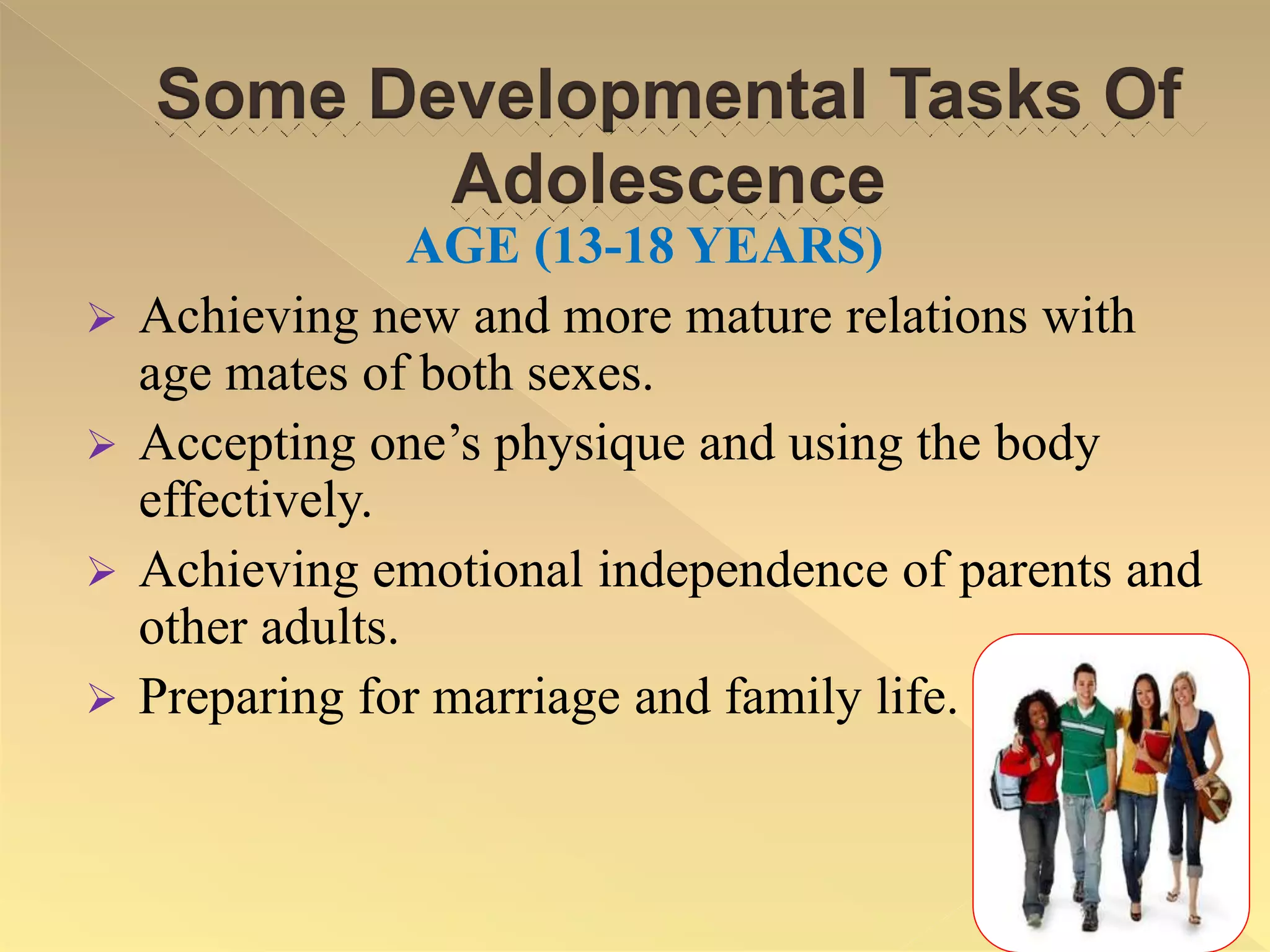
AGE (13-18 YEARS)
 Achieving new and more mature relations with
age mates of both sexes.
 Accepting one’s physique and using the body
effectively.
 Achieving emotional independence of parents and
other adults.
 Preparing for marriage and family life.
Some Developmental Tasks Of
Early Adulthood
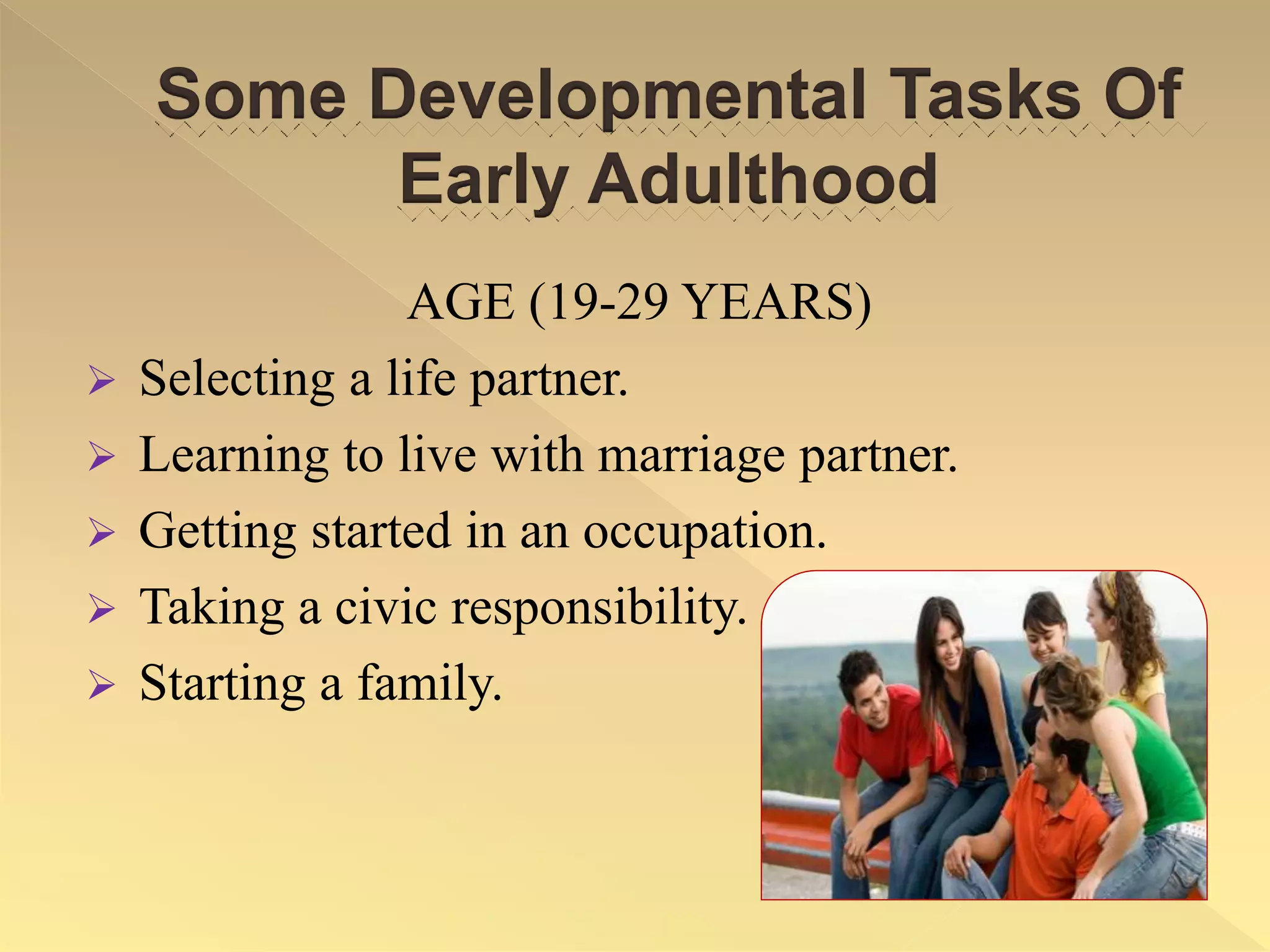
AGE (19-29 YEARS)
 Selecting a life partner.
 Learning to live with marriage partner.
 Getting started in an occupation.
 Taking a civic responsibility.
 Starting a family.
Some Developmental Tasks Of
Middle Age
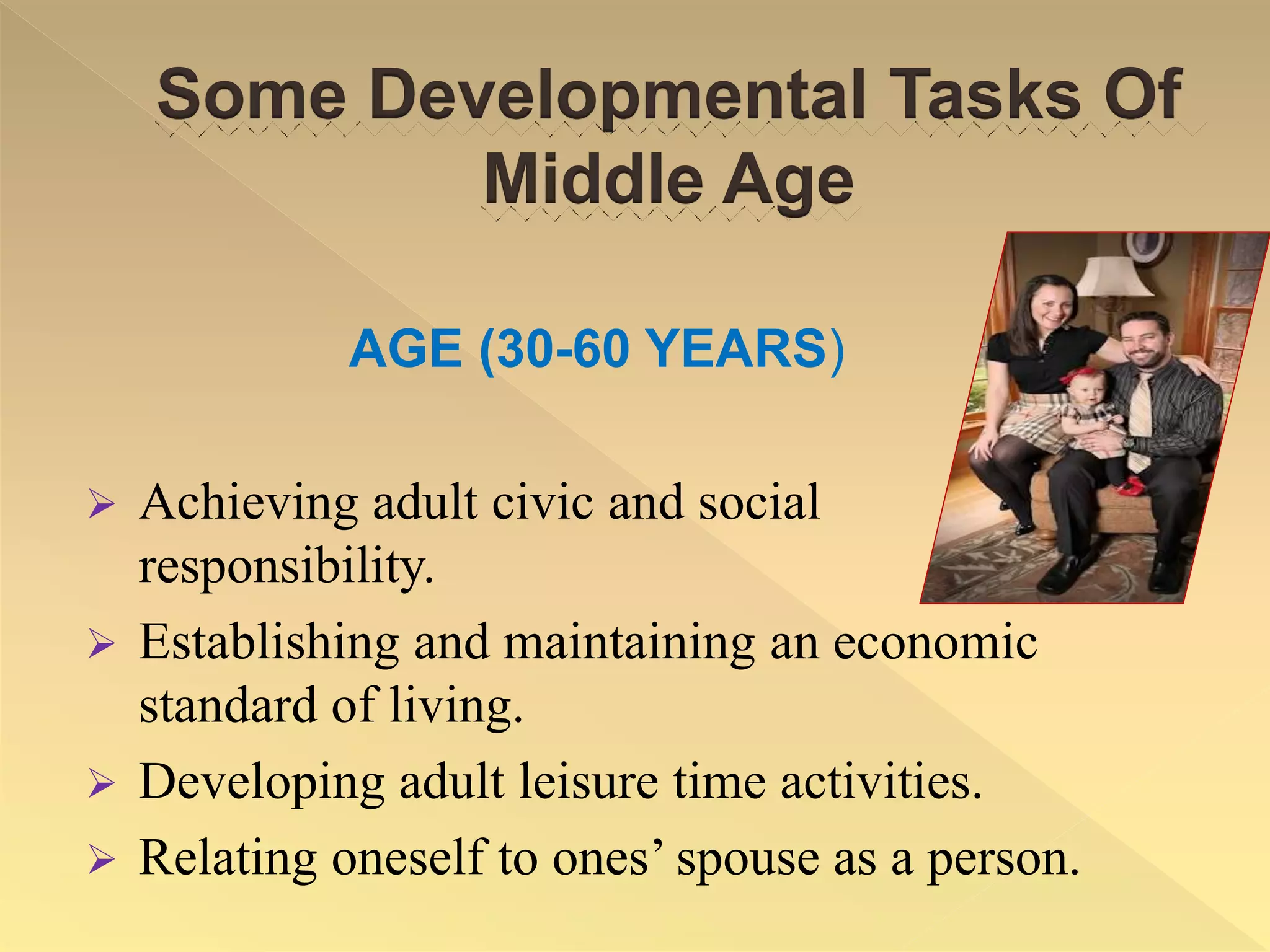
AGE (30-60 YEARS)
 Achieving adult civic and social
responsibility.
 Establishing and maintaining an economic
standard of living.
 Developing adult leisure time activities.
 Relating oneself to ones’ spouse as a person.
Some Developmental Tasks Of
Later Maturity
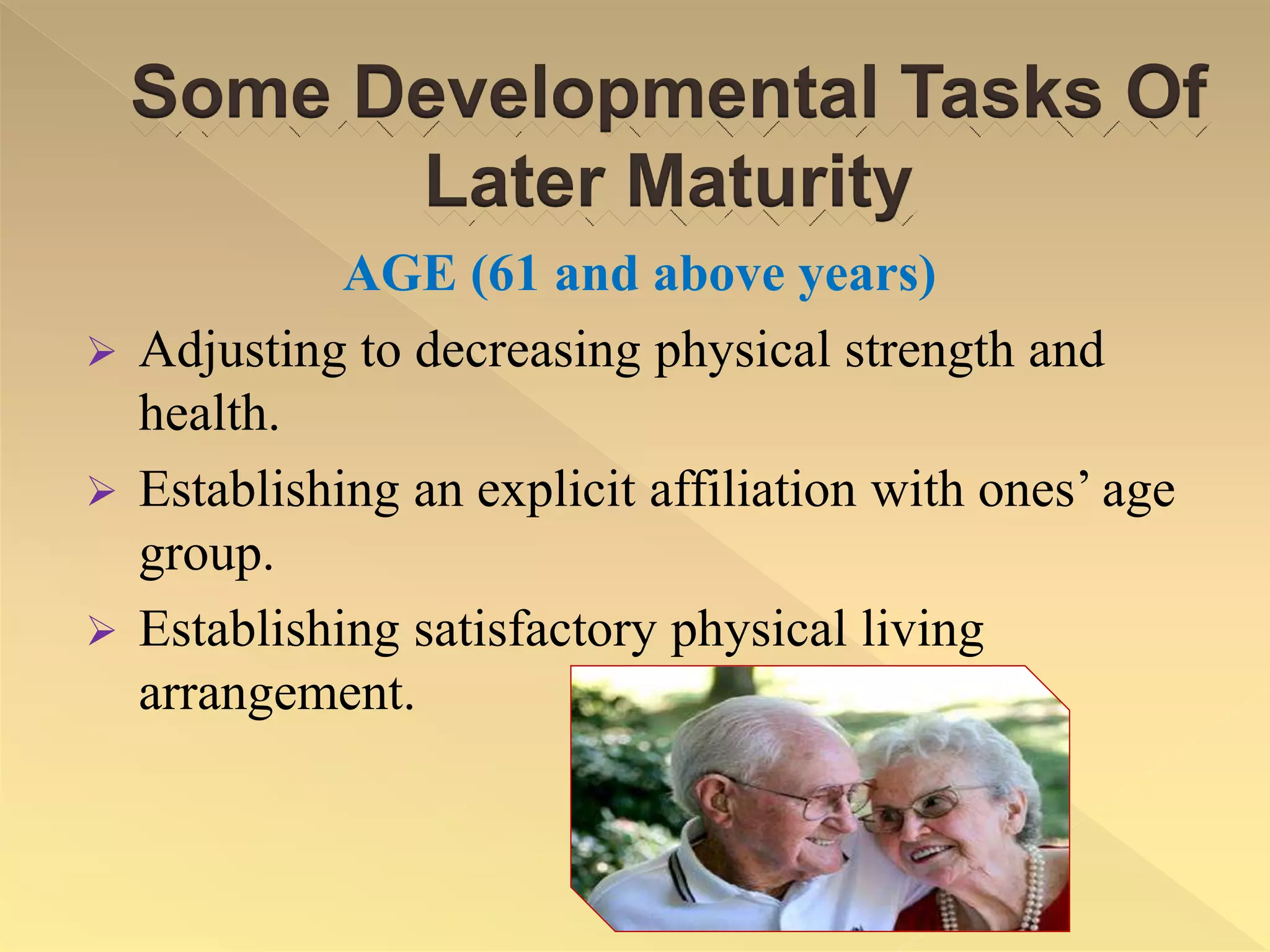
AGE (61 and above years)
 Adjusting to decreasing physical strength and
health.
 Establishing an explicit affiliation with ones’ age
group.
 Establishing satisfactory physical living
arrangement.
Havighurst’s development theory

Havighurst’s development theory

  • 4.
    The Concept OfDevelopmental Tasks The term developmental task was introduced by Robert Havighurst in 1950’s. R.H.havighhurst (1953) has stated: “a development task is a task which arise at or about a certain period in the life of the individual, successful achievement of which leads to his happiness and to success with later tasks, while failure leads to unhappiness and difficulty with later task.
  • 5.
    Characteristics Of Developmental Task Developmental tasks are based on the aspirations and need of the society.  Every society or culture has certain norms.  Every society expects its members to follow these norms. These norms are in terms of certain essential skills. Mastery over these skills leads to happiness and failure leads to unhappiness.  Some tasks are same for everyone, regardless of where he lives as they are about human biology. (continue)
  • 6.
    Characteristics Of Developmental Tasks Example: learning to crawl and walk.  Some tasks are different in different societies. Example: tasks of getting occupation in some cultures at very young stage.  The tasks in different age levels depend up on the person and the society he lives in.
  • 7.
    HAVIGHURST HAS IDENTIFIEDSIX MAJOR AGE PERIODS:  Infancy and Early childhood(0-5 years)  Middle childhood(6-12 years)  Adolescence (13-18 years)  Early adulthood(19-29 years)  Middle age(30-60 years)  Later maturity(61 years and above)
  • 8.
    Developmental Tasks InVarious Stages 0-5 YEARS 6-12 YEARS 13-18 YEARS 19-29 YEARS 30-60 YEARS 61 YEARS & ABOVE
  • 9.
    Some Developmental TasksAt Infancy And Early Childhood Are AGE (0-5 YEARS)  Learning to  walk  talk  Achieving physiological stability  Relate oneself emotionally to parents,  siblings and other people.  To control the elimination of body wastes.
  • 10.
    Some Developmental TasksOf Middle Childhood AGE (6-12 YEARS)  Learning physical skills necessary for ordinary games.  Developing fundamental skills-reading, writing and calculating.  Achieving personal independence.  Developing attitudes towards social group and institutions.  Learning appropriate masculine and feminine social role.
  • 11.
    Some Developmental TasksOf Adolescence AGE (13-18 YEARS)  Achieving new and more mature relations with age mates of both sexes.  Accepting one’s physique and using the body effectively.  Achieving emotional independence of parents and other adults.  Preparing for marriage and family life.
  • 12.
    Some Developmental TasksOf Early Adulthood AGE (19-29 YEARS)  Selecting a life partner.  Learning to live with marriage partner.  Getting started in an occupation.  Taking a civic responsibility.  Starting a family.
  • 13.
    Some Developmental TasksOf Middle Age AGE (30-60 YEARS)  Achieving adult civic and social responsibility.  Establishing and maintaining an economic standard of living.  Developing adult leisure time activities.  Relating oneself to ones’ spouse as a person.
  • 14.
    Some Developmental TasksOf Later Maturity AGE (61 and above years)  Adjusting to decreasing physical strength and health.  Establishing an explicit affiliation with ones’ age group.  Establishing satisfactory physical living arrangement.