

Case Study Scenarios for Discussion Board Some of these scenarios are to be discussed in the week one discussion in Blackboard. From NAEYC
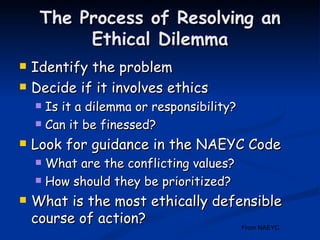
The Process of Resolving an Ethical Dilemma Identify the problem Decide if it involves ethics Is it a dilemma or responsibility? Can it be finessed? Look for guidance in the NAEYC Code What are the conflicting values? How should they be prioritized? What is the most ethically defensible course of action? From NAEYC
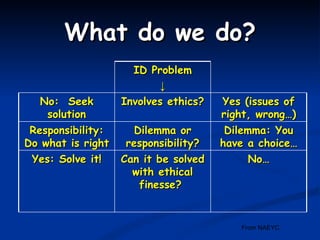
What do we do? From NAEYC  ID Problem ↓ No:  Seek solution Involves ethics? Yes (issues of right, wrong…) Responsibility: Do what is right Dilemma or responsibility? Dilemma: You have a choice… Yes: Solve it! Can it be solved with ethical finesse?  No…
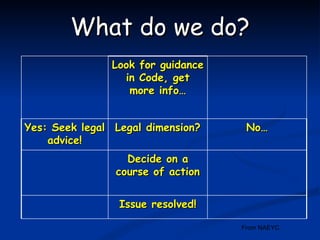
What do we do? From NAEYC  Look for guidance in Code, get more info… Yes: Seek legal advice! Legal dimension? No… Decide on a course of action Issue resolved!
So, How Can the Code Be Used in Real-Life Situations From NAEYC
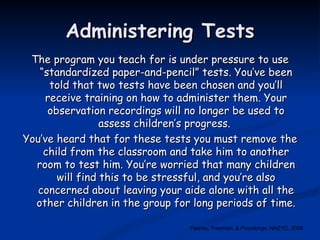
Administering Tests The program you teach for is under pressure to use “standardized paper-and-pencil” tests. You’ve been told that two tests have been chosen and you’ll receive training on how to administer them. Your observation recordings will no longer be used to assess children’s progress.  You’ve heard that for these tests you must remove the child from the classroom and take him to another room to test him. You’re worried that many children will find this to be stressful, and you’re also concerned about leaving your aide alone with all the other children in the group for long periods of time. Feeney, Freeman, & Pizzolongo, NAEYC, 2008
Administering Tests What should an early childhood professional do? Brainstorm Ideas
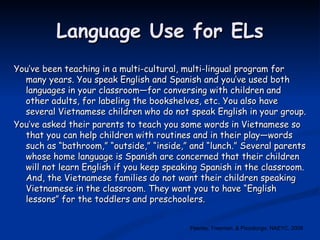
Language Use for ELs You’ve been teaching in a multi-cultural, multi-lingual program for many years. You speak English and Spanish and you’ve used both languages in your classroom—for conversing with children and other adults, for labeling the bookshelves, etc. You also have several Vietnamese children who do not speak English in your group.  You’ve asked their parents to teach you some words in Vietnamese so that you can help children with routines and in their play—words such as “bathroom,” “outside,” “inside,” and “lunch.” Several parents whose home language is Spanish are concerned that their children will not learn English if you keep speaking Spanish in the classroom. And, the Vietnamese families do not want their children speaking Vietnamese in the classroom. They want you to have “English lessons” for the toddlers and preschoolers. Feeney, Freeman, & Pizzolongo, NAEYC, 2008
Language Use for ELs What should an early childhood professional do? Brainstorm Ideas
Child’s Behavior A parent in our program has deep Biblical values and believes in "sparing the rod, spoiling the child." Her child who is almost two years old has been consistently hitting other children in your group. When you shared with her other alternatives to disciplining at home visits, she responded by saying, "I only listen to my pastor.“ What should an early childhood professional do? Feeney, Freeman, & Pizzolongo, NAEYC, 2008
Parent Request A parent calls to express concern that her three-year-old daughter is permitted to walk the short distance to the bathroom without an adult accompanying and waiting for her. You reassure her that the security in your center is good, but she insists that her child must be individually escorted to the bathroom. What should an early childhood professional do? Feeney, Freeman, & Pizzolongo, NAEYC, 2008
Parent Criticizes  Nearby Preschool Families who previously had children enrolled in a nearby preschool have told you stories of what happened to their children in that center. They describe dirty sheets on the cots, harsh punishments including withholding food, and ratios of twenty children to one adult. One day you drive by and see a lot covered with asphalt and dry grass. There are a few rusting pieces of playground equipment. Several children are standing along the chain link fence looking at the cars going by. There are no adults in sight. What should an early childhood professional do? Feeney, Freeman, & Pizzolongo, NAEYC, 2008
Standardized Testing Your program uses a standardized test for assessing children’s progress. You’ve been given a copy of the test and told that you must drill children on these items throughout the year so that they all will do well on the test. What should an early childhood professional do? Feeney, Freeman, & Pizzolongo, NAEYC, 2008
Tuition Policy The mother of a child in your school is a single parent. She has fallen behind on her tuition payments and is currently 2 months in arrears. She was arrested on drug charges about a month ago. Right now she is in jail trying to make bail. The child is staying with the maternal grandmother who works and brings him to the center. Several families are waiting for a space in the center. They are financially qualified and anxious for their children to be enrolled. Should the center’s policy for prompt payment of tuition be disregarded, upheld, or revised? What should an early childhood professional do? Feeney, Freeman, & Pizzolongo, NAEYC, 2008
The Sibling Rule A parent asks if he can bring a young sibling to a parent workshop even though there is a policy that younger siblings should not be brought to school. You have had problems with parents violating the no sibling rule but you also think this parent could benefit greatly from the content of the workshop. What should an early childhood professional do? Feeney, Freeman, & Pizzolongo, NAEYC, 2008
The Abused Child Mary Lou, a three-year-old in your center, is showing several signs of possible abuse: multiple bruises, frequent black eyes, and psychological withdrawal.  Her mother, a high-strung woman, says Mary Lou falls a lot, but nobody at the center has seen the child do this.  On two occasions, the child’s father appeared to be drunk when he picked her up.  The law says you are a mandated reporter who must report suspicions of child abuse to Child Protective Services, But in your experience, when the authorities get involved they are usually unable to remove the child from the home or improve the family’s behavior.  Sometimes the families simply disappear, or things become worse for the children. Koralek, Dodge, & Pizzolongo (2000). p. 335
The Abused Child What should an early childhood professional do? Brainstorm Ideas
The Working Mother Timothy’s mother has asked you not to allow her four-year-old son to nap in the afternoon.  She says, “Whenever he naps he stays up until 10:00 at night.  I have to get up at 5:00 in the morning to go to work.  I am not getting enough sleep.”  Along with the rest of the  children, Timothy takes a one-hour nap almost every day.  He seems to need it in order to stay in good spirits in the afternoon. Koralek, Dodge, & Pizzolongo (2000). p. 335.
What should an early childhood professional do? Brainstorm Ideas The Working Mother
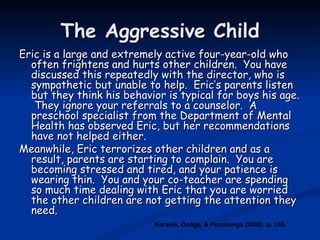
The Aggressive Child Eric is a large and extremely active four-year-old who often frightens and hurts other children.  You have discussed this repeatedly with the director, who is sympathetic but unable to help.  Eric’s parents listen but they think his behavior is typical for boys his age.  They ignore your referrals to a counselor.  A preschool specialist from the Department of Mental Health has observed Eric, but her recommendations have not helped either.  Meanwhile, Eric terrorizes other children and as a result, parents are starting to complain.  You are becoming stressed and tired, and your patience is wearing thin.  You and your co-teacher are spending so much time dealing with Eric that you are worried the other children are not getting the attention they need. Koralek, Dodge, & Pizzolongo (2000). p. 336.
What should an early childhood professional do? Brainstorm Ideas The Aggressive Child
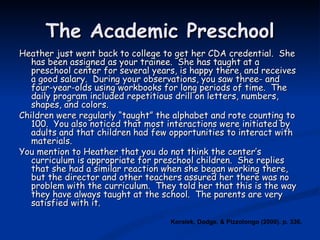
The Academic Preschool Heather just went back to college to get her CDA credential.  She has been assigned as your trainee.  She has taught at a preschool center for several years, is happy there, and receives a good salary.  During your observations, you saw three- and four-year-olds using workbooks for long periods of time.  The daily program included repetitious drill on letters, numbers, shapes, and colors.  Children were regularly “taught” the alphabet and rote counting to 100.  You also noticed that most interactions were initiated by adults and that children had few opportunities to interact with materials. You mention to Heather that you do not think the center’s curriculum is appropriate for preschool children.  She replies that she had a similar reaction when she began working there, but the director and other teachers assured her there was no problem with the curriculum.  They told her that this is the way they have always taught at the school.  The parents are very satisfied with it. Koralek, Dodge, & Pizzolongo (2000). p. 336.
What should an early childhood professional do? Brainstorm Ideas The Academic Preschool
Resources NAEYC General Session on the Code of Ethics Powerpoint –  www.naeyc.org/files/naeyc/file/ecprofessional/EthicsCodeGeneralSession.ppt   NAEYC Code of Ethics Position Statements http://www.naeyc.org/positionstatements/ethical_conduct NAEYC Professional Ethics CasesFeeney, S., Freeman, N., & Pizzolongo, P. J. (2008)  Koralek, D.G., Dodge, D.T., & Pizzolongo, P.J. (2000). Caring for Preschool Children, Vol. II. 2nd Ed. Teaching Strategies, Washington D.C. pp. 335-336. naeyc

Ethics case studies

  • 1.
    Case Study Scenariosfor Discussion Board Some of these scenarios are to be discussed in the week one discussion in Blackboard. From NAEYC
  • 2.
    The Process ofResolving an Ethical Dilemma Identify the problem Decide if it involves ethics Is it a dilemma or responsibility? Can it be finessed? Look for guidance in the NAEYC Code What are the conflicting values? How should they be prioritized? What is the most ethically defensible course of action? From NAEYC
  • 3.
    What do wedo? From NAEYC ID Problem ↓ No: Seek solution Involves ethics? Yes (issues of right, wrong…) Responsibility: Do what is right Dilemma or responsibility? Dilemma: You have a choice… Yes: Solve it! Can it be solved with ethical finesse? No…
  • 4.
    What do wedo? From NAEYC Look for guidance in Code, get more info… Yes: Seek legal advice! Legal dimension? No… Decide on a course of action Issue resolved!
  • 5.
    So, How Canthe Code Be Used in Real-Life Situations From NAEYC
  • 6.
    Administering Tests Theprogram you teach for is under pressure to use “standardized paper-and-pencil” tests. You’ve been told that two tests have been chosen and you’ll receive training on how to administer them. Your observation recordings will no longer be used to assess children’s progress. You’ve heard that for these tests you must remove the child from the classroom and take him to another room to test him. You’re worried that many children will find this to be stressful, and you’re also concerned about leaving your aide alone with all the other children in the group for long periods of time. Feeney, Freeman, & Pizzolongo, NAEYC, 2008
  • 7.
    Administering Tests Whatshould an early childhood professional do? Brainstorm Ideas
  • 8.
    Language Use forELs You’ve been teaching in a multi-cultural, multi-lingual program for many years. You speak English and Spanish and you’ve used both languages in your classroom—for conversing with children and other adults, for labeling the bookshelves, etc. You also have several Vietnamese children who do not speak English in your group. You’ve asked their parents to teach you some words in Vietnamese so that you can help children with routines and in their play—words such as “bathroom,” “outside,” “inside,” and “lunch.” Several parents whose home language is Spanish are concerned that their children will not learn English if you keep speaking Spanish in the classroom. And, the Vietnamese families do not want their children speaking Vietnamese in the classroom. They want you to have “English lessons” for the toddlers and preschoolers. Feeney, Freeman, & Pizzolongo, NAEYC, 2008
  • 9.
    Language Use forELs What should an early childhood professional do? Brainstorm Ideas
  • 10.
    Child’s Behavior Aparent in our program has deep Biblical values and believes in "sparing the rod, spoiling the child." Her child who is almost two years old has been consistently hitting other children in your group. When you shared with her other alternatives to disciplining at home visits, she responded by saying, "I only listen to my pastor.“ What should an early childhood professional do? Feeney, Freeman, & Pizzolongo, NAEYC, 2008
  • 11.
    Parent Request Aparent calls to express concern that her three-year-old daughter is permitted to walk the short distance to the bathroom without an adult accompanying and waiting for her. You reassure her that the security in your center is good, but she insists that her child must be individually escorted to the bathroom. What should an early childhood professional do? Feeney, Freeman, & Pizzolongo, NAEYC, 2008
  • 12.
    Parent Criticizes Nearby Preschool Families who previously had children enrolled in a nearby preschool have told you stories of what happened to their children in that center. They describe dirty sheets on the cots, harsh punishments including withholding food, and ratios of twenty children to one adult. One day you drive by and see a lot covered with asphalt and dry grass. There are a few rusting pieces of playground equipment. Several children are standing along the chain link fence looking at the cars going by. There are no adults in sight. What should an early childhood professional do? Feeney, Freeman, & Pizzolongo, NAEYC, 2008
  • 13.
    Standardized Testing Yourprogram uses a standardized test for assessing children’s progress. You’ve been given a copy of the test and told that you must drill children on these items throughout the year so that they all will do well on the test. What should an early childhood professional do? Feeney, Freeman, & Pizzolongo, NAEYC, 2008
  • 14.
    Tuition Policy Themother of a child in your school is a single parent. She has fallen behind on her tuition payments and is currently 2 months in arrears. She was arrested on drug charges about a month ago. Right now she is in jail trying to make bail. The child is staying with the maternal grandmother who works and brings him to the center. Several families are waiting for a space in the center. They are financially qualified and anxious for their children to be enrolled. Should the center’s policy for prompt payment of tuition be disregarded, upheld, or revised? What should an early childhood professional do? Feeney, Freeman, & Pizzolongo, NAEYC, 2008
  • 15.
    The Sibling RuleA parent asks if he can bring a young sibling to a parent workshop even though there is a policy that younger siblings should not be brought to school. You have had problems with parents violating the no sibling rule but you also think this parent could benefit greatly from the content of the workshop. What should an early childhood professional do? Feeney, Freeman, & Pizzolongo, NAEYC, 2008
  • 16.
    The Abused ChildMary Lou, a three-year-old in your center, is showing several signs of possible abuse: multiple bruises, frequent black eyes, and psychological withdrawal. Her mother, a high-strung woman, says Mary Lou falls a lot, but nobody at the center has seen the child do this. On two occasions, the child’s father appeared to be drunk when he picked her up. The law says you are a mandated reporter who must report suspicions of child abuse to Child Protective Services, But in your experience, when the authorities get involved they are usually unable to remove the child from the home or improve the family’s behavior. Sometimes the families simply disappear, or things become worse for the children. Koralek, Dodge, & Pizzolongo (2000). p. 335
  • 17.
    The Abused ChildWhat should an early childhood professional do? Brainstorm Ideas
  • 18.
    The Working MotherTimothy’s mother has asked you not to allow her four-year-old son to nap in the afternoon. She says, “Whenever he naps he stays up until 10:00 at night. I have to get up at 5:00 in the morning to go to work. I am not getting enough sleep.” Along with the rest of the children, Timothy takes a one-hour nap almost every day. He seems to need it in order to stay in good spirits in the afternoon. Koralek, Dodge, & Pizzolongo (2000). p. 335.
  • 19.
    What should anearly childhood professional do? Brainstorm Ideas The Working Mother
  • 20.
    The Aggressive ChildEric is a large and extremely active four-year-old who often frightens and hurts other children. You have discussed this repeatedly with the director, who is sympathetic but unable to help. Eric’s parents listen but they think his behavior is typical for boys his age. They ignore your referrals to a counselor. A preschool specialist from the Department of Mental Health has observed Eric, but her recommendations have not helped either. Meanwhile, Eric terrorizes other children and as a result, parents are starting to complain. You are becoming stressed and tired, and your patience is wearing thin. You and your co-teacher are spending so much time dealing with Eric that you are worried the other children are not getting the attention they need. Koralek, Dodge, & Pizzolongo (2000). p. 336.
  • 21.
    What should anearly childhood professional do? Brainstorm Ideas The Aggressive Child
  • 22.
    The Academic PreschoolHeather just went back to college to get her CDA credential. She has been assigned as your trainee. She has taught at a preschool center for several years, is happy there, and receives a good salary. During your observations, you saw three- and four-year-olds using workbooks for long periods of time. The daily program included repetitious drill on letters, numbers, shapes, and colors. Children were regularly “taught” the alphabet and rote counting to 100. You also noticed that most interactions were initiated by adults and that children had few opportunities to interact with materials. You mention to Heather that you do not think the center’s curriculum is appropriate for preschool children. She replies that she had a similar reaction when she began working there, but the director and other teachers assured her there was no problem with the curriculum. They told her that this is the way they have always taught at the school. The parents are very satisfied with it. Koralek, Dodge, & Pizzolongo (2000). p. 336.
  • 23.
    What should anearly childhood professional do? Brainstorm Ideas The Academic Preschool
  • 24.
    Resources NAEYC GeneralSession on the Code of Ethics Powerpoint – www.naeyc.org/files/naeyc/file/ecprofessional/EthicsCodeGeneralSession.ppt NAEYC Code of Ethics Position Statements http://www.naeyc.org/positionstatements/ethical_conduct NAEYC Professional Ethics CasesFeeney, S., Freeman, N., & Pizzolongo, P. J. (2008) Koralek, D.G., Dodge, D.T., & Pizzolongo, P.J. (2000). Caring for Preschool Children, Vol. II. 2nd Ed. Teaching Strategies, Washington D.C. pp. 335-336. naeyc