POPULATION
FORECASTING
Population forecasting is a method by which we
calculate the future population of any city or
region at the interval of n number of decade (10
year) years.
DEFINATION
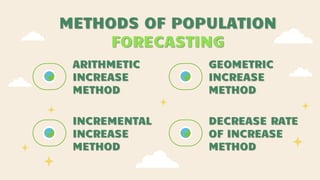
ARITHMETIC
INCREASE
METHOD
METHODS OF POPULATION
FORECASTING
INCREMENTAL
INCREASE
METHOD
GEOMETRIC
INCREASE
METHOD
DECREASE RATE
OF INCREASE
METHOD
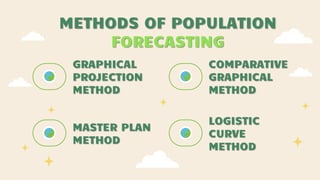
GRAPHICAL
PROJECTION
METHOD
METHODS OF POPULATION
FORECASTING
MASTER PLAN
METHOD
COMPARATIVE
GRAPHICAL
METHOD
LOGISTIC
CURVE
METHOD
01
ARITHMETICAL
INCREASE
METHOD
ARITHMETICAL INCREASE
METHOD
● Simplest method
● This method is Used for calculation of
population of large cities, which having
constant development.
● Not used for small cities, because it
gives lower value.
● In this method we consider that the rate
of change of population (dP/dt = C) of a
city is approximately constant C.
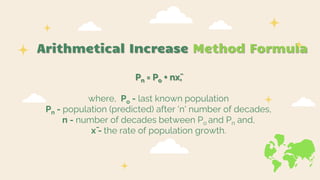
Arithmetical Increase Method Formula
Pn = Po + nx̄,
where, Po - last known population
Pn - population (predicted) after 'n' number of decades,
n - number of decades between Po and Pn and,
x̄ - the rate of population growth.
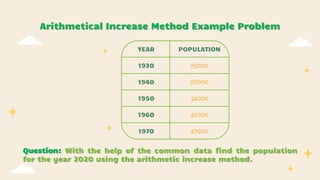
Arithmetical Increase Method Example Problem
YEAR POPULATION
1930 25000
1940 28000
1950 34000
1960 42000
1970 47000
Question: With the help of the common data find the population
for the year 2020 using the arithmetic increase method.
YEAR POPULATION INCREASE
1930 25000 -
1940 28000 3000
1950 34000
1960 42000 8000
1970 47000 5000
SOLUTION:
STEP 1 : Find the increase in population each decade
Step 2: Find the average rate of increase of population
(x̄)
x̄ = (3000+6000+8000+5000)/4
x̄ = 22000/4
x̄ = 5500
Step 3: Find the number of decades (n) between the last
known year and the required year
n = 5 (5 decades elapsed between 1970 and 2020)
Step 4: Apply the formula Pn = Po + nx̄,
P[2020] = P[1970] + (5 * 5500)
P[2020] = 47000 + 27500
P[2020] = 74,500.
Therefore, population at 2020 will be 74,500.
02
GEOMETRICAL
INCREASE
METHOD
GEOMETRICAL INCREASE
METHOD
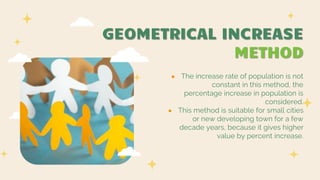
● The increase rate of population is not
constant in this method, the
percentage increase in population is
considered.
● This method is suitable for small cities
or new developing town for a few
decade years, because it gives higher
value by percent increase.
Geometrical Increase Method Formula
Pn = Po[1 + (r/100)]^n,
where, Po - last known population,
Pn - population (predicted) after 'n' number of decades,
n - number of decades between Po and Pn and,
r - growth rate = (increase in population/initial population) * 100 (%).
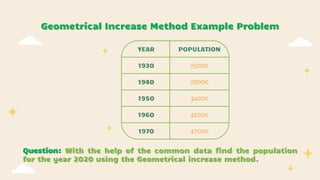
Geometrical Increase Method Example Problem
YEAR POPULATION
1930 25000
1940 28000
1950 34000
1960 42000
1970 47000
Question: With the help of the common data find the population
for the year 2020 using the Geometrical increase method.
YEAR
POPUL
ATION
INCR
EASE
GROWTH RATE
1930 25000 - -
1940 28000 3000
(3000/25000) X 100
= 12%
1950 34000 6000
(6000/28000) X
100= 21.4%
1960 42000 8000
(8000/34000) X
100= 23.5%
1970 47000 5000
(5000/42000) X
100= 11.9%
SOLUTION:
STEP 1 : Find the increase in population each decade and find the
growth rate
Step 3: Find the average growth rate (r) using
geometrical mean.
r = ∜(12 * 21.4 * 23.5 * 11.9)
r = 16.37 %
Step 4: Find the number of decades (n) between
the last known year and the required year
n = 5 (5 decades elapsed between 1970 and
2020)
Step 5: Apply the formula Pn = Po[1 + (r/100)]^n
P[2020] = P[1970][1 + (16.37/100)]^5
P[2020] = 47000[1.1637]^5
P[2020] = 1,00,300.
Therefore, population at 2020 will be 1,00,300.
03
INCREMENTAL
INCREASE
METHOD
INCREMENTAL INCREASE
METHOD
● This method is the combination of
arithmetic increase and incremental
increase method.
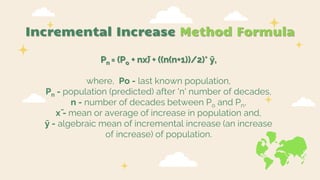
Incremental Increase Method Formula
Pn = (Po + nx̄) + ((n(n+1))/2)* ȳ,
where, Po - last known population,
Pn - population (predicted) after 'n' number of decades,
n - number of decades between Po and Pn,
x̄ - mean or average of increase in population and,
ȳ - algebraic mean of incremental increase (an increase
of increase) of population.
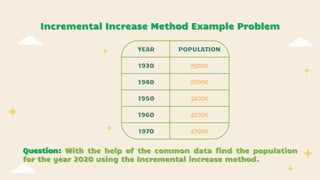
Incremental Increase Method Example Problem
YEAR POPULATION
1930 25000
1940 28000
1950 34000
1960 42000
1970 47000
Question: With the help of the common data find the population
for the year 2020 using the Incremental increase method.
YEAR
POPUL
ATION
INCR
EASE
INCREMENTAL
INCREASE
1930 25000 - -
1940 28000 3000 -
1950 34000 6000
6000-
3000=3000
1960 42000 8000
8000-
6000=2000
1970 47000 5000
5000-8000=
-300
SOLUTION:
STEP 1 : Find the increase in population each decade and find the
incremental increase i.e., increase of increase
Step 3: Find x̄ and ȳ as average of Increase in
population and Incremental increase values
respectively.
x̄ = (3000+6000+8000+5000)/4
x̄ = 5500
ȳ = (3000+2000-3000)/3
ȳ = 2000/3
Step 4: Find the number of decades (n) between the
last known year and the required year
n = 5 (5 decades elapsed between 1970 and 2020)
Step 5: Apply the formula Pn = (Po + nx̄) + ((n(n+1))/2)* ȳ,
P[2020] = (P[1970] + nx̄) + ((n(n+1))/2)* ȳ
P[2020] = 47000 + (5 * 5500) + (((5 * 6)/2) * (2000/3))
P[2020] = 84,500.
Therefore, population at 2020 will be 84,500.
04
DECREASING
RATE OF GROWTH
METHOD
DECREASING RATE OF GROWTH
METHOD
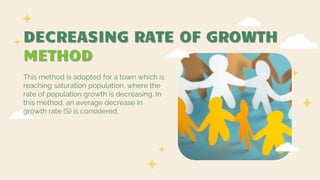
This method is adopted for a town which is
reaching saturation population, where the
rate of population growth is decreasing. In
this method, an average decrease in
growth rate (S) is considered.
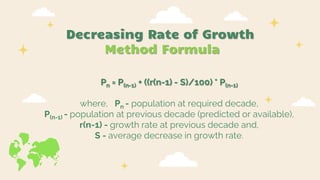
Decreasing Rate of Growth
Method Formula
Pn = P(n-1) + ((r(n-1) - S)/100) * P(n-1)
where, Pn - population at required decade,
P(n-1) - population at previous decade (predicted or available),
r(n-1) - growth rate at previous decade and,
S - average decrease in growth rate.
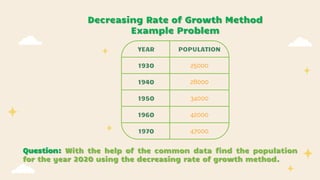
Decreasing Rate of Growth Method
Example Problem
YEAR POPULATION
1930 25000
1940 28000
1950 34000
1960 42000
1970 47000
Question: With the help of the common data find the population
for the year 2020 using the decreasing rate of growth method.
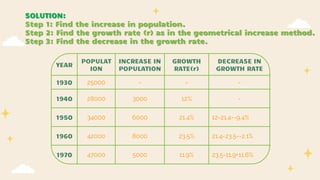
YEAR
POPULAT
ION
INCREASE IN
POPULATION
GROWTH
RATE(r)
DECREASE IN
GROWTH RATE
1930 25000 - = -
1940 28000 3000 12% -
1950 34000 6000 21.4% 12-21.4=-9.4%
1960 42000 8000 23.5% 21.4-23.5=-2.1%
1970 47000 5000 11.9% 23.5-11.9+11.6%
SOLUTION:
Step 1: Find the increase in population.
Step 2: Find the growth rate (r) as in the geometrical increase method.
Step 3: Find the decrease in the growth rate.
Step 4: Find the average of decrease in growth rate(s).
S = (-9.4-2.1+11.6)/3
S = 0.1/3
S = 0.03%
Step 5: Apply the formula Pn = P(n-1) + ((r(n-1) - S)/100) * P(n-1), and find the population at
successive decade till the population at required data is arrived.
P[1980] = P[1970] + ((r[1970] - S)/100) * P[1970]
P[1980] = 47000 + ((11.9 - 0.03)/100) * 47000
P[1980] = 52579
P[1990] = P[1980] + ((r[1980] - S)/100) * P[1980]
P[1990] = 52579 + ((11.87 - 0.03)/100) * 52579, here r[1980] is directly found as 11.9 - 0.03 i.e.,
r[1970] - S, which equals to 11.87.
P[1990] = 58,804
Similarly, P[2020] could be found.
05
GRAPHICAL
PROJECTION
METHOD
GRAPHICAL PROJECTION
METHOD
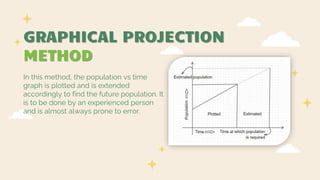
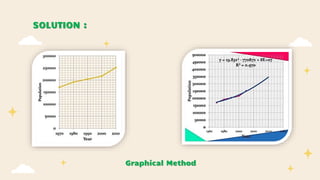
In this method, the population vs time
graph is plotted and is extended
accordingly to find the future population. It
is to be done by an experienced person
and is almost always prone to error.
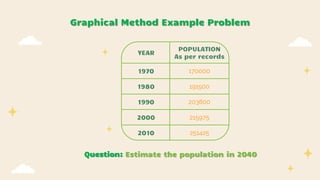
Graphical Method Example Problem
YEAR
POPULATION
As per records
1970 170000
1980 191500
1990 203800
2000 215975
2010 251425
Question: Estimate the population in 2040
SOLUTION :
Graphical Method
06
COMPARATIVE
GRAPHICAL
METHOD
COMPARATIVE GRAPHICAL
METHOD
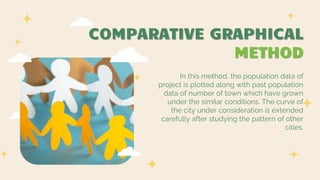
In this method, the population data of
project is plotted along with past population
data of number of town which have grown
under the similar conditions. The curve of
the city under consideration is extended
carefully after studying the pattern of other
cities.
07
MASTER PLAN
METHOD
MASTER PLAN
METHOD
This method is used for a completely
planned city that is not meant to be
developed in a haphazard manner.
08
LOGISTIC
CURVE
METHOD
LOGISTIC CURVE
METHOD
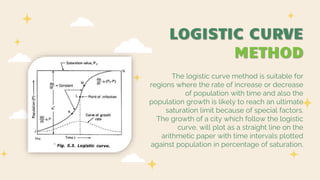
The logistic curve method is suitable for
regions where the rate of increase or decrease
of population with time and also the
population growth is likely to reach an ultimate
saturation limit because of special factors.
The growth of a city which follow the logistic
curve, will plot as a straight line on the
arithmetic paper with time intervals plotted
against population in percentage of saturation.
THANK YOU

POPULATION FORECASTING.pptx

  • 1.
  • 2.
    Population forecasting isa method by which we calculate the future population of any city or region at the interval of n number of decade (10 year) years. DEFINATION
  • 3.
  • 4.
    GRAPHICAL PROJECTION METHOD METHODS OF POPULATION FORECASTING MASTERPLAN METHOD COMPARATIVE GRAPHICAL METHOD LOGISTIC CURVE METHOD
  • 5.
  • 6.
    ARITHMETICAL INCREASE METHOD ● Simplestmethod ● This method is Used for calculation of population of large cities, which having constant development. ● Not used for small cities, because it gives lower value. ● In this method we consider that the rate of change of population (dP/dt = C) of a city is approximately constant C.
  • 7.
    Arithmetical Increase MethodFormula Pn = Po + nx̄, where, Po - last known population Pn - population (predicted) after 'n' number of decades, n - number of decades between Po and Pn and, x̄ - the rate of population growth.
  • 8.
    Arithmetical Increase MethodExample Problem YEAR POPULATION 1930 25000 1940 28000 1950 34000 1960 42000 1970 47000 Question: With the help of the common data find the population for the year 2020 using the arithmetic increase method.
  • 9.
    YEAR POPULATION INCREASE 193025000 - 1940 28000 3000 1950 34000 1960 42000 8000 1970 47000 5000 SOLUTION: STEP 1 : Find the increase in population each decade Step 2: Find the average rate of increase of population (x̄) x̄ = (3000+6000+8000+5000)/4 x̄ = 22000/4 x̄ = 5500 Step 3: Find the number of decades (n) between the last known year and the required year n = 5 (5 decades elapsed between 1970 and 2020) Step 4: Apply the formula Pn = Po + nx̄, P[2020] = P[1970] + (5 * 5500) P[2020] = 47000 + 27500 P[2020] = 74,500. Therefore, population at 2020 will be 74,500.
  • 10.
  • 11.
    GEOMETRICAL INCREASE METHOD ● Theincrease rate of population is not constant in this method, the percentage increase in population is considered. ● This method is suitable for small cities or new developing town for a few decade years, because it gives higher value by percent increase.
  • 12.
    Geometrical Increase MethodFormula Pn = Po[1 + (r/100)]^n, where, Po - last known population, Pn - population (predicted) after 'n' number of decades, n - number of decades between Po and Pn and, r - growth rate = (increase in population/initial population) * 100 (%).
  • 13.
    Geometrical Increase MethodExample Problem YEAR POPULATION 1930 25000 1940 28000 1950 34000 1960 42000 1970 47000 Question: With the help of the common data find the population for the year 2020 using the Geometrical increase method.
  • 14.
    YEAR POPUL ATION INCR EASE GROWTH RATE 1930 25000- - 1940 28000 3000 (3000/25000) X 100 = 12% 1950 34000 6000 (6000/28000) X 100= 21.4% 1960 42000 8000 (8000/34000) X 100= 23.5% 1970 47000 5000 (5000/42000) X 100= 11.9% SOLUTION: STEP 1 : Find the increase in population each decade and find the growth rate Step 3: Find the average growth rate (r) using geometrical mean. r = ∜(12 * 21.4 * 23.5 * 11.9) r = 16.37 % Step 4: Find the number of decades (n) between the last known year and the required year n = 5 (5 decades elapsed between 1970 and 2020) Step 5: Apply the formula Pn = Po[1 + (r/100)]^n P[2020] = P[1970][1 + (16.37/100)]^5 P[2020] = 47000[1.1637]^5 P[2020] = 1,00,300. Therefore, population at 2020 will be 1,00,300.
  • 15.
  • 16.
    INCREMENTAL INCREASE METHOD ● Thismethod is the combination of arithmetic increase and incremental increase method.
  • 17.
    Incremental Increase MethodFormula Pn = (Po + nx̄) + ((n(n+1))/2)* ȳ, where, Po - last known population, Pn - population (predicted) after 'n' number of decades, n - number of decades between Po and Pn, x̄ - mean or average of increase in population and, ȳ - algebraic mean of incremental increase (an increase of increase) of population.
  • 18.
    Incremental Increase MethodExample Problem YEAR POPULATION 1930 25000 1940 28000 1950 34000 1960 42000 1970 47000 Question: With the help of the common data find the population for the year 2020 using the Incremental increase method.
  • 19.
    YEAR POPUL ATION INCR EASE INCREMENTAL INCREASE 1930 25000 -- 1940 28000 3000 - 1950 34000 6000 6000- 3000=3000 1960 42000 8000 8000- 6000=2000 1970 47000 5000 5000-8000= -300 SOLUTION: STEP 1 : Find the increase in population each decade and find the incremental increase i.e., increase of increase Step 3: Find x̄ and ȳ as average of Increase in population and Incremental increase values respectively. x̄ = (3000+6000+8000+5000)/4 x̄ = 5500 ȳ = (3000+2000-3000)/3 ȳ = 2000/3 Step 4: Find the number of decades (n) between the last known year and the required year n = 5 (5 decades elapsed between 1970 and 2020) Step 5: Apply the formula Pn = (Po + nx̄) + ((n(n+1))/2)* ȳ, P[2020] = (P[1970] + nx̄) + ((n(n+1))/2)* ȳ P[2020] = 47000 + (5 * 5500) + (((5 * 6)/2) * (2000/3)) P[2020] = 84,500. Therefore, population at 2020 will be 84,500.
  • 20.
  • 21.
    DECREASING RATE OFGROWTH METHOD This method is adopted for a town which is reaching saturation population, where the rate of population growth is decreasing. In this method, an average decrease in growth rate (S) is considered.
  • 22.
    Decreasing Rate ofGrowth Method Formula Pn = P(n-1) + ((r(n-1) - S)/100) * P(n-1) where, Pn - population at required decade, P(n-1) - population at previous decade (predicted or available), r(n-1) - growth rate at previous decade and, S - average decrease in growth rate.
  • 23.
    Decreasing Rate ofGrowth Method Example Problem YEAR POPULATION 1930 25000 1940 28000 1950 34000 1960 42000 1970 47000 Question: With the help of the common data find the population for the year 2020 using the decreasing rate of growth method.
  • 24.
    YEAR POPULAT ION INCREASE IN POPULATION GROWTH RATE(r) DECREASE IN GROWTHRATE 1930 25000 - = - 1940 28000 3000 12% - 1950 34000 6000 21.4% 12-21.4=-9.4% 1960 42000 8000 23.5% 21.4-23.5=-2.1% 1970 47000 5000 11.9% 23.5-11.9+11.6% SOLUTION: Step 1: Find the increase in population. Step 2: Find the growth rate (r) as in the geometrical increase method. Step 3: Find the decrease in the growth rate.
  • 25.
    Step 4: Findthe average of decrease in growth rate(s). S = (-9.4-2.1+11.6)/3 S = 0.1/3 S = 0.03% Step 5: Apply the formula Pn = P(n-1) + ((r(n-1) - S)/100) * P(n-1), and find the population at successive decade till the population at required data is arrived. P[1980] = P[1970] + ((r[1970] - S)/100) * P[1970] P[1980] = 47000 + ((11.9 - 0.03)/100) * 47000 P[1980] = 52579 P[1990] = P[1980] + ((r[1980] - S)/100) * P[1980] P[1990] = 52579 + ((11.87 - 0.03)/100) * 52579, here r[1980] is directly found as 11.9 - 0.03 i.e., r[1970] - S, which equals to 11.87. P[1990] = 58,804 Similarly, P[2020] could be found.
  • 26.
  • 27.
    GRAPHICAL PROJECTION METHOD In thismethod, the population vs time graph is plotted and is extended accordingly to find the future population. It is to be done by an experienced person and is almost always prone to error.
  • 28.
    Graphical Method ExampleProblem YEAR POPULATION As per records 1970 170000 1980 191500 1990 203800 2000 215975 2010 251425 Question: Estimate the population in 2040
  • 29.
  • 30.
  • 31.
    COMPARATIVE GRAPHICAL METHOD In thismethod, the population data of project is plotted along with past population data of number of town which have grown under the similar conditions. The curve of the city under consideration is extended carefully after studying the pattern of other cities.
  • 32.
  • 33.
    MASTER PLAN METHOD This methodis used for a completely planned city that is not meant to be developed in a haphazard manner.
  • 34.
  • 35.
    LOGISTIC CURVE METHOD The logisticcurve method is suitable for regions where the rate of increase or decrease of population with time and also the population growth is likely to reach an ultimate saturation limit because of special factors. The growth of a city which follow the logistic curve, will plot as a straight line on the arithmetic paper with time intervals plotted against population in percentage of saturation.
  • 36.