Combating Poverty
What is Poverty?
 It is the general scarcity or the state of someone who lacks a certain amount of
material possessions or money. -Wikipedia
 Basically,it the state of someone with very little money and possessions.
 These possessions can be anything from medicine to vehicles to tools like
hammers or building materials like wood.
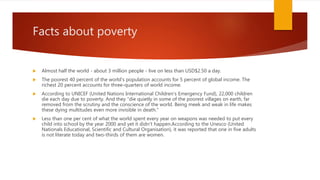
Facts about poverty
 Almost half the world - about 3 million people - live on less than USD$2.50 a day.
 The poorest 40 percent of the world's population accounts for 5 percent of global income. The
richest 20 percent accounts for three-quarters of world income.
 According to UNICEF (United Nations International Children's Emergency Fund), 22,000 children
die each day due to poverty. And they "die quietly in some of the poorest villages on earth, far
removed from the scrutiny and the conscience of the world. Being meek and weak in life makes
these dying multitudes even more invisible in death."
 Less than one per cent of what the world spent every year on weapons was needed to put every
child into school by the year 2000 and yet it didn't happen.According to the Unesco (United
Nationals Educational, Scientific and Cultural Organisation), it was reported that one in five adults
is not literate today and two-thirds of them are women.
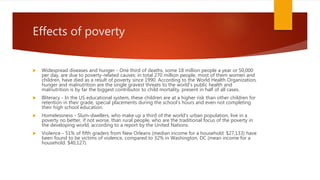
Effects of poverty
 Widespread diseases and hunger - One third of deaths, some 18 million people a year or 50,000
per day, are due to poverty-related causes: in total 270 million people, most of them women and
children, have died as a result of poverty since 1990. According to the World Health Organization,
hunger and malnutrition are the single gravest threats to the world's public health and
malnutrition is by far the biggest contributor to child mortality, present in half of all cases.
 Illiteracy - In the US educational system, these children are at a higher risk than other children for
retention in their grade, special placements during the school's hours and even not completing
their high school education.
 Homelessness - Slum-dwellers, who make up a third of the world's urban population, live in a
poverty no better, if not worse, than rural people, who are the traditional focus of the poverty in
the developing world, according to a report by the United Nations.
 Violence - 51% of fifth graders from New Orleans (median income for a household: $27,133) have
been found to be victims of violence, compared to 32% in Washington, DC (mean income for a
household: $40,127).
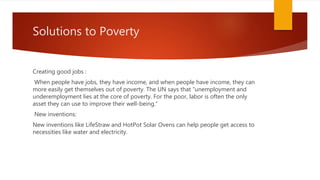
Solutions to Poverty
Creating good jobs :
When people have jobs, they have income, and when people have income, they can
more easily get themselves out of poverty. The UN says that “unemployment and
underemployment lies at the core of poverty. For the poor, labor is often the only
asset they can use to improve their well-being.”
New inventions:
New inventions like LifeStraw and HotPot Solar Ovens can help people get access to
necessities like water and electricity.
Thanks for Watching!
 We hope from this presentation we have sparked your curiosity on and help fight
all these issues that children face.
 Made by:Ivan Lim,James Tai,Andrew Quek,Figo Tanoto

Combating poverty

  • 1.
  • 2.
    What is Poverty? It is the general scarcity or the state of someone who lacks a certain amount of material possessions or money. -Wikipedia  Basically,it the state of someone with very little money and possessions.  These possessions can be anything from medicine to vehicles to tools like hammers or building materials like wood.
  • 3.
    Facts about poverty Almost half the world - about 3 million people - live on less than USD$2.50 a day.  The poorest 40 percent of the world's population accounts for 5 percent of global income. The richest 20 percent accounts for three-quarters of world income.  According to UNICEF (United Nations International Children's Emergency Fund), 22,000 children die each day due to poverty. And they "die quietly in some of the poorest villages on earth, far removed from the scrutiny and the conscience of the world. Being meek and weak in life makes these dying multitudes even more invisible in death."  Less than one per cent of what the world spent every year on weapons was needed to put every child into school by the year 2000 and yet it didn't happen.According to the Unesco (United Nationals Educational, Scientific and Cultural Organisation), it was reported that one in five adults is not literate today and two-thirds of them are women.
  • 4.
    Effects of poverty Widespread diseases and hunger - One third of deaths, some 18 million people a year or 50,000 per day, are due to poverty-related causes: in total 270 million people, most of them women and children, have died as a result of poverty since 1990. According to the World Health Organization, hunger and malnutrition are the single gravest threats to the world's public health and malnutrition is by far the biggest contributor to child mortality, present in half of all cases.  Illiteracy - In the US educational system, these children are at a higher risk than other children for retention in their grade, special placements during the school's hours and even not completing their high school education.  Homelessness - Slum-dwellers, who make up a third of the world's urban population, live in a poverty no better, if not worse, than rural people, who are the traditional focus of the poverty in the developing world, according to a report by the United Nations.  Violence - 51% of fifth graders from New Orleans (median income for a household: $27,133) have been found to be victims of violence, compared to 32% in Washington, DC (mean income for a household: $40,127).
  • 5.
    Solutions to Poverty Creatinggood jobs : When people have jobs, they have income, and when people have income, they can more easily get themselves out of poverty. The UN says that “unemployment and underemployment lies at the core of poverty. For the poor, labor is often the only asset they can use to improve their well-being.” New inventions: New inventions like LifeStraw and HotPot Solar Ovens can help people get access to necessities like water and electricity.
  • 6.
    Thanks for Watching! We hope from this presentation we have sparked your curiosity on and help fight all these issues that children face.  Made by:Ivan Lim,James Tai,Andrew Quek,Figo Tanoto