Essay Question Drawing from the textbook and classroom material regarding the social psychological variables that represent one’s essence of ‘self” (i.e., value-orientation, notion of self: esteem and self concept, gender identification, etc.), furnish a profile that best fully describes you as a person.  In particular, capture those social conditions that were most influential in shaping your identity.  In addition, reflect back on a particular conflict that you have encountered due to an apparent difference that existed with the other party; a difference due to you being very much different than the other(s), in terms of self-identity.  Discuss if you were able to do so, how you resolved this conflict,  while for those that have yet to resolve it, how you might approach it to resolve the conflictual issue at hand.
Chapter 4 Socialization
Chapter Outline Why Is Socialization Important Around the Globe? Social Psychological Theories of Human Development Sociological Theories of Human Development
Chapter Outline Agents of Socialization Gender and Racial-Ethnic Socialization Socialization As a Life-Course Process Resocialization Socialization in the Future
Sharpening Your Focus What purpose does socialization serve? How do individuals develop a sense of self? How does socialization occur? Who experiences resocialization?
Human Development Each of us is a product of two forces: Heredity- “nature”  The social environment -“nurture.” Biology dictates our physical makeup. The social environment largely determines how we develop and behave.
Sociobiology The systematic study of how biology affects social behavior.
 
WALL   STREET JOURNAL   Getty Images SEPTEMBER 22, 2009  New Light on the Plight of Winter Babies  Researchers Stumble Upon Alternative Explanation for the Lifelong Challenges Faced by Children Born in Colder Months By  JUSTIN LAHART   Children born in the winter months already have a few strikes against them. Study after study has shown that they test poorly, don't get as far in school, earn less, are less healthy, and don't live as long as children born at other times of year. Researchers have spent years documenting the effect and trying to understand it. But economists Kasey Buckles and Daniel Hungerman at the University of Notre Dame may have uncovered an overlooked explanation for why season of birth matters.
On Autism, Snow, Scores and Streams Read past WSJ stories that looked at controversies over the "natural experiment" approach: Is an Economist Qualified to Solve Puzzle of Autism?   (2/27/2007)  Novel Way to Assess School Competition Stirs Academic Row  (10/24/2005)  Their discovery challenges the validity of past research and highlights how seemingly safe assumptions economists make may overlook key causes of curious effects. And they came across it by accident. In 2007, Mr. Hungerman was doing research on sibling behavior when he noticed that children in the same families tend to be born at the same time of year. Meanwhile, Ms. Buckles was examining the economic factors that lead to multiple births, and coming across what looked like a relationship between mothers' education levels and when children were born.
"I was just playing around with the data and getting an unexpected result," Ms. Buckles recalls of the tendency that less educated mothers were having children in winter. The two economists, whose offices are across from one another, were comparing notes one day and realized that they might have stumbled across an answer to the season-of-birth puzzle that previous research had overlooked. A key assumption of much of that research is that the backgrounds of children born in the winter are the same as the backgrounds of children born at other times of the year. It must be something that happens to those winter-born children that accounts for their faring poorly. In a celebrated 1991 paper, economists Joshua Angrist of the Massachusetts Institute of Technology and Alan Krueger of Princeton University argued that season-of-birth differences in how far children go in school is due to how school-attendance laws affect children born at different times of the year. Children born in the winter reach their 16th birthdays earlier in the year than other children, which means they can legally drop out of school sooner in theschool year -- which some do, leading to lower education levels in the group .
While it was well known that the educated earned more, they also tended to come from privileged backgrounds -- something that also affects later earnings. Up until then, no one knew how to separately judge the impact of education on higher earnings. Data already showed the researchers that winter babies tended to earn less. Once Mr. Krueger and Mr. Angrist knew how much winter births affected education level, they were able to estimate how education affects later earnings. The statistical techniques Mr. Angrist and Mr. Kreuger developed helped set off a flurry of research that employs "natural experiments." In these, economists use some random or natural influence to approximate the controlled conditions of laboratory experiments -- the type of research that University of Chicago economist Steven Levitt popularized in the book "Freakonomics." Examples include using differences in the introduction of television in different parts of the U.S. to see how TV affects children's cognitive ability and using changes in daylight-saving time to see how setting clocks forward every spring affects energy use.
Other researchers have suggested other reasons for season-of-birth differences. Maybe vitamin D was playing a role, for example, because children born in the winter were getting less sunshine in early life. Or maybe being put in the same school year with children who are mostly younger makes children born in the winter less socially mature. A study published in the medical journal Acta P æ driatica in April found that children born in the winter have higher birth-defect rates and suggested it was due to a higher concentration of pesticides in surface water in the spring and summer, when the children were conceived. There may be validity to all of that research. But if there was any truth to the pattern that Ms. Buckles and Mr. Hungerman discovered, it would question the weightiness of other factors from past research. If winter babies were more likely to come from less-privileged families, it would be natural to expect them to do more poorly in life. The two economists examined birth-certificate data from the Centers for Disease Control and Prevention for 52 million children born between 1989 and 2001, which represents virtually all of the births in the U.S. during those years. The same pattern kept turning up: The percentage of children born to unwed mothers, teenage mothers and mothers who hadn't completed high school kept peaking in January every year. Over the 13-year period, for example, 13.2% of January births were to teen mothers, compared with 12% in May -
"Honestly, when we first saw these patterns, we were so stunned we wondered if we made some mistake," says Mr. Hungerman. "We weren't even excited, we were like, 'Is that right?'   “ He and Ms. Buckles estimate that family background accounts for up to 50% of the differences in education and earnings. That suggests to them that the compulsory-schooling effect Mr. Angrist and Mr. Krueger described could still be there, but that it can't be used to measure how schooling affects later earnings because it still mixes the effects of privilege and education instead of isolating them. Mr. Angrist, who has reviewed their research, disagrees. "The bottom line is a slight change in the estimate," he says. "It hardly overturns our finding." (Mr. Krueger, now an assistant Treasury secretary, deferred to Mr. Angrist for comment). The new research has hit the conference circuit. University of Texas economist Daniel Hamermesh, who selected for a conference discussion the working paper that resulted from Ms. Buckles and Mr. Hungerman's research, says that it makes an important point about the assumptions that economists rely on in natural experiments. "I love the paper," he says. "It means you have to think about things more than you want to think."
Janet Currie, a Columbia University economist who also selected the paper for a conference, says that what strikes her is how the pattern Ms. Buckles and Mr. Hungerman found shows up even in simple charts. "You can take a look at those graphs and see the clear pattern and that it's remarkably stable over time," she says. "It speaks for itself -- you don't have to put a lot of interpretation on it.“ The question now is what drives women from different socioeconomic backgrounds to tend to have children at different times of the year. Ms. Buckles and Mr. Hungerman aren't entirely sure yet. Perhaps it has to do with fluctuations in employment; married women tend to conceive when unemployment is higher, research has shown. They also speculate it might be due to cooler temperatures in springtime, which don't adversely affect the fertility of poor parents, who may not have air conditioning, like hot temperatures do. Or they wonder if there might even be a "prom" effect at work. January is, after all, about nine months after many of those soirees.
 
Related Reading Kasey Buckles, Daniel M. Hungerman: Season of Birth and Later Outcomes:  Old Questions, New Answers ; (2008)   NBER Working Papers 14573,  National Bureau of Economic Research, Inc. ideas.repec.org/e/phu114.html Joshua Angrist and Alan Krueger:  Does Compulsory School Attendance  Affect Schooling and Earnings?  (1990)  Does Compulsory School Attendance Affect Schooling and Earnings?,  Alan Krueger  http://de.scientificcommons.org/33413150 Abstract compulsory schooling, ability, bias, education  Details der Publikation Download  http://www.irs.princeton.edu/pubs/pdfs/273.pdf  Archiv
PSYCHOLOGICAL SOCIAL PSYCHOLOGICAL VARIABLES Deemed as individuated, highly personal traits, characteristics and behavioral patterns. Salient Psychological Social Psychological Variables: - IQ - perceptions - self > esteem > concept - attitudes - beliefs - sexual orientation/preference All the above comprise one’s personality; predispositional behavioral components
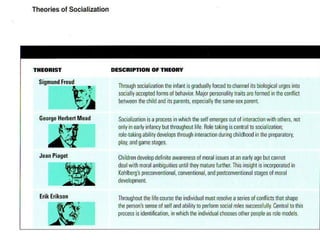
MAJOR DEVELOPMENTAL THEORISTS
 
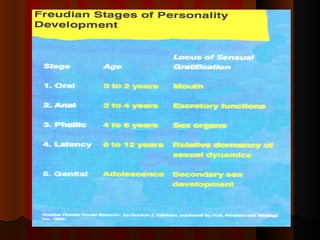
Freud’s Theory of Personality
 
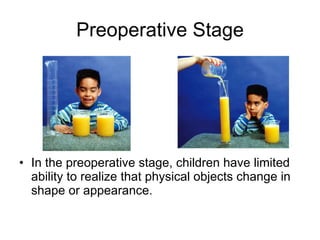
Preoperative Stage In the preoperative stage, children have limited ability to realize that physical objects change in shape or appearance.
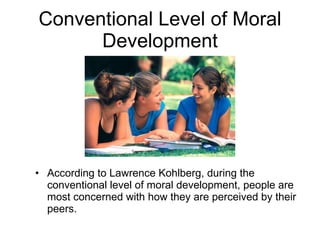
Conventional Level of Moral Development According to Lawrence Kohlberg, during the conventional level of moral development, people are most concerned with how they are perceived by their peers.
Socialization aka Nurture The lifelong process of social interaction through which individuals acquire a self identity and the physical, mental, and social skills needed for survival in society. Socialization is the essential link between the individual and society.
Why Socialization Is Important Teaches us ways to think, talk and act that are necessary for social living. Ensures that members of society are socialized to support the existing social structure. Allows society to pass culture on to the next generation.
Agents of Socialization Family Peer Group School Mass Media
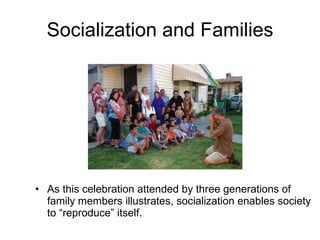
Socialization and Families As this celebration attended by three generations of family members illustrates, socialization enables society to “reproduce” itself.
Socialization and Schools How do tests and other forms of evaluation by teachers contribute to our socialization?
Functionalist Perspective: Functions of Schools Teach students to be productive members of society. Transmit culture. Social control and personal development. Select, train, and place individuals on different rungs in society.
Conflict Perspective: Schools  Experiences depend on social class, racial–ethnic background, gender, and other factors.  Children learn to be neat, punctual, quiet, wait their turn, and remain attentive to their work. Schools socialize children for later roles in the work force.
Peer Groups A group of people who are linked by common interests, equal social position, and age.  Peer groups contribute to our sense of “belonging” and our feelings of self-worth.  They provide children with an opportunity for successful adaptation to situations such as gaining access to ongoing play, protecting shared activities.
Media As Socializing Agents Inform us about events. Introduce us to a variety of people. Provide an array of viewpoints on current issues. Make us aware of products that will supposedly help us. Entertain us.
Sociology in Global Perspective: Cell Phones The number of children and adolescents in high income nations with cell phones: 80% of high school students and 25% of junior high students in Japan 75% of all teenagers in Scandinavia 50% of all 7- to 16-year-olds in the United Kingdom 6.6 million of the 20 million children between the ages of 8 and 12 in the U.S.
Self-concept The totality of our beliefs and feelings about ourselves. Throughout life, our self concept is influenced by our interactions with others.
Four Components of Self- Concept The physical self (“I am tall”) The active self (“I am good at soccer”) The social self (“I am nice to others”) The psychological self (“I believe in world peace”)
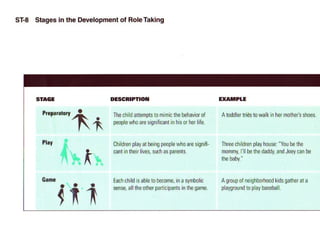
Mead and Role-taking The self is divided into “I” and “Me”: “ I” represents  the unique traits of each person. “ Me”  is composed of the demands of others and the awareness of those demands.  “ I” develops first.  “Me” is formed during three stages of self development.
 
The Looking-Glass Self Stage 1: We imagine how we look to others:
The Looking-Glass Self Stage 2: We imagine how other people judge the appearance that we think we present (i.e., self-concept = Who we are (i.e., roles)
The Looking-Glass Self (self-esteem) If we think the evaluation  is favorable our self-concept  (sic, esteem) is enhanced.
The Looking-Glass Self (self-esteem) If we think the evaluation  is unfavorable our self-concept (sic, esteem) is diminished.
Relationship between Self-concept and Self-esteem? Are these two variables positively correlated?; In other words, are those that have clear self-concepts (i.e., have concretized their role relationships) likely to possess high- self-esteem (i.e., feel good about themselves?
Answer Many of those that have clear self concepts are experiencing what is referred to as role conflict; Hence, these individuals typically feel overwhelmed, frustrated at this predicament causing them to feel poorly about their self-plight
 
 
Self-concept & Self-esteem, a mutually exclusive characteristic? Likewise, many who are in the midst of discovering the answer to the question, who am I? Have a positive view toward their quest to answer this question;  feel that life affords them with the opportunity to eventually acquire a clear understanding of who they are.
Social Devaluation When a person or group is considered to have less social value than other persons or groups. Social devaluation is especially acute when people are leaving roles that have defined their sense of social identity and provided them with meaningful activity
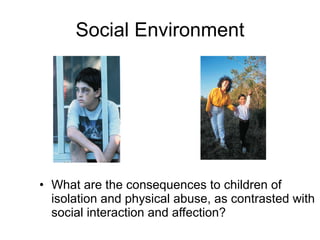
Social Environment What are the consequences to children of isolation and physical abuse, as contrasted with social interaction and affection?
How Much Do You Know About Early  Socialization and Child Care? True or False? The cost of child care is a major problem for many U.S. families.
True Child care outside the home is a major financial burden, particularly for the one out of every three families with young children but with an income of less than $25,000 a year.
How Much Do You Know About Early Socialization and Child Care? True or False ? In the United States, full-day child care often costs as much per year as college tuition at a public college or university.
True Full-day child care typically costs between $4,000 and $10,000 per child per year, which is as much or more than tuition at many public colleges and universities.
How Much Do You Know About Early  Socialization and Child Care? True or False? The average annual salary of a child-care worker is less than the average yearly salaries for funeral attendants or garbage collectors
True The average salary for a child-care worker is only $15,430 per year, which is less than the yearly salaries for people in many other employment categories.
How Much Do You Know About Early  Socialization and Child Care? True or False? All states require teachers in child-care centers to have training in their field and to pass a licensing examination.
False Although all states require hairdressers and manicurists to have about 1,500 hours of training at an accredited school, only 11 states require child-care providers to have any early childhood training prior to taking care of children.
SOCIOLOGICAL SOCIAL PSYCHOLOGICAL VARIABLES Shared by large demographic segments of the society; societal contextual focus. Examples: - gender; - social value orientation; - small group & collective behavioral  phenomena; - race and ethnicity
 
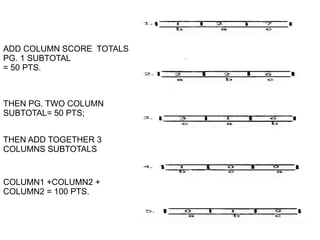
ADD COLUMN SCORE  TOTALS  PG. 1 SUBTOTAL  = 50 PTS. THEN PG. TWO COLUMN SUBTOTAL= 50 PTS;  THEN ADD TOGETHER 3 COLUMNS SUBTOTALS   COLUMN1 +COLUMN2 + COLUMN2 = 100 PTS. Column I  Column 2  Column 3 C O L U M N  S U B T O T A L  S   :  7pts.  6 pts.  37pts   = 50
Value Orientation--Defined The degree to which our life style choices depend upon societal influences, primary/secondary group relationships and/or our own individuated pursuits and self-interest
Fundamental value differences exist between those of different generations. Understanding these values may help understand differences that may arise in the learning environment. Organizational development scholar, Dr. Morris Massey, began looking at generational values and argues that our behaviors are driven by our value system or our value programming.
Morris Massey Morris Massey  (born 1939) is a producer of  training   videos . His undergraduate and  M.B.A.  degrees are from the  University of Texas, Austin , and his  Ph.D.  in business is from  Louisiana State University . During the late 1960s through the 1970s, as an Associate Dean and Professor of Marketing, at the  University of Colorado at Boulder , he received four awards for teaching excellence. Citation source: Wikpedia
COMPARISONS OF COLUMN SCORES BY LIFE STYLE ORIENTATION METRICS  Column I: Formalistic Orientation Life style Criteria: Antecedent of Action Form of Control/Info. Object of Responsibility Desired End To be Avoided Material Goods  Use of Experience Basis for Growth Self Relative to Others Interpersonal Relations Time Perspective Formalistic Category Direction from Authority Rules, reward & punishment Superordinate Powers Compliance Deviation from Authority Compete for Means of Control Validate External Order Following the Established Order Member of Hierarchy Structure Orientation Future
COMPARISONS OF COLUMN SCORES BY LIFE STYLE ORIENTATION METRICS  Column II: Sociocentric Life style Criteria: Antecedent of Action Form of Control/Info. Object of Responsibility Desired End To be Avoided Material Goods  Use of Experience Basis for Growth Self Relative to Others Interpersonal Relations Time Perspective Sociocentric Category Discussion/Agreement Interpersonal Commitments What “we” think & feel Peers, colleague & self Consensus & agreement Failure to reach agreement Collaborate for means of control Share for agreement & growth Interaction Peer group member Group oriented Future
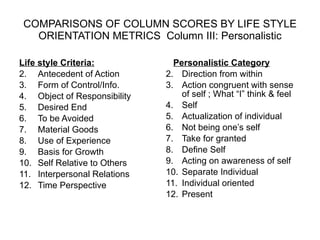
COMPARISONS OF COLUMN SCORES BY LIFE STYLE ORIENTATION METRICS  Column III: Personalistic Life style Criteria: Antecedent of Action Form of Control/Info. Object of Responsibility Desired End To be Avoided Material Goods  Use of Experience Basis for Growth Self Relative to Others Interpersonal Relations Time Perspective Personalistic Category Direction from within Action congruent with sense of self ; What “I” think & feel Self Actualization of individual Not being one’s self Take for granted Define Self Acting on awareness of self Separate Individual Individual oriented Present
What generations/value orientations are generally represented in today's society? Traditionalists Boomers' parents. These are the Traditionalists, War Babies or Veterans, who are now older than 55.   Baby Boomers The Baby Boomers make up the largest percentage of the population today according to U.S. Census statistics. Boomers consist of people currently between the ages of 37-55 (born between 1947-1965).
How about our younger generations? Generation Xers > The Generation Xers are people  in the 25-36 age group  > (born between 1966-1977).  Nexters or Generation Y  >  age 7-24  > (born between 1978 and 1995).  > These are the cyber kids; grew up  with the Internet, and speed and  access to information
Caveat One’s particular value orientation can be fundamentally  altered by an significant emotional event.  A Significant Emotional Event is an experience (or experiences) that creates an emotional meaning - a belief if you like - which affects us in later life. That emotional meaning could be positive (enjoying a School nativity play as a kid; enjoying public speaking as an adult) or it could be negative (hating a school nativity play as a kid; hating public speaking as an adult). An event often becomes a Significant Emotional Event if it is an  intense  experience, for example something traumatic which creates great emotional power. The younger you are, the more difficult it is to deal with that emotional power. If your parents divorce when you are 35, you will be pissed off at them. If your parents divorce when you are 5, you will be shattered, inconsolable and probably forming beliefs about yourself that do not reflect the reality of the situation. Citation:  http://adriantannock.com
Socialization Through the  Lifecourse Each time we experience a change in status (becoming a college student or getting married), we learn a new set of rules, roles, and relationships.  Before we achieve a new status, we often participate in  anticipatory socialization , the process by which knowledge and skills are learned for future roles.
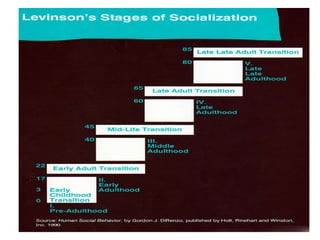
At what age do you believe our  Value Orientations become formed?  Each of the following stages are accompanied by a crisis that involves transitions in social relationships Hint:
 
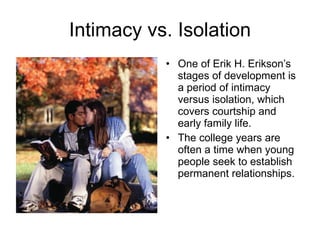
Intimacy vs. Isolation One of Erik H. Erikson’s stages of development is a period of intimacy versus isolation, which covers courtship and early family life.  The college years are often a time when young people seek to establish permanent relationships.
Rite of Passage An important rite of passage for many Latinas is the quinceañera—a celebration of their 15th birthday and their passage into womanhood.
Resocialization Learning a new set of attitudes, values, and behaviors.  Resocialization is  voluntary  when we assume a new status of our own free will.
Involuntary Resocialization Occurs against a person’s wishes and generally takes place within a total institution.  Military boot camps, jails, concentration camps, and some mental hospitals are total institutions.
Resocialization and the Military People in military training are resocialized through extensive, grueling military drills and maneuvers.
 
Quick Quiz
1. Socialization is essential for: the individual's survival and for human development. all of the choices. the survival and stability of society. society to learn how to reproduce itself.
Answer: B Socialization is essential for  the individual's survival and for human development, the survival and stability of society  and for  society to learn how to reproduce itself.
2. The lifelong practice of social interaction through which individuals acquire a self-identity and the physical, mental, and social skills needed for survival in society is called: socialization sociological imagination acculturation assimilation
Answer: A The lifelong practice of social interaction through which individuals acquire a self-identity and the physical, mental, and social skills needed for survival in society is called  socialization .
4. The ________ by Charles Horton Cooley refers to the way in which a person's sense of self is derived from the perceptions of others. generalized other reference group self looking glass self ego
Answer: C  The  looking glass self  by Charles Horton Cooley refers to the way in which a person's sense of self is derived from the perceptions of others.
5. Agents of socialization include: mass media school all of the choices the family
Answer: C Agents of socialization include the  mass media ,  school,  and  the family.

Socialization

  • 1.
    Essay Question Drawingfrom the textbook and classroom material regarding the social psychological variables that represent one’s essence of ‘self” (i.e., value-orientation, notion of self: esteem and self concept, gender identification, etc.), furnish a profile that best fully describes you as a person. In particular, capture those social conditions that were most influential in shaping your identity. In addition, reflect back on a particular conflict that you have encountered due to an apparent difference that existed with the other party; a difference due to you being very much different than the other(s), in terms of self-identity. Discuss if you were able to do so, how you resolved this conflict, while for those that have yet to resolve it, how you might approach it to resolve the conflictual issue at hand.
  • 2.
  • 3.
    Chapter Outline WhyIs Socialization Important Around the Globe? Social Psychological Theories of Human Development Sociological Theories of Human Development
  • 4.
    Chapter Outline Agentsof Socialization Gender and Racial-Ethnic Socialization Socialization As a Life-Course Process Resocialization Socialization in the Future
  • 5.
    Sharpening Your FocusWhat purpose does socialization serve? How do individuals develop a sense of self? How does socialization occur? Who experiences resocialization?
  • 6.
    Human Development Eachof us is a product of two forces: Heredity- “nature” The social environment -“nurture.” Biology dictates our physical makeup. The social environment largely determines how we develop and behave.
  • 7.
    Sociobiology The systematicstudy of how biology affects social behavior.
  • 8.
  • 9.
    WALL STREET JOURNAL Getty Images SEPTEMBER 22, 2009 New Light on the Plight of Winter Babies Researchers Stumble Upon Alternative Explanation for the Lifelong Challenges Faced by Children Born in Colder Months By JUSTIN LAHART Children born in the winter months already have a few strikes against them. Study after study has shown that they test poorly, don't get as far in school, earn less, are less healthy, and don't live as long as children born at other times of year. Researchers have spent years documenting the effect and trying to understand it. But economists Kasey Buckles and Daniel Hungerman at the University of Notre Dame may have uncovered an overlooked explanation for why season of birth matters.
  • 10.
    On Autism, Snow,Scores and Streams Read past WSJ stories that looked at controversies over the "natural experiment" approach: Is an Economist Qualified to Solve Puzzle of Autism? (2/27/2007) Novel Way to Assess School Competition Stirs Academic Row (10/24/2005) Their discovery challenges the validity of past research and highlights how seemingly safe assumptions economists make may overlook key causes of curious effects. And they came across it by accident. In 2007, Mr. Hungerman was doing research on sibling behavior when he noticed that children in the same families tend to be born at the same time of year. Meanwhile, Ms. Buckles was examining the economic factors that lead to multiple births, and coming across what looked like a relationship between mothers' education levels and when children were born.
  • 11.
    "I was justplaying around with the data and getting an unexpected result," Ms. Buckles recalls of the tendency that less educated mothers were having children in winter. The two economists, whose offices are across from one another, were comparing notes one day and realized that they might have stumbled across an answer to the season-of-birth puzzle that previous research had overlooked. A key assumption of much of that research is that the backgrounds of children born in the winter are the same as the backgrounds of children born at other times of the year. It must be something that happens to those winter-born children that accounts for their faring poorly. In a celebrated 1991 paper, economists Joshua Angrist of the Massachusetts Institute of Technology and Alan Krueger of Princeton University argued that season-of-birth differences in how far children go in school is due to how school-attendance laws affect children born at different times of the year. Children born in the winter reach their 16th birthdays earlier in the year than other children, which means they can legally drop out of school sooner in theschool year -- which some do, leading to lower education levels in the group .
  • 12.
    While it waswell known that the educated earned more, they also tended to come from privileged backgrounds -- something that also affects later earnings. Up until then, no one knew how to separately judge the impact of education on higher earnings. Data already showed the researchers that winter babies tended to earn less. Once Mr. Krueger and Mr. Angrist knew how much winter births affected education level, they were able to estimate how education affects later earnings. The statistical techniques Mr. Angrist and Mr. Kreuger developed helped set off a flurry of research that employs "natural experiments." In these, economists use some random or natural influence to approximate the controlled conditions of laboratory experiments -- the type of research that University of Chicago economist Steven Levitt popularized in the book "Freakonomics." Examples include using differences in the introduction of television in different parts of the U.S. to see how TV affects children's cognitive ability and using changes in daylight-saving time to see how setting clocks forward every spring affects energy use.
  • 13.
    Other researchers havesuggested other reasons for season-of-birth differences. Maybe vitamin D was playing a role, for example, because children born in the winter were getting less sunshine in early life. Or maybe being put in the same school year with children who are mostly younger makes children born in the winter less socially mature. A study published in the medical journal Acta P æ driatica in April found that children born in the winter have higher birth-defect rates and suggested it was due to a higher concentration of pesticides in surface water in the spring and summer, when the children were conceived. There may be validity to all of that research. But if there was any truth to the pattern that Ms. Buckles and Mr. Hungerman discovered, it would question the weightiness of other factors from past research. If winter babies were more likely to come from less-privileged families, it would be natural to expect them to do more poorly in life. The two economists examined birth-certificate data from the Centers for Disease Control and Prevention for 52 million children born between 1989 and 2001, which represents virtually all of the births in the U.S. during those years. The same pattern kept turning up: The percentage of children born to unwed mothers, teenage mothers and mothers who hadn't completed high school kept peaking in January every year. Over the 13-year period, for example, 13.2% of January births were to teen mothers, compared with 12% in May -
  • 14.
    "Honestly, when wefirst saw these patterns, we were so stunned we wondered if we made some mistake," says Mr. Hungerman. "We weren't even excited, we were like, 'Is that right?'   “ He and Ms. Buckles estimate that family background accounts for up to 50% of the differences in education and earnings. That suggests to them that the compulsory-schooling effect Mr. Angrist and Mr. Krueger described could still be there, but that it can't be used to measure how schooling affects later earnings because it still mixes the effects of privilege and education instead of isolating them. Mr. Angrist, who has reviewed their research, disagrees. "The bottom line is a slight change in the estimate," he says. "It hardly overturns our finding." (Mr. Krueger, now an assistant Treasury secretary, deferred to Mr. Angrist for comment). The new research has hit the conference circuit. University of Texas economist Daniel Hamermesh, who selected for a conference discussion the working paper that resulted from Ms. Buckles and Mr. Hungerman's research, says that it makes an important point about the assumptions that economists rely on in natural experiments. "I love the paper," he says. "It means you have to think about things more than you want to think."
  • 15.
    Janet Currie, aColumbia University economist who also selected the paper for a conference, says that what strikes her is how the pattern Ms. Buckles and Mr. Hungerman found shows up even in simple charts. "You can take a look at those graphs and see the clear pattern and that it's remarkably stable over time," she says. "It speaks for itself -- you don't have to put a lot of interpretation on it.“ The question now is what drives women from different socioeconomic backgrounds to tend to have children at different times of the year. Ms. Buckles and Mr. Hungerman aren't entirely sure yet. Perhaps it has to do with fluctuations in employment; married women tend to conceive when unemployment is higher, research has shown. They also speculate it might be due to cooler temperatures in springtime, which don't adversely affect the fertility of poor parents, who may not have air conditioning, like hot temperatures do. Or they wonder if there might even be a "prom" effect at work. January is, after all, about nine months after many of those soirees.
  • 16.
  • 17.
    Related Reading KaseyBuckles, Daniel M. Hungerman: Season of Birth and Later Outcomes: Old Questions, New Answers ; (2008) NBER Working Papers 14573, National Bureau of Economic Research, Inc. ideas.repec.org/e/phu114.html Joshua Angrist and Alan Krueger: Does Compulsory School Attendance Affect Schooling and Earnings? (1990) Does Compulsory School Attendance Affect Schooling and Earnings?, Alan Krueger http://de.scientificcommons.org/33413150 Abstract compulsory schooling, ability, bias, education Details der Publikation Download http://www.irs.princeton.edu/pubs/pdfs/273.pdf Archiv
  • 18.
    PSYCHOLOGICAL SOCIAL PSYCHOLOGICALVARIABLES Deemed as individuated, highly personal traits, characteristics and behavioral patterns. Salient Psychological Social Psychological Variables: - IQ - perceptions - self > esteem > concept - attitudes - beliefs - sexual orientation/preference All the above comprise one’s personality; predispositional behavioral components
  • 19.
  • 20.
  • 21.
  • 22.
  • 23.
    Preoperative Stage Inthe preoperative stage, children have limited ability to realize that physical objects change in shape or appearance.
  • 24.
    Conventional Level ofMoral Development According to Lawrence Kohlberg, during the conventional level of moral development, people are most concerned with how they are perceived by their peers.
  • 25.
    Socialization aka NurtureThe lifelong process of social interaction through which individuals acquire a self identity and the physical, mental, and social skills needed for survival in society. Socialization is the essential link between the individual and society.
  • 26.
    Why Socialization IsImportant Teaches us ways to think, talk and act that are necessary for social living. Ensures that members of society are socialized to support the existing social structure. Allows society to pass culture on to the next generation.
  • 27.
    Agents of SocializationFamily Peer Group School Mass Media
  • 28.
    Socialization and FamiliesAs this celebration attended by three generations of family members illustrates, socialization enables society to “reproduce” itself.
  • 29.
    Socialization and SchoolsHow do tests and other forms of evaluation by teachers contribute to our socialization?
  • 30.
    Functionalist Perspective: Functionsof Schools Teach students to be productive members of society. Transmit culture. Social control and personal development. Select, train, and place individuals on different rungs in society.
  • 31.
    Conflict Perspective: Schools Experiences depend on social class, racial–ethnic background, gender, and other factors. Children learn to be neat, punctual, quiet, wait their turn, and remain attentive to their work. Schools socialize children for later roles in the work force.
  • 32.
    Peer Groups Agroup of people who are linked by common interests, equal social position, and age. Peer groups contribute to our sense of “belonging” and our feelings of self-worth. They provide children with an opportunity for successful adaptation to situations such as gaining access to ongoing play, protecting shared activities.
  • 33.
    Media As SocializingAgents Inform us about events. Introduce us to a variety of people. Provide an array of viewpoints on current issues. Make us aware of products that will supposedly help us. Entertain us.
  • 34.
    Sociology in GlobalPerspective: Cell Phones The number of children and adolescents in high income nations with cell phones: 80% of high school students and 25% of junior high students in Japan 75% of all teenagers in Scandinavia 50% of all 7- to 16-year-olds in the United Kingdom 6.6 million of the 20 million children between the ages of 8 and 12 in the U.S.
  • 35.
    Self-concept The totalityof our beliefs and feelings about ourselves. Throughout life, our self concept is influenced by our interactions with others.
  • 36.
    Four Components ofSelf- Concept The physical self (“I am tall”) The active self (“I am good at soccer”) The social self (“I am nice to others”) The psychological self (“I believe in world peace”)
  • 37.
    Mead and Role-takingThe self is divided into “I” and “Me”: “ I” represents the unique traits of each person. “ Me” is composed of the demands of others and the awareness of those demands. “ I” develops first. “Me” is formed during three stages of self development.
  • 38.
  • 39.
    The Looking-Glass SelfStage 1: We imagine how we look to others:
  • 40.
    The Looking-Glass SelfStage 2: We imagine how other people judge the appearance that we think we present (i.e., self-concept = Who we are (i.e., roles)
  • 41.
    The Looking-Glass Self(self-esteem) If we think the evaluation is favorable our self-concept (sic, esteem) is enhanced.
  • 42.
    The Looking-Glass Self(self-esteem) If we think the evaluation is unfavorable our self-concept (sic, esteem) is diminished.
  • 43.
    Relationship between Self-conceptand Self-esteem? Are these two variables positively correlated?; In other words, are those that have clear self-concepts (i.e., have concretized their role relationships) likely to possess high- self-esteem (i.e., feel good about themselves?
  • 44.
    Answer Many ofthose that have clear self concepts are experiencing what is referred to as role conflict; Hence, these individuals typically feel overwhelmed, frustrated at this predicament causing them to feel poorly about their self-plight
  • 45.
  • 46.
  • 47.
    Self-concept & Self-esteem,a mutually exclusive characteristic? Likewise, many who are in the midst of discovering the answer to the question, who am I? Have a positive view toward their quest to answer this question; feel that life affords them with the opportunity to eventually acquire a clear understanding of who they are.
  • 48.
    Social Devaluation Whena person or group is considered to have less social value than other persons or groups. Social devaluation is especially acute when people are leaving roles that have defined their sense of social identity and provided them with meaningful activity
  • 49.
    Social Environment Whatare the consequences to children of isolation and physical abuse, as contrasted with social interaction and affection?
  • 50.
    How Much DoYou Know About Early Socialization and Child Care? True or False? The cost of child care is a major problem for many U.S. families.
  • 51.
    True Child careoutside the home is a major financial burden, particularly for the one out of every three families with young children but with an income of less than $25,000 a year.
  • 52.
    How Much DoYou Know About Early Socialization and Child Care? True or False ? In the United States, full-day child care often costs as much per year as college tuition at a public college or university.
  • 53.
    True Full-day childcare typically costs between $4,000 and $10,000 per child per year, which is as much or more than tuition at many public colleges and universities.
  • 54.
    How Much DoYou Know About Early Socialization and Child Care? True or False? The average annual salary of a child-care worker is less than the average yearly salaries for funeral attendants or garbage collectors
  • 55.
    True The averagesalary for a child-care worker is only $15,430 per year, which is less than the yearly salaries for people in many other employment categories.
  • 56.
    How Much DoYou Know About Early Socialization and Child Care? True or False? All states require teachers in child-care centers to have training in their field and to pass a licensing examination.
  • 57.
    False Although allstates require hairdressers and manicurists to have about 1,500 hours of training at an accredited school, only 11 states require child-care providers to have any early childhood training prior to taking care of children.
  • 58.
    SOCIOLOGICAL SOCIAL PSYCHOLOGICALVARIABLES Shared by large demographic segments of the society; societal contextual focus. Examples: - gender; - social value orientation; - small group & collective behavioral phenomena; - race and ethnicity
  • 59.
  • 60.
    ADD COLUMN SCORE TOTALS PG. 1 SUBTOTAL = 50 PTS. THEN PG. TWO COLUMN SUBTOTAL= 50 PTS; THEN ADD TOGETHER 3 COLUMNS SUBTOTALS COLUMN1 +COLUMN2 + COLUMN2 = 100 PTS. Column I Column 2 Column 3 C O L U M N S U B T O T A L S : 7pts. 6 pts. 37pts = 50
  • 61.
    Value Orientation--Defined Thedegree to which our life style choices depend upon societal influences, primary/secondary group relationships and/or our own individuated pursuits and self-interest
  • 62.
    Fundamental value differencesexist between those of different generations. Understanding these values may help understand differences that may arise in the learning environment. Organizational development scholar, Dr. Morris Massey, began looking at generational values and argues that our behaviors are driven by our value system or our value programming.
  • 63.
    Morris Massey MorrisMassey (born 1939) is a producer of training videos . His undergraduate and M.B.A. degrees are from the University of Texas, Austin , and his Ph.D. in business is from Louisiana State University . During the late 1960s through the 1970s, as an Associate Dean and Professor of Marketing, at the University of Colorado at Boulder , he received four awards for teaching excellence. Citation source: Wikpedia
  • 64.
    COMPARISONS OF COLUMNSCORES BY LIFE STYLE ORIENTATION METRICS Column I: Formalistic Orientation Life style Criteria: Antecedent of Action Form of Control/Info. Object of Responsibility Desired End To be Avoided Material Goods Use of Experience Basis for Growth Self Relative to Others Interpersonal Relations Time Perspective Formalistic Category Direction from Authority Rules, reward & punishment Superordinate Powers Compliance Deviation from Authority Compete for Means of Control Validate External Order Following the Established Order Member of Hierarchy Structure Orientation Future
  • 65.
    COMPARISONS OF COLUMNSCORES BY LIFE STYLE ORIENTATION METRICS Column II: Sociocentric Life style Criteria: Antecedent of Action Form of Control/Info. Object of Responsibility Desired End To be Avoided Material Goods Use of Experience Basis for Growth Self Relative to Others Interpersonal Relations Time Perspective Sociocentric Category Discussion/Agreement Interpersonal Commitments What “we” think & feel Peers, colleague & self Consensus & agreement Failure to reach agreement Collaborate for means of control Share for agreement & growth Interaction Peer group member Group oriented Future
  • 66.
    COMPARISONS OF COLUMNSCORES BY LIFE STYLE ORIENTATION METRICS Column III: Personalistic Life style Criteria: Antecedent of Action Form of Control/Info. Object of Responsibility Desired End To be Avoided Material Goods Use of Experience Basis for Growth Self Relative to Others Interpersonal Relations Time Perspective Personalistic Category Direction from within Action congruent with sense of self ; What “I” think & feel Self Actualization of individual Not being one’s self Take for granted Define Self Acting on awareness of self Separate Individual Individual oriented Present
  • 67.
    What generations/value orientationsare generally represented in today's society? Traditionalists Boomers' parents. These are the Traditionalists, War Babies or Veterans, who are now older than 55. Baby Boomers The Baby Boomers make up the largest percentage of the population today according to U.S. Census statistics. Boomers consist of people currently between the ages of 37-55 (born between 1947-1965).
  • 68.
    How about ouryounger generations? Generation Xers > The Generation Xers are people in the 25-36 age group > (born between 1966-1977). Nexters or Generation Y > age 7-24 > (born between 1978 and 1995). > These are the cyber kids; grew up with the Internet, and speed and access to information
  • 69.
    Caveat One’s particularvalue orientation can be fundamentally altered by an significant emotional event. A Significant Emotional Event is an experience (or experiences) that creates an emotional meaning - a belief if you like - which affects us in later life. That emotional meaning could be positive (enjoying a School nativity play as a kid; enjoying public speaking as an adult) or it could be negative (hating a school nativity play as a kid; hating public speaking as an adult). An event often becomes a Significant Emotional Event if it is an intense experience, for example something traumatic which creates great emotional power. The younger you are, the more difficult it is to deal with that emotional power. If your parents divorce when you are 35, you will be pissed off at them. If your parents divorce when you are 5, you will be shattered, inconsolable and probably forming beliefs about yourself that do not reflect the reality of the situation. Citation: http://adriantannock.com
  • 70.
    Socialization Through the Lifecourse Each time we experience a change in status (becoming a college student or getting married), we learn a new set of rules, roles, and relationships. Before we achieve a new status, we often participate in anticipatory socialization , the process by which knowledge and skills are learned for future roles.
  • 71.
    At what agedo you believe our Value Orientations become formed? Each of the following stages are accompanied by a crisis that involves transitions in social relationships Hint:
  • 72.
  • 73.
    Intimacy vs. IsolationOne of Erik H. Erikson’s stages of development is a period of intimacy versus isolation, which covers courtship and early family life. The college years are often a time when young people seek to establish permanent relationships.
  • 74.
    Rite of PassageAn important rite of passage for many Latinas is the quinceañera—a celebration of their 15th birthday and their passage into womanhood.
  • 75.
    Resocialization Learning anew set of attitudes, values, and behaviors. Resocialization is voluntary when we assume a new status of our own free will.
  • 76.
    Involuntary Resocialization Occursagainst a person’s wishes and generally takes place within a total institution. Military boot camps, jails, concentration camps, and some mental hospitals are total institutions.
  • 77.
    Resocialization and theMilitary People in military training are resocialized through extensive, grueling military drills and maneuvers.
  • 78.
  • 79.
  • 80.
    1. Socialization isessential for: the individual's survival and for human development. all of the choices. the survival and stability of society. society to learn how to reproduce itself.
  • 81.
    Answer: B Socializationis essential for the individual's survival and for human development, the survival and stability of society and for society to learn how to reproduce itself.
  • 82.
    2. The lifelongpractice of social interaction through which individuals acquire a self-identity and the physical, mental, and social skills needed for survival in society is called: socialization sociological imagination acculturation assimilation
  • 83.
    Answer: A Thelifelong practice of social interaction through which individuals acquire a self-identity and the physical, mental, and social skills needed for survival in society is called socialization .
  • 84.
    4. The ________by Charles Horton Cooley refers to the way in which a person's sense of self is derived from the perceptions of others. generalized other reference group self looking glass self ego
  • 85.
    Answer: C The looking glass self by Charles Horton Cooley refers to the way in which a person's sense of self is derived from the perceptions of others.
  • 86.
    5. Agents ofsocialization include: mass media school all of the choices the family
  • 87.
    Answer: C Agentsof socialization include the mass media , school, and the family.