Popular Multimedia Video
Tutorial Websites:
An Explanatory Study
	
	By:	Pra(k	Man	Singh	Pradhan		
PU Registration No: 057-1-3-05976-2014
Symbol No: 140023
Shepherd College
2016
Agendas
1.  Introduc(on	
2.  Literature	Review	
3.  Methodology	
4.  Data	Analysis	
5.  Conclusion	
6.  Recommenda(on
Introduction
•  Concept	of	digital	educa(on	started	a(er	
1990	when	internet	gained	public	access.	
•  Around	2005	online	mul(media	video	
tutorial	websites	emerged	as	connec(on	
speeds	got	beKer.	
•  Many	in	third	world	countries	like	Nepal	
don’t	access	these	websites	simple	
because	they	don’t	know	to	pay	for	it.		
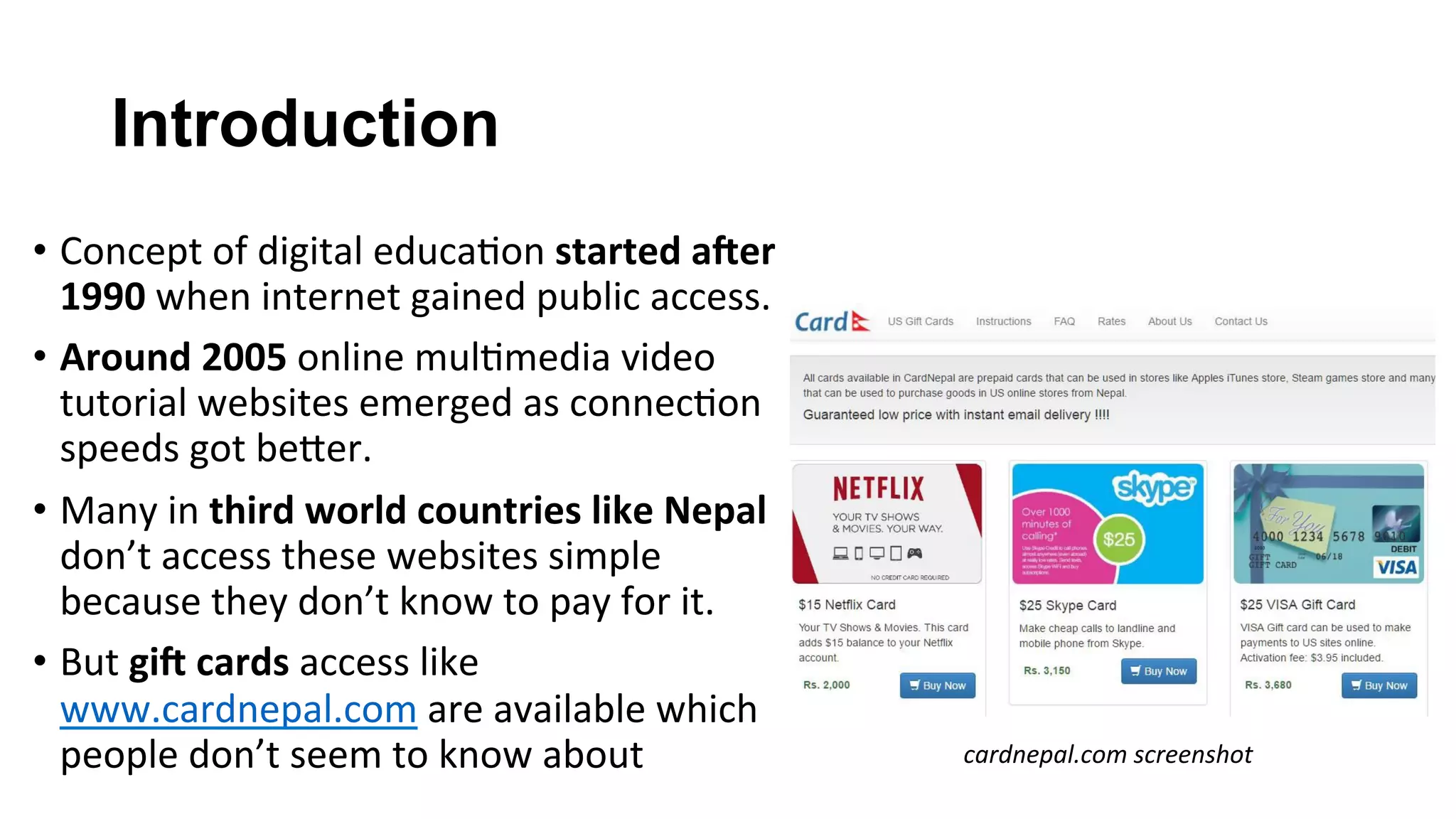
•  But	gi(	cards	access	like	
www.cardnepal.com	are	available	which	
people	don’t	seem	to	know	about	 cardnepal.com	screenshot
Introduction (Cont.)
•  Mul(media	video	tutorials	can	be	linear	or	interac;ve	
•  Linear	formats	are	easier	to	make	and	are	easy	to	access	
•  They	can	be	used	for:	
•  Course	Revision	
•  Flipped	Classroom	
•  Self-Learning	
•  Hobby	Development	
•  Skill	Update
Introduction (Cont.)
Some	popular	mul(media	video	tutorial	websites:	
•  tv.adobe.com	
•  udemy.com	
•  khanacademy.com	
•  lynda.com	
•  tutsplus.com	
•  laracasts.com	
•  skillsshare.com	
•  ditaltutors.com	
•  videocopilot.net	
•  videomaker.com
Literature Review
•  Video	tutorials	can	be	used	to	teach	almost	anything.	
•  Learners	can	access	lessons	the	way	they	want.	
(Caliner,	2004)	
	
•  1963	-	The	Bri(sh	Computer	Society	established	school	commi?ee	
for	promo;on	of	digital	educa;on	in	schools.		
•  Only	5%	of	teacher	used	e-learning	at	the	(me	and	most	actually	
preferred	the	tradi(onal	classroom	method.		
(Holmer	&	Gardner,	2006)
Literature Review (Cont.)
•  Linear	format	of	video	tutorials	are	much	in	use	
•  Interac;ve	formats	are	necessary	to	engage	a	deeper	level	of	
learning	in	students.	
•  There	are	2	types	of	E-learning	
•  Asynchronous	Mode	–	Learners	are	not	able	to	interact	like	in	TV,	
Radio	and	CD-ROM	
•  Synchronous	Mode	–	Learners	are	able	to	interact	through	forms,	
threads,	chats	etc.
Literature Review (Cont.)
Piskurich	(2004)	recognizes	seven	advantages	if	e-learning:	
•  Reduced	travel	(me	and	cost	of	learning	
•  Self-paced	learning	
•  Contents	accessible	in	any(me	and	in	any	place	
•  Ability	for	revising	the	learning	concepts	
•  Easy	review	process	
•  Self-reliant	learning	
•  Freedom	of	learning	any	content
Methodology
•  Research	Design	
•  Research	Ques(on	“How	much	are	learners	and	educa(onal	
ins(tu(ons	familiar	with	and	make	use	of	the	mul(media	video	
tutorial	websites?”	
•  Nature	and	Scope	of	Data	
•  Studies	are	base	both	on	primary	and	secondary	sources.	But	
mostly	primary.	
•  Sources	were	randomly	selected	on	the	basis	of	response	using	
online	media.
Methodology (Cont.)
•  Sampling	and	Data	Collec;on	
•  The	minimum	sample	size	was	decided	to	be	100	with	at	least	15	
of	local	subjects.	
•  Interviews,	surveys,	online	communi(es	and	personal	emails	
•  Ins(tu(ons,	Students,	teachers	and	professionals	from	
mul;media	related	sectors
Methodology (Cont.)
•  Research	Variables	
•  Awareness	of	mul(media	video	tutorial	websites	
•  Use	of	mul(media	video	tutorial	websites	
•  Encouragement	of	mul(media	video	tutorial	websites	
•  Methods	of	Analysis	and	Interpreta;on	
•  Level	of	awareness,	encouragement	and	use	of	it	by	learners,	
instructors	and	educa(onal	ins(tu(ons.
Data Analysis
•  Google	Forms	and	Microso(	Excel	use	to	represent	data.	
•  Data	collected	at	a	global	scale.	
•  The	surveys	are	taken	from	101	random	people.	
•  Interviews	are	done	specifically	with	media	professionals	and	
students	through	online	mediums	and	phone.	
•  2	universi;es	were	contacted	through	emails	for	some	data	as	well.
Data Analysis (Cont.)
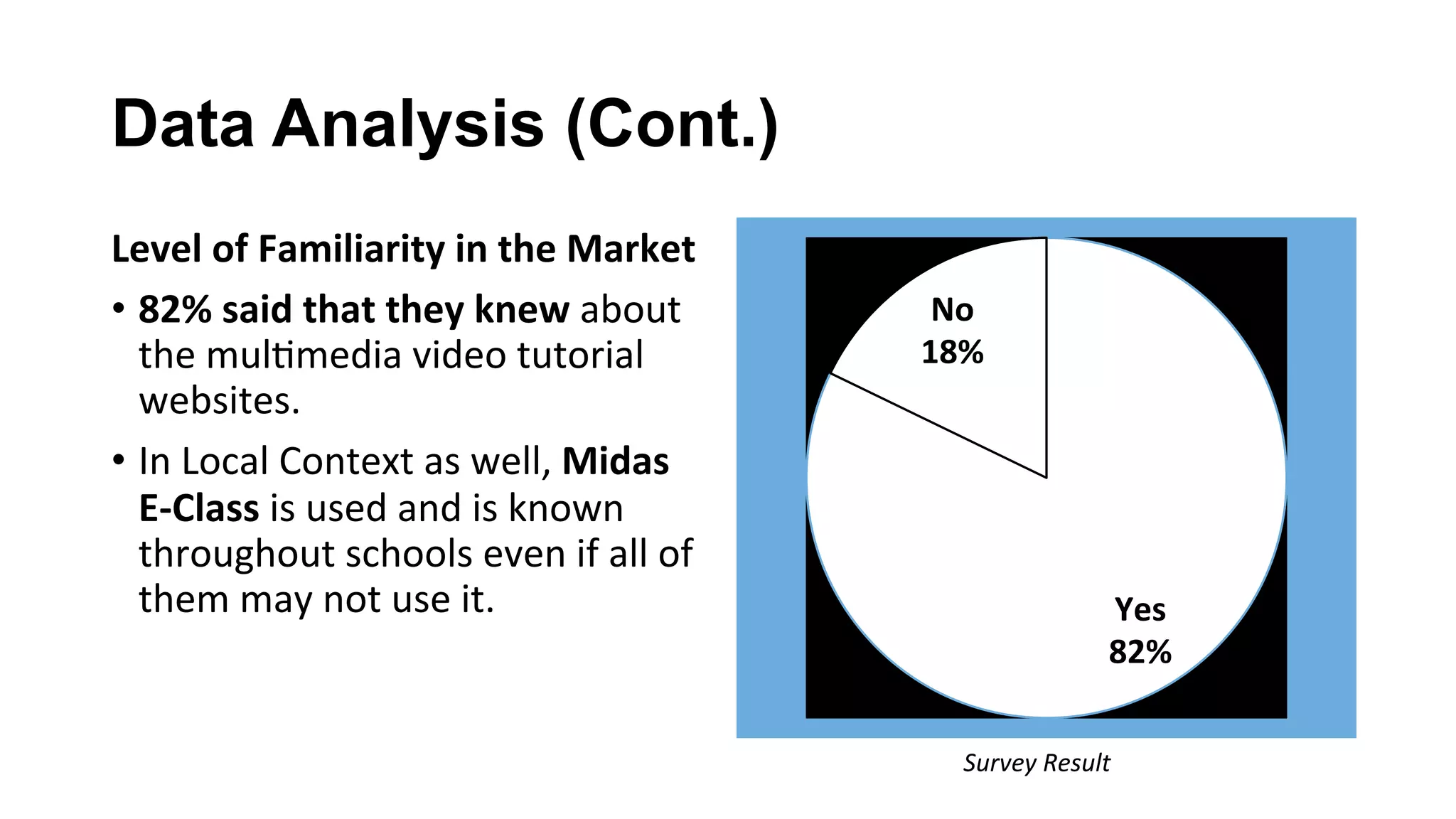
Level	of	Familiarity	in	the	Market	
•  82%	said	that	they	knew	about	
the	mul(media	video	tutorial	
websites.		
•  In	Local	Context	as	well,	Midas	
E-Class	is	used	and	is	known	
throughout	schools	even	if	all	of	
them	may	not	use	it.	 Yes	
82%	
No	
18%	
Survey	Result
Data Analysis (Cont.)
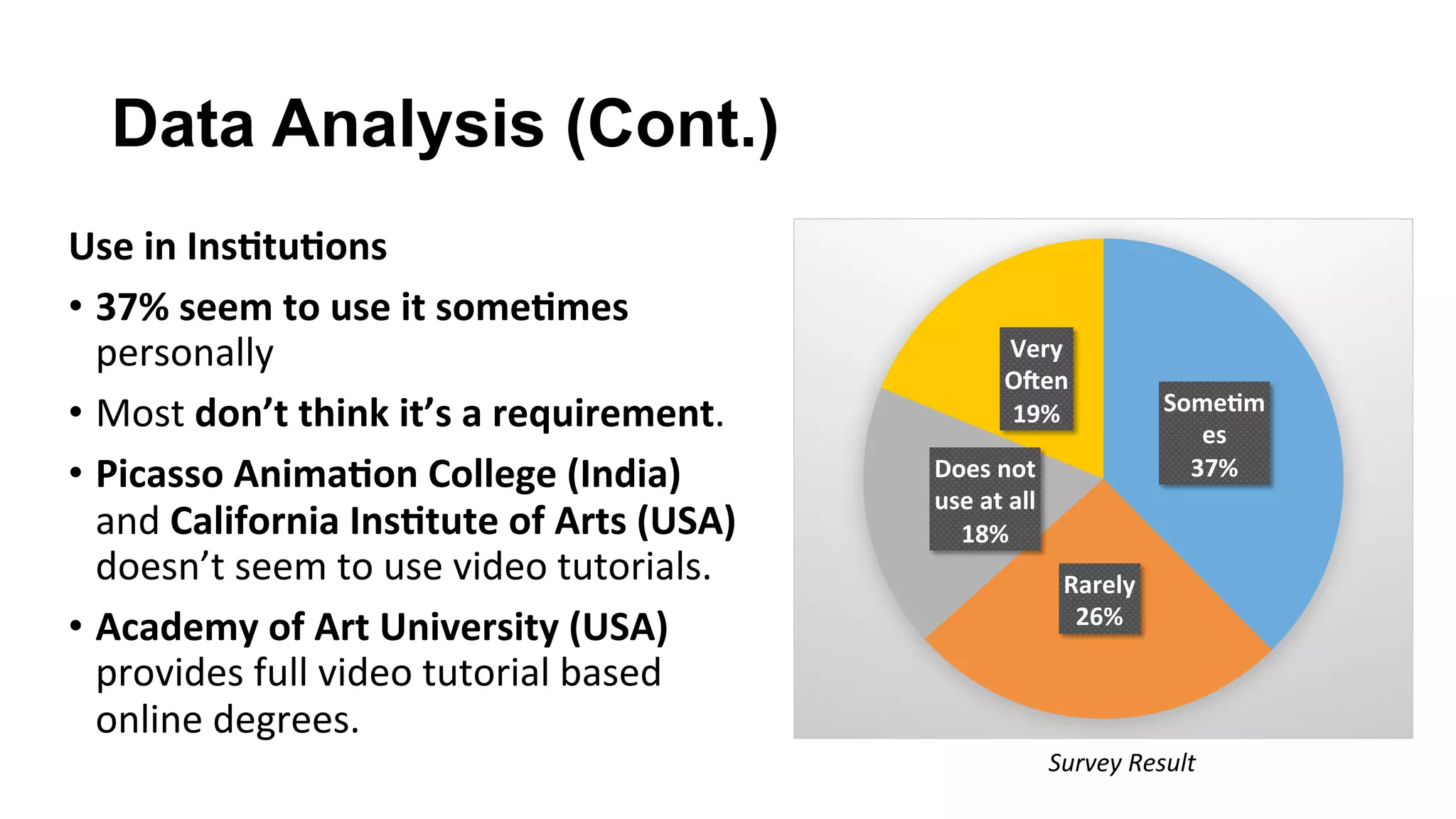
Use	in	Ins;tu;ons	
•  37%	seem	to	use	it	some;mes	
personally	
•  Most	don’t	think	it’s	a	requirement.	
•  Picasso	Anima;on	College	(India)	
and	California	Ins;tute	of	Arts	(USA)	
doesn’t	seem	to	use	video	tutorials.	
•  Academy	of	Art	University	(USA)	
provides	full	video	tutorial	based	
online	degrees.	
Some;m
es	
37%	
Rarely	
26%	
Does	not	
use	at	all	
18%	
Very	
O(en	
19%	
Survey	Result
Data Analysis (Cont.)
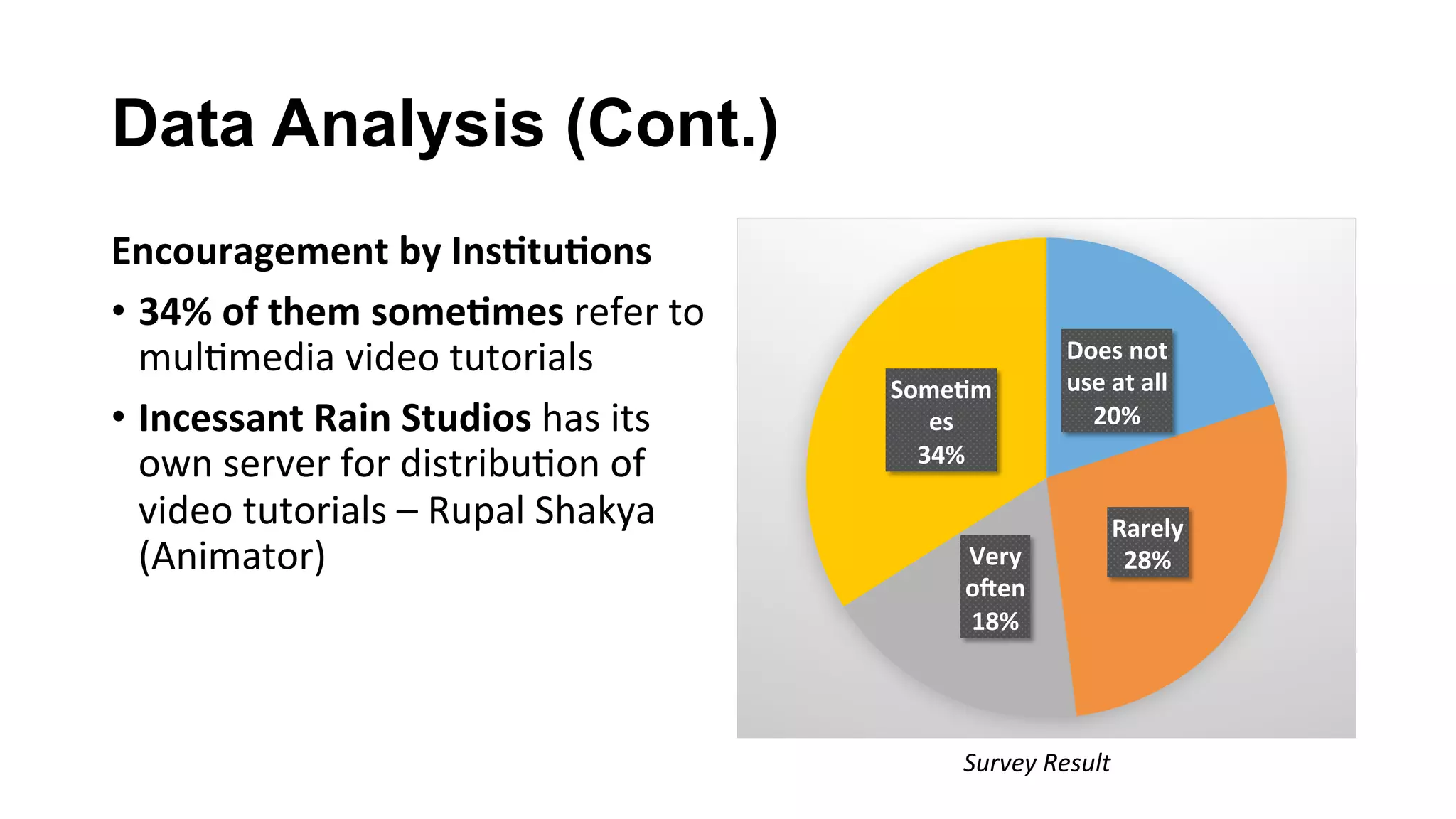
Encouragement	by	Ins;tu;ons	
•  34%	of	them	some;mes	refer	to	
mul(media	video	tutorials	
•  Incessant	Rain	Studios	has	its	
own	server	for	distribu(on	of	
video	tutorials	–	Rupal	Shakya	
(Animator)	
Does	not	
use	at	all	
20%	
Rarely	
28%	Very	
o(en	
18%	
Some;m
es	
34%	
Survey	Result
Data Analysis (Cont.)
•  Brad	Cowen	(Colombia	College)	men(oned	that	he	ocen	uses	it	
himself	as	well	and	he	knows	many	ins;tu;ons	in	USA	that	
uses	video	tutorials	
•  Also	Professor	Han	Verschure	(University	of	Leuven)	men(oned	
that	he	personally	encourages	his	students	to	use	these	
tutorials	but	only	as	an	extra	resource.
Data Analysis (Cont.)
Affordability	
•  44%	of	them	think	that	the	mul(media	video	tutorial	website	prices	
are	at	a	moderate	level	
•  55%	of	them	agrees	that	most	of	the	contents	should	be	free	of	
charge.		
•  41%	said	they	will	o(en	more	use	it		
•  Swornim	Bajracharya,	she	o(en	uses	mul;media	video	tutorials	
from	YouTube	to	learn	about	music.	And	she	prefers	free	websites	
rather	than	paid	once	to	develop	her	hobby.	
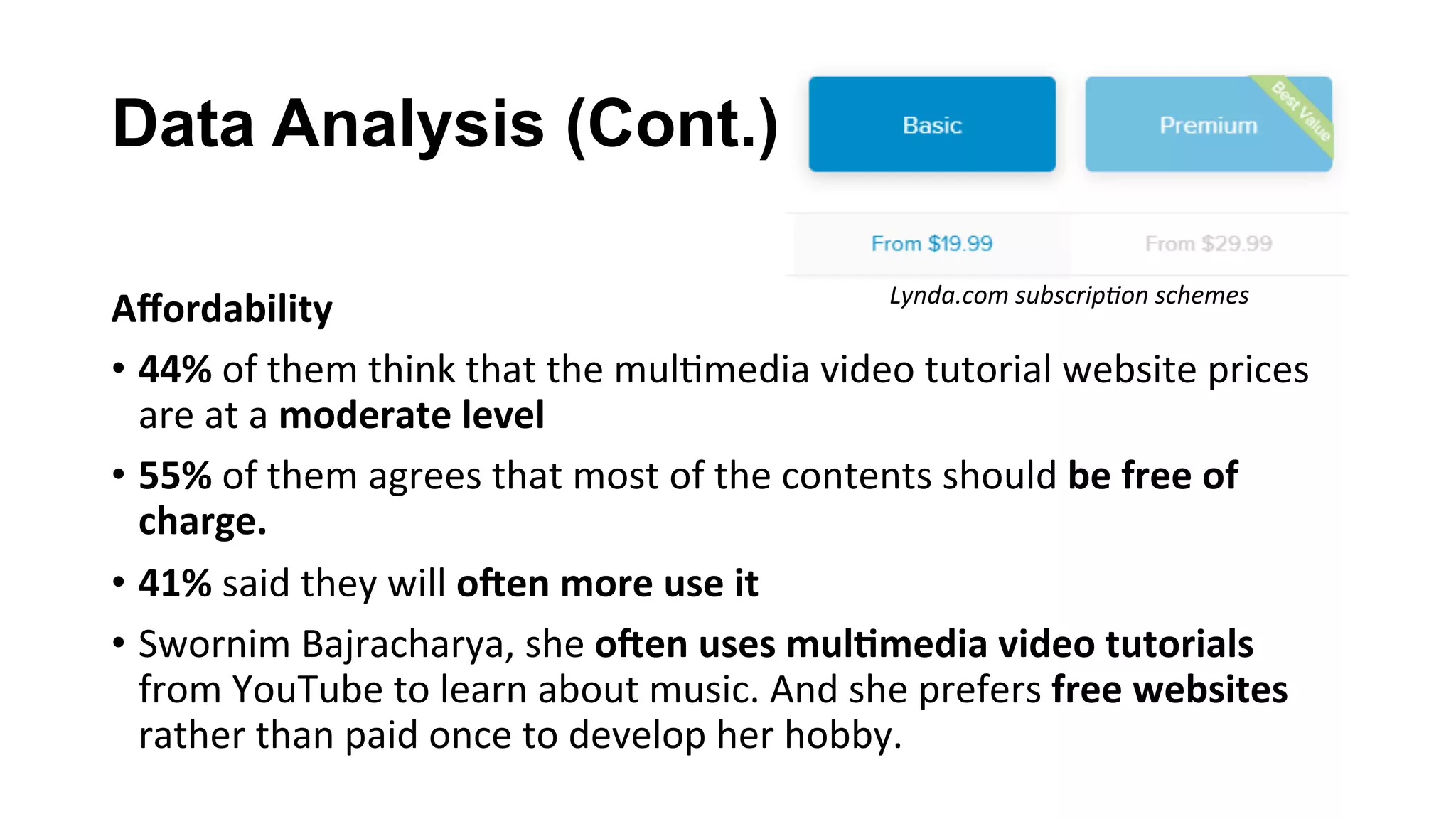
Lynda.com	subscrip;on	schemes
Data Analysis (Cont.)
Integra;on	in	the	Educa;on	System	
•  40%	of	the	survey	said	they	knew	very	few	ins;tu;ons	who	used	it.		
•  53%	of	them	said	that	they	can	be	party	integrated	into	the	
educa(on	system.	
•  Sangita	Sing	(Lecturer	of	Ins(tute	of	Engineering,	Pulchowk)	men(ons	
that	she	some;mes	use	mul;media	video	tutorials	and	it	can	be	
party	integrated	with	the	educa;onal	system	but	not	replace	it	
completely	as	it	might	create	confusion	among	students	and	
teachers.
Data Analysis (Cont.)
Academic	and	Professional	Use	
•  53%	of	them	use	it	some;mes	to	update	themselves	as	alterna(ve	to	
other	methods	of	learning.	
•  38%	of	the	majority	believe	that	to	come	extent	the	mul(media	video	
tutorial	websites	are	more	beneficial	than	tradi(onal	classroom.	
•  Kunal	Rai	(Highlights	Nepal)	men(ons	that	he	does	use	mul(media	
video	tutorial	some;mes	to	upgrade	himself	but	not	completely	
depend	on	it.
Data Analysis (Cont.)
•  Future	Prospects	
•  43%	of	them	says	that	they	might	be	more	familiar	in	the	days	to	
come.	
•  51%	thinks	that	e-learning	might	replace	the	tradi;onal	method	of	
educa(on.	
•  While	it	is	possible	for	learners	to	access	most	contents	online,	
complete	replacement	of	the	educa;on	system	might	not	happen	at	
least	for	now.
Data Analysis (Cont.)
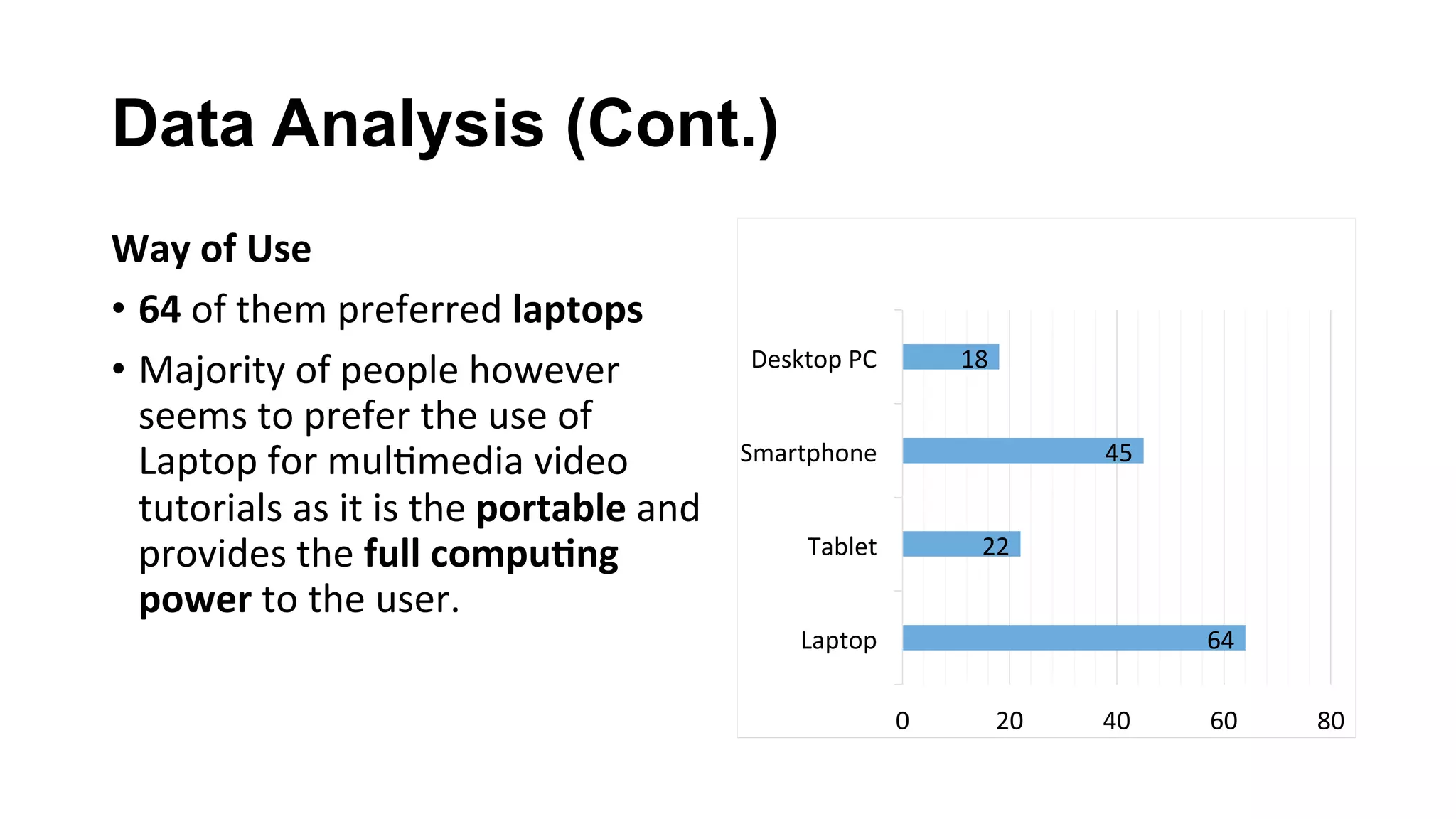
Way	of	Use	
•  64	of	them	preferred	laptops	
•  Majority	of	people	however	
seems	to	prefer	the	use	of	
Laptop	for	mul(media	video	
tutorials	as	it	is	the	portable	and	
provides	the	full	compu;ng	
power	to	the	user.		
64	
22	
45	
18	
0	 20	 40	 60	 80	
Laptop	
Tablet	
Smartphone	
Desktop	PC
Data Analysis (Cont.)
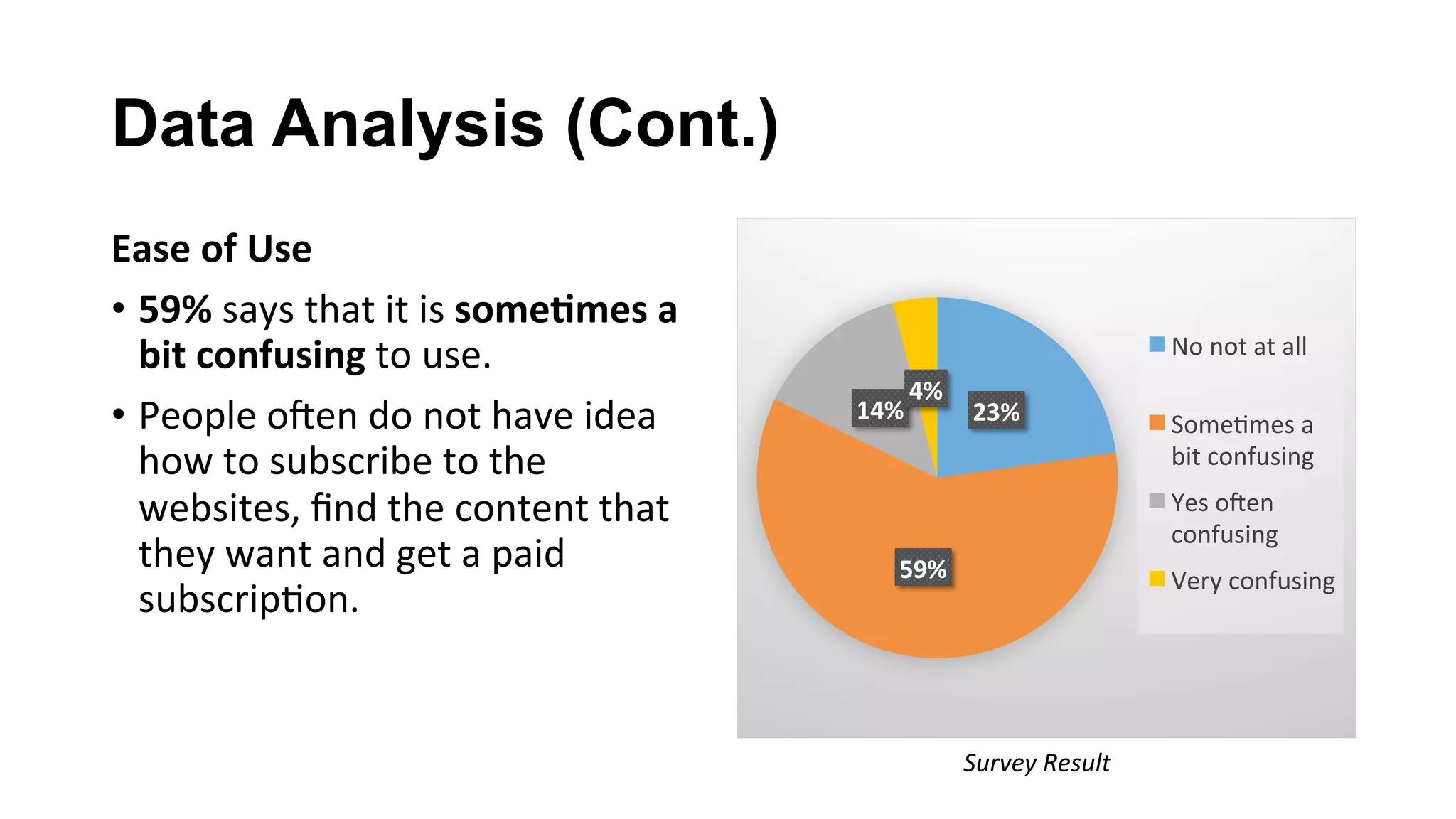
Ease	of	Use	
•  59%	says	that	it	is	some;mes	a	
bit	confusing	to	use.	
•  People	ocen	do	not	have	idea	
how	to	subscribe	to	the	
websites,	find	the	content	that	
they	want	and	get	a	paid	
subscrip(on.	
23%	
59%	
14%	
4%	
No	not	at	all	
Some(mes	a	
bit	confusing	
Yes	ocen	
confusing	
Very	confusing	
Survey	Result
Data Analysis (Cont.)
Level	of	Effec;veness	
•  66%	thinks	that	it	has	a	good	level	of	effect	that	is	seen	among	the	
learners.	
•  47%	of	the	majority	thinks	that	there	is	a	chance	for	them	to	be	
unproduc;ve	to	some	extent.	
•  Those	who	have	access	to	mul(media	video	tutorial	websites	tend	to	
depend	on	it	to	some	extent	as	they	do	not	feel	that	it	is	necessary	to	
remember	the	things	they	learn	as	they	are	easily	search	it	back.
Data Analysis (Cont.)
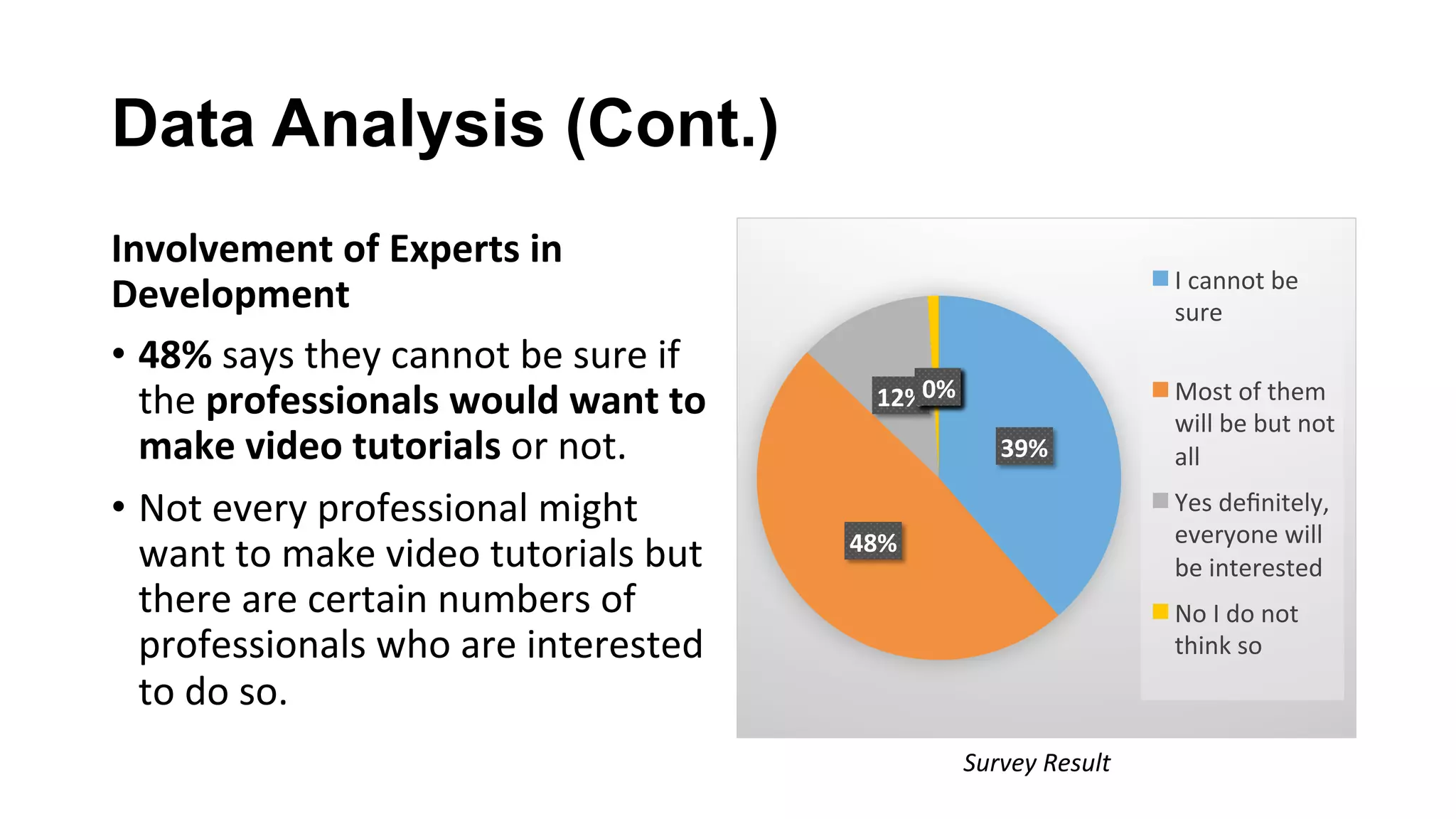
Involvement	of	Experts	in	
Development		
•  48%	says	they	cannot	be	sure	if	
the	professionals	would	want	to	
make	video	tutorials	or	not.	
•  Not	every	professional	might	
want	to	make	video	tutorials	but	
there	are	certain	numbers	of	
professionals	who	are	interested	
to	do	so.		
39%	
48%	
12%	1%	0%	0%	0%	0%	
I	cannot	be	
sure	
Most	of	them	
will	be	but	not	
all	
Yes	definitely,	
everyone	will	
be	interested	
No	I	do	not	
think	so	
Survey	Result
Data Analysis (Cont.)
Major	Findings	of	the	Study	
•  Responses	collected	were	mainly	from	technologically	driven	ci(es.	
•  So	we	can	say	that	most	people	in	a	society	with	access	to	
technology	knows	about	mul;media	video	tutorial	websites	well	
but	needs	(me	to	fully	integrate	it.
Data Analysis
(Cont.)
Major	Findings	of	the	Study	
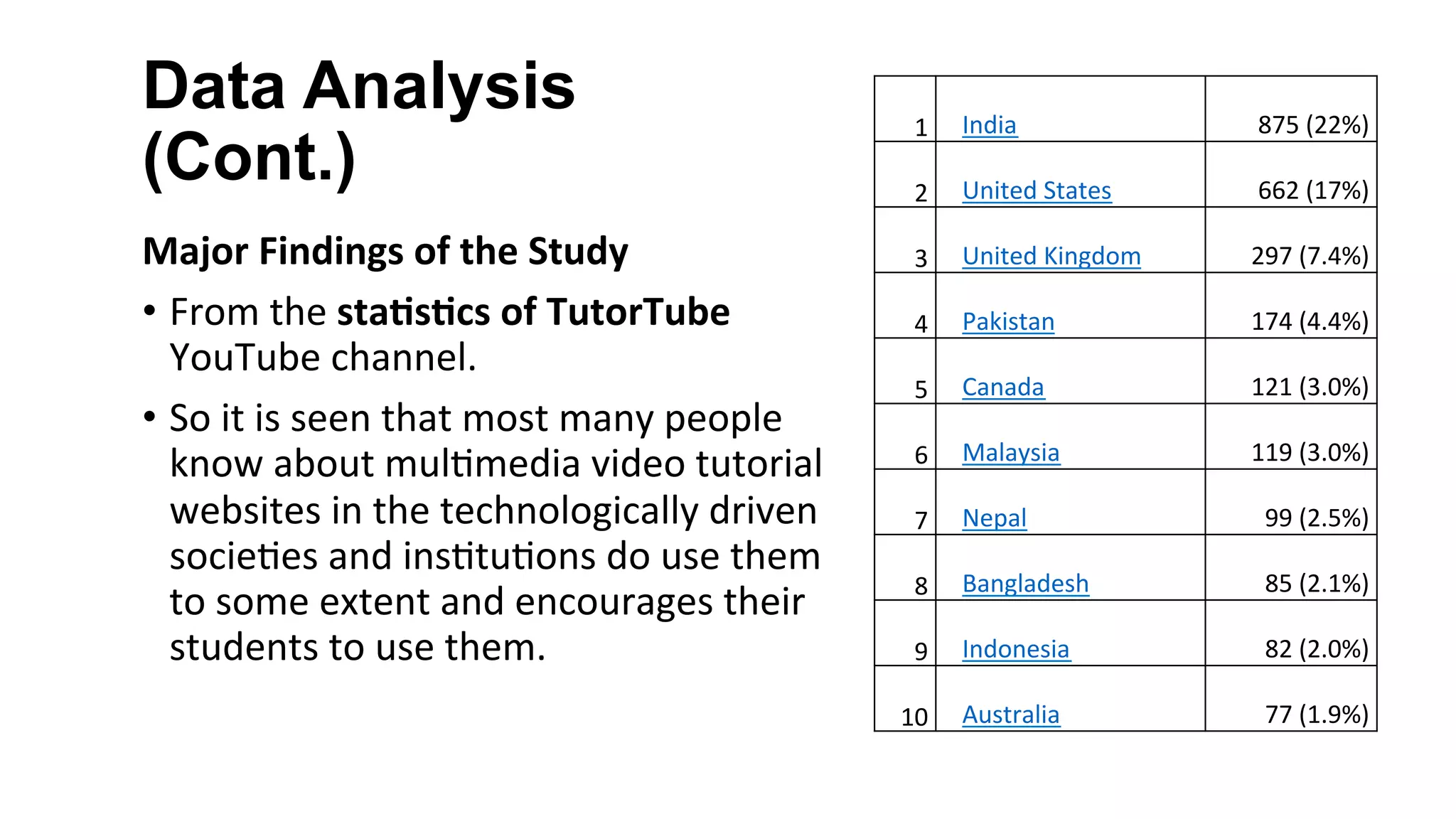
•  From	the	sta;s;cs	of	TutorTube	
YouTube	channel.	
•  So	it	is	seen	that	most	many	people	
know	about	mul(media	video	tutorial	
websites	in	the	technologically	driven	
socie(es	and	ins(tu(ons	do	use	them	
to	some	extent	and	encourages	their	
students	to	use	them.	
1 India 875	(22%)
2 United	States 662	(17%)
3 United	Kingdom 297	(7.4%)
4 Pakistan 174	(4.4%)
5 Canada 121	(3.0%)
6 Malaysia 119	(3.0%)
7 Nepal 99	(2.5%)
8 Bangladesh 85	(2.1%)
9 Indonesia 82	(2.0%)
10 Australia 77	(1.9%)
Conclusion
•  It	will	not	take	much	long	before	everyone	using	the	internet	will	
know	about	the	mul(media	video	tutorial	websites.	
•  Many	of	the	learners	are	subscribed	to	free	mul(media	video	tutorial	
websites.	
•  It	will	take	some	(me	before	mul(media	video	tutorials	can	be	fully	
integrated	in	the	educa(on	system.
Conclusion (Cont.)
•  Professionals	and	academicians	are	using	these	kinds	of	websites	to	
update	themselves.	
•  Most	of	these	tutorials	will	be	viewed	on	Laptops	and	Mobile	phones.	
•  There	are	s(ll	many	people	who	get	confused	with	the	use	of	internet	
and	websites.	
•  The	paid	subscrip(on	mul(media	video	tutorial	websites	are	mostly	
made	by	experienced	professionals.
Recommendation
•  The	use	of	mul(media	video	tutorial	websites	should	be	
encouraged	by	ins(tu(ons	and	trainers.	
•  Ins(tu(ons	should	subscribe	to	mul(media	video	tutorial	websites	
for	their	students	.	
•  More	of	mul(media	video	tutorial	contents	should	be	made	free.		
•  Mul(media	video	tutorials	and	e-learning	plalorms	should	be	
integrated	into	the	current	educa(on	system.
Recommendation (Cont.)
•  Academicians	and	professionals	must	use	and	get	updated	from	
mul(media	video	tutorial	websites.	
•  Mul(media	video	tutorial	websites	should	be	made	cross	
compa(ble	to	work	with	major	mul(media	systems.	
•  The	web	interface	of	mul(media	video	tutorials	should	be	made	
easier	a	much	as	possible.	
•  More	experts	should	be	involved	in	making	mul(media	video	
tutorial	websites.	
•  CDs	and	DVD	based	mul(media	video	tutorials	should	be	
con(nued	to	be	produced.
References
•  Ally,	M.	(2004).	Founda(ons	of	Educa(onal	Theory	for	Online	Learning.	
Retrieved	from	Athabasca	University:	hKp://cde.athabascau.ca/
online_book/ch1.html	
•  Anderson,	T.	(2008).	The	Theory	and	Prac(ce	of	Online	Learning.	
Edmonton:	Athabasca	University	Press.	
•  Anderson,	T.	(Ed.).	(2008).	The	Theory	and	Prac(ce	of	Online	Learning	(2nd	
ed.).	Athabasca:	AU	Press.	
•  BrockeK,	R.	G.,	&	Hiemstra,	R.	(1991).	BrockeK	and	Hiemstra:	A	conceptual	
framework	for	understanding	.	Retrieved	from	Infed:	hKp://infed.org/
archives/e-texts/hiemstra_self_direc(on.htm	
•  Broken	Airplane.	(n.d.).	Video	Tutorials.	Retrieved	from	Broken	Airplane:	
hKp://www.brokenairplane.com/p/video-tutorials.html
References (Cont.)
•  Carliner,	S.	(2004).	An	Overview	of	Online	Learning.	MassachuseKs:	Human	
Resource	Development	Press.	
•  Cermak,	K.	(2012).	How	to	get	into	and	survive	Film,	Adver(sing	and	TV	Post-
Produc(on:	The	alterna(ve	guide.	London:	Clouds	and	Ivy	Ltd.	
•  Dickey,	M.	R.	(2013,	February	15).	Key	Turning	Points	In	History	Of	YouTube	-	
Business	Insider.	Retrieved	from	Business	Insider:	hKp://
www.businessinsider.com/key-turning-points-history-of-youtube-2013-2	
•  Digital	Preserva(on	Management.	(2003).	Timeline:	Digital	Technology	and	
Preserva(on	|	dpworkshop.org.	Retrieved	from	Digital	Preserva(on	
Management:	hKp://www.dpworkshop.org/dpm-eng/(meline/viewall.html	
•  Educate	Nepal.	(2013,	3	19).	E-learning	to	shake	things	up	in	schools.	Retrieved	
from	EducateNepal:	hKp://www.educatenepal.com/news/detail/e-learning-to-
shake-things-up-in-schools
References (Cont.)
•  Fahy,	P.	J.	(2004).	Media	Characteris(cs	and	Online	Learning	Technology.	
Retrieved	from	Asthabasca	University:	hKp://cde.athabascau.ca/online_book/
ch6.html	
•  FitrieAprilia.	(2015,	June	3).	E-Learning.	Retrieved	from	SlideShare:	hKp://
www.slideshare.net/FitrieAprilia/group-members-e-learning-ppt-new	
•  Garland,	V.	E.,	&	Tadeja,	C.	(2013).	Educa(onal	Leadership	and	Technology.	New	
York:	Routledge.	
•  Garrison,	D.	R.	(2011).	E-Learning	in	the	21st	Century.	New	York:	Routledge.	
•  Holmes,	B.,	&	Gardner,	J.	(2006).	E-Learning	Concepts	and	Prac(ce.	London:	SAGE	
Publica(ons.	
•  Internet	Society.	(n.d.).	Brief	History	of	the	Internet.	Retrieved	from	Internet	
Society:	hKp://www.internetsociety.org/internet/what-internet/history-
internet/brief-history-internet
References (Cont.)
•  Jefferies,	A.,	&	Cubric,	M.	(2015).	Proceedings	of	the	14th	European	Conference	
on	e-Learning.	Halield:	Academic	Conferences	and	Publishing	Interna(onal	
Limited.	
•  Kaiser	Family	Founda(on.	(2010,	January	20).	Genera(on	M2:	Media	in	the	Lives	
of	8-	to	18-Year-Olds	|	The	Henry	J.	Kaiser	Family	Founda(on.	Retrieved	from	
KFF.org:	hKp://kff.org/other/event/genera(on-m2-media-in-the-lives-of/	
•  Koenen,	R.	(1998,	June).	MPEG-4:	a	Powerful	Standard	for	Use	in	Web	and	
Television	Environments.	Retrieved	from	W3C:	hKps://www.w3.org/
Architecture/1998/06/Workshop/paper26/	
•  Kopytoff,	V.,	&	Fost,	D.	(2004,	April	29).	For	early	Googlers,	key	word	is	$$$	/	
Founders,	backers	could	reap	billions	when	company	goes	public	-	SFGate.	
Retrieved	from	SFGate:	hKp://www.sfgate.com/news/ar(cle/For-early-Googlers-
key-word-is-Founders-2786378.php
References (Cont.)
•  Moore,	M.	G.	(2013).	Handbook	of	Distance	Educa;on.	New	York:	Routledge.		
•  Moreofit.	(2016,	July	11).	Alterna;ves	to	Khanacademy.	Retrieved	from	Moreofit:	
hKp://www.moreofit.com/similar-to/www.khanacademy.org/
Top_10_Sites_Like_Khanacademy/		
•  Owen,	D.	(2007,	July	4).	Successful	Website	Sta;s;cs.	Retrieved	from	Media	
College:	hKp://www.mediacollege.com/internet/sta(s(cs/successful-sites.html		
•  Pachler,	N.,	&	Daly,	C.	(2011).	Key	Issues	in	e-Learning:	Research	and	Prac;ce.	
London:	Con(nuum	Interna(onal	Publishing	Group.		
•  Piskurich,	G.	M.	(2004).	GeIng	the	Most	from	Online	Learning.	San	Francisco:	
Pfeiffer.		
•  Robertson,	M.	R.	(2015).	Reelseo.	Retrieved	from	500	Hours	of	Video	Uploaded	
To	YouTube	Every	Minute	[Forecast]:	hKp://www.reelseo.com/hours-minute-
uploaded-youtube/
References (Cont.)
•  Schiltz,	G.	(2015).	Video	Analy;cs:	when	and	how	do	students	use	
video	tutorials?	Retrieved	from	ETH	Zurich:	hKps://www.ethz.ch/
content/dam/ethz/special-interest/phys/solid-state-physics/
eduphys/lsp/publica(ons/2015_ICCE_paper.pdf		
•  TechTarget.	(n.d.).	Fast	Guide	to	CD/DVD.	Retrieved	from	WhatIs:	
hKp://wha(s.techtarget.com/reference/Fast-Guide-to-CD-DVD		
•  Tucker,	B.	(2012).	The	Flipped	Classroom.	Retrieved	from	ProQuest:	
hKp://search.proquest.com/openview/
7047b268f4106b18fd41c52f2db40867/1?pq-
origsite=gscholar&cbl=1766362
THANK YOU

Popular multimedia video tutorial websites pratik man singh pradhan - slides