Web Technology Shaping Education E-Learning 2.0 Kristen Valenti
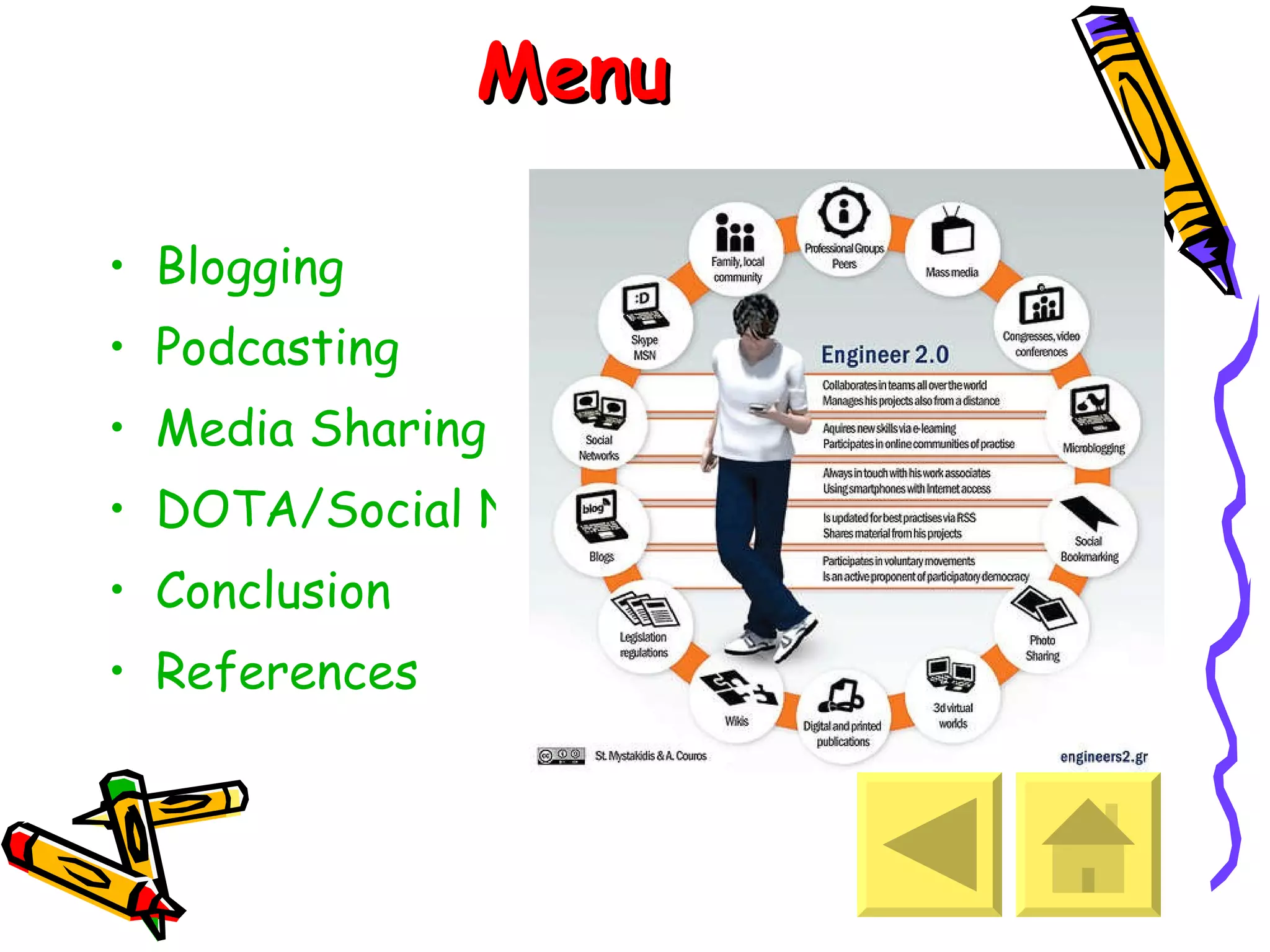
Menu Blogging Podcasting Media Sharing DOTA/Social Networking Conclusion References
BLOGGING the software removes the technical barriers to writing and publishing online - but the 'journal' format encourages students to keep a record of their thinking over time.   Allows students Personal space on the web To pose questions Publish work in progress Link to and comment on web sources Allows Teachers To post questions To post assignments To post links to relevant stories and websites Facilitates critical feedback Readers can comment Teachers Peers Wider audience Multiple Authors Teachers Students Mentors Subjects specialists I.e..  A Readers Guide
BLOGGING For Teachers Allows teachers to share Lesson plans Success stories Classroom photos Resources Allows teachers to connect with other teachers Allows parents to find teachers blogs
Blogging with  ClassPress.com Blogging sites make your posts available for the anyone to see.  ClassPress, allows only your class to view or participate in postings without the outside world seeing. Students from all of your classes can have a blog without e-mail address for students.  Teachers are in control of whether or not students can publish to the web and what gets published. Automatically filters inappropriate content from student blogs and comments. Teachers can post assignments on the blog and let students submit their work through built-in drop box. Common file types are used, including Word, Excel, PowerPoint, and Adobe.  Teachers can also submit files for their students to download or add lists of links that will show up on all student blogs for things like research projects.
Podcasting A  podcast  is a series of digital media files that are released episodically and downloaded through web syndication. Relevance of  Podcasting Provides a way to push educational content to learners Provides students with a sense of audience Makes students highly motivated because the skills required seem relevant Can be a radio show or media file that can be listened to on a computer, iPod or other Mp3 player. This allows anyone to listen on the go or at home. Effectiveness as an Educational Tool Students tend to learn better using multiple senses. Supplementing text, audio and video allow the students to use many senses. Allow students to find and access educational content. Allows school administration to give regular campus news and state of campus updates
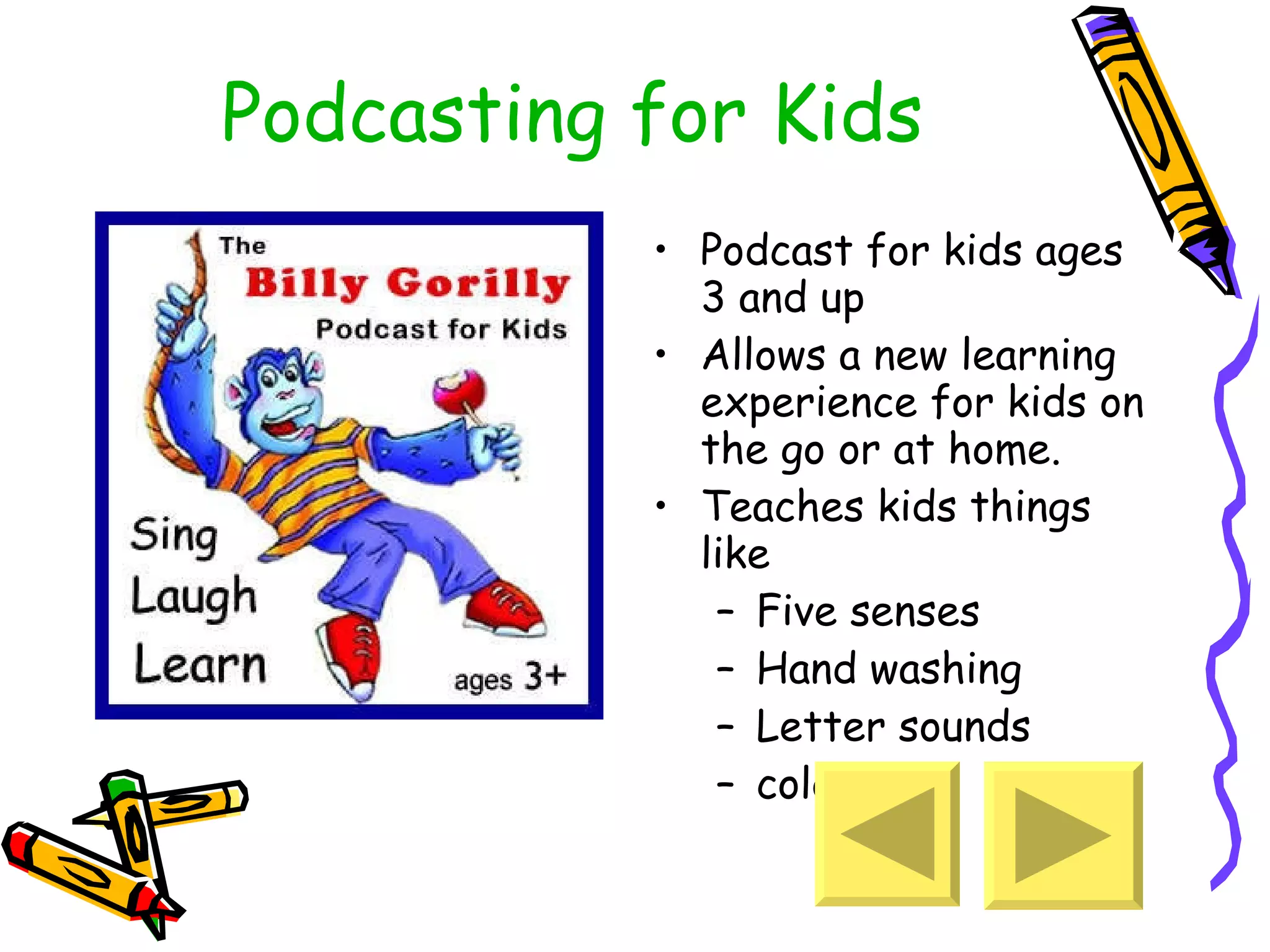
Podcasting  for Kids Podcast for kids ages 3 and up Allows a new learning experience for kids on the go or at home. Teaches kids things like Five senses Hand washing Letter sounds colors
Podcasting for Teachers A  Teacher Created Materials Podcast  episode gives current and useful information on  subjects from Professional Learning Communities to Building Vocabulary. This allows busy teachers to stay up to date on Educational Topics. Episodes also come with  downloadable handouts  with tips for teachers on selected subjects.
Media Sharing It is the interactive process of sending via email, instant message, text message, posting or linking to media on a website or blog and other methods of sharing media to a targeted audience  platforms that are most popular are user-friendly, highly accessible and include mobile devices such as cell phones, PDAs, computers, and home game consoles such as the Playstation 3 and Xbox 360.  Flickr and YouTube are two forms of Media Sharing that is used in the Educational Setting.  Flickr A photo sharing site YouTube A video and movie sharing site
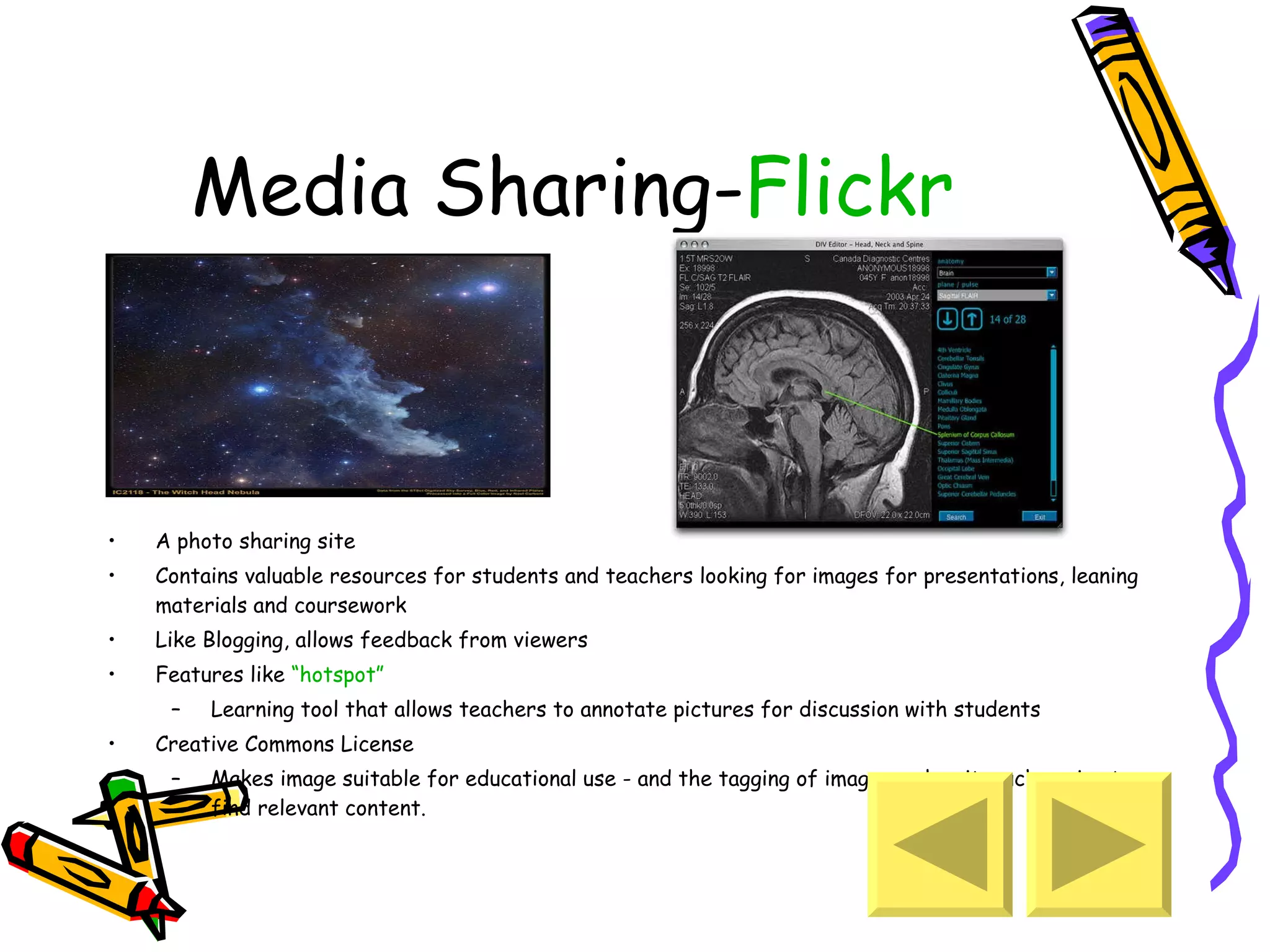
Media Sharing- Flickr A photo sharing site Contains valuable resources for students and teachers looking for images for presentations, leaning materials and coursework Like Blogging, allows feedback from viewers Features like  “hotspot” Learning tool that allows teachers to annotate pictures for discussion with students Creative Commons License Makes image suitable for educational use - and the tagging of images makes it much easier to find relevant content.
Media Sharing-  YouTube displays a wide variety of user-generated video content, including movie clips, TV clips, and music videos, as well as amateur content such as video blogging and short original videos.  features clips that can be used in the classroom to enhance discussion and break the monotony of lecture. Sometimes entire classes can be broadcast on YouTube. This could be useful for students who can not make it to class or a web based class. 	Educational 		Technology: Not 		Just Computers
DOPA/Social Networking Deleting Online Predators Act As useful and as popular as Web based technology is there are always downfalls.  MySpace ,  Facebook  and other social networking sites are said to pose dangers to children and any other person who uses them. Personal information used in these sites can allow predators to potentially put users in danger. The DOPA is banning the use of social networking in schools and libraries which receive federal IT funding.  Social Networking is defined as any web service that: "...allows users to create web pages or profiles that provide information about themselves and are available to other users; and offers a mechanism for communication with other users, such as a forum, chat room, email, or instant messenger."
Conclusion Web technology is in many ways shaping education today. Web technology is giving educators and students convenient ways of communicating and retrieving information. There are always going to be problems with technology. Whether it be issues with the safety of personal information put in social networking sites or long searches for needed information. Giving teachers ways to connect with students on different levels and giving students ways to find and apply educational information is an incredible step forward.  Blogging and Podcasts help busy teachers keep themselves informed and prepared to help students with their educational needs. These technologies allow parents teachers and students keep up to date and in touch on all valuable school and assignment information New technology is emerging everyday, and the things that this article explained will be commonly used and new improvements in these and other technologies will continue to make educational information more readily available and easier to present.
References O'Hear , S. (2006, August 08).  E-learning 2.0: how web 2.0 are shaping education . Retrieved from http://www.readwriteweb.com/archives/e-learning_20.php  Podcast. In Wikipedia, the free encyclopedia. Retrieved January 22, 2010, from  http://en.wikipedia.org/wiki/Podcasting Media Sharing. In Wikipedia, the free encyclopedia. Retrieved January 22, 2010, from http://en.wikipedia.org/wiki/Media_Sharing Maellaro, J. (2005).  Billy Gorilly, Music and Fun for Kids . Retrieved from  www.billygorilly.com YouTube. In Wikipedia, the free encyclopedia. Retrieved January 22, 2010 from http://en.wikipedia.org/wiki/YouTube

Web Technology Shaping Education

  • 1.
    Web Technology ShapingEducation E-Learning 2.0 Kristen Valenti
  • 2.
    Menu Blogging PodcastingMedia Sharing DOTA/Social Networking Conclusion References
  • 3.
    BLOGGING the softwareremoves the technical barriers to writing and publishing online - but the 'journal' format encourages students to keep a record of their thinking over time. Allows students Personal space on the web To pose questions Publish work in progress Link to and comment on web sources Allows Teachers To post questions To post assignments To post links to relevant stories and websites Facilitates critical feedback Readers can comment Teachers Peers Wider audience Multiple Authors Teachers Students Mentors Subjects specialists I.e.. A Readers Guide
  • 4.
    BLOGGING For TeachersAllows teachers to share Lesson plans Success stories Classroom photos Resources Allows teachers to connect with other teachers Allows parents to find teachers blogs
  • 5.
    Blogging with ClassPress.com Blogging sites make your posts available for the anyone to see. ClassPress, allows only your class to view or participate in postings without the outside world seeing. Students from all of your classes can have a blog without e-mail address for students. Teachers are in control of whether or not students can publish to the web and what gets published. Automatically filters inappropriate content from student blogs and comments. Teachers can post assignments on the blog and let students submit their work through built-in drop box. Common file types are used, including Word, Excel, PowerPoint, and Adobe. Teachers can also submit files for their students to download or add lists of links that will show up on all student blogs for things like research projects.
  • 6.
    Podcasting A podcast is a series of digital media files that are released episodically and downloaded through web syndication. Relevance of Podcasting Provides a way to push educational content to learners Provides students with a sense of audience Makes students highly motivated because the skills required seem relevant Can be a radio show or media file that can be listened to on a computer, iPod or other Mp3 player. This allows anyone to listen on the go or at home. Effectiveness as an Educational Tool Students tend to learn better using multiple senses. Supplementing text, audio and video allow the students to use many senses. Allow students to find and access educational content. Allows school administration to give regular campus news and state of campus updates
  • 7.
    Podcasting forKids Podcast for kids ages 3 and up Allows a new learning experience for kids on the go or at home. Teaches kids things like Five senses Hand washing Letter sounds colors
  • 8.
    Podcasting for TeachersA Teacher Created Materials Podcast episode gives current and useful information on subjects from Professional Learning Communities to Building Vocabulary. This allows busy teachers to stay up to date on Educational Topics. Episodes also come with downloadable handouts with tips for teachers on selected subjects.
  • 9.
    Media Sharing Itis the interactive process of sending via email, instant message, text message, posting or linking to media on a website or blog and other methods of sharing media to a targeted audience platforms that are most popular are user-friendly, highly accessible and include mobile devices such as cell phones, PDAs, computers, and home game consoles such as the Playstation 3 and Xbox 360. Flickr and YouTube are two forms of Media Sharing that is used in the Educational Setting. Flickr A photo sharing site YouTube A video and movie sharing site
  • 10.
    Media Sharing- FlickrA photo sharing site Contains valuable resources for students and teachers looking for images for presentations, leaning materials and coursework Like Blogging, allows feedback from viewers Features like “hotspot” Learning tool that allows teachers to annotate pictures for discussion with students Creative Commons License Makes image suitable for educational use - and the tagging of images makes it much easier to find relevant content.
  • 11.
    Media Sharing- YouTube displays a wide variety of user-generated video content, including movie clips, TV clips, and music videos, as well as amateur content such as video blogging and short original videos. features clips that can be used in the classroom to enhance discussion and break the monotony of lecture. Sometimes entire classes can be broadcast on YouTube. This could be useful for students who can not make it to class or a web based class. Educational Technology: Not Just Computers
  • 12.
    DOPA/Social Networking DeletingOnline Predators Act As useful and as popular as Web based technology is there are always downfalls. MySpace , Facebook and other social networking sites are said to pose dangers to children and any other person who uses them. Personal information used in these sites can allow predators to potentially put users in danger. The DOPA is banning the use of social networking in schools and libraries which receive federal IT funding. Social Networking is defined as any web service that: "...allows users to create web pages or profiles that provide information about themselves and are available to other users; and offers a mechanism for communication with other users, such as a forum, chat room, email, or instant messenger."
  • 13.
    Conclusion Web technologyis in many ways shaping education today. Web technology is giving educators and students convenient ways of communicating and retrieving information. There are always going to be problems with technology. Whether it be issues with the safety of personal information put in social networking sites or long searches for needed information. Giving teachers ways to connect with students on different levels and giving students ways to find and apply educational information is an incredible step forward. Blogging and Podcasts help busy teachers keep themselves informed and prepared to help students with their educational needs. These technologies allow parents teachers and students keep up to date and in touch on all valuable school and assignment information New technology is emerging everyday, and the things that this article explained will be commonly used and new improvements in these and other technologies will continue to make educational information more readily available and easier to present.
  • 14.
    References O'Hear ,S. (2006, August 08). E-learning 2.0: how web 2.0 are shaping education . Retrieved from http://www.readwriteweb.com/archives/e-learning_20.php Podcast. In Wikipedia, the free encyclopedia. Retrieved January 22, 2010, from http://en.wikipedia.org/wiki/Podcasting Media Sharing. In Wikipedia, the free encyclopedia. Retrieved January 22, 2010, from http://en.wikipedia.org/wiki/Media_Sharing Maellaro, J. (2005). Billy Gorilly, Music and Fun for Kids . Retrieved from www.billygorilly.com YouTube. In Wikipedia, the free encyclopedia. Retrieved January 22, 2010 from http://en.wikipedia.org/wiki/YouTube