Lecturers experiences on the use
of ‘WhatsApp’ for staff
development
Rita Ndagire Kizito
02 September 2014
“A personal reflection”
The Story line
• The hurdles
• Context
• The inquiry (questions)
• Data
• Findings
• What next?
https://vulcanpost.com/329021/whatsappening-to-us/
Image Credit: India Times
The hurdles
• The usefulness of most of the digital apps that
we are trying to use in education is sometimes
difficult to isolate because these ‘technologies’
were built for other purposes – not teaching and
learning.
• The rate of technology evolution is too fast for
the rate at which education provision can adapt
to these changes.
The hurdles
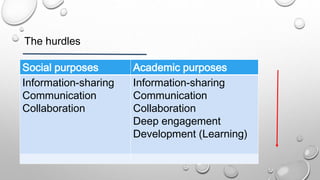
Social purposes Academic purposes
Information-sharing
Communication
Collaboration
Information-sharing
Communication
Collaboration
Deep engagement
Development (Learning)
What is in “WhatsApp”?
• worth 19 billion
• mobility
• instantaneity
has changed the face of
communication
Conradie, P. W., Lombard, A., & Moller, M. (2013).
Learners’ perceptions of mobile devices for learning in
higher education–towards a mobile learning pedagogical
framework. World Academy of Science, Engineering and
Technology, 73, 514-519.
Alsaleem, B. I. A. (2013). The effect of “Whatsapp”
electronic dialogue journaling on improving writing
Vocabulary Word Choice and Voice of EFL Undergraduate
Saudi Students. Arab World English Journal, 4(3), 213-
225.
* Yeboah, J., & Ewur, G. D. (2014). The impact of
WhatsApp messenger usage on students performance in
Tertiary Institutions in Ghana. Journal of Education and
practice, 5(6), 157-164.
Lauricella, S., & Kay, R. (2013). Exploring the use of text
and instant messaging in higher education classrooms.
Research in Learning technology, 21.
“MIM has potential to create alternative dialogic
spaces for student collaborative engagements in
informal contexts, which can gainfully transform
teaching and learning” (p. 540)
“WhatsApp also transformed pedagogy by
fostering social constructivist environments for
lecturer–student and peer-based co-construction of
knowledge” (p. 560)
Rambe & Bere (2013)
The inquiry – from a learning activity design perspective
What is the best way to incorporate WhatsApp in a
higher/vocational learning environment ?
 What are the benefits of using WhatsApp for staff
development?
 What challenges do lecturers encounter when
using WhatsApp in their personal learning spaces?
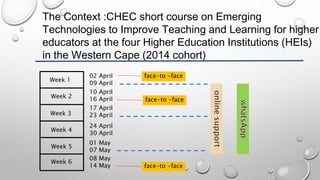
The Context :CHEC short course on Emerging
Technologies to Improve Teaching and Learning for higher
educators at the four Higher Education Institutions (HEIs)
in the Western Cape (2014 cohort)
02 April
09 April
10 April
16 April
17 April
23 April
24 April
30 April
01 May
07 May
08 May
14 May
face-to -face
face-to -face
face-to -face
Week 1
Week 2
Week 3
Week 4
Week 5
Week 6
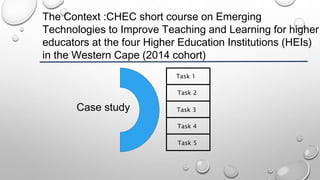
The Context :CHEC short course on Emerging
Technologies to Improve Teaching and Learning for higher
educators at the four Higher Education Institutions (HEIs)
in the Western Cape (2014 cohort)
Case study
Task 1
Task 2
Task 3
Task 4
Task 5
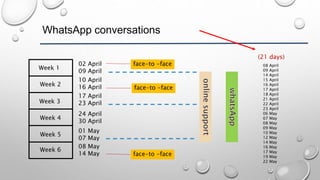
WhatsApp conversations
02 April
09 April
10 April
16 April
17 April
23 April
24 April
30 April
01 May
07 May
08 May
14 May
face-to -face
face-to -face
face-to -face
Week 1
Week 2
Week 3
Week 4
Week 5
Week 6
08 April
09 April
14 April
15 April
16 April
17 April
18 April
21 April
22 April
23 April
06 May
07 May
08 May
09 May
10 May
12 May
14 May
16 May
17 May
19 May
22 May
(21 days)
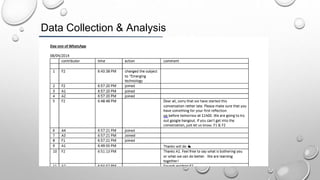
Data Collection
‘WhatsApp’ was used to facilitate the online sessions of
the 2014 emerging technologies course. The Teaching
and learning challenges for the 5 academics
participating in this study were collected using a content
analysis of the Google drive posts and ‘WhatsApp’
conversations.
Data Collection & Analysis
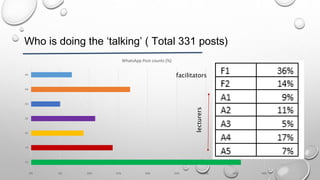
Who is doing the ‘talking’ ( Total 331 posts)
0% 5% 10% 15% 20% 25% 30% 35% 40%
F1
F2
A1
A2
A3
A4
A5
WhatsApp Post counts (%)
facilitators
lecturers
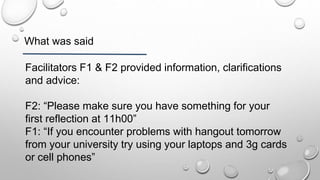
What was said
Facilitators F1 & F2 provided information, clarifications
and advice:
F2: “Please make sure you have something for your
first reflection at 11h00”
F1: “If you encounter problems with hangout tomorrow
from your university try using your laptops and 3g cards
or cell phones”
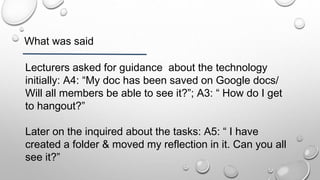
What was said
Lecturers asked for guidance about the technology
initially: A4: “My doc has been saved on Google docs/
Will all members be able to see it?”; A3: “ How do I get
to hangout?”
Later on the inquired about the tasks: A5: “ I have
created a folder & moved my reflection in it. Can you all
see it?”
What was said
Once they became comfortable with the technology,
lecturers started engaging deeply with the learning
tasks. A1 beginning to identify the learning challenge:
A1: “ I feel the dental terms and understanding them
can only be overcome by the students themselves.
More reading or journals and articles pertaining to
dentistry can improve their knowledge greatly and this
is what they do not do….”
What was said
They even began supporting each other:
A2: “ Will rework my challenges to achieve intended
outcomes esp. to provide resources which will facilitate
learning”
A5: “ I was considering that as well… I was thinking
Google drive would be a great platform for our 3rd and
4th years where they cover case studies”
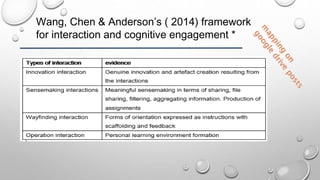
Wang, Chen & Anderson’s ( 2014) framework
for interaction and cognitive engagement *
Challenges
There were challenges with connectivity;
A5:” Is anyone on the X Campus struggling with their
internet connection?”
And sometime loss of the thread of the conversations:
A2: “I am lost”
One participant did not feel very comfortable discussing
issues in the WhatsApp space.
Overall participants were pleased with WhatsApp
A5: “ I am happy with WhatsApp. It won’t leave us in
the lurch”
A3: “ Yes, WU has been a revelation”
A2: “ WhatsApp is a cheap and easy method to
communicate and post links to. E.g. YouTube clippings
etc.”
One participant did not feel very comfortable discussing
Issues in the WhatsApp space
However this does not translate into use later (2015)
3. Are you using WhatsApp in your teaching? If yes
how and if no , why?
A4:“No. Students are not very interested in engaging
with technology. I am also not very ofay with how to use
WA in education besides for messaging. I would like to
learn how to use it more effectively. Any articles that
could be recommended for ideas?”
However this does not translate into use later (2015)
3. Are you using WhatsApp in your teaching? If yes
how and if no , why?
A1: “No. No time to respond to all the chats”
A2: “No I have not implemented the use of WhatsApp .I
did not find the need to do so with my class this year
but will however give it a try next year”
 What are the benefits of using WhatsApp
for staff development?
 What challenges do lecturers encounter
when using WhatsApp in their personal
learning spaces?
What is the best way to
incorporate WhatsApp in a
higher/vocational learning
environment ?
Additional References
Rambe, P., & Bere, A. (2013). Using mobile instant
messaging to leverage learner participation and
transform pedagogy at a South African University of
Technology. British Journal of Educational
Technology, 44(4), 544-561.
Wang, Z., Chen, L., & Anderson, T. (2014). A framework for
interaction and cognitive engagement in connectivist
learning contexts. The International Review of
Research in Open and Distributed Learning, 15(2).
Thank-you

Whats app 2015 presentation kizito 2015

  • 1.
    Lecturers experiences onthe use of ‘WhatsApp’ for staff development Rita Ndagire Kizito 02 September 2014 “A personal reflection”
  • 2.
    The Story line •The hurdles • Context • The inquiry (questions) • Data • Findings • What next? https://vulcanpost.com/329021/whatsappening-to-us/ Image Credit: India Times
  • 3.
    The hurdles • Theusefulness of most of the digital apps that we are trying to use in education is sometimes difficult to isolate because these ‘technologies’ were built for other purposes – not teaching and learning. • The rate of technology evolution is too fast for the rate at which education provision can adapt to these changes.
  • 4.
    The hurdles Social purposesAcademic purposes Information-sharing Communication Collaboration Information-sharing Communication Collaboration Deep engagement Development (Learning)
  • 5.
    What is in“WhatsApp”? • worth 19 billion • mobility • instantaneity has changed the face of communication
  • 6.
    Conradie, P. W.,Lombard, A., & Moller, M. (2013). Learners’ perceptions of mobile devices for learning in higher education–towards a mobile learning pedagogical framework. World Academy of Science, Engineering and Technology, 73, 514-519. Alsaleem, B. I. A. (2013). The effect of “Whatsapp” electronic dialogue journaling on improving writing Vocabulary Word Choice and Voice of EFL Undergraduate Saudi Students. Arab World English Journal, 4(3), 213- 225. * Yeboah, J., & Ewur, G. D. (2014). The impact of WhatsApp messenger usage on students performance in Tertiary Institutions in Ghana. Journal of Education and practice, 5(6), 157-164. Lauricella, S., & Kay, R. (2013). Exploring the use of text and instant messaging in higher education classrooms. Research in Learning technology, 21.
  • 7.
    “MIM has potentialto create alternative dialogic spaces for student collaborative engagements in informal contexts, which can gainfully transform teaching and learning” (p. 540) “WhatsApp also transformed pedagogy by fostering social constructivist environments for lecturer–student and peer-based co-construction of knowledge” (p. 560) Rambe & Bere (2013)
  • 8.
    The inquiry –from a learning activity design perspective What is the best way to incorporate WhatsApp in a higher/vocational learning environment ?  What are the benefits of using WhatsApp for staff development?  What challenges do lecturers encounter when using WhatsApp in their personal learning spaces?
  • 9.
    The Context :CHECshort course on Emerging Technologies to Improve Teaching and Learning for higher educators at the four Higher Education Institutions (HEIs) in the Western Cape (2014 cohort) 02 April 09 April 10 April 16 April 17 April 23 April 24 April 30 April 01 May 07 May 08 May 14 May face-to -face face-to -face face-to -face Week 1 Week 2 Week 3 Week 4 Week 5 Week 6
  • 10.
    The Context :CHECshort course on Emerging Technologies to Improve Teaching and Learning for higher educators at the four Higher Education Institutions (HEIs) in the Western Cape (2014 cohort) Case study Task 1 Task 2 Task 3 Task 4 Task 5
  • 11.
    WhatsApp conversations 02 April 09April 10 April 16 April 17 April 23 April 24 April 30 April 01 May 07 May 08 May 14 May face-to -face face-to -face face-to -face Week 1 Week 2 Week 3 Week 4 Week 5 Week 6 08 April 09 April 14 April 15 April 16 April 17 April 18 April 21 April 22 April 23 April 06 May 07 May 08 May 09 May 10 May 12 May 14 May 16 May 17 May 19 May 22 May (21 days)
  • 12.
    Data Collection ‘WhatsApp’ wasused to facilitate the online sessions of the 2014 emerging technologies course. The Teaching and learning challenges for the 5 academics participating in this study were collected using a content analysis of the Google drive posts and ‘WhatsApp’ conversations.
  • 13.
  • 14.
    Who is doingthe ‘talking’ ( Total 331 posts) 0% 5% 10% 15% 20% 25% 30% 35% 40% F1 F2 A1 A2 A3 A4 A5 WhatsApp Post counts (%) facilitators lecturers
  • 15.
    What was said FacilitatorsF1 & F2 provided information, clarifications and advice: F2: “Please make sure you have something for your first reflection at 11h00” F1: “If you encounter problems with hangout tomorrow from your university try using your laptops and 3g cards or cell phones”
  • 16.
    What was said Lecturersasked for guidance about the technology initially: A4: “My doc has been saved on Google docs/ Will all members be able to see it?”; A3: “ How do I get to hangout?” Later on the inquired about the tasks: A5: “ I have created a folder & moved my reflection in it. Can you all see it?”
  • 17.
    What was said Oncethey became comfortable with the technology, lecturers started engaging deeply with the learning tasks. A1 beginning to identify the learning challenge: A1: “ I feel the dental terms and understanding them can only be overcome by the students themselves. More reading or journals and articles pertaining to dentistry can improve their knowledge greatly and this is what they do not do….”
  • 18.
    What was said Theyeven began supporting each other: A2: “ Will rework my challenges to achieve intended outcomes esp. to provide resources which will facilitate learning” A5: “ I was considering that as well… I was thinking Google drive would be a great platform for our 3rd and 4th years where they cover case studies”
  • 19.
    Wang, Chen &Anderson’s ( 2014) framework for interaction and cognitive engagement *
  • 20.
    Challenges There were challengeswith connectivity; A5:” Is anyone on the X Campus struggling with their internet connection?” And sometime loss of the thread of the conversations: A2: “I am lost” One participant did not feel very comfortable discussing issues in the WhatsApp space.
  • 21.
    Overall participants werepleased with WhatsApp A5: “ I am happy with WhatsApp. It won’t leave us in the lurch” A3: “ Yes, WU has been a revelation” A2: “ WhatsApp is a cheap and easy method to communicate and post links to. E.g. YouTube clippings etc.” One participant did not feel very comfortable discussing Issues in the WhatsApp space
  • 22.
    However this doesnot translate into use later (2015) 3. Are you using WhatsApp in your teaching? If yes how and if no , why? A4:“No. Students are not very interested in engaging with technology. I am also not very ofay with how to use WA in education besides for messaging. I would like to learn how to use it more effectively. Any articles that could be recommended for ideas?”
  • 23.
    However this doesnot translate into use later (2015) 3. Are you using WhatsApp in your teaching? If yes how and if no , why? A1: “No. No time to respond to all the chats” A2: “No I have not implemented the use of WhatsApp .I did not find the need to do so with my class this year but will however give it a try next year”
  • 24.
     What arethe benefits of using WhatsApp for staff development?  What challenges do lecturers encounter when using WhatsApp in their personal learning spaces?
  • 25.
    What is thebest way to incorporate WhatsApp in a higher/vocational learning environment ?
  • 26.
    Additional References Rambe, P.,& Bere, A. (2013). Using mobile instant messaging to leverage learner participation and transform pedagogy at a South African University of Technology. British Journal of Educational Technology, 44(4), 544-561. Wang, Z., Chen, L., & Anderson, T. (2014). A framework for interaction and cognitive engagement in connectivist learning contexts. The International Review of Research in Open and Distributed Learning, 15(2).
  • 27.