K.THIYAGU NEW FRONTIERS IN EDUCATION JOURNAL 2013
1
WIKIS IN HIGHER EDUCATION: THE CONSTRUCTIVIST
LEARNING PARADIGM
K.Thiyagu,
Assistant Professor,
thiyagusuri@gmail.com
surithiyagu@gmail.com
ABSTRACT
Wikis are a very versatile and easy-to-use tool that is finding increasing
applications in teaching and learning. Wikis are largely used in education for both
teaching and learning. Wikis can be used in the classroom to support many learning
approaches. Learning approaches that could most be supported by wikis are
collaborative learning and the constructivist learning paradigms. A wiki is a web
page that can be viewed and modified by anybody with a web browser and access to
the internet. This means that any visitor to the wiki can change its content if they
desire. While the potential for mischief exists, wikis can be surprisingly robust, open-
ended, collaborative group sites. This paper deals about the characteristics of wiki,
wiki as a learning tool and uses of wiki in education. This paper also explains the
concept of STOLEN principles for using wiki in higher education.
Key words: Wiki, STOLEN, Learning, Tool etc.,
INTRODUCTION: WIKI
The word Wiki originates from a Hawaiian term which means “quick” or “Super
fast”. As popularly known a wiki refers to a web site that anybody can edit. The first wiki
was launched by Howard G Cunningham whose wiki site was named as WikiWikiWeb on
March 25, 1996. The most popular wiki site is Wikipedia (http://www.wikipedia.org).
Other examples of wiki sites are http://www.twiki.org, and http://pbwiki.com. The main
distinctive feature of any wiki site is that anyone can edit it. The underlying concept of a
wiki is the fact that it acts as a collaborative tool and henceforth facilitates more effectively
the production of a group work. There are now thousands of wikis on the Internet and their
numbers are growing rapidly. There are three important characteristics that differentiate
wikis from traditional websites. First, one does not need to download any software to work
with wikis. Second, learning how to edit a wiki is very easy and intuitive. Third, by default,
wikis are designed to support collaborative projects and allow virtually anybody to edit
K.THIYAGU NEW FRONTIERS IN EDUCATION JOURNAL 2013
2
anything. Wikis permit asynchronous communication and group collaboration across the
internet. Variously described as a composition system, a discussion medium, a repository, a
mail system, and a tool for collaboration, wikis provide users with both author and editor
privileges; the overall organisation of contributions can be edited as well as the content
itself. Wikis are able to incorporate sounds, movies, and pictures; they may prove to be a
simple to tool to create multimedia presentations and simple digital stories.
CHARACTERISTICS OF WIKI
The following are the some of the characteristics of wiki:
No authorship certified: A wiki is owned by its community, meaning that anybody
who posts something on a wiki must let it go, even if it means that the next user will erase
or rephrase everything that has been posted. It is a democratic tool which enables
collaboration.
Simplified mark-up language: Wiki mark-up language is easier and more
automated than HTML. URLs are linked automatically. Creating an internal link creates a
new page without further programming. In other words, “Wiki language is the most naked
embodiment of the Hyperlink concept.”
Focal point is on content, not on design: Most wikis look like very plain HTML
pages. The quality of a wiki is in its content, not in the way it looks.
Version tracking: The history of every single small change of every wiki page is
available to anybody, which means that a page can travel back in time to a previous state at
any moment.
The structure is defined by the community: There is no need to create a wiki
architecture from the get‐go or to have a group leader who imposes a way of organizing
content. Wiki rules will emerge from consensus when needed.
The community is the watchdog: If the community is engaged in the wiki and
because of the version tracking feature, getting rid of wrong entries and graffiti (made
consciously by vandals) is fast and efficient. Therefore, there is no need for any kind of
security procedure or for a user registration process.
A lot of wikis are currently working very efficiently by following these “anarchic
guidelines”. But as usage began to explode, a lot of people saw a huge potential for other
usages, particularly in the corporate world, where accountability, copyright respect, and
privacy are all required.
K.THIYAGU NEW FRONTIERS IN EDUCATION JOURNAL 2013
3
TYPICAL USAGE OF WIKIS
Wikis are used to support a large number of different activities. Here are some of
the most common ways wikis are used.
Brainstorming: When starting a specific project or a creative process, participants
are invited to add items and thoughts on a wiki. They are also asked to link all these
random thoughts and concept together in order to stimulate creativity.
Group project: A wiki can act as a private intranet for a specific group project so
all participants can communicate, share resources (including texts, videos, spreadsheets,
links, etc.), and write a report or a book together.
Meeting support: An agenda for a specific meeting is posted on a wiki and
participants are invited to consult and edit it prior to a meeting. The wiki is edited during
the meeting to include was discussed. Participants can later use the wiki to post missing
information or follow‐up items. This technique is also very useful for training,
presentations, and birds of a feather sessions during conferences.
Make lists: From a list of best restaurants in town to a glossary of terms used in a
specific field of expertise, a wiki is a great way to organize this kind of content. In the same
spirit, wikis can also be used to build an online repository of relevant documents or FAQs.
Collections of links: Wikis can be used for social bookmarking. They give to all
participants the possibility to post, comment, group, and classify links of all nature or in a
specific field of expertise.
Writing a collective letter, position, statement, web content: When writing
something that is intended for an official legal instance, to clients, to upper management or
to the general public, a wiki is an excellent tool to reach a consensus, define key ideas, and
write down the content to be clear and non‐offensive.
Building a group portfolio: Any organization can use a wiki to post past projects,
testimonials from clients, history of the organization, etc. This kind of portfolio is a
powerful marketing tool.
K.THIYAGU NEW FRONTIERS IN EDUCATION JOURNAL 2013
4
THE STOLEN PRINCIPLE FOR USING WIKIS IN EDUCATION
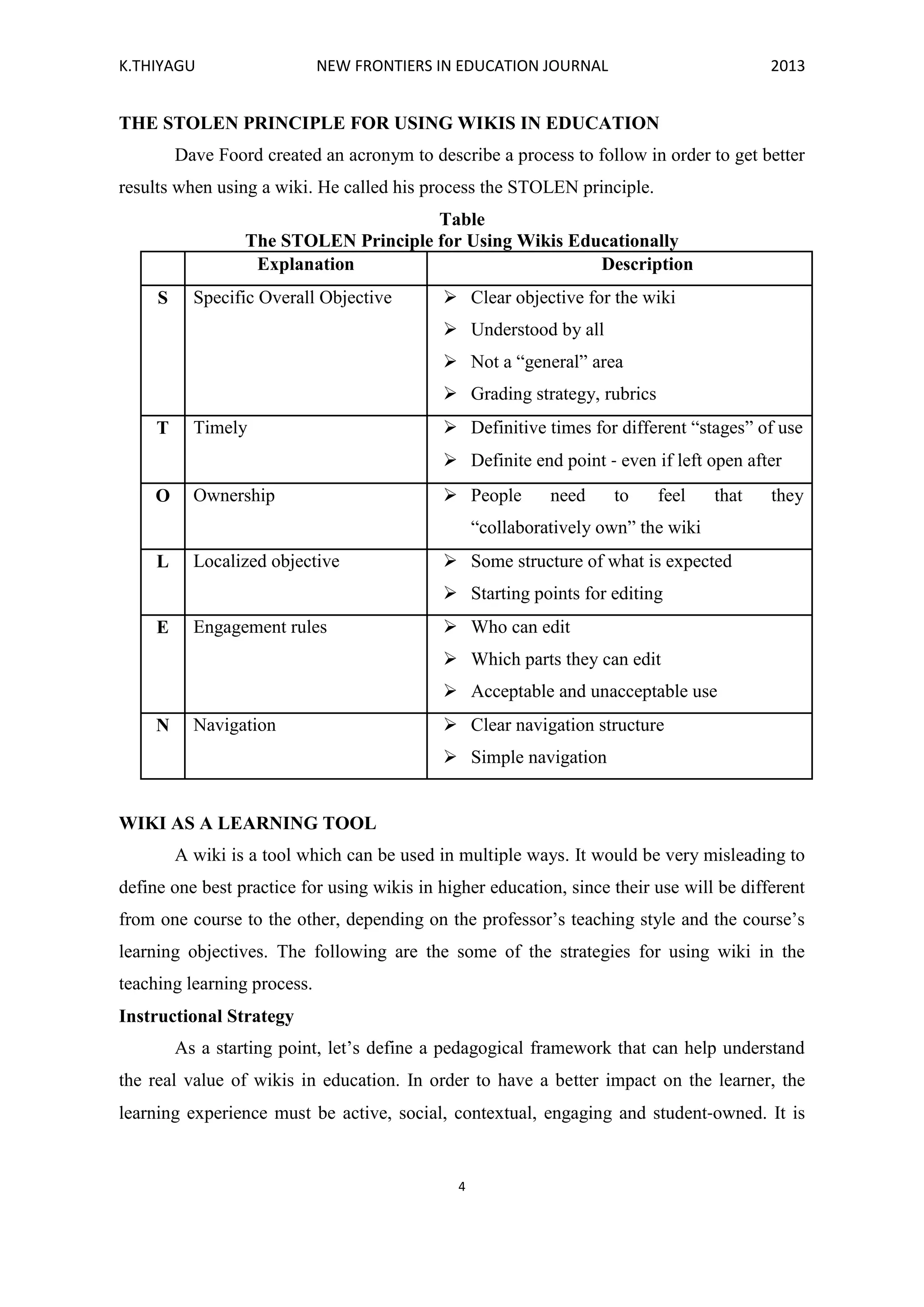
Dave Foord created an acronym to describe a process to follow in order to get better
results when using a wiki. He called his process the STOLEN principle.
Table
The STOLEN Principle for Using Wikis Educationally
Explanation Description
S Specific Overall Objective  Clear objective for the wiki
 Understood by all
 Not a “general” area
 Grading strategy, rubrics
T Timely  Definitive times for different “stages” of use
 Definite end point ‐ even if left open after
O Ownership  People need to feel that they
“collaboratively own” the wiki
L Localized objective  Some structure of what is expected
 Starting points for editing
E Engagement rules  Who can edit
 Which parts they can edit
 Acceptable and unacceptable use
N Navigation  Clear navigation structure
 Simple navigation
WIKI AS A LEARNING TOOL
A wiki is a tool which can be used in multiple ways. It would be very misleading to
define one best practice for using wikis in higher education, since their use will be different
from one course to the other, depending on the professor’s teaching style and the course’s
learning objectives. The following are the some of the strategies for using wiki in the
teaching learning process.
Instructional Strategy
As a starting point, let’s define a pedagogical framework that can help understand
the real value of wikis in education. In order to have a better impact on the learner, the
learning experience must be active, social, contextual, engaging and student‐owned. It is
K.THIYAGU NEW FRONTIERS IN EDUCATION JOURNAL 2013
5
easy to see that wikis have an excellent potential to help achieve all – or at least some – of
these principles.
Control and Ownership Issues
Wikis are, by nature, open. Being open means that contents are, by default, visible
to everybody. There are two issues here which have to be addressed: permissions and
copyright.
Permission Issues: Instructors have to think about the purpose of their wiki and
the impact of having it public versus private. Some students might not like the idea of
sharing their formative thoughts to the entire world, while other might want to be fully
transparent. And some wiki pages might also be fully controlled by the faculty member
only, or reserved to a specific group of students to discuss group‐related issues that should
not be visible to other participants.
Copyright Issues: Some contents might be shared under fair use for educational
purposes, but cannot be replicated or redistributed if the wiki is entirely public. Any
participant can post content to a wiki, even students. Writing it down in your syllabus,
making students sign waivers, and defining copyright in your wiki charter are all valid
alternatives. Discussing copyright issues and fair use with your students from the get‐go
will promote a proper use of your wiki throughout the course, or, at least, give the
instructor ground for disciplinary actions if necessary.
Individual, Team, and Class Contribution
By design, a wiki is a collaborative space, owned and edited by anyone. But there
are some circumstances which require more individuality, privacy, and ownership. A wiki
can be appropriate in these situations, as long as the following conditions are met:
Users are registered: It is possible to track changes and associate a user with them.
That way, if a user changes a page or a section that is reserved to some other users, it is
possible to revert that change or take some actions against that user.
Content can be viewed by everyone: Most wiki tools don’t have a feature that
hides some pages from a registered user, which means that even if a user is not allowed to
make a change, the content is still viewable.
An example of a bad use of a wiki would be asking students to individually post
their answers to an assignment that has a limited scope of answers. When a first student
will have his/her answer posted, others might be tempted to have a quick look for
inspiration. A drop box or an email attachment would be better strategies in such a case.
K.THIYAGU NEW FRONTIERS IN EDUCATION JOURNAL 2013
6
Templates
By using a template, you create a zone between a blank page (which could lead to a
usability disaster) and a pre‐built autocratic structure (which could lead to fear of making
mistakes or plain boredom). Most wiki tools offer the opportunity of modifying the default
template page (the blank page that is presented by default when any user creates a new
page). That default page is a perfect place to promote best or common practices in the wiki.
Understanding the Mark-up Language
Some users get very frustrated of the fact that they cannot, in a wiki, format the
information in the same way as in Word or in HTML. Simplicity has its cost. If the students
want to add something fancy on a wiki, they probably need to build it in another tool and
import it as an image, or link to a PowerPoint file they created. The goal of the wiki is to
create mostly written content. This is what it is good for. Even though wiki mark-up
language is pretty easy to use, some people will be reluctant to “code” a page. It is
imperative to train your users to be proficient with the most common mark-up language, as
a starting point. Sometimes, the Help file is not enough, or way too much.
Wiki Charter and Etiquette
A wiki charter is the equivalent of the syllabus for the entire course: it defines the
usage, the expectation, the conventions, and the accepted behavior within the wiki. It is a
code of conduct that can be set in stone from the beginning by the professor, or negotiated
as the need emerges by the entire community. The wiki charter can act as a code of
conduct, a kind of contract based on the willingness of each participant to be a good
e‐citizen. Sometimes, the charter can define ways to use the wiki that go beyond the
technological capabilities. For instance, teams can be assigned a specific set of pages to edit
into and asked to avoid editing other pages, even though the wiki cannot prevent them to
edit any of the pages.
Using the Wiki Beyond the Wiki
A wiki is a working space. It is an unpolished web page which can be edited by
anyone. Content developed in a wiki doesn’t have to stay in a wiki. The wiki can be the
process in its entirety, or it can be one or more steps in a larger workflow which leads to
another kind of media.
K.THIYAGU NEW FRONTIERS IN EDUCATION JOURNAL 2013
7
USES OF WIKI IN HIGHER EDUCATION
The most uses of wiki obtained from the survey done by Majchrzak et al., (2006)
are as follows;
 Wikis are used in e-learning including web design, requirement descriptions,
testing, and assignments to training.
 Wiki is used in software development processes such as technical documentation,
client approval, issues tracking, internal workflow, quality & process management,
software design, reference information, application maintenance and operations.
 Wiki is used in project management for creating deliverables, meeting agendas,
status reports, standards and practices.
 Wikis is used for community of Practice and user groups, and collaboration.
 Wiki is also used to provide technology support including best practices, and
 customer support information-sharing Other wiki uses include tracking interesting
marketing trends, collecting data, logging daily lead counts, information on
partnerships, notifying users of new features, marketing materials, with some
opening up their wikis to selected customers, also it is used in Research and
Development (R&D) for product requirements, product information, &
commercialization in which everything relating to R&D is tracked through the wiki.
Wikis are used in Education in several ways:
 To support collaborative work, substituting old .doc or .pdf documents.
 To produce a course or study corpus in cooperation with all academic stakeholders:
lecturers, students …
 To distribute information to students, in order to facilitate the updating of materials
by the professor.
CONCLUSION
A wiki is not meant to be true, it’s meant to be discussed. Wikis are transparent; not
only do they show the final product, they reveal the entire creative process. A wiki is one of
the tools that are now available to all to become more literate, not only by increasing
writing skills, but by understanding what this new media literacy really means. They are
also a fun and engaging way to develop collaborative and teamwork skills. Wikis also offer
opportunities for constructive learning more extensively in an educational environment due
to their low technological barriers and their flexible functionality. Wikis and other online
K.THIYAGU NEW FRONTIERS IN EDUCATION JOURNAL 2013
8
collaboration tools can be used in the classroom for a variety of uses, but Wikis, in
particular, may not be as directly applicable to classroom objectives as Blogs are, due to the
nature of allowing anyone to make edits.
REFERENCES
 Barton, Matt (2004). Embrace the Wiki Way!, Personal Blog. Retrieved April 24,
2012.
 Chickering, A. W., Gamson, Z. F., & American Association for Higher Education,
Washington, DC. (1987). Seven principles for good practice in undergraduate
education. AAHE Bulletin, 3.
 Cunningham, Ward (1995), Wiki History. Retrieved April 24, 2012.
http://c2.com/cgi/wiki?WikiHistory
 Foord, Dave (2007). The STOLEN principle Tick List, A6 Training and
Consultancy. Retrieved April 24, 2012.
http://www.a6training.co.uk/Social_Software.php
 Foster, Andrea (2007). Software Group Gets Online Textbooks to the Developing
World, The Chronicle of Higher Education, April 26, 2012. Pages A28‐A29.
 Grenier, Brian (2007), Wikis in the Classroom, El Paso Independent School
District. Retrieved April 28, 2012.
http://www.slideshare.net/wikis‐in‐the‐classroom‐34105.
 Lamb, Bryan (2004), Wide Open Spaces: Wikis, Ready or Not, EDUCAUSE
Review, vol. 39, no. 5 (September/October 2004). Pages 36‐48.
 Majchrzak et al., (2006). Wikipatterns: a practical guide to improving productivity
and collaboration in your organization, Wiley, Indianapolis. ISBN:
978‐0‐470‐22362‐8.
 Richardson, Will (2006). Blogs, wikis, podcasts, and other powerful web tools for
classrooms, Corwin Press, Thousand Oaks CA. ISBN: 978‐1412927673.
 Schacht, Paul (2006). The Wiki Collaborative Writing Project, in Mader, Stewart,
Using Wiki in Education. http://wikiineducation.com.
 Shareski, D., & Winkler, C. A. K. (2006). Are wikis worth the time?, Learning and
Leading with Technology, 33(4), 6.
 Turnbull, Giles (2004). Talking to Ward Cunningham about Wiki, luvly, April 6,
2012. http://gorjuss.com/luvly/20040406‐wardcunningham.html.

1 WIKIS IN HIGHER EDUCATION: THE CONSTRUCTIVIST LEARNING PARADIGM

  • 1.
    K.THIYAGU NEW FRONTIERSIN EDUCATION JOURNAL 2013 1 WIKIS IN HIGHER EDUCATION: THE CONSTRUCTIVIST LEARNING PARADIGM K.Thiyagu, Assistant Professor, thiyagusuri@gmail.com surithiyagu@gmail.com ABSTRACT Wikis are a very versatile and easy-to-use tool that is finding increasing applications in teaching and learning. Wikis are largely used in education for both teaching and learning. Wikis can be used in the classroom to support many learning approaches. Learning approaches that could most be supported by wikis are collaborative learning and the constructivist learning paradigms. A wiki is a web page that can be viewed and modified by anybody with a web browser and access to the internet. This means that any visitor to the wiki can change its content if they desire. While the potential for mischief exists, wikis can be surprisingly robust, open- ended, collaborative group sites. This paper deals about the characteristics of wiki, wiki as a learning tool and uses of wiki in education. This paper also explains the concept of STOLEN principles for using wiki in higher education. Key words: Wiki, STOLEN, Learning, Tool etc., INTRODUCTION: WIKI The word Wiki originates from a Hawaiian term which means “quick” or “Super fast”. As popularly known a wiki refers to a web site that anybody can edit. The first wiki was launched by Howard G Cunningham whose wiki site was named as WikiWikiWeb on March 25, 1996. The most popular wiki site is Wikipedia (http://www.wikipedia.org). Other examples of wiki sites are http://www.twiki.org, and http://pbwiki.com. The main distinctive feature of any wiki site is that anyone can edit it. The underlying concept of a wiki is the fact that it acts as a collaborative tool and henceforth facilitates more effectively the production of a group work. There are now thousands of wikis on the Internet and their numbers are growing rapidly. There are three important characteristics that differentiate wikis from traditional websites. First, one does not need to download any software to work with wikis. Second, learning how to edit a wiki is very easy and intuitive. Third, by default, wikis are designed to support collaborative projects and allow virtually anybody to edit
  • 2.
    K.THIYAGU NEW FRONTIERSIN EDUCATION JOURNAL 2013 2 anything. Wikis permit asynchronous communication and group collaboration across the internet. Variously described as a composition system, a discussion medium, a repository, a mail system, and a tool for collaboration, wikis provide users with both author and editor privileges; the overall organisation of contributions can be edited as well as the content itself. Wikis are able to incorporate sounds, movies, and pictures; they may prove to be a simple to tool to create multimedia presentations and simple digital stories. CHARACTERISTICS OF WIKI The following are the some of the characteristics of wiki: No authorship certified: A wiki is owned by its community, meaning that anybody who posts something on a wiki must let it go, even if it means that the next user will erase or rephrase everything that has been posted. It is a democratic tool which enables collaboration. Simplified mark-up language: Wiki mark-up language is easier and more automated than HTML. URLs are linked automatically. Creating an internal link creates a new page without further programming. In other words, “Wiki language is the most naked embodiment of the Hyperlink concept.” Focal point is on content, not on design: Most wikis look like very plain HTML pages. The quality of a wiki is in its content, not in the way it looks. Version tracking: The history of every single small change of every wiki page is available to anybody, which means that a page can travel back in time to a previous state at any moment. The structure is defined by the community: There is no need to create a wiki architecture from the get‐go or to have a group leader who imposes a way of organizing content. Wiki rules will emerge from consensus when needed. The community is the watchdog: If the community is engaged in the wiki and because of the version tracking feature, getting rid of wrong entries and graffiti (made consciously by vandals) is fast and efficient. Therefore, there is no need for any kind of security procedure or for a user registration process. A lot of wikis are currently working very efficiently by following these “anarchic guidelines”. But as usage began to explode, a lot of people saw a huge potential for other usages, particularly in the corporate world, where accountability, copyright respect, and privacy are all required.
  • 3.
    K.THIYAGU NEW FRONTIERSIN EDUCATION JOURNAL 2013 3 TYPICAL USAGE OF WIKIS Wikis are used to support a large number of different activities. Here are some of the most common ways wikis are used. Brainstorming: When starting a specific project or a creative process, participants are invited to add items and thoughts on a wiki. They are also asked to link all these random thoughts and concept together in order to stimulate creativity. Group project: A wiki can act as a private intranet for a specific group project so all participants can communicate, share resources (including texts, videos, spreadsheets, links, etc.), and write a report or a book together. Meeting support: An agenda for a specific meeting is posted on a wiki and participants are invited to consult and edit it prior to a meeting. The wiki is edited during the meeting to include was discussed. Participants can later use the wiki to post missing information or follow‐up items. This technique is also very useful for training, presentations, and birds of a feather sessions during conferences. Make lists: From a list of best restaurants in town to a glossary of terms used in a specific field of expertise, a wiki is a great way to organize this kind of content. In the same spirit, wikis can also be used to build an online repository of relevant documents or FAQs. Collections of links: Wikis can be used for social bookmarking. They give to all participants the possibility to post, comment, group, and classify links of all nature or in a specific field of expertise. Writing a collective letter, position, statement, web content: When writing something that is intended for an official legal instance, to clients, to upper management or to the general public, a wiki is an excellent tool to reach a consensus, define key ideas, and write down the content to be clear and non‐offensive. Building a group portfolio: Any organization can use a wiki to post past projects, testimonials from clients, history of the organization, etc. This kind of portfolio is a powerful marketing tool.
  • 4.
    K.THIYAGU NEW FRONTIERSIN EDUCATION JOURNAL 2013 4 THE STOLEN PRINCIPLE FOR USING WIKIS IN EDUCATION Dave Foord created an acronym to describe a process to follow in order to get better results when using a wiki. He called his process the STOLEN principle. Table The STOLEN Principle for Using Wikis Educationally Explanation Description S Specific Overall Objective  Clear objective for the wiki  Understood by all  Not a “general” area  Grading strategy, rubrics T Timely  Definitive times for different “stages” of use  Definite end point ‐ even if left open after O Ownership  People need to feel that they “collaboratively own” the wiki L Localized objective  Some structure of what is expected  Starting points for editing E Engagement rules  Who can edit  Which parts they can edit  Acceptable and unacceptable use N Navigation  Clear navigation structure  Simple navigation WIKI AS A LEARNING TOOL A wiki is a tool which can be used in multiple ways. It would be very misleading to define one best practice for using wikis in higher education, since their use will be different from one course to the other, depending on the professor’s teaching style and the course’s learning objectives. The following are the some of the strategies for using wiki in the teaching learning process. Instructional Strategy As a starting point, let’s define a pedagogical framework that can help understand the real value of wikis in education. In order to have a better impact on the learner, the learning experience must be active, social, contextual, engaging and student‐owned. It is
  • 5.
    K.THIYAGU NEW FRONTIERSIN EDUCATION JOURNAL 2013 5 easy to see that wikis have an excellent potential to help achieve all – or at least some – of these principles. Control and Ownership Issues Wikis are, by nature, open. Being open means that contents are, by default, visible to everybody. There are two issues here which have to be addressed: permissions and copyright. Permission Issues: Instructors have to think about the purpose of their wiki and the impact of having it public versus private. Some students might not like the idea of sharing their formative thoughts to the entire world, while other might want to be fully transparent. And some wiki pages might also be fully controlled by the faculty member only, or reserved to a specific group of students to discuss group‐related issues that should not be visible to other participants. Copyright Issues: Some contents might be shared under fair use for educational purposes, but cannot be replicated or redistributed if the wiki is entirely public. Any participant can post content to a wiki, even students. Writing it down in your syllabus, making students sign waivers, and defining copyright in your wiki charter are all valid alternatives. Discussing copyright issues and fair use with your students from the get‐go will promote a proper use of your wiki throughout the course, or, at least, give the instructor ground for disciplinary actions if necessary. Individual, Team, and Class Contribution By design, a wiki is a collaborative space, owned and edited by anyone. But there are some circumstances which require more individuality, privacy, and ownership. A wiki can be appropriate in these situations, as long as the following conditions are met: Users are registered: It is possible to track changes and associate a user with them. That way, if a user changes a page or a section that is reserved to some other users, it is possible to revert that change or take some actions against that user. Content can be viewed by everyone: Most wiki tools don’t have a feature that hides some pages from a registered user, which means that even if a user is not allowed to make a change, the content is still viewable. An example of a bad use of a wiki would be asking students to individually post their answers to an assignment that has a limited scope of answers. When a first student will have his/her answer posted, others might be tempted to have a quick look for inspiration. A drop box or an email attachment would be better strategies in such a case.
  • 6.
    K.THIYAGU NEW FRONTIERSIN EDUCATION JOURNAL 2013 6 Templates By using a template, you create a zone between a blank page (which could lead to a usability disaster) and a pre‐built autocratic structure (which could lead to fear of making mistakes or plain boredom). Most wiki tools offer the opportunity of modifying the default template page (the blank page that is presented by default when any user creates a new page). That default page is a perfect place to promote best or common practices in the wiki. Understanding the Mark-up Language Some users get very frustrated of the fact that they cannot, in a wiki, format the information in the same way as in Word or in HTML. Simplicity has its cost. If the students want to add something fancy on a wiki, they probably need to build it in another tool and import it as an image, or link to a PowerPoint file they created. The goal of the wiki is to create mostly written content. This is what it is good for. Even though wiki mark-up language is pretty easy to use, some people will be reluctant to “code” a page. It is imperative to train your users to be proficient with the most common mark-up language, as a starting point. Sometimes, the Help file is not enough, or way too much. Wiki Charter and Etiquette A wiki charter is the equivalent of the syllabus for the entire course: it defines the usage, the expectation, the conventions, and the accepted behavior within the wiki. It is a code of conduct that can be set in stone from the beginning by the professor, or negotiated as the need emerges by the entire community. The wiki charter can act as a code of conduct, a kind of contract based on the willingness of each participant to be a good e‐citizen. Sometimes, the charter can define ways to use the wiki that go beyond the technological capabilities. For instance, teams can be assigned a specific set of pages to edit into and asked to avoid editing other pages, even though the wiki cannot prevent them to edit any of the pages. Using the Wiki Beyond the Wiki A wiki is a working space. It is an unpolished web page which can be edited by anyone. Content developed in a wiki doesn’t have to stay in a wiki. The wiki can be the process in its entirety, or it can be one or more steps in a larger workflow which leads to another kind of media.
  • 7.
    K.THIYAGU NEW FRONTIERSIN EDUCATION JOURNAL 2013 7 USES OF WIKI IN HIGHER EDUCATION The most uses of wiki obtained from the survey done by Majchrzak et al., (2006) are as follows;  Wikis are used in e-learning including web design, requirement descriptions, testing, and assignments to training.  Wiki is used in software development processes such as technical documentation, client approval, issues tracking, internal workflow, quality & process management, software design, reference information, application maintenance and operations.  Wiki is used in project management for creating deliverables, meeting agendas, status reports, standards and practices.  Wikis is used for community of Practice and user groups, and collaboration.  Wiki is also used to provide technology support including best practices, and  customer support information-sharing Other wiki uses include tracking interesting marketing trends, collecting data, logging daily lead counts, information on partnerships, notifying users of new features, marketing materials, with some opening up their wikis to selected customers, also it is used in Research and Development (R&D) for product requirements, product information, & commercialization in which everything relating to R&D is tracked through the wiki. Wikis are used in Education in several ways:  To support collaborative work, substituting old .doc or .pdf documents.  To produce a course or study corpus in cooperation with all academic stakeholders: lecturers, students …  To distribute information to students, in order to facilitate the updating of materials by the professor. CONCLUSION A wiki is not meant to be true, it’s meant to be discussed. Wikis are transparent; not only do they show the final product, they reveal the entire creative process. A wiki is one of the tools that are now available to all to become more literate, not only by increasing writing skills, but by understanding what this new media literacy really means. They are also a fun and engaging way to develop collaborative and teamwork skills. Wikis also offer opportunities for constructive learning more extensively in an educational environment due to their low technological barriers and their flexible functionality. Wikis and other online
  • 8.
    K.THIYAGU NEW FRONTIERSIN EDUCATION JOURNAL 2013 8 collaboration tools can be used in the classroom for a variety of uses, but Wikis, in particular, may not be as directly applicable to classroom objectives as Blogs are, due to the nature of allowing anyone to make edits. REFERENCES  Barton, Matt (2004). Embrace the Wiki Way!, Personal Blog. Retrieved April 24, 2012.  Chickering, A. W., Gamson, Z. F., & American Association for Higher Education, Washington, DC. (1987). Seven principles for good practice in undergraduate education. AAHE Bulletin, 3.  Cunningham, Ward (1995), Wiki History. Retrieved April 24, 2012. http://c2.com/cgi/wiki?WikiHistory  Foord, Dave (2007). The STOLEN principle Tick List, A6 Training and Consultancy. Retrieved April 24, 2012. http://www.a6training.co.uk/Social_Software.php  Foster, Andrea (2007). Software Group Gets Online Textbooks to the Developing World, The Chronicle of Higher Education, April 26, 2012. Pages A28‐A29.  Grenier, Brian (2007), Wikis in the Classroom, El Paso Independent School District. Retrieved April 28, 2012. http://www.slideshare.net/wikis‐in‐the‐classroom‐34105.  Lamb, Bryan (2004), Wide Open Spaces: Wikis, Ready or Not, EDUCAUSE Review, vol. 39, no. 5 (September/October 2004). Pages 36‐48.  Majchrzak et al., (2006). Wikipatterns: a practical guide to improving productivity and collaboration in your organization, Wiley, Indianapolis. ISBN: 978‐0‐470‐22362‐8.  Richardson, Will (2006). Blogs, wikis, podcasts, and other powerful web tools for classrooms, Corwin Press, Thousand Oaks CA. ISBN: 978‐1412927673.  Schacht, Paul (2006). The Wiki Collaborative Writing Project, in Mader, Stewart, Using Wiki in Education. http://wikiineducation.com.  Shareski, D., & Winkler, C. A. K. (2006). Are wikis worth the time?, Learning and Leading with Technology, 33(4), 6.  Turnbull, Giles (2004). Talking to Ward Cunningham about Wiki, luvly, April 6, 2012. http://gorjuss.com/luvly/20040406‐wardcunningham.html.