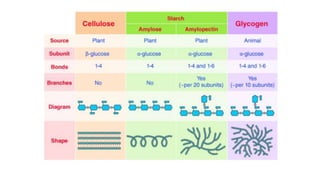
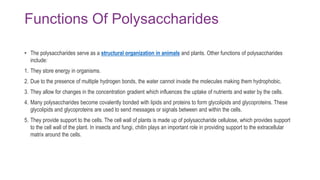
Polysaccharides have several key properties: they are not sweet, many are insoluble in water, and they are high molecular weight carbohydrates made of hydrogen, carbon, and oxygen. Polysaccharides are categorized as either homopolysaccharides, which contain the same type of monosaccharide, or heteropolysaccharides, which contain different types. Examples of important homopolysaccharides include glycogen, cellulose, and starch, while examples of heteropolysaccharides include hyaluronic acid, heparin, and chondroitin-4-sulfate. Polysaccharides serve structural roles in organisms and also store energy, influence nutrient and water uptake, and provide support to cells.