Carbohydrates-III
December 20, 2022
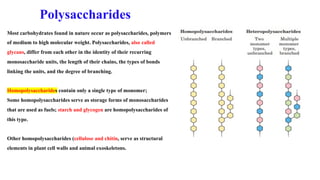
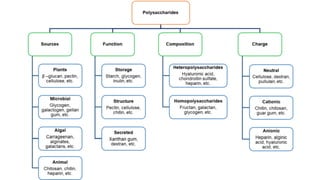
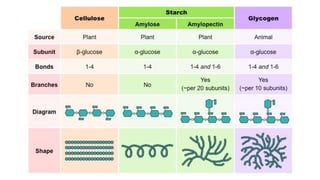
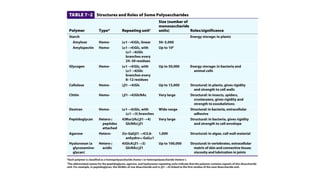
Most carbohydrates found in nature occur as polysaccharides, polymers
of medium to high molecular weight. Polysaccharides, also called
glycans, differ from each other in the identity of their recurring
monosaccharide units, the length of their chains, the types of bonds
linking the units, and the degree of branching.
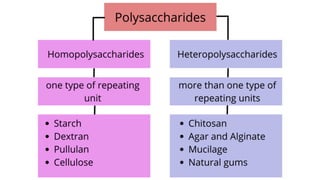
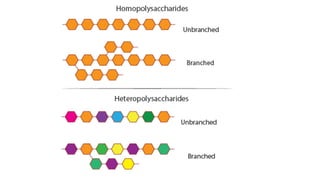
Homopolysaccharides contain only a single type of monomer;
Some homopolysaccharides serve as storage forms of monosaccharides
that are used as fuels; starch and glycogen are homopolysaccharides of
this type.
Other homopolysaccharides (cellulose and chitin, serve as structural
elements in plant cell walls and animal exoskeletons.
Polysaccharides
Heteropolysaccharides contain two or more different kinds.
Heteropolysaccharides provide extracellular support for
organisms of all kingdoms.
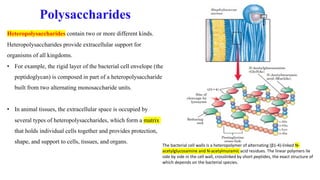
• For example, the rigid layer of the bacterial cell envelope (the
peptidoglycan) is composed in part of a heteropolysaccharide
built from two alternating monosaccharide units.
• In animal tissues, the extracellular space is occupied by
several types of heteropolysaccharides, which form a matrix
that holds individual cells together and provides protection,
shape, and support to cells, tissues, and organs.
Polysaccharides
The bacterial cell walls is a heteropolymer of alternating (β1-4)-linked N-
acetylglucosamine and N-acetylmuramic acid residues. The linear polymers lie
side by side in the cell wall, crosslinked by short peptides, the exact structure of
which depends on the bacterial species.
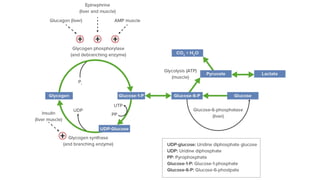
Glycogen
1. Glycogen is the main storage polysaccharide occurring in animal cells.
2. Its structure is very similar to amylopectin, in that main chain linkages between D glucose units are (a1"4) and the
linkages at branch points are (a1"6).
Branch points occur more frequently in glycogen (about every 8 to 12 residues) than in amylopectin.
Glycogen
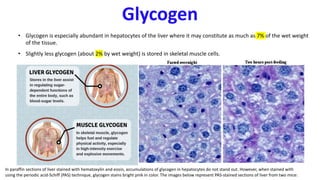
• Glycogen is especially abundant in hepatocytes of the liver where it may constitute as much as 7% of the wet weight
of the tissue.
• Slightly less glycogen (about 2% by wet weight) is stored in skeletal muscle cells.
In paraffin sections of liver stained with hematoxylin and eosin, accumulations of glycogen in hepatocytes do not stand out. However, when stained with
using the periodic acid-Schiff (PAS) technique, glycogen stains bright pink in color. The images below represent PAS-stained sections of liver from two mice:
Glycogen
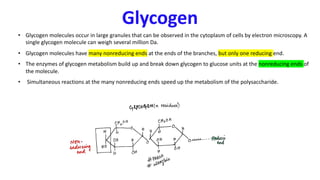
• Glycogen molecules occur in large granules that can be observed in the cytoplasm of cells by electron microscopy. A
single glycogen molecule can weigh several million Da.
• Glycogen molecules have many nonreducing ends at the ends of the branches, but only one reducing end.
• The enzymes of glycogen metabolism build up and break down glycogen to glucose units at the nonreducing ends of
the molecule.
• Simultaneous reactions at the many nonreducing ends speed up the metabolism of the polysaccharide.
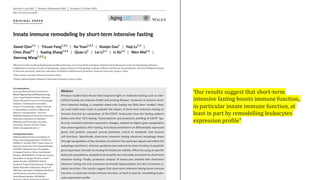
‘Our results suggest that short-term
intensive fasting boosts immune function,
in particular innate immune function, at
least in part by remodelling leukocytes
expression profile”
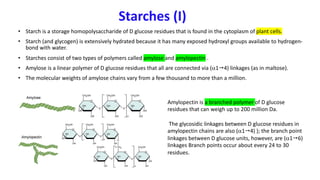
Starches (I)
• Starch is a storage homopolysaccharide of D glucose residues that is found in the cytoplasm of plant cells.
• Starch (and glycogen) is extensively hydrated because it has many exposed hydroxyl groups available to hydrogen-
bond with water.
• Starches consist of two types of polymers called amylose and amylopectin .
• Amylose is a linear polymer of D glucose residues that all are connected via (a1"4) linkages (as in maltose).
• The molecular weights of amylose chains vary from a few thousand to more than a million.
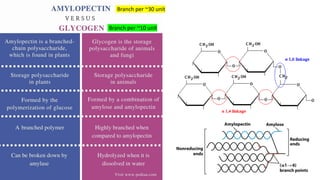
Amylopectin is a branched polymer of D glucose
residues that can weigh up to 200 million Da.
The glycosidic linkages between D glucose residues in
amylopectin chains are also (a1"4) ); the branch point
linkages between D glucose units, however, are (a1"6)
linkages Branch points occur about every 24 to 30
residues.
Branch per ~10 unit
Branch per ~30 unit
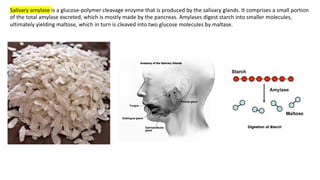
Salivary amylase is a glucose-polymer cleavage enzyme that is produced by the salivary glands. It comprises a small portion
of the total amylase excreted, which is mostly made by the pancreas. Amylases digest starch into smaller molecules,
ultimately yielding maltose, which in turn is cleaved into two glucose molecules by maltase.
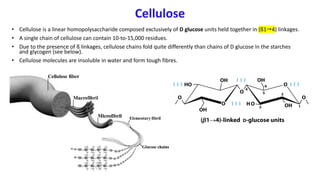
Cellulose
• Cellulose is a linear homopolysaccharide composed exclusively of D glucose units held together in (ß1"4) linkages.
• A single chain of cellulose can contain 10-to-15,000 residues.
• Due to the presence of ß linkages, cellulose chains fold quite differently than chains of D glucose in the starches
and glycogen (see below).
• Cellulose molecules are insoluble in water and form tough fibres.
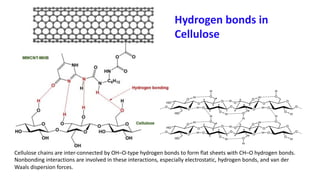
Cellulose chains are inter-connected by OH–O-type hydrogen bonds to form flat sheets with CH–O hydrogen bonds.
Nonbonding interactions are involved in these interactions, especially electrostatic, hydrogen bonds, and van der
Waals dispersion forces.
Hydrogen bonds in
Cellulose
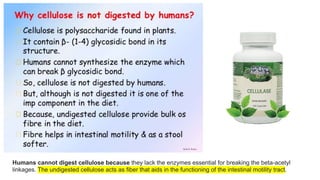
Humans cannot digest cellulose because they lack the enzymes essential for breaking the beta-acetyl
linkages. The undigested cellulose acts as fiber that aids in the functioning of the intestinal motility tract.
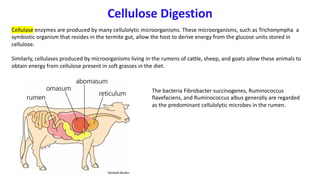
Cellulase enzymes are produced by many cellulolytic microorganisms. These microorganisms, such as Trichonympha a
symbiotic organism that resides in the termite gut, allow the host to derive energy from the glucose units stored in
cellulose.
Similarly, cellulases produced by microorganisms living in the rumens of cattle, sheep, and goats allow these animals to
obtain energy from cellulose present in soft grasses in the diet.
Cellulose Digestion
The bacteria Fibrobacter succinogenes, Ruminococcus
flavefaciens, and Ruminococcus albus generally are regarded
as the predominant cellulolytic microbes in the rumen.
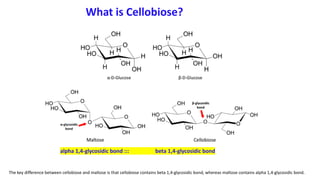
What is Cellobiose?
The key difference between cellobiose and maltose is that cellobiose contains beta 1,4-glycosidic bond, whereas maltose contains alpha 1,4-glycosidic bond.
alpha 1,4-glycosidic bond ::: beta 1,4-glycosidic bond
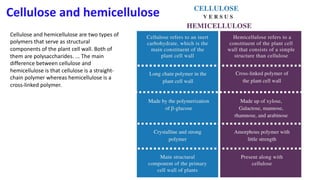
Cellulose and hemicellulose are two types of
polymers that serve as structural
components of the plant cell wall. Both of
them are polysaccharides. ... The main
difference between cellulose and
hemicellulose is that cellulose is a straight-
chain polymer whereas hemicellulose is a
cross-linked polymer.
Cellulose and hemicellulose
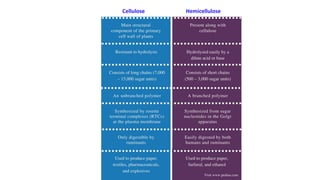
Cellulose Hemicellulose
Chitin
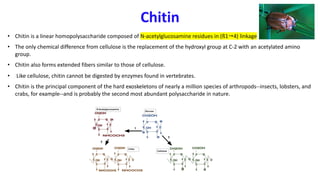
• Chitin is a linear homopolysaccharide composed of N-acetylglucosamine residues in (ß1"4) linkage
• The only chemical difference from cellulose is the replacement of the hydroxyl group at C-2 with an acetylated amino
group.
• Chitin also forms extended fibers similar to those of cellulose.
• Like cellulose, chitin cannot be digested by enzymes found in vertebrates.
• Chitin is the principal component of the hard exoskeletons of nearly a million species of arthropods--insects, lobsters, and
crabs, for example--and is probably the second most abundant polysaccharide in nature.
Glycosaminoglycans (I)
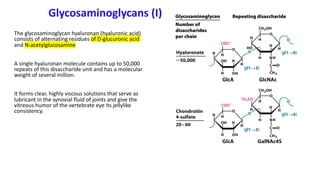
The glycosaminoglycan hyaluronan (hyaluronic acid)
consists of alternating residues of D-glucuronic acid
and N-acetylglucosamine
A single hyaluronan molecule contains up to 50,000
repeats of this disaccharide unit and has a molecular
weight of several million.
It forms clear, highly viscous solutions that serve as
lubricant in the synovial fluid of joints and give the
vitreous humor of the vertebrate eye its jellylike
consistency.
Glycosaminoglycans (II)
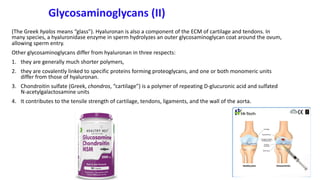
(The Greek hyalos means “glass”). Hyaluronan is also a component of the ECM of cartilage and tendons. In
many species, a hyaluronidase enzyme in sperm hydrolyzes an outer glycosaminoglycan coat around the ovum,
allowing sperm entry.
Other glycosaminoglycans differ from hyaluronan in three respects:
1. they are generally much shorter polymers,
2. they are covalently linked to specific proteins forming proteoglycans, and one or both monomeric units
differ from those of hyaluronan.
3. Chondroitin sulfate (Greek, chondros, “cartilage”) is a polymer of repeating D-glucuronic acid and sulfated
N-acetylgalactosamine units
4. It contributes to the tensile strength of cartilage, tendons, ligaments, and the wall of the aorta.
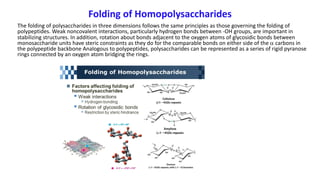
Folding of Homopolysaccharides
The folding of polysaccharides in three dimensions follows the same principles as those governing the folding of
polypeptides. Weak noncovalent interactions, particularly hydrogen bonds between -OH groups, are important in
stabilizing structures. In addition, rotation about bonds adjacent to the oxygen atoms of glycosidic bonds between
monosaccharide units have steric constraints as they do for the comparable bonds on either side of the a carbons in
the polypeptide backbone Analogous to polypeptides, polysaccharides can be represented as a series of rigid pyranose
rings connected by an oxygen atom bridging the rings.
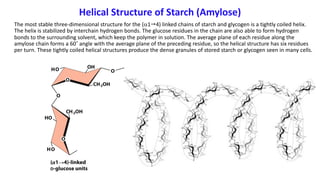
Helical Structure of Starch (Amylose)
The most stable three-dimensional structure for the (a1"4) linked chains of starch and glycogen is a tightly coiled helix.
The helix is stabilized by interchain hydrogen bonds. The glucose residues in the chain are also able to form hydrogen
bonds to the surrounding solvent, which keep the polymer in solution. The average plane of each residue along the
amylose chain forms a 60˚ angle with the average plane of the preceding residue, so the helical structure has six residues
per turn. These tightly coiled helical structures produce the dense granules of stored starch or glycogen seen in many cells.
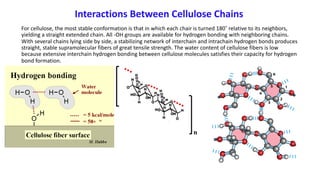
Interactions Between Cellulose Chains
For cellulose, the most stable conformation is that in which each chair is turned 180˚ relative to its neighbors,
yielding a straight extended chain. All -OH groups are available for hydrogen bonding with neighboring chains.
With several chains lying side by side, a stabilizing network of interchain and intrachain hydrogen bonds produces
straight, stable supramolecular fibers of great tensile strength. The water content of cellulose fibers is low
because extensive interchain hydrogen bonding between cellulose molecules satisfies their capacity for hydrogen
bond formation.
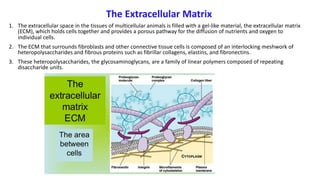
The Extracellular Matrix
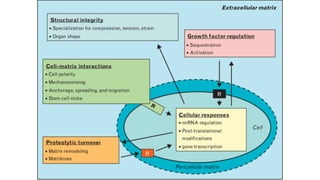
1. The extracellular space in the tissues of multicellular animals is filled with a gel-like material, the extracellular matrix
(ECM), which holds cells together and provides a porous pathway for the diffusion of nutrients and oxygen to
individual cells.
2. The ECM that surrounds fibroblasts and other connective tissue cells is composed of an interlocking meshwork of
heteropolysaccharides and fibrous proteins such as fibrillar collagens, elastins, and fibronectins.
3. These heteropolysaccharides, the glycosaminoglycans, are a family of linear polymers composed of repeating
disaccharide units.
The Extracellular Matrix
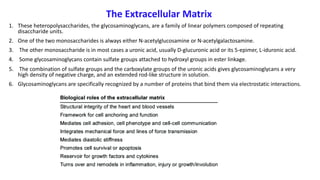
1. These heteropolysaccharides, the glycosaminoglycans, are a family of linear polymers composed of repeating
disaccharide units.
2. One of the two monosaccharides is always either N-acetylglucosamine or N-acetylgalactosamine.
3. The other monosaccharide is in most cases a uronic acid, usually D-glucuronic acid or its 5-epimer, L-iduronic acid.
4. Some glycosaminoglycans contain sulfate groups attached to hydroxyl groups in ester linkage.
5. The combination of sulfate groups and the carboxylate groups of the uronic acids gives glycosaminoglycans a very
high density of negative charge, and an extended rod-like structure in solution.
6. Glycosaminoglycans are specifically recognized by a number of proteins that bind them via electrostatic interactions.
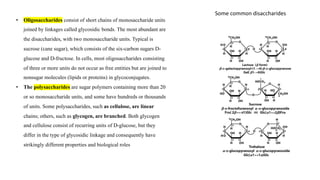
• Oligosaccharides consist of short chains of monosaccharide units
joined by linkages called glycosidic bonds. The most abundant are
the disaccharides, with two monosaccharide units. Typical is
sucrose (cane sugar), which consists of the six-carbon sugars D-
glucose and D-fructose. In cells, most oligosaccharides consisting
of three or more units do not occur as free entities but are joined to
nonsugar molecules (lipids or proteins) in glycoconjugates.
• The polysaccharides are sugar polymers containing more than 20
or so monosaccharide units, and some have hundreds or thousands
of units. Some polysaccharides, such as cellulose, are linear
chains; others, such as glycogen, are branched. Both glycogen
and cellulose consist of recurring units of D-glucose, but they
differ in the type of glycosidic linkage and consequently have
strikingly different properties and biological roles
Some common disaccharides
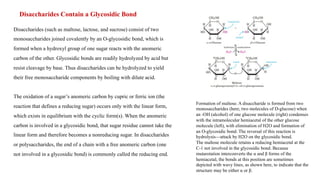
Disaccharides Contain a Glycosidic Bond
Disaccharides (such as maltose, lactose, and sucrose) consist of two
monosaccharides joined covalently by an O-glycosidic bond, which is
formed when a hydroxyl group of one sugar reacts with the anomeric
carbon of the other. Glycosidic bonds are readily hydrolyzed by acid but
resist cleavage by base. Thus disaccharides can be hydrolyzed to yield
their free monosaccharide components by boiling with dilute acid.
The oxidation of a sugar’s anomeric carbon by cupric or ferric ion (the
reaction that defines a reducing sugar) occurs only with the linear form,
which exists in equilibrium with the cyclic form(s). When the anomeric
carbon is involved in a glycosidic bond, that sugar residue cannot take the
linear form and therefore becomes a nonreducing sugar. In disaccharides
or polysaccharides, the end of a chain with a free anomeric carbon (one
not involved in a glycosidic bond) is commonly called the reducing end.
Formation of maltose. A disaccharide is formed from two
monosaccharides (here, two molecules of D-glucose) when
an -OH (alcohol) of one glucose molecule (right) condenses
with the intramolecular hemiacetal of the other glucose
molecule (left), with elimination of H2O and formation of
an O-glycosidic bond. The reversal of this reaction is
hydrolysis—attack by H2O on the glycosidic bond.
The maltose molecule retains a reducing hemiacetal at the
C-1 not involved in the glycosidic bond. Because
mutarotation interconverts the α and β forms of the
hemiacetal, the bonds at this position are sometimes
depicted with wavy lines, as shown here, to indicate that the
structure may be either α or β.
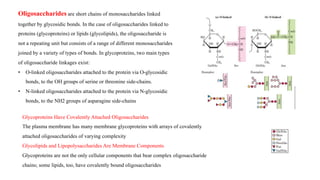
Oligosaccharides are short chains of monosaccharides linked
together by glycosidic bonds. In the case of oligosaccharides linked to
proteins (glycoproteins) or lipids (glycolipids), the oligosaccharide is
not a repeating unit but consists of a range of different monosaccharides
joined by a variety of types of bonds. In glycoproteins, two main types
of oligosaccharide linkages exist:
• O-linked oligosaccharides attached to the protein via O-glycosidic
bonds, to the OH groups of serine or threonine side-chains.
• N-linked oligosaccharides attached to the protein via N-glycosidic
bonds, to the NH2 groups of asparagine side-chains
Glycoproteins Have Covalently Attached Oligosaccharides
The plasma membrane has many membrane glycoproteins with arrays of covalently
attached oligosaccharides of varying complexity
Glycolipids and Lipopolysaccharides Are Membrane Components
Glycoproteins are not the only cellular components that bear complex oligosaccharide
chains; some lipids, too, have covalently bound oligosaccharides
Some Homopolysaccharides Are Stored Forms of Fuel
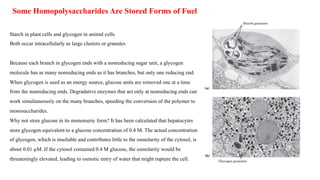
Starch in plant cells and glycogen in animal cells
Both occur intracellularly as large clusters or granules
Because each branch in glycogen ends with a nonreducing sugar unit, a glycogen
molecule has as many nonreducing ends as it has branches, but only one reducing end.
When glycogen is used as an energy source, glucose units are removed one at a time
from the nonreducing ends. Degradative enzymes that act only at nonreducing ends can
work simultaneously on the many branches, speeding the conversion of the polymer to
monosaccharides.
Why not store glucose in its monomeric form? It has been calculated that hepatocytes
store glycogen equivalent to a glucose concentration of 0.4 M. The actual concentration
of glycogen, which is insoluble and contributes little to the osmolarity of the cytosol, is
about 0.01 µM. If the cytosol contained 0.4 M glucose, the osmolarity would be
threateningly elevated, leading to osmotic entry of water that might rupture the cell.
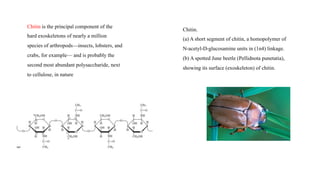
Chitin.
(a) A short segment of chitin, a homopolymer of
N-acetyl-D-glucosamine units in (1n4) linkage.
(b) A spotted June beetle (Pellidnota punetatia),
showing its surface (exoskeleton) of chitin.
Chitin is the principal component of the
hard exoskeletons of nearly a million
species of arthropods—insects, lobsters, and
crabs, for example— and is probably the
second most abundant polysaccharide, next
to cellulose, in nature
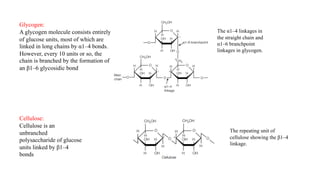
Glycogen:
A glycogen molecule consists entirely
of glucose units, most of which are
linked in long chains by α1–4 bonds.
However, every 10 units or so, the
chain is branched by the formation of
an β1–6 glycosidic bond
Cellulose:
Cellulose is an
unbranched
polysaccharide of glucose
units linked by β1–4
bonds
The repeating unit of
cellulose showing the β1–4
linkage.
The α1–4 linkages in
the straight chain and
α1–6 branchpoint
linkages in glycogen.
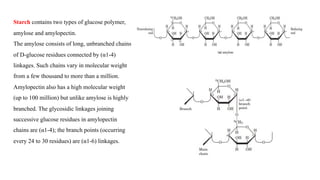
Starch contains two types of glucose polymer,
amylose and amylopectin.
The amylose consists of long, unbranched chains
of D-glucose residues connected by (α1-4)
linkages. Such chains vary in molecular weight
from a few thousand to more than a million.
Amylopectin also has a high molecular weight
(up to 100 million) but unlike amylose is highly
branched. The glycosidic linkages joining
successive glucose residues in amylopectin
chains are (α1-4); the branch points (occurring
every 24 to 30 residues) are (α1-6) linkages.
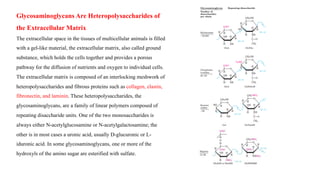
Glycosaminoglycans Are Heteropolysaccharides of
the Extracellular Matrix
The extracellular space in the tissues of multicellular animals is filled
with a gel-like material, the extracellular matrix, also called ground
substance, which holds the cells together and provides a porous
pathway for the diffusion of nutrients and oxygen to individual cells.
The extracellular matrix is composed of an interlocking meshwork of
heteropolysaccharides and fibrous proteins such as collagen, elastin,
fibronectin, and laminin. These heteropolysaccharides, the
glycosaminoglycans, are a family of linear polymers composed of
repeating disaccharide units. One of the two monosaccharides is
always either N-acetylglucosamine or N-acetylgalactosamine; the
other is in most cases a uronic acid, usually D-glucuronic or L-
iduronic acid. In some glycosaminoglycans, one or more of the
hydroxyls of the amino sugar are esterified with sulfate.
Thanks

Carbohydrates 3.pdf

  • 1.
  • 3.
    Most carbohydrates foundin nature occur as polysaccharides, polymers of medium to high molecular weight. Polysaccharides, also called glycans, differ from each other in the identity of their recurring monosaccharide units, the length of their chains, the types of bonds linking the units, and the degree of branching. Homopolysaccharides contain only a single type of monomer; Some homopolysaccharides serve as storage forms of monosaccharides that are used as fuels; starch and glycogen are homopolysaccharides of this type. Other homopolysaccharides (cellulose and chitin, serve as structural elements in plant cell walls and animal exoskeletons. Polysaccharides
  • 4.
    Heteropolysaccharides contain twoor more different kinds. Heteropolysaccharides provide extracellular support for organisms of all kingdoms. • For example, the rigid layer of the bacterial cell envelope (the peptidoglycan) is composed in part of a heteropolysaccharide built from two alternating monosaccharide units. • In animal tissues, the extracellular space is occupied by several types of heteropolysaccharides, which form a matrix that holds individual cells together and provides protection, shape, and support to cells, tissues, and organs. Polysaccharides The bacterial cell walls is a heteropolymer of alternating (β1-4)-linked N- acetylglucosamine and N-acetylmuramic acid residues. The linear polymers lie side by side in the cell wall, crosslinked by short peptides, the exact structure of which depends on the bacterial species.
  • 7.
    Glycogen 1. Glycogen isthe main storage polysaccharide occurring in animal cells. 2. Its structure is very similar to amylopectin, in that main chain linkages between D glucose units are (a1"4) and the linkages at branch points are (a1"6). Branch points occur more frequently in glycogen (about every 8 to 12 residues) than in amylopectin.
  • 8.
    Glycogen • Glycogen isespecially abundant in hepatocytes of the liver where it may constitute as much as 7% of the wet weight of the tissue. • Slightly less glycogen (about 2% by wet weight) is stored in skeletal muscle cells. In paraffin sections of liver stained with hematoxylin and eosin, accumulations of glycogen in hepatocytes do not stand out. However, when stained with using the periodic acid-Schiff (PAS) technique, glycogen stains bright pink in color. The images below represent PAS-stained sections of liver from two mice:
  • 9.
    Glycogen • Glycogen moleculesoccur in large granules that can be observed in the cytoplasm of cells by electron microscopy. A single glycogen molecule can weigh several million Da. • Glycogen molecules have many nonreducing ends at the ends of the branches, but only one reducing end. • The enzymes of glycogen metabolism build up and break down glycogen to glucose units at the nonreducing ends of the molecule. • Simultaneous reactions at the many nonreducing ends speed up the metabolism of the polysaccharide.
  • 11.
    ‘Our results suggestthat short-term intensive fasting boosts immune function, in particular innate immune function, at least in part by remodelling leukocytes expression profile”
  • 12.
    Starches (I) • Starchis a storage homopolysaccharide of D glucose residues that is found in the cytoplasm of plant cells. • Starch (and glycogen) is extensively hydrated because it has many exposed hydroxyl groups available to hydrogen- bond with water. • Starches consist of two types of polymers called amylose and amylopectin . • Amylose is a linear polymer of D glucose residues that all are connected via (a1"4) linkages (as in maltose). • The molecular weights of amylose chains vary from a few thousand to more than a million. Amylopectin is a branched polymer of D glucose residues that can weigh up to 200 million Da. The glycosidic linkages between D glucose residues in amylopectin chains are also (a1"4) ); the branch point linkages between D glucose units, however, are (a1"6) linkages Branch points occur about every 24 to 30 residues.
  • 13.
    Branch per ~10unit Branch per ~30 unit
  • 14.
    Salivary amylase isa glucose-polymer cleavage enzyme that is produced by the salivary glands. It comprises a small portion of the total amylase excreted, which is mostly made by the pancreas. Amylases digest starch into smaller molecules, ultimately yielding maltose, which in turn is cleaved into two glucose molecules by maltase.
  • 15.
    Cellulose • Cellulose isa linear homopolysaccharide composed exclusively of D glucose units held together in (ß1"4) linkages. • A single chain of cellulose can contain 10-to-15,000 residues. • Due to the presence of ß linkages, cellulose chains fold quite differently than chains of D glucose in the starches and glycogen (see below). • Cellulose molecules are insoluble in water and form tough fibres.
  • 16.
    Cellulose chains areinter-connected by OH–O-type hydrogen bonds to form flat sheets with CH–O hydrogen bonds. Nonbonding interactions are involved in these interactions, especially electrostatic, hydrogen bonds, and van der Waals dispersion forces. Hydrogen bonds in Cellulose
  • 17.
    Humans cannot digestcellulose because they lack the enzymes essential for breaking the beta-acetyl linkages. The undigested cellulose acts as fiber that aids in the functioning of the intestinal motility tract.
  • 18.
    Cellulase enzymes areproduced by many cellulolytic microorganisms. These microorganisms, such as Trichonympha a symbiotic organism that resides in the termite gut, allow the host to derive energy from the glucose units stored in cellulose. Similarly, cellulases produced by microorganisms living in the rumens of cattle, sheep, and goats allow these animals to obtain energy from cellulose present in soft grasses in the diet. Cellulose Digestion The bacteria Fibrobacter succinogenes, Ruminococcus flavefaciens, and Ruminococcus albus generally are regarded as the predominant cellulolytic microbes in the rumen.
  • 19.
    What is Cellobiose? Thekey difference between cellobiose and maltose is that cellobiose contains beta 1,4-glycosidic bond, whereas maltose contains alpha 1,4-glycosidic bond. alpha 1,4-glycosidic bond ::: beta 1,4-glycosidic bond
  • 20.
    Cellulose and hemicelluloseare two types of polymers that serve as structural components of the plant cell wall. Both of them are polysaccharides. ... The main difference between cellulose and hemicellulose is that cellulose is a straight- chain polymer whereas hemicellulose is a cross-linked polymer. Cellulose and hemicellulose
  • 21.
  • 23.
    Chitin • Chitin isa linear homopolysaccharide composed of N-acetylglucosamine residues in (ß1"4) linkage • The only chemical difference from cellulose is the replacement of the hydroxyl group at C-2 with an acetylated amino group. • Chitin also forms extended fibers similar to those of cellulose. • Like cellulose, chitin cannot be digested by enzymes found in vertebrates. • Chitin is the principal component of the hard exoskeletons of nearly a million species of arthropods--insects, lobsters, and crabs, for example--and is probably the second most abundant polysaccharide in nature.
  • 24.
    Glycosaminoglycans (I) The glycosaminoglycanhyaluronan (hyaluronic acid) consists of alternating residues of D-glucuronic acid and N-acetylglucosamine A single hyaluronan molecule contains up to 50,000 repeats of this disaccharide unit and has a molecular weight of several million. It forms clear, highly viscous solutions that serve as lubricant in the synovial fluid of joints and give the vitreous humor of the vertebrate eye its jellylike consistency.
  • 25.
    Glycosaminoglycans (II) (The Greekhyalos means “glass”). Hyaluronan is also a component of the ECM of cartilage and tendons. In many species, a hyaluronidase enzyme in sperm hydrolyzes an outer glycosaminoglycan coat around the ovum, allowing sperm entry. Other glycosaminoglycans differ from hyaluronan in three respects: 1. they are generally much shorter polymers, 2. they are covalently linked to specific proteins forming proteoglycans, and one or both monomeric units differ from those of hyaluronan. 3. Chondroitin sulfate (Greek, chondros, “cartilage”) is a polymer of repeating D-glucuronic acid and sulfated N-acetylgalactosamine units 4. It contributes to the tensile strength of cartilage, tendons, ligaments, and the wall of the aorta.
  • 26.
    Folding of Homopolysaccharides Thefolding of polysaccharides in three dimensions follows the same principles as those governing the folding of polypeptides. Weak noncovalent interactions, particularly hydrogen bonds between -OH groups, are important in stabilizing structures. In addition, rotation about bonds adjacent to the oxygen atoms of glycosidic bonds between monosaccharide units have steric constraints as they do for the comparable bonds on either side of the a carbons in the polypeptide backbone Analogous to polypeptides, polysaccharides can be represented as a series of rigid pyranose rings connected by an oxygen atom bridging the rings.
  • 27.
    Helical Structure ofStarch (Amylose) The most stable three-dimensional structure for the (a1"4) linked chains of starch and glycogen is a tightly coiled helix. The helix is stabilized by interchain hydrogen bonds. The glucose residues in the chain are also able to form hydrogen bonds to the surrounding solvent, which keep the polymer in solution. The average plane of each residue along the amylose chain forms a 60˚ angle with the average plane of the preceding residue, so the helical structure has six residues per turn. These tightly coiled helical structures produce the dense granules of stored starch or glycogen seen in many cells.
  • 28.
    Interactions Between CelluloseChains For cellulose, the most stable conformation is that in which each chair is turned 180˚ relative to its neighbors, yielding a straight extended chain. All -OH groups are available for hydrogen bonding with neighboring chains. With several chains lying side by side, a stabilizing network of interchain and intrachain hydrogen bonds produces straight, stable supramolecular fibers of great tensile strength. The water content of cellulose fibers is low because extensive interchain hydrogen bonding between cellulose molecules satisfies their capacity for hydrogen bond formation.
  • 29.
    The Extracellular Matrix 1.The extracellular space in the tissues of multicellular animals is filled with a gel-like material, the extracellular matrix (ECM), which holds cells together and provides a porous pathway for the diffusion of nutrients and oxygen to individual cells. 2. The ECM that surrounds fibroblasts and other connective tissue cells is composed of an interlocking meshwork of heteropolysaccharides and fibrous proteins such as fibrillar collagens, elastins, and fibronectins. 3. These heteropolysaccharides, the glycosaminoglycans, are a family of linear polymers composed of repeating disaccharide units.
  • 30.
    The Extracellular Matrix 1.These heteropolysaccharides, the glycosaminoglycans, are a family of linear polymers composed of repeating disaccharide units. 2. One of the two monosaccharides is always either N-acetylglucosamine or N-acetylgalactosamine. 3. The other monosaccharide is in most cases a uronic acid, usually D-glucuronic acid or its 5-epimer, L-iduronic acid. 4. Some glycosaminoglycans contain sulfate groups attached to hydroxyl groups in ester linkage. 5. The combination of sulfate groups and the carboxylate groups of the uronic acids gives glycosaminoglycans a very high density of negative charge, and an extended rod-like structure in solution. 6. Glycosaminoglycans are specifically recognized by a number of proteins that bind them via electrostatic interactions.
  • 34.
    • Oligosaccharides consistof short chains of monosaccharide units joined by linkages called glycosidic bonds. The most abundant are the disaccharides, with two monosaccharide units. Typical is sucrose (cane sugar), which consists of the six-carbon sugars D- glucose and D-fructose. In cells, most oligosaccharides consisting of three or more units do not occur as free entities but are joined to nonsugar molecules (lipids or proteins) in glycoconjugates. • The polysaccharides are sugar polymers containing more than 20 or so monosaccharide units, and some have hundreds or thousands of units. Some polysaccharides, such as cellulose, are linear chains; others, such as glycogen, are branched. Both glycogen and cellulose consist of recurring units of D-glucose, but they differ in the type of glycosidic linkage and consequently have strikingly different properties and biological roles Some common disaccharides
  • 35.
    Disaccharides Contain aGlycosidic Bond Disaccharides (such as maltose, lactose, and sucrose) consist of two monosaccharides joined covalently by an O-glycosidic bond, which is formed when a hydroxyl group of one sugar reacts with the anomeric carbon of the other. Glycosidic bonds are readily hydrolyzed by acid but resist cleavage by base. Thus disaccharides can be hydrolyzed to yield their free monosaccharide components by boiling with dilute acid. The oxidation of a sugar’s anomeric carbon by cupric or ferric ion (the reaction that defines a reducing sugar) occurs only with the linear form, which exists in equilibrium with the cyclic form(s). When the anomeric carbon is involved in a glycosidic bond, that sugar residue cannot take the linear form and therefore becomes a nonreducing sugar. In disaccharides or polysaccharides, the end of a chain with a free anomeric carbon (one not involved in a glycosidic bond) is commonly called the reducing end. Formation of maltose. A disaccharide is formed from two monosaccharides (here, two molecules of D-glucose) when an -OH (alcohol) of one glucose molecule (right) condenses with the intramolecular hemiacetal of the other glucose molecule (left), with elimination of H2O and formation of an O-glycosidic bond. The reversal of this reaction is hydrolysis—attack by H2O on the glycosidic bond. The maltose molecule retains a reducing hemiacetal at the C-1 not involved in the glycosidic bond. Because mutarotation interconverts the α and β forms of the hemiacetal, the bonds at this position are sometimes depicted with wavy lines, as shown here, to indicate that the structure may be either α or β.
  • 36.
    Oligosaccharides are shortchains of monosaccharides linked together by glycosidic bonds. In the case of oligosaccharides linked to proteins (glycoproteins) or lipids (glycolipids), the oligosaccharide is not a repeating unit but consists of a range of different monosaccharides joined by a variety of types of bonds. In glycoproteins, two main types of oligosaccharide linkages exist: • O-linked oligosaccharides attached to the protein via O-glycosidic bonds, to the OH groups of serine or threonine side-chains. • N-linked oligosaccharides attached to the protein via N-glycosidic bonds, to the NH2 groups of asparagine side-chains Glycoproteins Have Covalently Attached Oligosaccharides The plasma membrane has many membrane glycoproteins with arrays of covalently attached oligosaccharides of varying complexity Glycolipids and Lipopolysaccharides Are Membrane Components Glycoproteins are not the only cellular components that bear complex oligosaccharide chains; some lipids, too, have covalently bound oligosaccharides
  • 37.
    Some Homopolysaccharides AreStored Forms of Fuel Starch in plant cells and glycogen in animal cells Both occur intracellularly as large clusters or granules Because each branch in glycogen ends with a nonreducing sugar unit, a glycogen molecule has as many nonreducing ends as it has branches, but only one reducing end. When glycogen is used as an energy source, glucose units are removed one at a time from the nonreducing ends. Degradative enzymes that act only at nonreducing ends can work simultaneously on the many branches, speeding the conversion of the polymer to monosaccharides. Why not store glucose in its monomeric form? It has been calculated that hepatocytes store glycogen equivalent to a glucose concentration of 0.4 M. The actual concentration of glycogen, which is insoluble and contributes little to the osmolarity of the cytosol, is about 0.01 µM. If the cytosol contained 0.4 M glucose, the osmolarity would be threateningly elevated, leading to osmotic entry of water that might rupture the cell.
  • 38.
    Chitin. (a) A shortsegment of chitin, a homopolymer of N-acetyl-D-glucosamine units in (1n4) linkage. (b) A spotted June beetle (Pellidnota punetatia), showing its surface (exoskeleton) of chitin. Chitin is the principal component of the hard exoskeletons of nearly a million species of arthropods—insects, lobsters, and crabs, for example— and is probably the second most abundant polysaccharide, next to cellulose, in nature
  • 39.
    Glycogen: A glycogen moleculeconsists entirely of glucose units, most of which are linked in long chains by α1–4 bonds. However, every 10 units or so, the chain is branched by the formation of an β1–6 glycosidic bond Cellulose: Cellulose is an unbranched polysaccharide of glucose units linked by β1–4 bonds The repeating unit of cellulose showing the β1–4 linkage. The α1–4 linkages in the straight chain and α1–6 branchpoint linkages in glycogen.
  • 40.
    Starch contains twotypes of glucose polymer, amylose and amylopectin. The amylose consists of long, unbranched chains of D-glucose residues connected by (α1-4) linkages. Such chains vary in molecular weight from a few thousand to more than a million. Amylopectin also has a high molecular weight (up to 100 million) but unlike amylose is highly branched. The glycosidic linkages joining successive glucose residues in amylopectin chains are (α1-4); the branch points (occurring every 24 to 30 residues) are (α1-6) linkages.
  • 41.
    Glycosaminoglycans Are Heteropolysaccharidesof the Extracellular Matrix The extracellular space in the tissues of multicellular animals is filled with a gel-like material, the extracellular matrix, also called ground substance, which holds the cells together and provides a porous pathway for the diffusion of nutrients and oxygen to individual cells. The extracellular matrix is composed of an interlocking meshwork of heteropolysaccharides and fibrous proteins such as collagen, elastin, fibronectin, and laminin. These heteropolysaccharides, the glycosaminoglycans, are a family of linear polymers composed of repeating disaccharide units. One of the two monosaccharides is always either N-acetylglucosamine or N-acetylgalactosamine; the other is in most cases a uronic acid, usually D-glucuronic or L- iduronic acid. In some glycosaminoglycans, one or more of the hydroxyls of the amino sugar are esterified with sulfate.
  • 42.