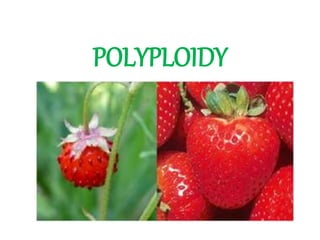
POLYPLOIDY
Introduction
• Polyploids are plants/organisms with multiple sets of
chromosomes in excess of the diploid number.
• Polyploidy is the state of a cell or organism having more than
two paired (homologous) sets of chromosomes.
• Polyploidy has also been known to arise from polyembryonic
seeds (Webber 1940).
• Polyploidy is common in nature and provides a major mechanism
for adaptation and speciation.
• Approximately 50-70% of angiosperms, which include many
crop plants, have undergone polyploidy during their evolutionary
process.
• Most species whose cells have nuclei (eukaryotes) are diploid,
meaning they have two sets of chromosomes—one set inherited
from each parent.
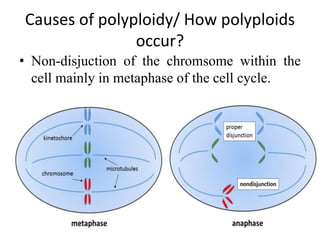
Causes of polyploidy/ How polyploids
occur?
• Non-disjuction of the chromsome within the
cell mainly in metaphase of the cell cycle.
Classification of polyploids
• Based on their chromosomal composition
1. Euploids
2. Aneuploids.
• Euploids constitute the majority of polyploids.
1. Euploidy
• They are polyploids with multiples of the
complete set of chromosomes specific to
a species.
• Depending on the composition of the
genome, euploids can be further
classified into
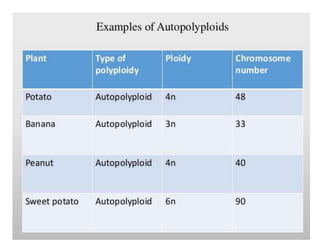
1. Autopolyploids
2. Allopolyploids
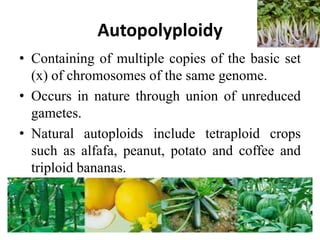
Autopolyploidy
• Containing of multiple copies of the basic set
(x) of chromosomes of the same genome.
• Occurs in nature through union of unreduced
gametes.
• Natural autoploids include tetraploid crops
such as alfafa, peanut, potato and coffee and
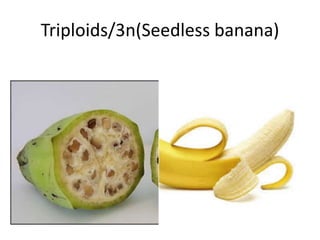
triploid bananas.
Allopolyploidy
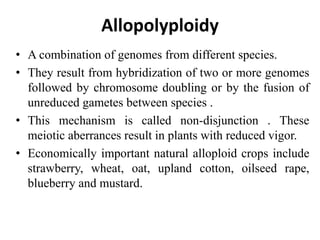
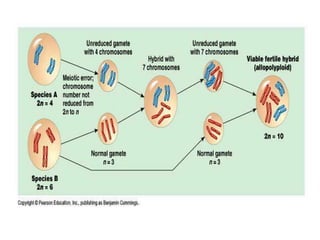
• A combination of genomes from different species.
• They result from hybridization of two or more genomes
followed by chromosome doubling or by the fusion of
unreduced gametes between species .
• This mechanism is called non-disjunction . These
meiotic aberrances result in plants with reduced vigor.
• Economically important natural alloploid crops include
strawberry, wheat, oat, upland cotton, oilseed rape,
blueberry and mustard.
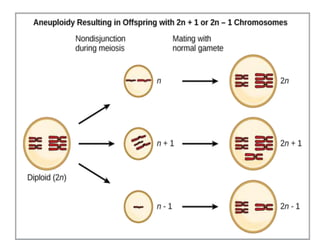
2. Aneuploidy
• are polyploids that contain either an addition or
subtraction of one or more specific chromosome(s) to
the total number of chromosomes that usually make up
the ploidy of a species.
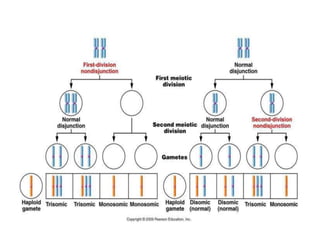
• Aneuploids result from the formation of univalents and
multivalents during meiosis of euploids .
• With no mechanism of dividing univalents equally
among daughter cells during anaphase I, some cells
inherit more genetic material than others .
• Similarly, multivalents such as homologous
chromosomes may fail to separate during meiosis
leading to unequal migration of chromosomes to
opposite poles.
Why it is needed????
• Enlargement and Increased Vigour
• Creation of Sterile Triploids/SEEDLESS
FRUITS
• Restoring Fertility in Hybrids
• Overcoming Barriers in Hybridization
• Enhancing Pest Resistance and Stress
tolerance
• Ornamental and forage breeding
• Disease resistance through aneuploidy
• Industrial applications of polyploidy
Triploids/3n(Seedless watermelon)
Triploids/3n(Seedless banana)
Tetraploids/4n(larger in size)
Inducing polyploids
CyFlow Ploidy Analyser
• The CyFlow Ploidy Analyser is
a compact flow cytometer for
ploidy analysis, high-resolution
DNA and genome size analysis
for plants, animals and micro-
organisms.
• This modular system is
equipped with a UV LED (365
nm) and/or a green laser (532
nm) which, when used in
combination with Partec
CyStain reagents, provides
high-resolution DNA analysis
with DAPI(4′,6-diamidino-2-
phenylindole) or propidium
iodide.
• It is necessary to eliminate duplicated genes in
a newly formed polyploid to avoid gene
silencing(Gene silencing is the regulation
of gene expression in a cell to prevent the
expression of a certain gene) as well as to
stabilize fertility.
• Polyploidy results in increased leaf and flower
size, stomatal density, cell size and chloroplast
count.
Applications in polyploids
1. Mutation breeding
2. Seedless fruits
3. Bridge crossing
4. Ornamental and forage breeding
5. Disease resistance through aneuploidy
6. Industrial applications of polyploidy
1 .Mutation breeding
• Mutation tolerance in polyploid crop improvement in two ways.
1. polyploids are able to tolerate deleterious allele modifications
post-mutation, and
2. they have increased mutation frequency because of their large
genomes resulting from duplicated condition of their genes .
• The high mutation frequencies observed with polyploids may be
exploited when trying to induce mutations in diploid cultivars
that do not produce enough genetic variation after a mutagenic
treatment.
• This approach has been used in mutation breeding of Achimenes
sp. (nut orchids) by first forming autotetraploids through
colchicine treatment followed by the application of fast neutrons
and X-rays.
• In this study, the autotetraploids were found to have 20-40 times
higher mutation frequency than the corresponding diploid
cultivar due to the large genome (Broertjes, 1976).
2 .Seedless fruits production
3.Bridge crossing
• Utilize the reproductive superiority of polyploids .
• When sexual incompatibilities between two
species are due to ploidy levels, transitional
crosses can be carried out followed by
chromosome doubling to produce fertile bridge
hybrids.
• This method has been used to breed for superior
tall fescue grass (F. arundinacea) from Italian
ryegrass (2n=2x=14) and tall fescue (2n=6x=42)
by using meadow grass (Fescue pratensis) as a
bridge species.
4 .Ornamental and forage breeding
• Polyploidy in plants is an increase in cell
size which in turn leads to enlarged plant
organs.
• This phenomenon termed as gigas
effect(Acquaah, 2007; Levin, 1983;
Stebbins, 1971).
• The increase in cell volume however is
mainly attributed to increased water and
not biomass.
• Although chromosome doubling may
result in significantly larger seeds and
increased seed-protein content in cereal
crops, this advantage is offset by low seed
set.
5 .Disease resistance through
aneuploidy
• Aneuploidy applied in
breeding to develop disease
resistant plants through the
addition of an extra
chromosome into the
progeny genome.
• Ex -: The transfer of leaf
rust resistance to Tricum
aestivum from Aegilops
umbellulata through
backcrossing.
6 .Industrial applications of
polyploidy
• Commercial synthesis of sex hormones and
corticosteroids has been improved significantly by
artificial induction of tetraploids from diploid
Dioscorea zingiberensis, native to China.
• Other plants whose production of terpenes has
increased following artificial chromosome doubling.
• It enhances production of secondary metabolites such
as alkaloids and terpenes in polyploids may
concurrently offer resistance to pests and pathogens.
Advantages of polyploids
• Enlargement and Increased Vigor
• Creation of Sterile Triploids
• Restoring Fertility in Hybrids
• Overcoming Barriers in Hybridization
• Enhancing Pest Resistance and Stress
tolerance
Draw backs in polyploidy in plants
breeding
• Sometimes, resulting plants could be
undesirable or unstable
• Effect of polyploidy on sterility
• Effect of polyploidy on inheritance
and population genetics.
Polyploidy

Polyploidy

  • 1.
  • 2.
    Introduction • Polyploids areplants/organisms with multiple sets of chromosomes in excess of the diploid number. • Polyploidy is the state of a cell or organism having more than two paired (homologous) sets of chromosomes. • Polyploidy has also been known to arise from polyembryonic seeds (Webber 1940). • Polyploidy is common in nature and provides a major mechanism for adaptation and speciation. • Approximately 50-70% of angiosperms, which include many crop plants, have undergone polyploidy during their evolutionary process. • Most species whose cells have nuclei (eukaryotes) are diploid, meaning they have two sets of chromosomes—one set inherited from each parent.
  • 5.
    Causes of polyploidy/How polyploids occur? • Non-disjuction of the chromsome within the cell mainly in metaphase of the cell cycle.
  • 6.
    Classification of polyploids •Based on their chromosomal composition 1. Euploids 2. Aneuploids. • Euploids constitute the majority of polyploids.
  • 7.
    1. Euploidy • Theyare polyploids with multiples of the complete set of chromosomes specific to a species. • Depending on the composition of the genome, euploids can be further classified into 1. Autopolyploids 2. Allopolyploids
  • 8.
    Autopolyploidy • Containing ofmultiple copies of the basic set (x) of chromosomes of the same genome. • Occurs in nature through union of unreduced gametes. • Natural autoploids include tetraploid crops such as alfafa, peanut, potato and coffee and triploid bananas.
  • 11.
    Allopolyploidy • A combinationof genomes from different species. • They result from hybridization of two or more genomes followed by chromosome doubling or by the fusion of unreduced gametes between species . • This mechanism is called non-disjunction . These meiotic aberrances result in plants with reduced vigor. • Economically important natural alloploid crops include strawberry, wheat, oat, upland cotton, oilseed rape, blueberry and mustard.
  • 13.
    2. Aneuploidy • arepolyploids that contain either an addition or subtraction of one or more specific chromosome(s) to the total number of chromosomes that usually make up the ploidy of a species. • Aneuploids result from the formation of univalents and multivalents during meiosis of euploids . • With no mechanism of dividing univalents equally among daughter cells during anaphase I, some cells inherit more genetic material than others . • Similarly, multivalents such as homologous chromosomes may fail to separate during meiosis leading to unequal migration of chromosomes to opposite poles.
  • 18.
    Why it isneeded???? • Enlargement and Increased Vigour • Creation of Sterile Triploids/SEEDLESS FRUITS • Restoring Fertility in Hybrids • Overcoming Barriers in Hybridization • Enhancing Pest Resistance and Stress tolerance • Ornamental and forage breeding • Disease resistance through aneuploidy • Industrial applications of polyploidy
  • 19.
  • 20.
  • 23.
  • 24.
  • 27.
    CyFlow Ploidy Analyser •The CyFlow Ploidy Analyser is a compact flow cytometer for ploidy analysis, high-resolution DNA and genome size analysis for plants, animals and micro- organisms. • This modular system is equipped with a UV LED (365 nm) and/or a green laser (532 nm) which, when used in combination with Partec CyStain reagents, provides high-resolution DNA analysis with DAPI(4′,6-diamidino-2- phenylindole) or propidium iodide.
  • 28.
    • It isnecessary to eliminate duplicated genes in a newly formed polyploid to avoid gene silencing(Gene silencing is the regulation of gene expression in a cell to prevent the expression of a certain gene) as well as to stabilize fertility. • Polyploidy results in increased leaf and flower size, stomatal density, cell size and chloroplast count.
  • 29.
    Applications in polyploids 1.Mutation breeding 2. Seedless fruits 3. Bridge crossing 4. Ornamental and forage breeding 5. Disease resistance through aneuploidy 6. Industrial applications of polyploidy
  • 30.
    1 .Mutation breeding •Mutation tolerance in polyploid crop improvement in two ways. 1. polyploids are able to tolerate deleterious allele modifications post-mutation, and 2. they have increased mutation frequency because of their large genomes resulting from duplicated condition of their genes . • The high mutation frequencies observed with polyploids may be exploited when trying to induce mutations in diploid cultivars that do not produce enough genetic variation after a mutagenic treatment. • This approach has been used in mutation breeding of Achimenes sp. (nut orchids) by first forming autotetraploids through colchicine treatment followed by the application of fast neutrons and X-rays. • In this study, the autotetraploids were found to have 20-40 times higher mutation frequency than the corresponding diploid cultivar due to the large genome (Broertjes, 1976).
  • 31.
  • 32.
    3.Bridge crossing • Utilizethe reproductive superiority of polyploids . • When sexual incompatibilities between two species are due to ploidy levels, transitional crosses can be carried out followed by chromosome doubling to produce fertile bridge hybrids. • This method has been used to breed for superior tall fescue grass (F. arundinacea) from Italian ryegrass (2n=2x=14) and tall fescue (2n=6x=42) by using meadow grass (Fescue pratensis) as a bridge species.
  • 33.
    4 .Ornamental andforage breeding • Polyploidy in plants is an increase in cell size which in turn leads to enlarged plant organs. • This phenomenon termed as gigas effect(Acquaah, 2007; Levin, 1983; Stebbins, 1971). • The increase in cell volume however is mainly attributed to increased water and not biomass. • Although chromosome doubling may result in significantly larger seeds and increased seed-protein content in cereal crops, this advantage is offset by low seed set.
  • 34.
    5 .Disease resistancethrough aneuploidy • Aneuploidy applied in breeding to develop disease resistant plants through the addition of an extra chromosome into the progeny genome. • Ex -: The transfer of leaf rust resistance to Tricum aestivum from Aegilops umbellulata through backcrossing.
  • 35.
    6 .Industrial applicationsof polyploidy • Commercial synthesis of sex hormones and corticosteroids has been improved significantly by artificial induction of tetraploids from diploid Dioscorea zingiberensis, native to China. • Other plants whose production of terpenes has increased following artificial chromosome doubling. • It enhances production of secondary metabolites such as alkaloids and terpenes in polyploids may concurrently offer resistance to pests and pathogens.
  • 36.
    Advantages of polyploids •Enlargement and Increased Vigor • Creation of Sterile Triploids • Restoring Fertility in Hybrids • Overcoming Barriers in Hybridization • Enhancing Pest Resistance and Stress tolerance
  • 37.
    Draw backs inpolyploidy in plants breeding • Sometimes, resulting plants could be undesirable or unstable • Effect of polyploidy on sterility • Effect of polyploidy on inheritance and population genetics.