The son of a Rich Tory Squire, Percy Bysshe
Shelley was educated at Eton and then sent
to Oxford. Shelley came under the influence
of revolutionary ideas of the English
philosopher, William Godwin, whose daughter,
Mary Godwin he ultimately married. In 1818,
Shelley left for Italy; he drowned in the Bay
of Spezia in 1822.
‘Ozymandias’ is one of the greatest poems of the renowned
poet P.B. Shelley. Ozymandias was a mighty and famous king
of Egypt. He got his own statue built. The poet came to know
through a traveller that Ozymandias’ statue was seen by him
in a broken condition. His trunk less statue stands lonely in
the desert. Under the statue are inscribes the words : ‘My
name is Ozymandias, King of Kings’. Thus, in this poem the
poet brings out the vanity of human pomp and power.
Everything in this world is subject to decay. The name and
fame of mighty and powerful human beings is short lived.
Time may be a great healer, but it is also a merciless
destroyer.
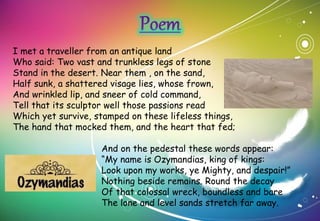
I met a traveller from an antique land
Who said: Two vast and trunkless legs of stone
Stand in the desert. Near them , on the sand,
Half sunk, a shattered visage lies, whose frown,
And wrinkled lip, and sneer of cold command,
Tell that its sculptor well those passions read
Which yet survive, stamped on these lifeless things,
The hand that mocked them, and the heart that fed;
And on the pedestal these words appear:
“My name is Ozymandias, king of kings:
Look upon my works, ye Mighty, and despair!”
Nothing beside remains. Round the decay
Of that colossal wreck, boundless and bare
The lone and level sands stretch far away.
Once the poet met a traveller from the ancient land
of Egypt. He told the poet of story of an Egyptian
king named Ozymandias. The traveller told him that
he had seen two huge legs of stone standing in the
desert of Egypt. The legs were trunk less. A
shattered visage lay by the side of these huge legs.
It had wrinkled lips. It had a sneering look. There
was an expression of cold command in its eyes. These
things stamped on the visage showed that the
sculptor had understood the king’s passions on stone
had died, but his art was still alive.
Similarly, the king whose heart fed those cruel
passions on stone had died, but the signs of his cruelty
could still be seen. The poet means to suggest that a
man dies but his actions outlive him. The following
words were written on the pedestal of the statue :
“My name is Ozymandias, King of Kings :
Look upon my works, ye! Mighty, and despair!”
The traveller told the poet that now nothing remained
of that proud king. No trace of his power was left on
the sands of time. There was nothing but sand round
the decay of that huge statue. It lay all in ruins.
Round it the lone, level and barren sands of the desert
stretch far away.
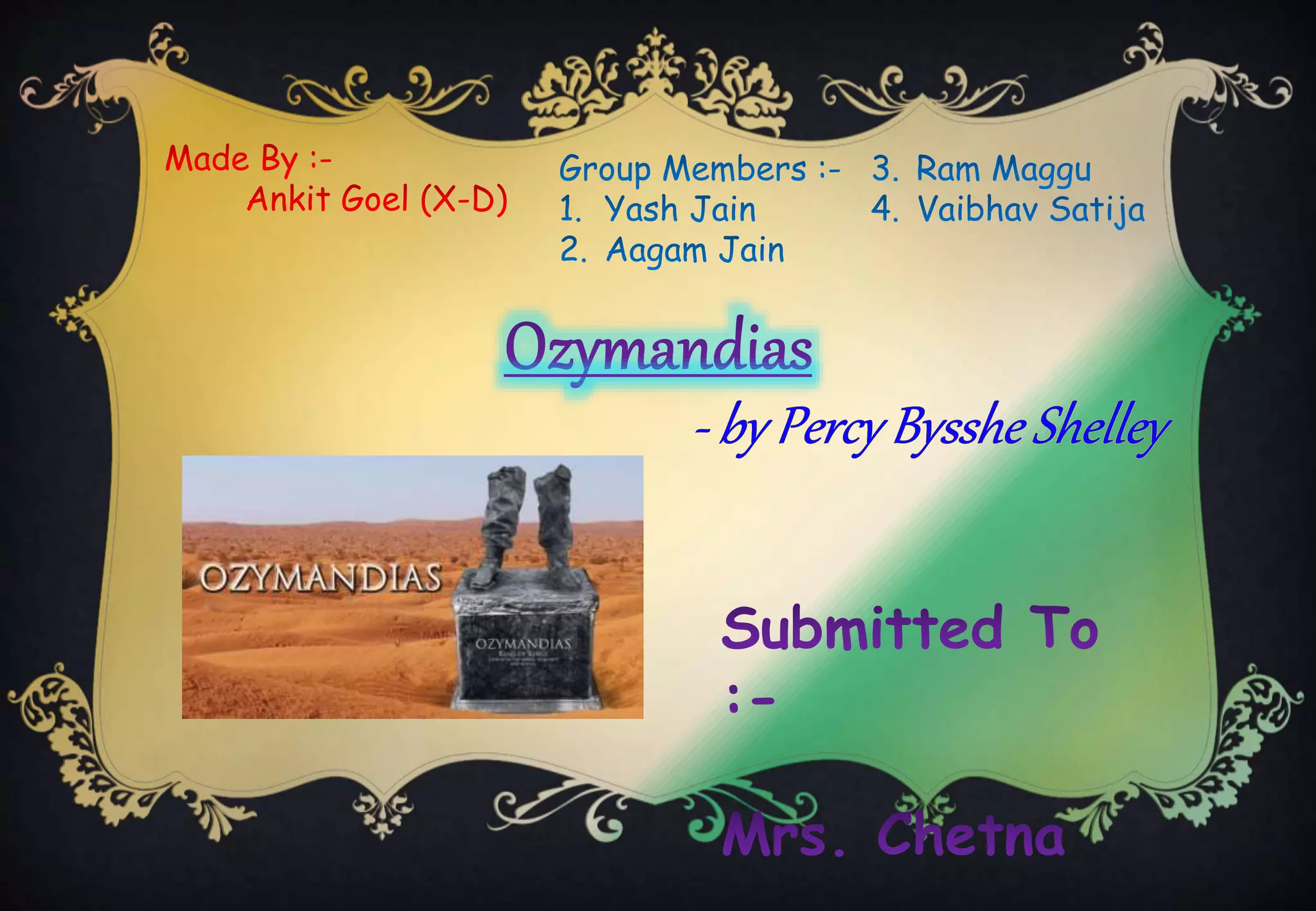
Ozymandias

Ozymandias

  • 3.
    The son ofa Rich Tory Squire, Percy Bysshe Shelley was educated at Eton and then sent to Oxford. Shelley came under the influence of revolutionary ideas of the English philosopher, William Godwin, whose daughter, Mary Godwin he ultimately married. In 1818, Shelley left for Italy; he drowned in the Bay of Spezia in 1822.
  • 4.
    ‘Ozymandias’ is oneof the greatest poems of the renowned poet P.B. Shelley. Ozymandias was a mighty and famous king of Egypt. He got his own statue built. The poet came to know through a traveller that Ozymandias’ statue was seen by him in a broken condition. His trunk less statue stands lonely in the desert. Under the statue are inscribes the words : ‘My name is Ozymandias, King of Kings’. Thus, in this poem the poet brings out the vanity of human pomp and power. Everything in this world is subject to decay. The name and fame of mighty and powerful human beings is short lived. Time may be a great healer, but it is also a merciless destroyer.
  • 5.
    I met atraveller from an antique land Who said: Two vast and trunkless legs of stone Stand in the desert. Near them , on the sand, Half sunk, a shattered visage lies, whose frown, And wrinkled lip, and sneer of cold command, Tell that its sculptor well those passions read Which yet survive, stamped on these lifeless things, The hand that mocked them, and the heart that fed; And on the pedestal these words appear: “My name is Ozymandias, king of kings: Look upon my works, ye Mighty, and despair!” Nothing beside remains. Round the decay Of that colossal wreck, boundless and bare The lone and level sands stretch far away.
  • 6.
    Once the poetmet a traveller from the ancient land of Egypt. He told the poet of story of an Egyptian king named Ozymandias. The traveller told him that he had seen two huge legs of stone standing in the desert of Egypt. The legs were trunk less. A shattered visage lay by the side of these huge legs. It had wrinkled lips. It had a sneering look. There was an expression of cold command in its eyes. These things stamped on the visage showed that the sculptor had understood the king’s passions on stone had died, but his art was still alive.
  • 7.
    Similarly, the kingwhose heart fed those cruel passions on stone had died, but the signs of his cruelty could still be seen. The poet means to suggest that a man dies but his actions outlive him. The following words were written on the pedestal of the statue : “My name is Ozymandias, King of Kings : Look upon my works, ye! Mighty, and despair!” The traveller told the poet that now nothing remained of that proud king. No trace of his power was left on the sands of time. There was nothing but sand round the decay of that huge statue. It lay all in ruins. Round it the lone, level and barren sands of the desert stretch far away.