Polyneuropathy
- Dr. Samrth Pareta(PT)
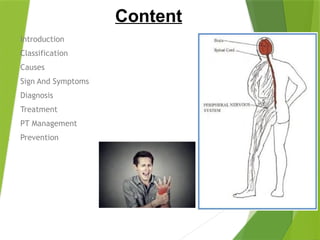
1. Introduction
2. Classification
3. Causes
4. Sign And Symptoms
5. Diagnosis
6. Treatment
7. PT Management
8. Prevention
Content
• It is inflammation and degeneration of the
peripheral nerves and/or the cranial nerves
resulting in impairment of the conductivity of
these nerves.
• Polyneuropathy is when multiple peripheral
nerve becomes damaged and it is also known as
peripheral neuropathy.
INTRODUCTION
• Polyneuropathy affects several nerves in different
parts of the body at the same time. In cases of
mononeuropathy, just one nerve is affected.
• Polyneuropathy can affect nerves responsible for
feeling (sensory neuropathy), movement (motor
neuropathy), or both (sensorimotor neuropathy).
• It may also affect the autonomic nerves responsible
for controlling functions such as digestion, the
bladder, blood pressure , and heart rate.
Introduction Cont…
• Classification of Neuropathy
• Mononeuropathy
• Mononeuropathy multiplex:
• Polyneuropathy
Classification
• Trauma: wrong injection into a nerve, callus
compression.
• Infective: leprosy, herpes zoster.
• Vascular: polyarteritis nodosa.
• Metabolic: diabetes mellius.
Causes
• tingling
• numbness
• pins and needles
• difficulty using the arms, legs, hands, or feet
• increased pain (such as burning, stabbing,
freezing, or shooting pains)
• sleep problems due to night-time pain
• inability to feel pain
Sign and Symptoms
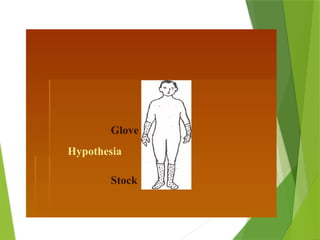
Glove and Stocking
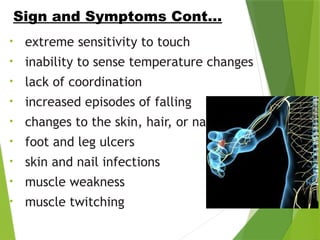
• extreme sensitivity to touch
• inability to sense temperature changes
• lack of coordination
• increased episodes of falling
• changes to the skin, hair, or nails
• foot and leg ulcers
• skin and nail infections
• muscle weakness
• muscle twitching
Sign and Symptoms Cont…
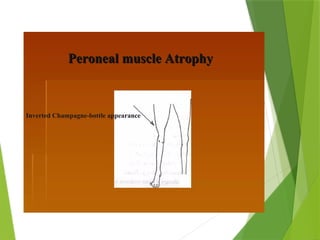
Peroneal Muscle Atrophy
• Symptoms associated with autonomic nerve
damage include:
• heat intolerance
• unusual sweating
• bladder problems or incontinence
• digestive problems
• dizziness
Sign and Symptoms Cont…
• Diagnosis is based upon medical history, a
physical exam, and neurological evaluation.
Depending on the person’s symptoms, tests may
be ordered.
• A detailed review of all symptoms, lifestyle
factors, and family history.
• Also check the patient’s height, weight, pulse,
blood pressure, and temperature. The heart,
lungs, and abdomen may also be checked to rule
out alternative physiological causes.
Diagnosis
• MRI or CT scan: These imaging techniques look for
tumors, herniated disk, or other abnormalities that
may be affecting nerve function.
• Electro-diagnostic tests: These non-invasive tests
measure the electrical activity in the muscles and
nerves, helping to detect nerve damage. Examples
are electromyography and nerve conduction
velocity.s
• Biopsies: The doctor may remove a small portion of
a nerve, or sample of the skin, to test for
abnormalities in nerve function or nerve endings.
Diagnostic Imaging
• Transcutaneous electrical nerve stimulation:
Electrodes send a gentle current of electricity through
the skin. This can help with pain and sensitivity.
• Plasma exchange: The practitioner removes blood
from the body, then separates antibodies and other
proteins from the blood, before returning the blood to
the body.
• Immune globulin therapy: Those with inflammatory
and autoimmune conditions are given high levels of
proteins to act as antibodies, which helps with
immune function.
Treatment Cont…
• Physical therapy: People with muscle weakness
or coordination issues may find physical therapy
helpful.
• Orthotic and other devices: Braces, canes,
casts, splints, walkers, and wheelchairs may
provide support and pain relief to those with
neuropathy of the hands, feet, legs, and arms.
Treatment Cont…
• Tricyclic antidepressants and anticonvulsants
have become the mainstay in the treatment of
pain in polyneuropathy. Research supports the
use of the anticonvulsants gabapentin
(Neurontin) and pregabalin (Lyrica) to help
relieve pain caused by damaged nerves.
Treatment
• Restore, or maintain muscle strength, and
prevent muscle shortening and deformity
• Balance, coordination and functional training.
• Pain relief e.g. provision of TENS , pain
management
• Splints as needed, prevent deformity and
contractures
• Education, re-managing conditions, preventing
damage and emotional support.
PT Management
• Soft tissue techniques
• mobilization of joints and soft tissues
• Respiratory physiotherapy
• hygiene of the respiratory tract, or strength
of breathing muscle. Increase in the
function of the diaphragm and improvement
in breathing stereotype is important among
individuals with Polyneuropathy
PT Management Cont…
• PNF (Kabat method)
• PNF uses different types of facilitating
elements to increase motoric control and
motoric function. Application of these
elements should lead to an improvement in
coordination. Increase in muscle activity and
effectiveness of motor function, decrease in
fatigue, and development of mobility or
stability in body segments
PT Management Cont…
• Nerve gliding therapy
• Nerve gliding exercise can potentially decrease
pain and might be a valuable addition for the
rehabilitation plan in peripheral neuropathy
after chemotherapy. It seems that
neurodynamic exercise might reduce pain and
improve nerve regeneration
PT Management Cont…
• sum up, physiotherapy has underlying significance
in mitigation symptoms such as pain, postural in-
stability, sensation impairment, or foot muscle
weakness. Exercise therapy , including
strengthening, stretching, functional, aerobic,
weight, and no-weight-bearing exercises, showed
to be the most effective, however,
electrotherapy, laser therapy, acupuncture,
whole/body vibration or Thai foot massage
appeared to have importance as well.
PT Management Cont…
• Avoiding alcohol
• Avoiding exposure to toxins, including cigarette
smoke
• Getting enough sleep and physical activity to
support immune function
• Eating a balanced diet rich in vitamins and
minerals
• Considering vitamin B-12 supplements if a vegan
or vegetarian
Preventions
References
1. https://www.ncbi.nlm.nih.gov/pmc/articles/PMC7808681/
2. https://scholar.google.co.in/scholar_url?url=https://www.ncbi.nlm.nih.gov/
pmc/articles/PMC5832891/&hl=en&sa=X&ei=jssXZubcFJSr6rQPzOiEiA0&scisig
=AFWwaebRUv_T4L8Zv156riyv0rwR&oi=scholarr
3. https://www.rehabbasics.co.uk/uncategorized
/physiotherapy-for-polyneuropathy/
4. https://is.muni.cz/th/zijs0
/Possibilities_of_rehabilitation_treatment_for_polyneuropathy.pdf
THANKS

Polyneuropathy ppt (Dr. Samrth Pareta).pptx

  • 1.
  • 2.
    1. Introduction 2. Classification 3.Causes 4. Sign And Symptoms 5. Diagnosis 6. Treatment 7. PT Management 8. Prevention Content
  • 3.
    • It isinflammation and degeneration of the peripheral nerves and/or the cranial nerves resulting in impairment of the conductivity of these nerves. • Polyneuropathy is when multiple peripheral nerve becomes damaged and it is also known as peripheral neuropathy. INTRODUCTION
  • 4.
    • Polyneuropathy affectsseveral nerves in different parts of the body at the same time. In cases of mononeuropathy, just one nerve is affected. • Polyneuropathy can affect nerves responsible for feeling (sensory neuropathy), movement (motor neuropathy), or both (sensorimotor neuropathy). • It may also affect the autonomic nerves responsible for controlling functions such as digestion, the bladder, blood pressure , and heart rate. Introduction Cont…
  • 5.
    • Classification ofNeuropathy • Mononeuropathy • Mononeuropathy multiplex: • Polyneuropathy Classification
  • 6.
    • Trauma: wronginjection into a nerve, callus compression. • Infective: leprosy, herpes zoster. • Vascular: polyarteritis nodosa. • Metabolic: diabetes mellius. Causes
  • 7.
    • tingling • numbness •pins and needles • difficulty using the arms, legs, hands, or feet • increased pain (such as burning, stabbing, freezing, or shooting pains) • sleep problems due to night-time pain • inability to feel pain Sign and Symptoms
  • 8.
  • 9.
    • extreme sensitivityto touch • inability to sense temperature changes • lack of coordination • increased episodes of falling • changes to the skin, hair, or nails • foot and leg ulcers • skin and nail infections • muscle weakness • muscle twitching Sign and Symptoms Cont…
  • 10.
  • 11.
    • Symptoms associatedwith autonomic nerve damage include: • heat intolerance • unusual sweating • bladder problems or incontinence • digestive problems • dizziness Sign and Symptoms Cont…
  • 12.
    • Diagnosis isbased upon medical history, a physical exam, and neurological evaluation. Depending on the person’s symptoms, tests may be ordered. • A detailed review of all symptoms, lifestyle factors, and family history. • Also check the patient’s height, weight, pulse, blood pressure, and temperature. The heart, lungs, and abdomen may also be checked to rule out alternative physiological causes. Diagnosis
  • 13.
    • MRI orCT scan: These imaging techniques look for tumors, herniated disk, or other abnormalities that may be affecting nerve function. • Electro-diagnostic tests: These non-invasive tests measure the electrical activity in the muscles and nerves, helping to detect nerve damage. Examples are electromyography and nerve conduction velocity.s • Biopsies: The doctor may remove a small portion of a nerve, or sample of the skin, to test for abnormalities in nerve function or nerve endings. Diagnostic Imaging
  • 14.
    • Transcutaneous electricalnerve stimulation: Electrodes send a gentle current of electricity through the skin. This can help with pain and sensitivity. • Plasma exchange: The practitioner removes blood from the body, then separates antibodies and other proteins from the blood, before returning the blood to the body. • Immune globulin therapy: Those with inflammatory and autoimmune conditions are given high levels of proteins to act as antibodies, which helps with immune function. Treatment Cont…
  • 15.
    • Physical therapy:People with muscle weakness or coordination issues may find physical therapy helpful. • Orthotic and other devices: Braces, canes, casts, splints, walkers, and wheelchairs may provide support and pain relief to those with neuropathy of the hands, feet, legs, and arms. Treatment Cont…
  • 16.
    • Tricyclic antidepressantsand anticonvulsants have become the mainstay in the treatment of pain in polyneuropathy. Research supports the use of the anticonvulsants gabapentin (Neurontin) and pregabalin (Lyrica) to help relieve pain caused by damaged nerves. Treatment
  • 17.
    • Restore, ormaintain muscle strength, and prevent muscle shortening and deformity • Balance, coordination and functional training. • Pain relief e.g. provision of TENS , pain management • Splints as needed, prevent deformity and contractures • Education, re-managing conditions, preventing damage and emotional support. PT Management
  • 18.
    • Soft tissuetechniques • mobilization of joints and soft tissues • Respiratory physiotherapy • hygiene of the respiratory tract, or strength of breathing muscle. Increase in the function of the diaphragm and improvement in breathing stereotype is important among individuals with Polyneuropathy PT Management Cont…
  • 19.
    • PNF (Kabatmethod) • PNF uses different types of facilitating elements to increase motoric control and motoric function. Application of these elements should lead to an improvement in coordination. Increase in muscle activity and effectiveness of motor function, decrease in fatigue, and development of mobility or stability in body segments PT Management Cont…
  • 20.
    • Nerve glidingtherapy • Nerve gliding exercise can potentially decrease pain and might be a valuable addition for the rehabilitation plan in peripheral neuropathy after chemotherapy. It seems that neurodynamic exercise might reduce pain and improve nerve regeneration PT Management Cont…
  • 21.
    • sum up,physiotherapy has underlying significance in mitigation symptoms such as pain, postural in- stability, sensation impairment, or foot muscle weakness. Exercise therapy , including strengthening, stretching, functional, aerobic, weight, and no-weight-bearing exercises, showed to be the most effective, however, electrotherapy, laser therapy, acupuncture, whole/body vibration or Thai foot massage appeared to have importance as well. PT Management Cont…
  • 22.
    • Avoiding alcohol •Avoiding exposure to toxins, including cigarette smoke • Getting enough sleep and physical activity to support immune function • Eating a balanced diet rich in vitamins and minerals • Considering vitamin B-12 supplements if a vegan or vegetarian Preventions
  • 23.
    References 1. https://www.ncbi.nlm.nih.gov/pmc/articles/PMC7808681/ 2. https://scholar.google.co.in/scholar_url?url=https://www.ncbi.nlm.nih.gov/ pmc/articles/PMC5832891/&hl=en&sa=X&ei=jssXZubcFJSr6rQPzOiEiA0&scisig =AFWwaebRUv_T4L8Zv156riyv0rwR&oi=scholarr 3.https://www.rehabbasics.co.uk/uncategorized /physiotherapy-for-polyneuropathy/ 4. https://is.muni.cz/th/zijs0 /Possibilities_of_rehabilitation_treatment_for_polyneuropathy.pdf
  • 24.