INHERITANCE
IN JAVA
Content
•What is Inheritance?
•Basic Example of Inheritance in Java
•Types Of Inheritance
•Inheritance By Animal
What Is Inheritance?
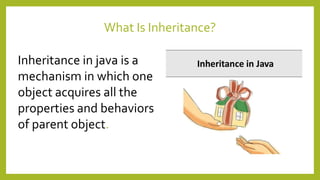
Inheritance in java is a
mechanism in which one
object acquires all the
properties and behaviors
of parent object.
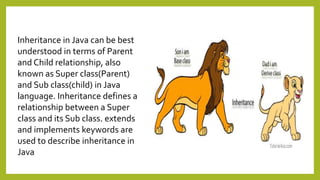
Inheritance in Java can be best
understood in terms of Parent
and Child relationship, also
known as Super class(Parent)
and Sub class(child) in Java
language. Inheritance defines a
relationship between a Super
class and its Sub class. extends
and implements keywords are
used to describe inheritance in
Java
BASIC EXAMPLE OF
INHERITANCE IN JAVA
//Creating a SubClass
class A{
int a=10, b=20;
void showab(){
System.out.println(“a: “+a+ “b: ”+b);
}
}
//Creating a SubClass by extanding A class
class B extends A{
void sum(){
System.out.println(“Sum of a and b is: ”+(a+b));
}
}
//Creating Main Class
class Main{
public static void main(String args[]){
A obj1= new A();
obj1.showab();
B obj2= new B();
obj2.sum();
}
}
Output
Inheritance
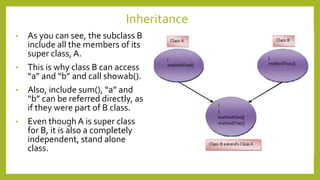
• As you can see, the subclass B
include all the members of its
super class, A.
• This is why class B can access
“a” and “b” and call showab().
• Also, include sum(), “a” and
“b” can be referred directly, as
if they were part of B class.
• Even though A is super class
for B, it is also a completely
independent, stand alone
class.
TYPES OF
INHERITANCE
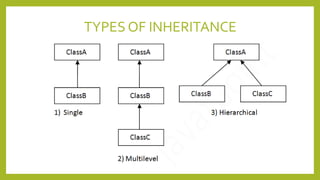
TYPES OF INHERITANCE
Based on number of ways inheriting the feature of
base class into derived class we have some types of
inheritance; they are:
• Single inheritance
• Multilevel inheritance
• Hierarchical inheritance
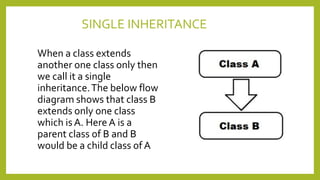
SINGLE INHERITANCE
When a class extends
another one class only then
we call it a single
inheritance.The below flow
diagram shows that class B
extends only one class
which is A. Here A is a
parent class of B and B
would be a child class of A
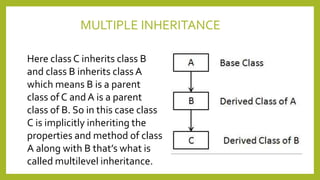
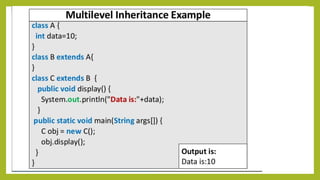
MULTIPLE INHERITANCE
Here class C inherits class B
and class B inherits class A
which means B is a parent
class of C andA is a parent
class of B. So in this case class
C is implicitly inheriting the
properties and method of class
A along with B that’s what is
called multilevel inheritance.
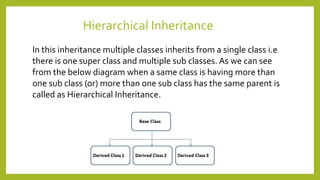
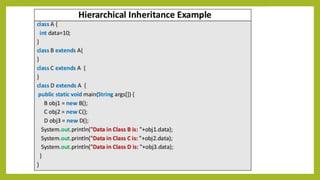
Hierarchical Inheritance
In this inheritance multiple classes inherits from a single class i.e
there is one super class and multiple sub classes. As we can see
from the below diagram when a same class is having more than
one sub class (or) more than one sub class has the same parent is
called as Hierarchical Inheritance.
TYPES OF INHERITANCE
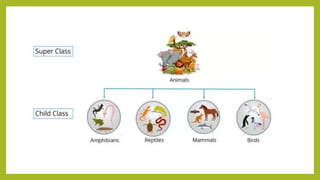
INHERITANCE BY
ANIMAL
SAMPLE PROGRAM
public class Animal{
}
public class Amphibians extends Animal{
}
public class Reptiles extends Animal{
}
public class Mammals extends Animal{
}
public class Birds extends Animal{
}
public class Main{
public static void main(String args[]){
// write your code
}
}
INHERITANCE BY
ANIMAL
Main Program
public class Animal{
eat();
reproduce();
sleep();
}
public class Amphibians extends Animal {
swim();
}
public class Reptiles extends Animal{
crawl();
}
public class Mammals extends Animal{
giveMilk();
}
public class Birds extends Animal {
fly();
}
public class Main{
public static void main (String args[] ){
Amphibians obj1=new Amphibians();
Reptiles obj2=new Reptiles();
Mammals obj3=new Mammals();
Birds obj4=new Birds();
}
}
THANKYOU
Any Suggestion Or Question IsWelcome

Inheritance In Java

  • 1.
  • 2.
    Content •What is Inheritance? •BasicExample of Inheritance in Java •Types Of Inheritance •Inheritance By Animal
  • 3.
    What Is Inheritance? Inheritancein java is a mechanism in which one object acquires all the properties and behaviors of parent object.
  • 4.
    Inheritance in Javacan be best understood in terms of Parent and Child relationship, also known as Super class(Parent) and Sub class(child) in Java language. Inheritance defines a relationship between a Super class and its Sub class. extends and implements keywords are used to describe inheritance in Java
  • 5.
  • 6.
    //Creating a SubClass classA{ int a=10, b=20; void showab(){ System.out.println(“a: “+a+ “b: ”+b); } } //Creating a SubClass by extanding A class class B extends A{ void sum(){ System.out.println(“Sum of a and b is: ”+(a+b)); } } //Creating Main Class class Main{ public static void main(String args[]){ A obj1= new A(); obj1.showab(); B obj2= new B(); obj2.sum(); } }
  • 7.
  • 8.
    Inheritance • As youcan see, the subclass B include all the members of its super class, A. • This is why class B can access “a” and “b” and call showab(). • Also, include sum(), “a” and “b” can be referred directly, as if they were part of B class. • Even though A is super class for B, it is also a completely independent, stand alone class.
  • 11.
  • 12.
    TYPES OF INHERITANCE Basedon number of ways inheriting the feature of base class into derived class we have some types of inheritance; they are: • Single inheritance • Multilevel inheritance • Hierarchical inheritance
  • 13.
    SINGLE INHERITANCE When aclass extends another one class only then we call it a single inheritance.The below flow diagram shows that class B extends only one class which is A. Here A is a parent class of B and B would be a child class of A
  • 15.
    MULTIPLE INHERITANCE Here classC inherits class B and class B inherits class A which means B is a parent class of C andA is a parent class of B. So in this case class C is implicitly inheriting the properties and method of class A along with B that’s what is called multilevel inheritance.
  • 17.
    Hierarchical Inheritance In thisinheritance multiple classes inherits from a single class i.e there is one super class and multiple sub classes. As we can see from the below diagram when a same class is having more than one sub class (or) more than one sub class has the same parent is called as Hierarchical Inheritance.
  • 19.
  • 20.
  • 22.
    SAMPLE PROGRAM public classAnimal{ } public class Amphibians extends Animal{ } public class Reptiles extends Animal{ } public class Mammals extends Animal{ } public class Birds extends Animal{ } public class Main{ public static void main(String args[]){ // write your code } }
  • 24.
  • 25.
    public class Animal{ eat(); reproduce(); sleep(); } publicclass Amphibians extends Animal { swim(); } public class Reptiles extends Animal{ crawl(); } public class Mammals extends Animal{ giveMilk(); } public class Birds extends Animal { fly(); } public class Main{ public static void main (String args[] ){ Amphibians obj1=new Amphibians(); Reptiles obj2=new Reptiles(); Mammals obj3=new Mammals(); Birds obj4=new Birds(); } }
  • 26.
    THANKYOU Any Suggestion OrQuestion IsWelcome