J AV A
TE CHN OLOG IE S
Centurion University Of Technology And
Management
N ame: - Hitesh kumar N ath
Regd.N O.: -
200301150005
B arnc h: - E E E
POLYMORPHISM
TAB LE OF CON TE N TS
D efinition
01
Types of
Polymorphism
02
Compile Time
03
04
E xamples
05 06
Run Time Advantages
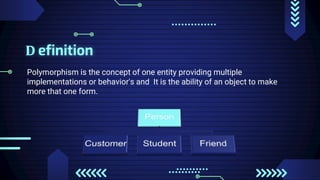
D efinition
Polymorphism is the concept of one entity providing multiple
implementations or behavior's and It is the ability of an object to make
more that one form.
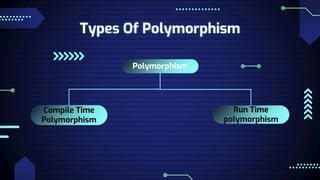
Types Of Polymorphism
Polymorphism
Compile Time
Polymorphism
Run Time
polymorphism
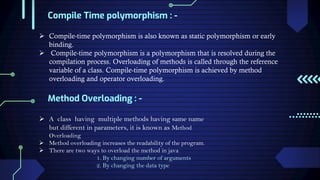
Compile Time polymorphism : -
 Compile-time polymorphism is also known as static polymorphism or early
binding.
 Compile-time polymorphism is a polymorphism that is resolved during the
compilation process. Overloading of methods is called through the reference
variable of a class. Compile-time polymorphism is achieved by method
overloading and operator overloading.
Method Overloading : -
 A class having multiple methods having same name
but different in parameters, it is known as Method
Overloading
 Method overloading increases the readability of the program.
 There are two ways to overload the method in java
1. By changing number of arguments
2. By changing the data type
Syntax For Method Overloading : -
package com.company; // by changing num of
arguments
public class add {
static int add(int a,int b){return a+b;}
static int add(int a,int b,int c){return a+b+c;}
}
class TestOverloading{
public static void main(String[] args){
System.out.println(add.add(15,16));
System.out.println(add.add(15,16,17));
}
}
 Here we have created two
methods for adding two and
three numbers respectively.
 Used the Static methods.
Output: -
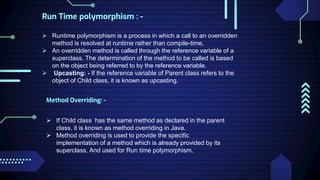
Run Time polymorphism : -
 Runtime polymorphism is a process in which a call to an overridden
method is resolved at runtime rather than compile-time.
 An overridden method is called through the reference variable of a
superclass. The determination of the method to be called is based
on the object being referred to by the reference variable.
 Upcasting: - If the reference variable of Parent class refers to the
object of Child class, it is known as upcasting.
Method Overriding: -
 If Child class has the same method as declared in the parent
class, it is known as method overriding in Java.
 Method overriding is used to provide the specific
implementation of a method which is already provided by its
superclass. And used for Run time polymorphism.
Syntax for Method Overriding: -
package com.company;
public class Vehicle {
void run(){System.out.println("Vehicle is running");
}
}
class Bike2 extends Vehicle{
void run(){System.out.println("Bike is running safely");
}
public static void main(String args[]){
Bike2 obj = new Bike2();
obj.run();
}
}
Output :-
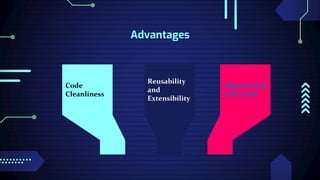
Advantages
Code
Cleanliness
Reusability
and
Extensibility
Aligned with
real world
THAN K
YOU !

JAVA_POLYMORPHISM.pptx

  • 1.
    J AV A TECHN OLOG IE S Centurion University Of Technology And Management
  • 2.
    N ame: -Hitesh kumar N ath Regd.N O.: - 200301150005 B arnc h: - E E E POLYMORPHISM
  • 3.
    TAB LE OFCON TE N TS D efinition 01 Types of Polymorphism 02 Compile Time 03 04 E xamples 05 06 Run Time Advantages
  • 4.
    D efinition Polymorphism isthe concept of one entity providing multiple implementations or behavior's and It is the ability of an object to make more that one form.
  • 5.
    Types Of Polymorphism Polymorphism CompileTime Polymorphism Run Time polymorphism
  • 6.
    Compile Time polymorphism: -  Compile-time polymorphism is also known as static polymorphism or early binding.  Compile-time polymorphism is a polymorphism that is resolved during the compilation process. Overloading of methods is called through the reference variable of a class. Compile-time polymorphism is achieved by method overloading and operator overloading. Method Overloading : -  A class having multiple methods having same name but different in parameters, it is known as Method Overloading  Method overloading increases the readability of the program.  There are two ways to overload the method in java 1. By changing number of arguments 2. By changing the data type
  • 7.
    Syntax For MethodOverloading : - package com.company; // by changing num of arguments public class add { static int add(int a,int b){return a+b;} static int add(int a,int b,int c){return a+b+c;} } class TestOverloading{ public static void main(String[] args){ System.out.println(add.add(15,16)); System.out.println(add.add(15,16,17)); } }  Here we have created two methods for adding two and three numbers respectively.  Used the Static methods. Output: -
  • 8.
    Run Time polymorphism: -  Runtime polymorphism is a process in which a call to an overridden method is resolved at runtime rather than compile-time.  An overridden method is called through the reference variable of a superclass. The determination of the method to be called is based on the object being referred to by the reference variable.  Upcasting: - If the reference variable of Parent class refers to the object of Child class, it is known as upcasting. Method Overriding: -  If Child class has the same method as declared in the parent class, it is known as method overriding in Java.  Method overriding is used to provide the specific implementation of a method which is already provided by its superclass. And used for Run time polymorphism.
  • 9.
    Syntax for MethodOverriding: - package com.company; public class Vehicle { void run(){System.out.println("Vehicle is running"); } } class Bike2 extends Vehicle{ void run(){System.out.println("Bike is running safely"); } public static void main(String args[]){ Bike2 obj = new Bike2(); obj.run(); } } Output :-
  • 10.
  • 11.