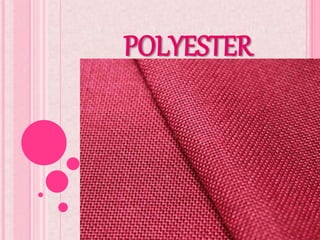
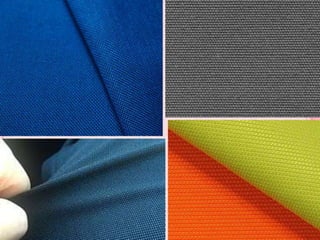
POLYESTER
CREATION OF POLYESTER
In 1926, United States – based E.I Du Pont de Nemours and
Co. began researchinto very large molecules and synthetic
fibres.This early research headedby W.H. Carothers centered
on what became nylon, the first synthetic fibre. Soon after ,in
the years 1939-1941, British research chemiststook interest in
the du Pont studies and conducted their own research in
laboratories of Calico Printers Association , Ltd. This work
resulted in the creation of the polyester fiber known in
England as Terylene.
Terylene wascreted by Whinfield and Dickson along with
Birtwhistle and Ritchiethey in 1941. It is first manufactured by
Imperial Chemical laboratories (ICI)
Polyester is a chemical termwhichcan be broken into poly,
meaning many, and ester, a basic organic chemical
compound. The principleingredient usedin the manufacture
of polyester is ethylene, whichis derived frompetroleum. In
this process, ethylene is the polymer, the chemical building
block of polyester, and the chemical process that produces the
finished polyester is called polymerization. Extruder is used
to produce very fine threads of polyester
.
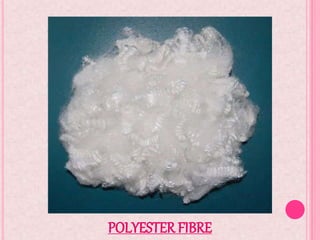
POLYESTER FIBRE
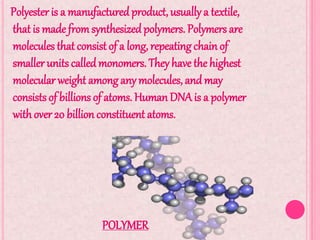
Polyester is a manufacturedproduct, usually a textile,
that is made fromsynthesized polymers. Polymers are
molecules that consist of a long, repeating chain of
smallerunits called monomers. They have the highest
molecular weight among any molecules, and may
consists of billions of atoms. Human DNA is a polymer
withover 20 billion constituent atoms.
POLYMER
CHARACTERISTICS OF POLYESTER
Strong
Resilient
Quick drying
Resistant to biological damage
such as mold and mildew
Easy to wash
Resistant to stretching and
shrinking
Wrinkle resistant
Retains heat
Resistant to most
chemicals
Abrasion resistant
Set pleats and crease
Highlyflammable
TYPES OF POLYESTER
Terylene
Terrycot
Terrywool
TERYLENE
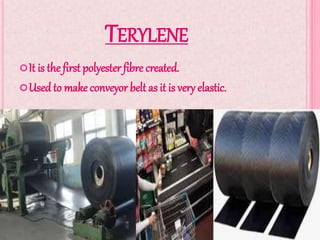
It is the first polyester fibre created.
Used to make conveyor belt as it is very elastic.
TERRYCOT
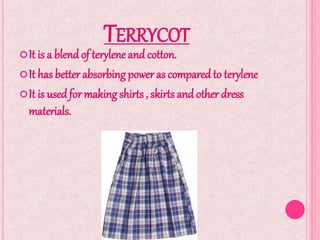
It is a blendof terylene and cotton.
It has better absorbingpower as compared to terylene
It is usedfor making shirts , skirts and other dress
materials.
TERRYWOOL
It is a blendof terylene and wool.
It is warmin addition to all characteristics observedin
polyesters.
It is usedfor making formal suits.
OTHER USES OF POLYESTER
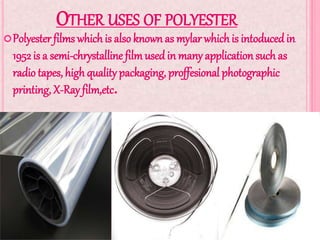
Polyester films whichis alsoknown as mylar which is intoduced in
1952 is a semi-chrystalline filmused in many application such as
radio tapes, high quality packaging, proffesional photographic
printing, X-Ray film,etc.
For making lightweight sails , tents polyestercore rope, etc.
THE END

Polyester

  • 1.
  • 2.
    CREATION OF POLYESTER In1926, United States – based E.I Du Pont de Nemours and Co. began researchinto very large molecules and synthetic fibres.This early research headedby W.H. Carothers centered on what became nylon, the first synthetic fibre. Soon after ,in the years 1939-1941, British research chemiststook interest in the du Pont studies and conducted their own research in laboratories of Calico Printers Association , Ltd. This work resulted in the creation of the polyester fiber known in England as Terylene.
  • 3.
    Terylene wascreted byWhinfield and Dickson along with Birtwhistle and Ritchiethey in 1941. It is first manufactured by Imperial Chemical laboratories (ICI) Polyester is a chemical termwhichcan be broken into poly, meaning many, and ester, a basic organic chemical compound. The principleingredient usedin the manufacture of polyester is ethylene, whichis derived frompetroleum. In this process, ethylene is the polymer, the chemical building block of polyester, and the chemical process that produces the finished polyester is called polymerization. Extruder is used to produce very fine threads of polyester .
  • 4.
  • 6.
    Polyester is amanufacturedproduct, usually a textile, that is made fromsynthesized polymers. Polymers are molecules that consist of a long, repeating chain of smallerunits called monomers. They have the highest molecular weight among any molecules, and may consists of billions of atoms. Human DNA is a polymer withover 20 billion constituent atoms. POLYMER
  • 7.
    CHARACTERISTICS OF POLYESTER Strong Resilient Quickdrying Resistant to biological damage such as mold and mildew Easy to wash Resistant to stretching and shrinking Wrinkle resistant Retains heat Resistant to most chemicals Abrasion resistant Set pleats and crease Highlyflammable
  • 8.
  • 9.
    TERYLENE It is thefirst polyester fibre created. Used to make conveyor belt as it is very elastic.
  • 10.
    TERRYCOT It is ablendof terylene and cotton. It has better absorbingpower as compared to terylene It is usedfor making shirts , skirts and other dress materials.
  • 11.
    TERRYWOOL It is ablendof terylene and wool. It is warmin addition to all characteristics observedin polyesters. It is usedfor making formal suits.
  • 12.
    OTHER USES OFPOLYESTER Polyester films whichis alsoknown as mylar which is intoduced in 1952 is a semi-chrystalline filmused in many application such as radio tapes, high quality packaging, proffesional photographic printing, X-Ray film,etc.
  • 13.
    For making lightweightsails , tents polyestercore rope, etc.
  • 14.