NYLON FIBRES
MANJINDER SINGH
SC16MO72
Indian Institute of Space Science and Technology
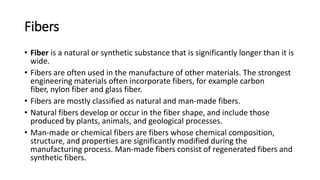
OVERVIEW
• Fibres
• Polyamide fibres
• Aramid fibres
• Nylon fibres
• Nylon 6 : Synthesis, Properties, Application
• Nylon 6,6 : Synthesis, Properties, Application
• Characteristics of nylon fibers
• Modern use of nylon
• Preparation using electrospinning
Fibers
• Fiber is a natural or synthetic substance that is significantly longer than it is
wide.
• Fibers are often used in the manufacture of other materials. The strongest
engineering materials often incorporate fibers, for example carbon
fiber, nylon fiber and glass fiber.
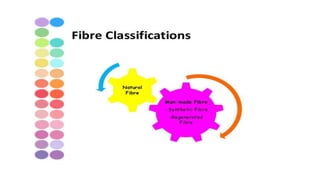
• Fibers are mostly classified as natural and man-made fibers.
• Natural fibers develop or occur in the fiber shape, and include those
produced by plants, animals, and geological processes.

• Man-made or chemical fibers are fibers whose chemical composition,
structure, and properties are significantly modified during the
manufacturing process. Man-made fibers consist of regenerated fibers and
synthetic fibers.
POLYAMIDE FIBRE
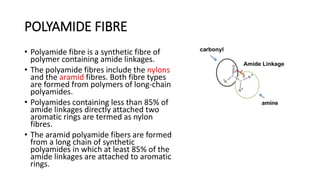
• Polyamide fibre is a synthetic fibre of
polymer containing amide linkages.
• The polyamide fibres include the nylons
and the aramid fibres. Both fibre types
are formed from polymers of long-chain
polyamides.
• Polyamides containing less than 85% of
amide linkages directly attached two
aromatic rings are termed as nylon
fibres.
• The aramid polyamide fibers are formed
from a long chain of synthetic
polyamides in which at least 85% of the
amide linkages are attached to aromatic
rings.
Aramid fibers
• Aramid fibers are a class of heat-resistant and strong synthetic fibers.
• They are fibers in which the chain molecules are highly oriented along
the fiber axis, so the strength of the chemical bond can be exploited.
• They are used in aerospace and military applications, for ballistic-
rated body armor fabric and ballistic composites, in bicycle tires, and
as an asbestos substitute.
• Aramid fibers are highly crystalline aromatic polyamide manufactured
by extruding an acidic solution of a proprietary precursor.
• Aramid fibers have very low density and high specific tensile strength
when compared to commonly available reinforcing fibers.
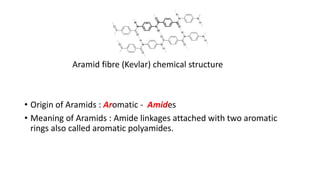
Aramid fibre (Kevlar) chemical structure
• Origin of Aramids : Aromatic - Amides
• Meaning of Aramids : Amide linkages attached with two aromatic
rings also called aromatic polyamides.
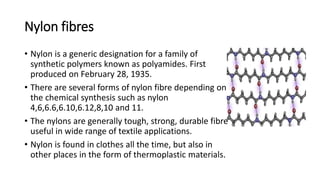
Nylon fibres
• Nylon is a generic designation for a family of
synthetic polymers known as polyamides. First
produced on February 28, 1935.
• There are several forms of nylon fibre depending on
the chemical synthesis such as nylon
4,6,6.6,6.10,6.12,8,10 and 11.
• The nylons are generally tough, strong, durable fibre
useful in wide range of textile applications.
• Nylon is found in clothes all the time, but also in
other places in the form of thermoplastic materials.
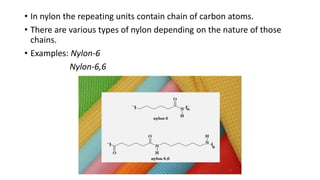
• In nylon the repeating units contain chain of carbon atoms.
• There are various types of nylon depending on the nature of those
chains.
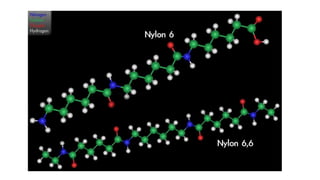
• Examples: Nylon-6
Nylon-6,6
Nylon 6
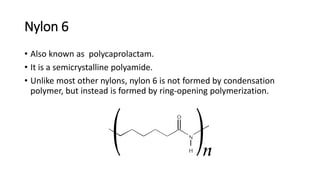
• Also known as polycaprolactam.
• It is a semicrystalline polyamide.
• Unlike most other nylons, nylon 6 is not formed by condensation
polymer, but instead is formed by ring-opening polymerization.
(a) (b) (c)
(a) fishing twin (b) nylon 6 wires (c) nylon 6 wires granules
Synthesis of Nylon 6
• Nylon 6 is made by heating caprolactam to about 250oC with about
5-10% water thrown in.
• Following reaction will take place.
Properties of Nylon 6
• Nylon 6 fibers are tough, possessing high tensile strength, as well as
elasticity and luster.
• They are wrinkleproof and highly resistant to abrasion and chemicals
such as acids and alkalis.
• The fibres can absorb up to 2.4% of water, although this lowers
tensile strength.
• The glass transition temperature of Nylon 6 is 47 °C.
• As a synthetic fiber, Nylon 6 is generally white but can be dyed to in a
solution bath prior to production for different color results.
• Its tenacity is between 6 and 8.5 gm/den with a density of 1.14
gm/cc.
• Its melting point is at 215 °C and can protect heat up to 150 °C on
average.
Application of Nylon 6
• Nylon 6 is widely used for gears, fittings, and bearings, in automotive
industry for various parts, and as a material for power tools housings.
• It is used as thread in bristles for toothbrushes, surgical sutures, and
strings for acoustic and classical musical instruments, including
guitars, sitars, violins, violas, and cellos.
• It is also used in the manufacture of a large variety of threads, ropes,
filaments, nets, and tire cords, as well as hosiery and knitted
garments.
• It can also be used in gun frames, such as those used by Glock, which
are made with a composite of Nylon 6 and other polymers.
Nylon 6,6
• Nylon 6,6 is a type of polyamide or nylon. Nylons come in many
types, and the two most common for textile and plastics industries
are nylon 6 and nylon 6,6.
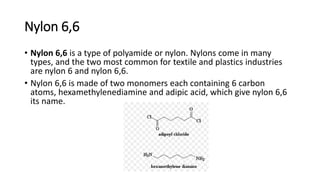
• Nylon 6,6 is made of two monomers each containing 6 carbon
atoms, hexamethylenediamine and adipic acid, which give nylon 6,6
its name.
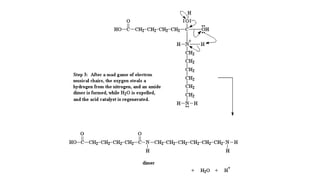
• To make nylon 6,6 on doesn't need a catalyst, but acids do catalyze
the reaction, one of the monomers is itself an acid. A little reaction
happens between two adipic acid molecules. One will donate a
proton to a the carbonyl oxygen of another.
Properties of Nylon 6,6
• Chemical formula : (C12H22N2O2)n
• Density : 1.14 g/mL
• Melting point : 507 °F (264 °C)
• High mechanical strength, rigidity, good stability under heat and
chemical resistance.
Applications of nylon 6,6
• Nylon 6,6 is used in fibers for textiles and carpets and molded parts.
• It is also used in airbags, apparel, and for carpet fibres.
• It is used to make 3D structural objects by injection molding which is
used in auto application such as radiator end tanks, rocker covers, air
intake manifolds, oil pans and numerous other structural parts such
as ball bearing cages and electro-insulating elements.
• Nylon 6,6 is also a popular guitar nut material.
• Nylon 6,6, especially glass fibre grades can be effectively fire retarded
with halogen free products.
Characteristics of nylon fibre
• Functional group is amide.
• Light in weight.
• Incredible tensile strength.
• Great stretch ability.
• Varies in luster.
• Durable and elastic.
• Easy to wash and can dye.
• High resistance to insects, fungi and chemicals.
• Abrasion resistance.
• Melts instead of burning.
Modern use of nylon
• Clothing: footwear, Velcro, carpet fibre.
• Auto-parts: petrol tanks, gears, bearing.
• Abseiling gears: sling and ropes.
• Sports items: basketball netting, racquet strings, fishing lines.
• Strings: musical instruments.
• Medical equipment: filtering media in sterilizing and sutures.
Preparation of Polymer Nano Fibre (Nylon Fibre)
Produced from Electrospinning
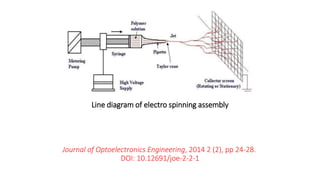
Line diagram of electro spinning assembly
Journal of Optoelectronics Engineering, 2014 2 (2), pp 24-28.
DOI: 10.12691/joe-2-2-1
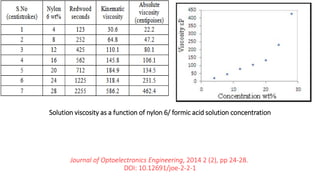
Solution viscosity as a function of nylon 6/ formic acid solution concentration
Journal of Optoelectronics Engineering, 2014 2 (2), pp 24-28.
DOI: 10.12691/joe-2-2-1
SEM images of electro spun nylon fibre (a) 16wt% concentration,
(b) 20wt% concentration and (c) 24wt% concentration
Journal of Optoelectronics Engineering, 2014 2 (2), pp 24-28.
DOI: 10.12691/joe-2-2-1
Nylon fibre

Nylon fibre

  • 1.
    NYLON FIBRES MANJINDER SINGH SC16MO72 IndianInstitute of Space Science and Technology
  • 2.
    OVERVIEW • Fibres • Polyamidefibres • Aramid fibres • Nylon fibres • Nylon 6 : Synthesis, Properties, Application • Nylon 6,6 : Synthesis, Properties, Application • Characteristics of nylon fibers • Modern use of nylon • Preparation using electrospinning
  • 3.
    Fibers • Fiber isa natural or synthetic substance that is significantly longer than it is wide. • Fibers are often used in the manufacture of other materials. The strongest engineering materials often incorporate fibers, for example carbon fiber, nylon fiber and glass fiber. • Fibers are mostly classified as natural and man-made fibers. • Natural fibers develop or occur in the fiber shape, and include those produced by plants, animals, and geological processes. • Man-made or chemical fibers are fibers whose chemical composition, structure, and properties are significantly modified during the manufacturing process. Man-made fibers consist of regenerated fibers and synthetic fibers.
  • 6.
    POLYAMIDE FIBRE • Polyamidefibre is a synthetic fibre of polymer containing amide linkages. • The polyamide fibres include the nylons and the aramid fibres. Both fibre types are formed from polymers of long-chain polyamides. • Polyamides containing less than 85% of amide linkages directly attached two aromatic rings are termed as nylon fibres. • The aramid polyamide fibers are formed from a long chain of synthetic polyamides in which at least 85% of the amide linkages are attached to aromatic rings.
  • 7.
    Aramid fibers • Aramidfibers are a class of heat-resistant and strong synthetic fibers. • They are fibers in which the chain molecules are highly oriented along the fiber axis, so the strength of the chemical bond can be exploited. • They are used in aerospace and military applications, for ballistic- rated body armor fabric and ballistic composites, in bicycle tires, and as an asbestos substitute. • Aramid fibers are highly crystalline aromatic polyamide manufactured by extruding an acidic solution of a proprietary precursor. • Aramid fibers have very low density and high specific tensile strength when compared to commonly available reinforcing fibers.
  • 8.
    Aramid fibre (Kevlar)chemical structure • Origin of Aramids : Aromatic - Amides • Meaning of Aramids : Amide linkages attached with two aromatic rings also called aromatic polyamides.
  • 9.
    Nylon fibres • Nylonis a generic designation for a family of synthetic polymers known as polyamides. First produced on February 28, 1935. • There are several forms of nylon fibre depending on the chemical synthesis such as nylon 4,6,6.6,6.10,6.12,8,10 and 11. • The nylons are generally tough, strong, durable fibre useful in wide range of textile applications. • Nylon is found in clothes all the time, but also in other places in the form of thermoplastic materials.
  • 10.
    • In nylonthe repeating units contain chain of carbon atoms. • There are various types of nylon depending on the nature of those chains. • Examples: Nylon-6 Nylon-6,6
  • 13.
    Nylon 6 • Alsoknown as polycaprolactam. • It is a semicrystalline polyamide. • Unlike most other nylons, nylon 6 is not formed by condensation polymer, but instead is formed by ring-opening polymerization.
  • 14.
    (a) (b) (c) (a)fishing twin (b) nylon 6 wires (c) nylon 6 wires granules
  • 15.
    Synthesis of Nylon6 • Nylon 6 is made by heating caprolactam to about 250oC with about 5-10% water thrown in. • Following reaction will take place.
  • 18.
    Properties of Nylon6 • Nylon 6 fibers are tough, possessing high tensile strength, as well as elasticity and luster. • They are wrinkleproof and highly resistant to abrasion and chemicals such as acids and alkalis. • The fibres can absorb up to 2.4% of water, although this lowers tensile strength. • The glass transition temperature of Nylon 6 is 47 °C. • As a synthetic fiber, Nylon 6 is generally white but can be dyed to in a solution bath prior to production for different color results.
  • 19.
    • Its tenacityis between 6 and 8.5 gm/den with a density of 1.14 gm/cc. • Its melting point is at 215 °C and can protect heat up to 150 °C on average.
  • 20.
    Application of Nylon6 • Nylon 6 is widely used for gears, fittings, and bearings, in automotive industry for various parts, and as a material for power tools housings. • It is used as thread in bristles for toothbrushes, surgical sutures, and strings for acoustic and classical musical instruments, including guitars, sitars, violins, violas, and cellos. • It is also used in the manufacture of a large variety of threads, ropes, filaments, nets, and tire cords, as well as hosiery and knitted garments. • It can also be used in gun frames, such as those used by Glock, which are made with a composite of Nylon 6 and other polymers.
  • 21.
    Nylon 6,6 • Nylon6,6 is a type of polyamide or nylon. Nylons come in many types, and the two most common for textile and plastics industries are nylon 6 and nylon 6,6. • Nylon 6,6 is made of two monomers each containing 6 carbon atoms, hexamethylenediamine and adipic acid, which give nylon 6,6 its name.
  • 22.
    • To makenylon 6,6 on doesn't need a catalyst, but acids do catalyze the reaction, one of the monomers is itself an acid. A little reaction happens between two adipic acid molecules. One will donate a proton to a the carbonyl oxygen of another.
  • 29.
    Properties of Nylon6,6 • Chemical formula : (C12H22N2O2)n • Density : 1.14 g/mL • Melting point : 507 °F (264 °C) • High mechanical strength, rigidity, good stability under heat and chemical resistance.
  • 30.
    Applications of nylon6,6 • Nylon 6,6 is used in fibers for textiles and carpets and molded parts. • It is also used in airbags, apparel, and for carpet fibres. • It is used to make 3D structural objects by injection molding which is used in auto application such as radiator end tanks, rocker covers, air intake manifolds, oil pans and numerous other structural parts such as ball bearing cages and electro-insulating elements. • Nylon 6,6 is also a popular guitar nut material. • Nylon 6,6, especially glass fibre grades can be effectively fire retarded with halogen free products.
  • 31.
    Characteristics of nylonfibre • Functional group is amide. • Light in weight. • Incredible tensile strength. • Great stretch ability. • Varies in luster. • Durable and elastic. • Easy to wash and can dye. • High resistance to insects, fungi and chemicals. • Abrasion resistance. • Melts instead of burning.
  • 32.
    Modern use ofnylon • Clothing: footwear, Velcro, carpet fibre. • Auto-parts: petrol tanks, gears, bearing. • Abseiling gears: sling and ropes. • Sports items: basketball netting, racquet strings, fishing lines. • Strings: musical instruments. • Medical equipment: filtering media in sterilizing and sutures.
  • 33.
    Preparation of PolymerNano Fibre (Nylon Fibre) Produced from Electrospinning
  • 34.
    Line diagram ofelectro spinning assembly Journal of Optoelectronics Engineering, 2014 2 (2), pp 24-28. DOI: 10.12691/joe-2-2-1
  • 35.
    Solution viscosity asa function of nylon 6/ formic acid solution concentration Journal of Optoelectronics Engineering, 2014 2 (2), pp 24-28. DOI: 10.12691/joe-2-2-1
  • 36.
    SEM images ofelectro spun nylon fibre (a) 16wt% concentration, (b) 20wt% concentration and (c) 24wt% concentration Journal of Optoelectronics Engineering, 2014 2 (2), pp 24-28. DOI: 10.12691/joe-2-2-1