Amipara Jaynish R.
140520123003
Topic name:
POLYACRYLATE
INTRODUCTION
• Polyacrylate IUPAC name is Prop-2-enoic acid.
• Polyacrylate trade name is ACRALEN A.
• Acrylate polymer belong to a group of polymers which could be
referred to generally as plastics.
• They are noted for their transparency, resistance to breakage,
and elasticity. They are also commonly known
as acrylics or polyacrylates.
• Polyacrylate polymer is commonly used in cosmetics such as
nail polish as an adhesive and mainly water absorbtion.
HISTORY
 Until the 1920s, water absorbing materials were cellulosic or fiber-based
products. Choices were tissue paper, cotton, sponge. The water
absorbent capacity of these types of materials is only up to 11 times their
weight.
 In the early 1960s, the United States Department of Agriculture (USDA)
was conducting work on materials to improve water conservation in soils.
They developed a resin based on the grafting of acrylonitrile polymer
onto the backbone of starch molecules. . The water absorbent capacity of
these types of materials greater than 400 times its weight.
 Polyacrylate copolymers were originally designed for use in conditions
with high electrolyte content and a need for long term stability including
numerous wet or dry cycles. Uses include agricultural and horticultural.
With the added strength of the acrylate monomer, used as medical spill
control, wire & cable water blocking.
MATERIAL STRUCTURE
• A polyacrylate polymer of acrylic acid or meyacrylic acid, with
the general structure.
• Acrylates are a family of polymers, which are a type of vinyl
polymer. Acrylates are of course made from acrylate
monomers, and it's about time we explained what those are.
Acrylate monomers are esters which contain vinyl groups, that
is, two carbon atoms double-bonded to each other, directly
attached to the carbonyl carbon.
STRUCTURE
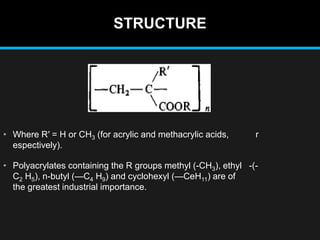
• Where R′ = H or CH3 (for acrylic and methacrylic acids, r
espectively).
• Polyacrylates containing the R groups methyl (-CH3), ethyl -(-
C2 H5), n-butyl (—C4 H9) and cyclohexyl (—CeH11) are of
the greatest industrial importance.
SYNTHESIS OF MATERIAL
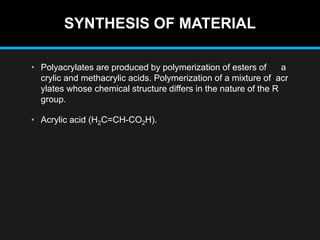
• Polyacrylates are produced by polymerization of esters of a
crylic and methacrylic acids. Polymerization of a mixture of acr
ylates whose chemical structure differs in the nature of the R
group.
• Acrylic acid (H2C=CH-CO2H).
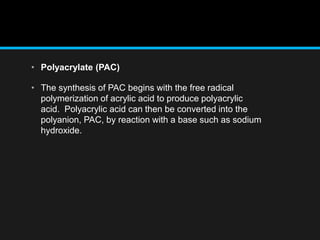
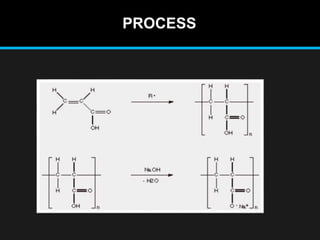
• Polyacrylate (PAC)
• The synthesis of PAC begins with the free radical
polymerization of acrylic acid to produce polyacrylic
acid. Polyacrylic acid can then be converted into the
polyanion, PAC, by reaction with a base such as sodium
hydroxide.
PROCESS
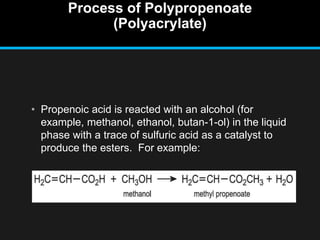
Process of Polypropenoate
(Polyacrylate)
• Propenoic acid is reacted with an alcohol (for
example, methanol, ethanol, butan-1-ol) in the liquid
phase with a trace of sulfuric acid as a catalyst to
produce the esters. For example:
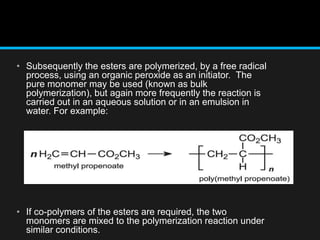
• Subsequently the esters are polymerized, by a free radical
process, using an organic peroxide as an initiator. The
pure monomer may be used (known as bulk
polymerization), but again more frequently the reaction is
carried out in an aqueous solution or in an emulsion in
water. For example:
• If co-polymers of the esters are required, the two
monomers are mixed to the polymerization reaction under
similar conditions.
PROPERTIES
• Polyacrylate is available in a wide range of molecular weights.
• It is thermally stable.
• It is hydrolytically stable.
• Polyacrylate are available in liquid or powder, acid or neutralized
forms.
• Polyacrylate standard compound at 149°C .
PHYSICAL PROPERTIES
Physical Properties Value
Density 1.15 ‐ 1.19 g/cm3
Water Absorption 0.3-2%
Moisture absorption at Equilibrium 0.3-0.33%
Linear Mould Shrinkage 0.003-0065cm/cm
Melt Flow 0.9-27 g/10min
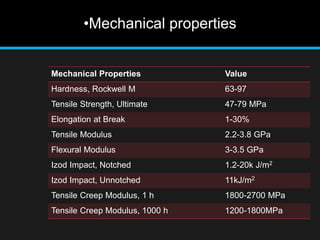
•Mechanical properties
Mechanical Properties Value
Hardness, Rockwell M 63-97
Tensile Strength, Ultimate 47-79 MPa
Elongation at Break 1-30%
Tensile Modulus 2.2-3.8 GPa
Flexural Modulus 3-3.5 GPa
Izod Impact, Notched 1.2-20k J/m2
Izod Impact, Unnotched 11kJ/m2
Tensile Creep Modulus, 1 h 1800-2700 MPa
Tensile Creep Modulus, 1000 h 1200-1800MPa
Advantage
• Wide range of colour choice with excellent stability and surface
effect.
• Polyacrylate is made of multiple chains of acrylate compounds
thatbposses a positive anionic charge, which attract waterbased
molecules to combine with it,and make super absorbent
compound.
• Polyacrylate is primarily used as thickening agent because of its
unique ability to absorb and hold onto water molecules.
• To moisture absorb in the coating of sensitive electrical wiring to
keep moisture away from the wire.
• Polyacrylates are cost-effective ingredients in soap and detergent
formulations.
Disadvantage
• While resistance to hot air aging is superior to Nitrile,
Polyacrylate strength, compression set, water resistance
properties and low temperature capabilities are inferior to
many other polymers. Polyacrylates are also not generally
recommended for exposure to alcohol, glycols, alkalis, brake
fluids, or to chlorinated or aromatic hydrocarbons.
APPLICATION
• Improve seed germination and give plants an early, healthy start.
• Save the irrigation,increase crops and fruit yield.
• Sodium polyacrylate is widely used in hygiene products such as paper diaper, sanitary towel,pets pad
etc.
• Used in waterproof tape and waterproof ointment for using in optical fibers cable.
• Filtration applications
• Fire protection
• Fragrance carrier
• Grow-in-water toys
• Hot & cold therapy packs
• Instant snow
• Medical waste solidification
• Wire & cable water blocking
The obvious uses of
sodium polyacrylate
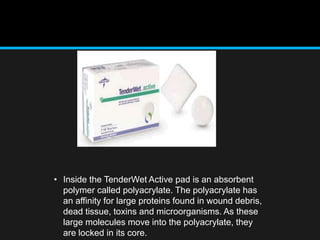
• Inside the TenderWet Active pad is an absorbent
polymer called polyacrylate. The polyacrylate has
an affinity for large proteins found in wound debris,
dead tissue, toxins and microorganisms. As these
large molecules move into the polyacrylate, they
are locked in its core.
•Our self-inflating floodbags
keep you prepared. Unlike
traditional sandbags our
floodbags come flat packed.
Contained within each bag is a
cotton liner holding 200g of
Sodium Polyacrylate. This
polymer has the ability to
absorb and safely hold up to
100 times its weight in water.
One floodbag can absorb up to
20 litres of water.
Response Super Absorbent Clean Up
Powders
Absorbs 300 times its weight in liquid.
Non toxic, non-bleaching and non
corrosive powder is highly effective in
absorbing blood, vomit and urine.
Sprinkle powder onto affected area and
wait a few moments until waste has been
fully absorbed.
Just 10g of powder is sufficient to absorb
most body fluid spills.
Insta-Snow
Just add water to the Insta-Snow
powder and watch the snow erupt. You
won't believe your eyes!
Insta-Snow Chemical is Sodium
Polyacrylate. (This product is NOT
considered to be a health risk. This is
the same material used in disposable
baby diapers.)
Insta-Snow will biodegrade in 90 days.
•Waterproof Tape
•Agriculture

Synthesis of Polycarbonate

  • 1.
  • 2.
    INTRODUCTION • Polyacrylate IUPACname is Prop-2-enoic acid. • Polyacrylate trade name is ACRALEN A. • Acrylate polymer belong to a group of polymers which could be referred to generally as plastics. • They are noted for their transparency, resistance to breakage, and elasticity. They are also commonly known as acrylics or polyacrylates. • Polyacrylate polymer is commonly used in cosmetics such as nail polish as an adhesive and mainly water absorbtion.
  • 3.
    HISTORY  Until the1920s, water absorbing materials were cellulosic or fiber-based products. Choices were tissue paper, cotton, sponge. The water absorbent capacity of these types of materials is only up to 11 times their weight.  In the early 1960s, the United States Department of Agriculture (USDA) was conducting work on materials to improve water conservation in soils. They developed a resin based on the grafting of acrylonitrile polymer onto the backbone of starch molecules. . The water absorbent capacity of these types of materials greater than 400 times its weight.  Polyacrylate copolymers were originally designed for use in conditions with high electrolyte content and a need for long term stability including numerous wet or dry cycles. Uses include agricultural and horticultural. With the added strength of the acrylate monomer, used as medical spill control, wire & cable water blocking.
  • 4.
    MATERIAL STRUCTURE • Apolyacrylate polymer of acrylic acid or meyacrylic acid, with the general structure. • Acrylates are a family of polymers, which are a type of vinyl polymer. Acrylates are of course made from acrylate monomers, and it's about time we explained what those are. Acrylate monomers are esters which contain vinyl groups, that is, two carbon atoms double-bonded to each other, directly attached to the carbonyl carbon.
  • 5.
    STRUCTURE • Where R′= H or CH3 (for acrylic and methacrylic acids, r espectively). • Polyacrylates containing the R groups methyl (-CH3), ethyl -(- C2 H5), n-butyl (—C4 H9) and cyclohexyl (—CeH11) are of the greatest industrial importance.
  • 6.
    SYNTHESIS OF MATERIAL •Polyacrylates are produced by polymerization of esters of a crylic and methacrylic acids. Polymerization of a mixture of acr ylates whose chemical structure differs in the nature of the R group. • Acrylic acid (H2C=CH-CO2H).
  • 7.
    • Polyacrylate (PAC) •The synthesis of PAC begins with the free radical polymerization of acrylic acid to produce polyacrylic acid. Polyacrylic acid can then be converted into the polyanion, PAC, by reaction with a base such as sodium hydroxide.
  • 8.
  • 9.
    Process of Polypropenoate (Polyacrylate) •Propenoic acid is reacted with an alcohol (for example, methanol, ethanol, butan-1-ol) in the liquid phase with a trace of sulfuric acid as a catalyst to produce the esters. For example:
  • 10.
    • Subsequently theesters are polymerized, by a free radical process, using an organic peroxide as an initiator. The pure monomer may be used (known as bulk polymerization), but again more frequently the reaction is carried out in an aqueous solution or in an emulsion in water. For example: • If co-polymers of the esters are required, the two monomers are mixed to the polymerization reaction under similar conditions.
  • 11.
    PROPERTIES • Polyacrylate isavailable in a wide range of molecular weights. • It is thermally stable. • It is hydrolytically stable. • Polyacrylate are available in liquid or powder, acid or neutralized forms. • Polyacrylate standard compound at 149°C .
  • 12.
    PHYSICAL PROPERTIES Physical PropertiesValue Density 1.15 ‐ 1.19 g/cm3 Water Absorption 0.3-2% Moisture absorption at Equilibrium 0.3-0.33% Linear Mould Shrinkage 0.003-0065cm/cm Melt Flow 0.9-27 g/10min
  • 13.
    •Mechanical properties Mechanical PropertiesValue Hardness, Rockwell M 63-97 Tensile Strength, Ultimate 47-79 MPa Elongation at Break 1-30% Tensile Modulus 2.2-3.8 GPa Flexural Modulus 3-3.5 GPa Izod Impact, Notched 1.2-20k J/m2 Izod Impact, Unnotched 11kJ/m2 Tensile Creep Modulus, 1 h 1800-2700 MPa Tensile Creep Modulus, 1000 h 1200-1800MPa
  • 14.
    Advantage • Wide rangeof colour choice with excellent stability and surface effect. • Polyacrylate is made of multiple chains of acrylate compounds thatbposses a positive anionic charge, which attract waterbased molecules to combine with it,and make super absorbent compound. • Polyacrylate is primarily used as thickening agent because of its unique ability to absorb and hold onto water molecules. • To moisture absorb in the coating of sensitive electrical wiring to keep moisture away from the wire. • Polyacrylates are cost-effective ingredients in soap and detergent formulations.
  • 15.
    Disadvantage • While resistanceto hot air aging is superior to Nitrile, Polyacrylate strength, compression set, water resistance properties and low temperature capabilities are inferior to many other polymers. Polyacrylates are also not generally recommended for exposure to alcohol, glycols, alkalis, brake fluids, or to chlorinated or aromatic hydrocarbons.
  • 16.
    APPLICATION • Improve seedgermination and give plants an early, healthy start. • Save the irrigation,increase crops and fruit yield. • Sodium polyacrylate is widely used in hygiene products such as paper diaper, sanitary towel,pets pad etc. • Used in waterproof tape and waterproof ointment for using in optical fibers cable. • Filtration applications • Fire protection • Fragrance carrier • Grow-in-water toys • Hot & cold therapy packs • Instant snow • Medical waste solidification • Wire & cable water blocking
  • 17.
    The obvious usesof sodium polyacrylate
  • 18.
    • Inside theTenderWet Active pad is an absorbent polymer called polyacrylate. The polyacrylate has an affinity for large proteins found in wound debris, dead tissue, toxins and microorganisms. As these large molecules move into the polyacrylate, they are locked in its core.
  • 19.
    •Our self-inflating floodbags keepyou prepared. Unlike traditional sandbags our floodbags come flat packed. Contained within each bag is a cotton liner holding 200g of Sodium Polyacrylate. This polymer has the ability to absorb and safely hold up to 100 times its weight in water. One floodbag can absorb up to 20 litres of water.
  • 20.
    Response Super AbsorbentClean Up Powders Absorbs 300 times its weight in liquid. Non toxic, non-bleaching and non corrosive powder is highly effective in absorbing blood, vomit and urine. Sprinkle powder onto affected area and wait a few moments until waste has been fully absorbed. Just 10g of powder is sufficient to absorb most body fluid spills.
  • 21.
    Insta-Snow Just add waterto the Insta-Snow powder and watch the snow erupt. You won't believe your eyes! Insta-Snow Chemical is Sodium Polyacrylate. (This product is NOT considered to be a health risk. This is the same material used in disposable baby diapers.) Insta-Snow will biodegrade in 90 days.
  • 22.