How can a group—such as two or more nations— 
serve its collective interests when doing so 
requires its members to forgo their individual 
interests? 
Example: 
stopping global warming, can be achieved 
only by many countries acting together yet each 
country has an individual interest in burning fossil 
fuel to keep its economy going 
though they recognize the benefits of military 
alliance, each has a separate interest in 
minimizing its own contribution in troops and 
money
• It is the problem of how to provide 
something that benefits all members of 
what each member contributes to it. 
May 
also be 
called 
problem 
of: 
Collective action 
Free riding 
Burden sharing 
The tragedy of the commons 
Mixed interest game 
The prisoner’s dilemma
• Collective goods are easier to provide 
in small groups than in large ones 
• Defection (free riding) in small groups 
is harder to conceal, has greater 
impact on the overall collective good, 
and easier to punish
• It is acute in international affairs 
because each nation is sovereign, 
with no central authority such as world 
government to enforce on individual 
nations the necessary measures to 
provide for the common good
• Imagine you have two good friends, a man and a 
woman, who are in a romantic relationship. They 
love each other and enjoy the other’s company, but 
they come to you for help because they have 
problems. When they go out together, the man likes 
to go the opera, whereas the woman enjoys boxing 
matches. Because of your training in international 
relations, you quickly recognize this as a collective 
goods problem, in which a shared interest is 
spending time together and the conflicting individual 
interests are watching opera and watching boxing. 
• Question: How will you approach this problem?
1. You might say, 
“Traditionally, relationships work best 
when the man wears the pants. For 
thousands of years the man has made 
decisions and the woman has followed it. I 
suggest you do the same, and buy season 
tickets to the opera.” 
- Dominance Solution
2. You could say, 
“Look, instead of fighting all the same, 
why don’t you establish a pattern and trade 
off going to boxing one time and opera the 
next.” 
- Reciprocity Solution
3. You could say, 
“Who cares about opera or boxing? 
The point is that you love each other and 
want to be together. Get past the 
superficial issues and strengthen the core 
feelings that brought you together. Then it 
won’t matter where you go or what you’re 
watching.” 
- Reciprocity Solution
A very stable 
solution if the 
woman cares 
more about 
spending time with 
her true love 
This solution might 
leave the woman 
permanently 
resentful at the 
manifestly unequal 
nature of the 
outcome.
You could set up 
agreements, accounting 
systems, and shared 
expectations 
It can become very 
complicated, they require 
constant monitoring to see 
if obligations are being met 
and cheating is avoided
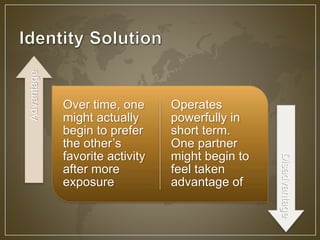
Over time, one 
might actually 
begin to prefer 
the other’s 
favorite activity 
after more 
exposure 
Operates 
powerfully in 
short term. 
One partner 
might begin to 
feel taken 
advantage of 
Advantage 
Disadvantage
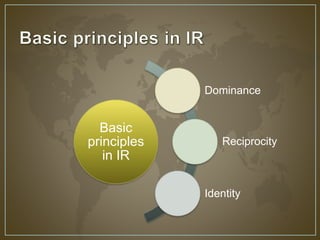
Basic 
principles 
in IR 
Dominance 
Reciprocity 
Identity
• It solves the collective goods problem by 
establishing a power hierarchy in which 
those at the top control those below—a bit 
like a government but without an actual 
government 
• Members of the group can just fight 
occasionally over the position in the “status 
hierarchy” rather than fighting over who gets 
scarce resources 
• Fights over dominance position have 
scripted rules that minimizes, to some 
extent, the harm inflicted on the group 
members 
• Dominance is complex, not just a matter of
• It underlies the great-power system, in 
which a handful of countries dictate the 
rules for all the others 
• Sometimes the hegemon or superpower 
stands atop the great powers as the 
dominant nation 
•UN Security Council, permanent members 
are the world’s strongest military powers 
that hold a veto, reflects the dominance 
principle
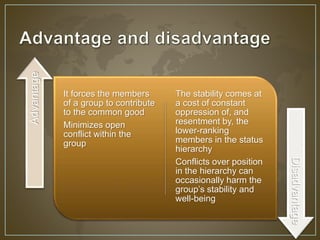
It forces the members 
of a group to contribute 
to the common good 
Minimizes open 
conflict within the 
group 
The stability comes at 
a cost of constant 
oppression of, and 
resentment by, the 
lower-ranking 
members in the status 
hierarchy 
Conflicts over position 
in the hierarchy can 
occasionally harm the 
group’s stability and 
well-being 
Advantage 
Disadvantage
• It solves the collective goods problem 
by rewarding behavior that contributes 
to the group and punishing behavior 
that pursues self-interest at the 
expense of the group 
• It is very easy to understand and can 
be “enforced” without any central 
authority, making it a robust way to 
get individuals to cooperate for the 
common good
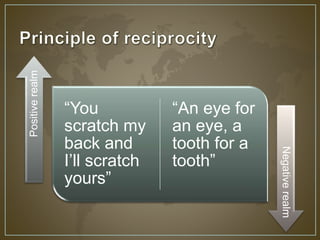
“You 
scratch my 
back and 
I’ll scratch 
yours” 
“An eye for 
an eye, a 
tooth for a 
tooth” 
Positive realm 
Negative realm
• It does not rely on self-interest 
• Members of identity community care 
about the interests of others in the 
community enough to sacrifice their own 
interests to benefit others 
• The roots of this principle lie in the family, 
the extended family, and kinship group. 
• Examples: 
•A rich American university may share lab 
equipment to a biologist in a poor country 
•A European Jewish may give money to 
Israel
• Important in overcoming difficult collective 
goods problems, including the issue of who 
contributes to : 
• development assistance 
• world health 
• UN peacekeeping missions 
• Examples: 
• Large foreign aids given by Scandinavian 
countries 
• High Canadian participation in peacekeeping 
• The shared identities of military professionals 
and diplomats
Consider the problem of nuclear proliferation. 
All countries share an interest in the collective 
good of peace and stability, which is hard to 
achieve in a world where more and more 
countries make more and more nuclear 
weapons. Within a society, if individuals 
acquire dangerous weapons, the government 
can take them away to keep everyone safe. 
But in the society of nations, no such central 
authority exists. In 2006, North Korea tested 
its first nuclear bomb and Iran continued 
uranium enrichment that could lead to nuclear 
bomb – defying UN resolutions in both cases. 
Determine how states solve this problem by 
using the three available approaches.
• Ownership of nuclear weapons and facilities 
by just few powerful countries , try to keep 
their exclusive hold on these weapons and 
prevent smaller nations from getting them. 
• One drawback to these dominance solutions 
is the resentment they create among small 
countries. 
• Examples: 
• In 2003, United States invaded Iraq and 
overthrew its government after it thought that 
Saddam Hussein might have an active nuclear 
weapons program 
• In 1982, Israel sent jets to bomb Iraq’s nuclear 
facility
• The Non-Proliferation Treaty (NPT) 
• Existing nuclear powers’ obligation to disarm in 
exchange for smaller countries’ agreement to stay 
nonnuclear. 
• It can be positive or negative 
• The use of deterrence 
• Examples: 
• US warned NoKor in 2006 against selling its bombs, 
threatening to retaliate against NoKor if any other 
actor used such bomb against US 
• Libya’s giving up of its nuclear weapons program in 
2003 receive rewards from the international 
community, including the ending of economic 
sanctions
• Many nations that have the technical 
ability to make nuclear weapons have 
chosen not to do so for it is 
undesirable. 
• Example: 
•Sweden, Germany, South Africa, and 
Japan
Polsc6   3 core principles in ir

Polsc6 3 core principles in ir

  • 2.
    How can agroup—such as two or more nations— serve its collective interests when doing so requires its members to forgo their individual interests? Example: stopping global warming, can be achieved only by many countries acting together yet each country has an individual interest in burning fossil fuel to keep its economy going though they recognize the benefits of military alliance, each has a separate interest in minimizing its own contribution in troops and money
  • 3.
    • It isthe problem of how to provide something that benefits all members of what each member contributes to it. May also be called problem of: Collective action Free riding Burden sharing The tragedy of the commons Mixed interest game The prisoner’s dilemma
  • 4.
    • Collective goodsare easier to provide in small groups than in large ones • Defection (free riding) in small groups is harder to conceal, has greater impact on the overall collective good, and easier to punish
  • 5.
    • It isacute in international affairs because each nation is sovereign, with no central authority such as world government to enforce on individual nations the necessary measures to provide for the common good
  • 6.
    • Imagine youhave two good friends, a man and a woman, who are in a romantic relationship. They love each other and enjoy the other’s company, but they come to you for help because they have problems. When they go out together, the man likes to go the opera, whereas the woman enjoys boxing matches. Because of your training in international relations, you quickly recognize this as a collective goods problem, in which a shared interest is spending time together and the conflicting individual interests are watching opera and watching boxing. • Question: How will you approach this problem?
  • 7.
    1. You mightsay, “Traditionally, relationships work best when the man wears the pants. For thousands of years the man has made decisions and the woman has followed it. I suggest you do the same, and buy season tickets to the opera.” - Dominance Solution
  • 8.
    2. You couldsay, “Look, instead of fighting all the same, why don’t you establish a pattern and trade off going to boxing one time and opera the next.” - Reciprocity Solution
  • 9.
    3. You couldsay, “Who cares about opera or boxing? The point is that you love each other and want to be together. Get past the superficial issues and strengthen the core feelings that brought you together. Then it won’t matter where you go or what you’re watching.” - Reciprocity Solution
  • 10.
    A very stable solution if the woman cares more about spending time with her true love This solution might leave the woman permanently resentful at the manifestly unequal nature of the outcome.
  • 11.
    You could setup agreements, accounting systems, and shared expectations It can become very complicated, they require constant monitoring to see if obligations are being met and cheating is avoided
  • 12.
    Over time, one might actually begin to prefer the other’s favorite activity after more exposure Operates powerfully in short term. One partner might begin to feel taken advantage of Advantage Disadvantage
  • 13.
    Basic principles inIR Dominance Reciprocity Identity
  • 15.
    • It solvesthe collective goods problem by establishing a power hierarchy in which those at the top control those below—a bit like a government but without an actual government • Members of the group can just fight occasionally over the position in the “status hierarchy” rather than fighting over who gets scarce resources • Fights over dominance position have scripted rules that minimizes, to some extent, the harm inflicted on the group members • Dominance is complex, not just a matter of
  • 16.
    • It underliesthe great-power system, in which a handful of countries dictate the rules for all the others • Sometimes the hegemon or superpower stands atop the great powers as the dominant nation •UN Security Council, permanent members are the world’s strongest military powers that hold a veto, reflects the dominance principle
  • 17.
    It forces themembers of a group to contribute to the common good Minimizes open conflict within the group The stability comes at a cost of constant oppression of, and resentment by, the lower-ranking members in the status hierarchy Conflicts over position in the hierarchy can occasionally harm the group’s stability and well-being Advantage Disadvantage
  • 19.
    • It solvesthe collective goods problem by rewarding behavior that contributes to the group and punishing behavior that pursues self-interest at the expense of the group • It is very easy to understand and can be “enforced” without any central authority, making it a robust way to get individuals to cooperate for the common good
  • 20.
    “You scratch my back and I’ll scratch yours” “An eye for an eye, a tooth for a tooth” Positive realm Negative realm
  • 22.
    • It doesnot rely on self-interest • Members of identity community care about the interests of others in the community enough to sacrifice their own interests to benefit others • The roots of this principle lie in the family, the extended family, and kinship group. • Examples: •A rich American university may share lab equipment to a biologist in a poor country •A European Jewish may give money to Israel
  • 23.
    • Important inovercoming difficult collective goods problems, including the issue of who contributes to : • development assistance • world health • UN peacekeeping missions • Examples: • Large foreign aids given by Scandinavian countries • High Canadian participation in peacekeeping • The shared identities of military professionals and diplomats
  • 25.
    Consider the problemof nuclear proliferation. All countries share an interest in the collective good of peace and stability, which is hard to achieve in a world where more and more countries make more and more nuclear weapons. Within a society, if individuals acquire dangerous weapons, the government can take them away to keep everyone safe. But in the society of nations, no such central authority exists. In 2006, North Korea tested its first nuclear bomb and Iran continued uranium enrichment that could lead to nuclear bomb – defying UN resolutions in both cases. Determine how states solve this problem by using the three available approaches.
  • 26.
    • Ownership ofnuclear weapons and facilities by just few powerful countries , try to keep their exclusive hold on these weapons and prevent smaller nations from getting them. • One drawback to these dominance solutions is the resentment they create among small countries. • Examples: • In 2003, United States invaded Iraq and overthrew its government after it thought that Saddam Hussein might have an active nuclear weapons program • In 1982, Israel sent jets to bomb Iraq’s nuclear facility
  • 27.
    • The Non-ProliferationTreaty (NPT) • Existing nuclear powers’ obligation to disarm in exchange for smaller countries’ agreement to stay nonnuclear. • It can be positive or negative • The use of deterrence • Examples: • US warned NoKor in 2006 against selling its bombs, threatening to retaliate against NoKor if any other actor used such bomb against US • Libya’s giving up of its nuclear weapons program in 2003 receive rewards from the international community, including the ending of economic sanctions
  • 28.
    • Many nationsthat have the technical ability to make nuclear weapons have chosen not to do so for it is undesirable. • Example: •Sweden, Germany, South Africa, and Japan