Anurug Chakma
               Department of Peace
Presented By   and Conflict Studies
               University of Dhaka
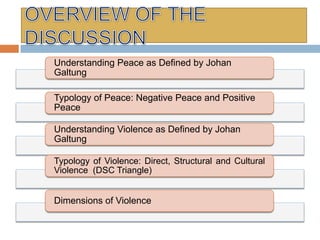
Understanding Peace as Defined by Johan
Galtung

Typology of Peace: Negative Peace and Positive
Peace

Understanding Violence as Defined by Johan
Galtung

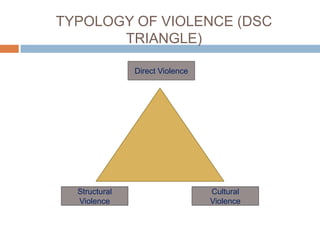
Typology of Violence: Direct, Structural and Cultural
Violence (DSC Triangle)


Dimensions of Violence
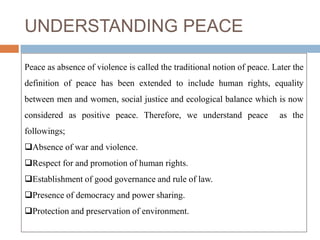
UNDERSTANDING PEACE

Peace as absence of violence is called the traditional notion of peace. Later the
definition of peace has been extended to include human rights, equality
between men and women, social justice and ecological balance which is now
considered as positive peace. Therefore, we understand peace              as the
followings;
Absence of war and violence.
Respect for and promotion of human rights.
Establishment of good governance and rule of law.
Presence of democracy and power sharing.
Protection and preservation of environment.
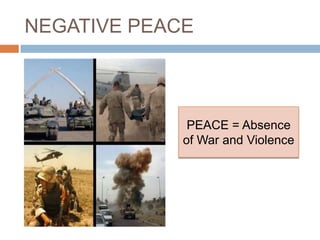
NEGATIVE PEACE


              PEACE = Absence
             of War and Violence
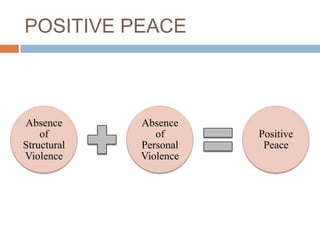
POSITIVE PEACE


Absence      Absence
    of          of      Positive
Structural   Personal    Peace
Violence     Violence
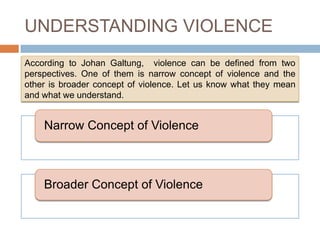
UNDERSTANDING VIOLENCE
According to Johan Galtung, violence can be defined from two
perspectives. One of them is narrow concept of violence and the
other is broader concept of violence. Let us know what they mean
and what we understand.


    Narrow Concept of Violence


    Broader Concept of Violence
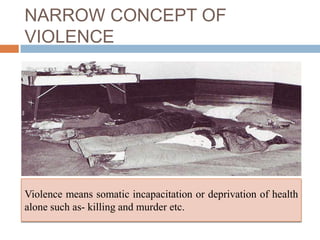
NARROW CONCEPT OF
VIOLENCE


Violence means somatic incapacitation or deprivation of health
alone such as- killing and murder etc.
BROADER CONCEPT OF
VIOLENCE


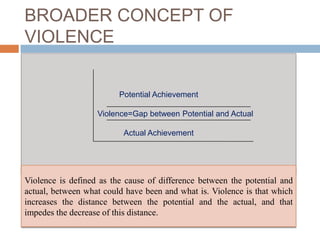
                         Potential Achievement

                   Violence=Gap between Potential and Actual

                          Actual Achievement


Violence is defined as the cause of difference between the potential and
actual, between what could have been and what is. Violence is that which
increases the distance between the potential and the actual, and that
impedes the decrease of this distance.
TYPOLOGY OF VIOLENCE (DSC
       TRIANGLE)

               Direct Violence


  Structural                     Cultural
  Violence                       Violence
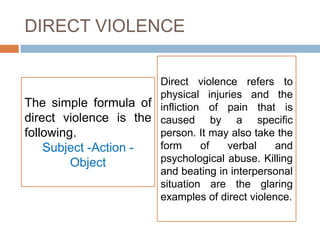
DIRECT VIOLENCE

                       Direct violence refers to
                       physical injuries and the
The simple formula of infliction of pain that is
direct violence is the caused by a specific
following.             person. It may also take the
    Subject -Action -  form     of   verbal     and
         Object        psychological abuse. Killing
                       and beating in interpersonal
                       situation are the glaring
                       examples of direct violence.
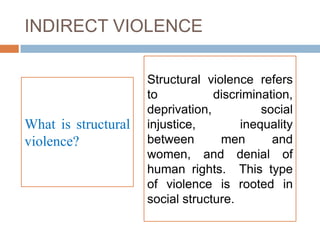
INDIRECT VIOLENCE

                     Structural violence refers
                     to           discrimination,
                     deprivation,          social
What is structural   injustice,        inequality
violence?            between       men       and
                     women, and denial of
                     human rights. This type
                     of violence is rooted in
                     social structure.
INDIRECT VIOLENCE

                   Cultural violence is seen
                   as the source of other
                   types of violence through
What is cultural   its production of hatred,
violence?          fear     and     suspicion.
                   Religion, ideology and art
                   may be pointed out as
                   possible      sources    of
                   cultural violence.
DIMENSIONS OF VIOLENCE

The first distinction to be made is between physical and
psychological violence.

                      • Under physical violence human
    Physical            beings are hurt somatically to the
                        point of killing.
    Violence

                      • Psychological violence includes lies,
 Psychological          brainwashing,      indoctrination    of
                        various kinds, threats, etc. that serve
   Violence             to decrease mental potentialities.
DIMENSIONS OF VIOLENCE
(Cont.)

              • A person can be influenced not
  Negative      only by punishing him when he
  Approach      does what the influencer
                considers wrong.


              • A person can be influenced not
   Positive     only by rewarding him when he
  Approach      does what the influencer
                considers right.
DIMENSIONS OF VIOLENCE
(Cont.)
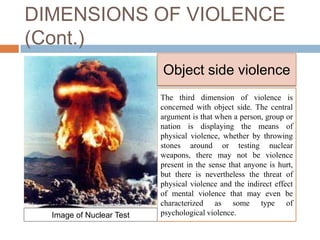
                          Object side violence
                          The third dimension of violence is
                          concerned with object side. The central
                          argument is that when a person, group or
                          nation is displaying the means of
                          physical violence, whether by throwing
                          stones around or testing nuclear
                          weapons, there may not be violence
                          present in the sense that anyone is hurt,
                          but there is nevertheless the threat of
                          physical violence and the indirect effect
                          of mental violence that may even be
                          characterized as some type of
  Image of Nuclear Test   psychological violence.
DIMENSIONS OF VIOLENCE
(cont.)


 Subject side
  violence      The fourth distinction is to
                be made based on the
                subject side. Individuals
                may be killed or hurt
                during both direct and
                indirect violence.
DIMENSIONS OF VIOLENCE
(cont.)


Intended and
 Unintended
               The fifth distinction is to
  Violence     be      made       between
               violence that is intended
               and    unintended.      The
               concept of guilt is decided
               based on intention.
DIMENSIONS OF VIOLENCE
(cont.)

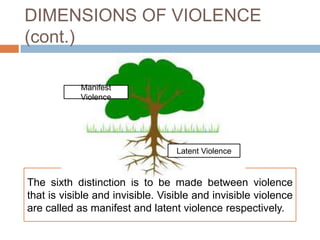
            Manifest
            Violence


                                  Latent Violence


The sixth distinction is to be made between violence
that is visible and invisible. Visible and invisible violence
are called as manifest and latent violence respectively.
Peace and violence
Peace and violence

Peace and violence

  • 1.
    Anurug Chakma Department of Peace Presented By and Conflict Studies University of Dhaka
  • 2.
    Understanding Peace asDefined by Johan Galtung Typology of Peace: Negative Peace and Positive Peace Understanding Violence as Defined by Johan Galtung Typology of Violence: Direct, Structural and Cultural Violence (DSC Triangle) Dimensions of Violence
  • 3.
    UNDERSTANDING PEACE Peace asabsence of violence is called the traditional notion of peace. Later the definition of peace has been extended to include human rights, equality between men and women, social justice and ecological balance which is now considered as positive peace. Therefore, we understand peace as the followings; Absence of war and violence. Respect for and promotion of human rights. Establishment of good governance and rule of law. Presence of democracy and power sharing. Protection and preservation of environment.
  • 4.
    NEGATIVE PEACE PEACE = Absence of War and Violence
  • 5.
    POSITIVE PEACE Absence Absence of of Positive Structural Personal Peace Violence Violence
  • 6.
    UNDERSTANDING VIOLENCE According toJohan Galtung, violence can be defined from two perspectives. One of them is narrow concept of violence and the other is broader concept of violence. Let us know what they mean and what we understand. Narrow Concept of Violence Broader Concept of Violence
  • 7.
    NARROW CONCEPT OF VIOLENCE Violencemeans somatic incapacitation or deprivation of health alone such as- killing and murder etc.
  • 8.
    BROADER CONCEPT OF VIOLENCE Potential Achievement Violence=Gap between Potential and Actual Actual Achievement Violence is defined as the cause of difference between the potential and actual, between what could have been and what is. Violence is that which increases the distance between the potential and the actual, and that impedes the decrease of this distance.
  • 9.
    TYPOLOGY OF VIOLENCE(DSC TRIANGLE) Direct Violence Structural Cultural Violence Violence
  • 10.
    DIRECT VIOLENCE Direct violence refers to physical injuries and the The simple formula of infliction of pain that is direct violence is the caused by a specific following. person. It may also take the Subject -Action - form of verbal and Object psychological abuse. Killing and beating in interpersonal situation are the glaring examples of direct violence.
  • 11.
    INDIRECT VIOLENCE Structural violence refers to discrimination, deprivation, social What is structural injustice, inequality violence? between men and women, and denial of human rights. This type of violence is rooted in social structure.
  • 12.
    INDIRECT VIOLENCE Cultural violence is seen as the source of other types of violence through What is cultural its production of hatred, violence? fear and suspicion. Religion, ideology and art may be pointed out as possible sources of cultural violence.
  • 13.
    DIMENSIONS OF VIOLENCE Thefirst distinction to be made is between physical and psychological violence. • Under physical violence human Physical beings are hurt somatically to the point of killing. Violence • Psychological violence includes lies, Psychological brainwashing, indoctrination of various kinds, threats, etc. that serve Violence to decrease mental potentialities.
  • 14.
    DIMENSIONS OF VIOLENCE (Cont.) • A person can be influenced not Negative only by punishing him when he Approach does what the influencer considers wrong. • A person can be influenced not Positive only by rewarding him when he Approach does what the influencer considers right.
  • 15.
    DIMENSIONS OF VIOLENCE (Cont.) Object side violence The third dimension of violence is concerned with object side. The central argument is that when a person, group or nation is displaying the means of physical violence, whether by throwing stones around or testing nuclear weapons, there may not be violence present in the sense that anyone is hurt, but there is nevertheless the threat of physical violence and the indirect effect of mental violence that may even be characterized as some type of Image of Nuclear Test psychological violence.
  • 16.
    DIMENSIONS OF VIOLENCE (cont.) Subject side violence The fourth distinction is to be made based on the subject side. Individuals may be killed or hurt during both direct and indirect violence.
  • 17.
    DIMENSIONS OF VIOLENCE (cont.) Intendedand Unintended The fifth distinction is to Violence be made between violence that is intended and unintended. The concept of guilt is decided based on intention.
  • 18.
    DIMENSIONS OF VIOLENCE (cont.) Manifest Violence Latent Violence The sixth distinction is to be made between violence that is visible and invisible. Visible and invisible violence are called as manifest and latent violence respectively.