The Political, Legal
and Technological Environment
chapter two
McGraw-Hill/Irwin Copyright © 2009 by The McGraw-Hill Companies, Inc. All Rights Reserved.
2-3
The Political, Legal, and
Technological Environment
• Chapter Objectives:
1. INTRODUCE the basic political systems
that characterize regions and countries
around the world and offer brief examples
of each.
2. PRESENT an overview of the legal and
regulatory environment in which MNCs
operate worldwide.
3. REVIEW key technological developments
as well as their impact on MNCs now and
in the future.
2-4
Political Environment:
• Ideologies (ideas reflecting beliefs and values
influencing behavior/culture of nations and
political systems) underlie the actions of
governments.
• Evaluate a political system along two
dimensions: (1) rights of citizens based on a
system of government (range democratic to
totalitarian); (2) Focus of political system on
individualism vs. collectivism.
• No pure form of government
• Democratic tend to emphasize individualism
and totalitarian tends to emphasize
collectivism.
2-5
(1) Ideologies:
Individualism
• People should be free to pursue economic and
political endeavors without constraint.
• In business context, similar to capitalism and
connected to free market society
• Private property more successful, productive,
and progressive than communal property
• Betterment of society related to level of
freedom individuals have in pursuing
economic goals.
2-6
(1) Ideologies:
Collectivism
• Does not value individual as such
• Views needs/goals of society at large as
more important than individual desires
• No rigid form of collectivism as societal
goals differ greatly among cultures
• e.g.: Fascism: nationalism,
authoritarianism, militarism, corporatism,
collectivism, totalitarianism
2-7
(1) Ideologies:
Socialism
• Government ownership of institutions
• Profit is not the ultimate goal
• Can be viewed as moderate example of
collectivism in practice
• Has been practiced in China, North Korea,
Cuba
• Democratic socialism, more moderate form,
practiced by Great Britain’s Labour Party, and
in France, Spain, and Greece
• Communism is extreme form of socialist
thought
2-8
(2) Political Systems:
Democracy
• European roots
• System in which government is
controlled by citizens either directly or
through elections.
• Democratic society cannot exist without
at least a two-party system
• Once elected, representative is held
accountable to electorate for actions
(which limits power of government)
2-9
(2) Political System:
Totalitarianism
• Only one representative party which
exhibits control over every facet of
political and human life
• Power maintained by suppression of
opposition
• Dominant ideals include media
censorship, political representation,
denial of rights, and civil liberties
2-10
Political Environment
Regional Example: China
• Emerging economic power
• Government attempting to open up economy:
– Speed up conversion of state enterprises into
corporations
– Trade liberalization a top priority since joining WTO
in 2001
– Becoming a more open, democratic society
– Greater tolerance of individual freedoms
– Worker retraining, low-cost housing and other
programs
– Seeking to unleash a more dynamic market
economy
2-11
Political Environment:
Regional Example: Europe
• Privatization and economic liberalization
reinforce EU-wide political and economic
integration
• Political power is variable and complex
• Strong opposition to U.S.-led intervention in
Iraq sometimes spill over into business
relationships and dealings
• Europe is a large interwoven region
economically, but contains vast cultural
differences
2-12
Political Environment:
Example: The Middle East
• In Iran and Saudi Arabia laws and
government based on Islamic principles
• Business conduct in Middle East similar
to Western in many ways
• Worldwide fallout from war on terrorism
have made business environment there
risky and potentially dangerous
2-13
Political Environment:
Example: Russia
• Neglect and confusing changes in
economic policy
• Infrastructure is weak and a political
quagmire
• Corruption interferes with attraction of
more foreign investment
2-14
Legal and Regulatory Environment
• Confusion and challenge for the MNC
due to many different laws and
regulations in global business operations
• MNCs must carefully evaluate legal
framework in each market before doing
business
2-15
Four Global Foundations of Law:
1. Islamic
2. Socialist
3. Common
4. Civil or code
2-16
Four Global Foundations of Law:
Islamic Law
• Derived from interpretation of Qur’an and
teachings of Prophet Muhammad
• Found in Islamic countries: Middle East
and Central Asia
2-17
Four Global Foundations of Law: Socialist
Law
• Origins in Marxist socialist system
• Requires most property to be owned by state
or state enterprises
• Continues to influence regulations in former
communist countries:
– Members of former Soviet Union
– Peoples’ Republic of China
– Vietnam
– North Korea
– Cuba
2-18
Four Global Foundations of Law:
Common Law
• Origins in English law
• Foundation of legal system for:
– United States
– Canada
– England
– Australia
– New Zealand
2-19
Four Global Foundations of Law:
Civil or Code Law
• Derived from Roman law
• Found in non-Islamic and non-socialist
countries:
– France
– Some Latin American countries
– Louisiana in the U.S.
2-20
Basic Principles of
International Law
• Sovereignty and Sovereign Immunity
• International Jurisdiction
• Doctrine of Comity
• Act of State Doctrine
• Treatment and Rights of Aliens
• Forum for Hearing and Settling Disputes
2-21
Basic Principles of
International Law:
• Sovereignty and Sovereign Immunity:
An international principle of law which
holds that governments have the right to
rule themselves as they see fit.
2-22
Basic Principles of International Law:
• International Jurisdiction: A
jurisdictional principle of international law
which holds that every country has
jurisdiction over its citizens no matter
where they are located
– Nationality principle
– Territoriality principle
– Protective principle
2-23
Basic Principles of
International Law:
• Doctrine of Comity: A jurisdictional
principle of international law which holds
that there must be mutual respect for the
laws, institutions, and government of
other countries in the matter of
jurisdiction over their own citizens.
2-24
Basic Principles of
International Law:
• Act of State Doctrine: A jurisdictional
principle of international law which holds
that all acts of other governments are
considered to be valid by U.S. courts,
even if such acts are illegal or
inappropriate under U.S. law.
2-25
Basic Principles of
International Law:
• Treatment and Rights of Aliens:
Countries have the legal right to refuse
admission of foreign citizens and to
impose special restrictions on their
conduct, right of travel, where they can
stay, and what business they may
conduct.
• Nations can also deport aliens.
2-26
Basic Principles of
International Law:
• Forum for Hearing and Settling Disputes:
U.S. courts can dismiss cases brought before
them by foreigners; however, they are bound
to examine issues such as:
– where the plaintiffs are located
– where the evidence must be gathered
– where property to be used in restitution is located
2-27
Legal and Regulatory Issues
• Foreign Corrupt Practices Act
– Illegal to influence foreign officials through:
• personal payment
• political contribution
• Restrictive bureaucratization
• Privatization
2-28
Regulation of
Trade and Investment
• Individual countries use legal and regulatory
policies to affect the international management
environment
• Country is perceived to engage in unfair trade
practices (WTO and similar agreements)
– Government support (subsidies)
– Require MNCs to accept local partners
• Response may be
– Retaliatory tariffs
– Restrictive trade regulations
2-29
Technological Environment and
Global Shifts in Production
• Biotechnology
• Nanotechnology
• Satellites
• Automatic translation telephones
• Artificial intelligence and embedded learning
technology
• Advancements in computer chip technology
• Supercomputers
2-30
Technological Environment and
Global Shifts in Production (continued):
• E-business:
– Business to business (B2B)
– Business to consumer (B2C)
– E-tailing
– Financial services (e-cash)
• Telecommunications
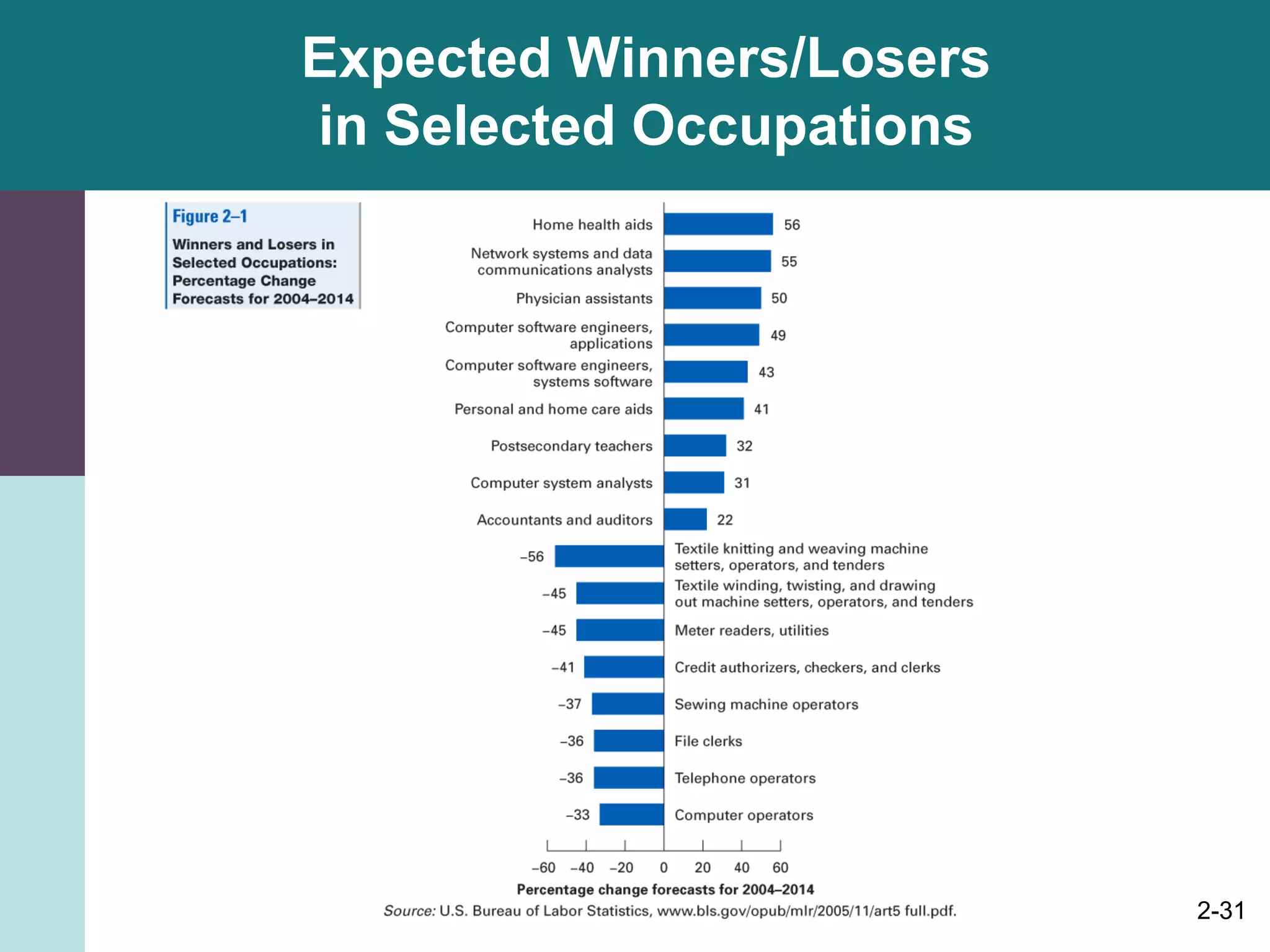
• Technology, outsourcing and offshoring:
– Technology has reduced and eliminated some work
in middle management and white collar
– Global competition has forced some MNCs to
outsource jobs to offshore productions
– Emerging technology makes work more portable
2-31
Expected Winners/Losers
in Selected Occupations
2-32
Review and Discuss
1. In what ways do different ideologies and
political systems influence the environment
in which MNC’s operate?
2. How do the following legal principles impact
MNC operations: the principle of sovereignty,
the nationality principle, the territoriality
principle, the protective principle, and
principle of comity?
3. How will advances in technology and
telecommunications affect developing
countries? Give some specific examples.

The political, legal and Technological Environment

  • 2.
    The Political, Legal andTechnological Environment chapter two McGraw-Hill/Irwin Copyright © 2009 by The McGraw-Hill Companies, Inc. All Rights Reserved.
  • 3.
    2-3 The Political, Legal,and Technological Environment • Chapter Objectives: 1. INTRODUCE the basic political systems that characterize regions and countries around the world and offer brief examples of each. 2. PRESENT an overview of the legal and regulatory environment in which MNCs operate worldwide. 3. REVIEW key technological developments as well as their impact on MNCs now and in the future.
  • 4.
    2-4 Political Environment: • Ideologies(ideas reflecting beliefs and values influencing behavior/culture of nations and political systems) underlie the actions of governments. • Evaluate a political system along two dimensions: (1) rights of citizens based on a system of government (range democratic to totalitarian); (2) Focus of political system on individualism vs. collectivism. • No pure form of government • Democratic tend to emphasize individualism and totalitarian tends to emphasize collectivism.
  • 5.
    2-5 (1) Ideologies: Individualism • Peopleshould be free to pursue economic and political endeavors without constraint. • In business context, similar to capitalism and connected to free market society • Private property more successful, productive, and progressive than communal property • Betterment of society related to level of freedom individuals have in pursuing economic goals.
  • 6.
    2-6 (1) Ideologies: Collectivism • Doesnot value individual as such • Views needs/goals of society at large as more important than individual desires • No rigid form of collectivism as societal goals differ greatly among cultures • e.g.: Fascism: nationalism, authoritarianism, militarism, corporatism, collectivism, totalitarianism
  • 7.
    2-7 (1) Ideologies: Socialism • Governmentownership of institutions • Profit is not the ultimate goal • Can be viewed as moderate example of collectivism in practice • Has been practiced in China, North Korea, Cuba • Democratic socialism, more moderate form, practiced by Great Britain’s Labour Party, and in France, Spain, and Greece • Communism is extreme form of socialist thought
  • 8.
    2-8 (2) Political Systems: Democracy •European roots • System in which government is controlled by citizens either directly or through elections. • Democratic society cannot exist without at least a two-party system • Once elected, representative is held accountable to electorate for actions (which limits power of government)
  • 9.
    2-9 (2) Political System: Totalitarianism •Only one representative party which exhibits control over every facet of political and human life • Power maintained by suppression of opposition • Dominant ideals include media censorship, political representation, denial of rights, and civil liberties
  • 10.
    2-10 Political Environment Regional Example:China • Emerging economic power • Government attempting to open up economy: – Speed up conversion of state enterprises into corporations – Trade liberalization a top priority since joining WTO in 2001 – Becoming a more open, democratic society – Greater tolerance of individual freedoms – Worker retraining, low-cost housing and other programs – Seeking to unleash a more dynamic market economy
  • 11.
    2-11 Political Environment: Regional Example:Europe • Privatization and economic liberalization reinforce EU-wide political and economic integration • Political power is variable and complex • Strong opposition to U.S.-led intervention in Iraq sometimes spill over into business relationships and dealings • Europe is a large interwoven region economically, but contains vast cultural differences
  • 12.
    2-12 Political Environment: Example: TheMiddle East • In Iran and Saudi Arabia laws and government based on Islamic principles • Business conduct in Middle East similar to Western in many ways • Worldwide fallout from war on terrorism have made business environment there risky and potentially dangerous
  • 13.
    2-13 Political Environment: Example: Russia •Neglect and confusing changes in economic policy • Infrastructure is weak and a political quagmire • Corruption interferes with attraction of more foreign investment
  • 14.
    2-14 Legal and RegulatoryEnvironment • Confusion and challenge for the MNC due to many different laws and regulations in global business operations • MNCs must carefully evaluate legal framework in each market before doing business
  • 15.
    2-15 Four Global Foundationsof Law: 1. Islamic 2. Socialist 3. Common 4. Civil or code
  • 16.
    2-16 Four Global Foundationsof Law: Islamic Law • Derived from interpretation of Qur’an and teachings of Prophet Muhammad • Found in Islamic countries: Middle East and Central Asia
  • 17.
    2-17 Four Global Foundationsof Law: Socialist Law • Origins in Marxist socialist system • Requires most property to be owned by state or state enterprises • Continues to influence regulations in former communist countries: – Members of former Soviet Union – Peoples’ Republic of China – Vietnam – North Korea – Cuba
  • 18.
    2-18 Four Global Foundationsof Law: Common Law • Origins in English law • Foundation of legal system for: – United States – Canada – England – Australia – New Zealand
  • 19.
    2-19 Four Global Foundationsof Law: Civil or Code Law • Derived from Roman law • Found in non-Islamic and non-socialist countries: – France – Some Latin American countries – Louisiana in the U.S.
  • 20.
    2-20 Basic Principles of InternationalLaw • Sovereignty and Sovereign Immunity • International Jurisdiction • Doctrine of Comity • Act of State Doctrine • Treatment and Rights of Aliens • Forum for Hearing and Settling Disputes
  • 21.
    2-21 Basic Principles of InternationalLaw: • Sovereignty and Sovereign Immunity: An international principle of law which holds that governments have the right to rule themselves as they see fit.
  • 22.
    2-22 Basic Principles ofInternational Law: • International Jurisdiction: A jurisdictional principle of international law which holds that every country has jurisdiction over its citizens no matter where they are located – Nationality principle – Territoriality principle – Protective principle
  • 23.
    2-23 Basic Principles of InternationalLaw: • Doctrine of Comity: A jurisdictional principle of international law which holds that there must be mutual respect for the laws, institutions, and government of other countries in the matter of jurisdiction over their own citizens.
  • 24.
    2-24 Basic Principles of InternationalLaw: • Act of State Doctrine: A jurisdictional principle of international law which holds that all acts of other governments are considered to be valid by U.S. courts, even if such acts are illegal or inappropriate under U.S. law.
  • 25.
    2-25 Basic Principles of InternationalLaw: • Treatment and Rights of Aliens: Countries have the legal right to refuse admission of foreign citizens and to impose special restrictions on their conduct, right of travel, where they can stay, and what business they may conduct. • Nations can also deport aliens.
  • 26.
    2-26 Basic Principles of InternationalLaw: • Forum for Hearing and Settling Disputes: U.S. courts can dismiss cases brought before them by foreigners; however, they are bound to examine issues such as: – where the plaintiffs are located – where the evidence must be gathered – where property to be used in restitution is located
  • 27.
    2-27 Legal and RegulatoryIssues • Foreign Corrupt Practices Act – Illegal to influence foreign officials through: • personal payment • political contribution • Restrictive bureaucratization • Privatization
  • 28.
    2-28 Regulation of Trade andInvestment • Individual countries use legal and regulatory policies to affect the international management environment • Country is perceived to engage in unfair trade practices (WTO and similar agreements) – Government support (subsidies) – Require MNCs to accept local partners • Response may be – Retaliatory tariffs – Restrictive trade regulations
  • 29.
    2-29 Technological Environment and GlobalShifts in Production • Biotechnology • Nanotechnology • Satellites • Automatic translation telephones • Artificial intelligence and embedded learning technology • Advancements in computer chip technology • Supercomputers
  • 30.
    2-30 Technological Environment and GlobalShifts in Production (continued): • E-business: – Business to business (B2B) – Business to consumer (B2C) – E-tailing – Financial services (e-cash) • Telecommunications • Technology, outsourcing and offshoring: – Technology has reduced and eliminated some work in middle management and white collar – Global competition has forced some MNCs to outsource jobs to offshore productions – Emerging technology makes work more portable
  • 31.
  • 32.
    2-32 Review and Discuss 1.In what ways do different ideologies and political systems influence the environment in which MNC’s operate? 2. How do the following legal principles impact MNC operations: the principle of sovereignty, the nationality principle, the territoriality principle, the protective principle, and principle of comity? 3. How will advances in technology and telecommunications affect developing countries? Give some specific examples.