
Chapter 9 – Political Parties
Clicker QuestionWhich of the following differentiates an interest group from a political party? a.  A party attempts to influence policy, whereas an interest group attempts to gain control of government by running candidates for office. b.  An interest group is more comprehensive than a party. c.  An interest group seeks to influence government on a narrow range of issues, whereas a party attempts to win elections. d.  An interest group attempts to appeal broadly to many groups of voters.
Clicker QuestionDo you agree or disagree that political parties are good for American democracy?Strongly agreeAgreeDisagreeStrongly disagree
Clicker QuestionDo you think it is a good thing we only have two major parties in America?YesNo
Clicker QuestionWould you ever consider supporting a third party candidate?		a. YES		b. NO		c. MAYBE
What are Political Parties?Political parties are organized groups that attempt to influence the government by electing their members to important government offices, thereby controlling government.Interest groups, while similar in goals (influencing the government), are very different in terms of characteristics and strategies.
Parties and DemocracyPrimary Goal – Influence Public PolicySecondary Goal – Win ElectionsTo get what they want, they have to give us what we want – they have to convince us to elect them.Political parties are fundamentally connected to voters – their power comes from us delegating our power.
Clicker QuestionCompared with political parties in Europe, parties in the United States have always seemed:	a.  strong	b.  centralized	c.  weak	d.  coherent
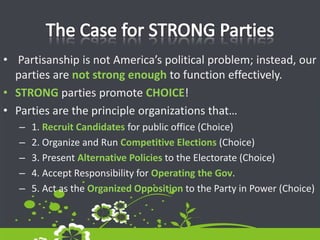
The Case for STRONG Parties Partisanship is not America’s political problem; instead, our parties are not strong enough to function effectively. STRONG parties promote CHOICE!Parties are the principle organizations that… 1. Recruit Candidates for public office (Choice) 2. Organize and Run Competitive Elections (Choice) 3. Present Alternative Policies to the Electorate (Choice) 4. Accept Responsibility for Operating the Gov. 5. Act as the Organized Opposition to the Party in Power (Choice)
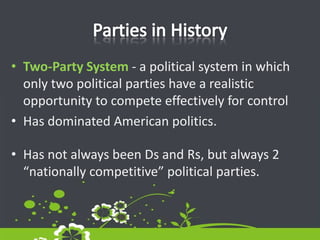
Parties in HistoryTwo-Party System - a political system in which only two political parties have a realistic opportunity to compete effectively for control Has dominated American politics.Has not always been Ds and Rs, but always 2 “nationally competitive” political parties.
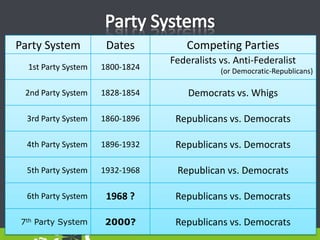
Clicker QuestionHow many Party Systems have their been in American history?4126		9
Figure 9.1
Clicker QuestionThe Republican Party was formed: a.  as a coalition of anti-slavery forcesb.  as a coalition of pro-slavery forcesc.  in response to Thomas Jefferson’s call for states rightsd.  after suffering persecution under the Alien and Sedition Acts
Party Systems
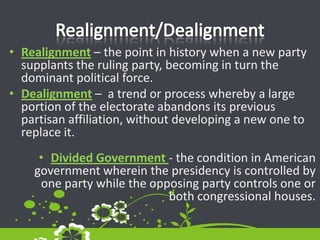
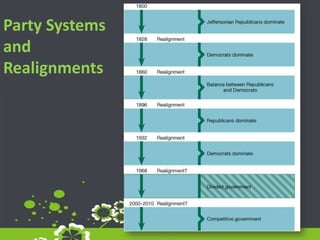
Realignment/DealignmentRealignment – the point in history when a new party supplants the ruling party, becoming in turn the dominant political force. Dealignment –  a trend or process whereby a large portion of the electorate abandons its previous partisan affiliation, without developing a new one to replace it.Divided Government - the condition in American government wherein the presidency is controlled by one party while the opposing party controls one or both congressional houses.
Party Systems and Realignments
Clicker QuestionHave you ever heard of Proportional Representation?YESNO
Clicker QuestionThe American electoral system is similar to most other electoral systems…TRUEFALSE
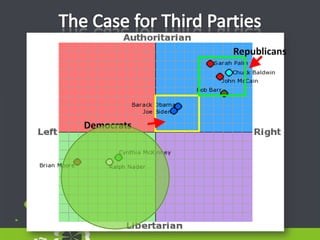
The Case for Third PartiesRepublicansDemocrats
Clicker QuestionIn PLURALITY voting, what does it take to be the winner?50% + 12/3 of the VoteAt least 35%1 more vote than anyone else
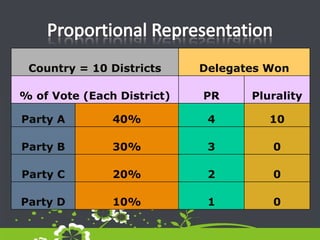
Why JUST 2 Parties?Electoral Laws - Winner-Take-All VotingSingle-Member Districts – Only 1 winner/seat per contestPlurality – Just 1 more vote than anybody else.The rules we have affect who wins, and therefore, who participates in the political process.  Our system offers NO REWARDS for 2nd, 3rd, 4th...
Proportional Representation
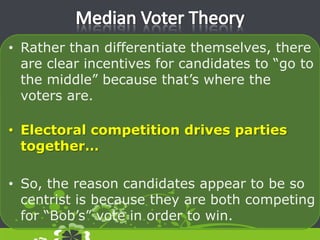
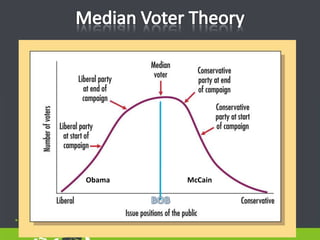
Median Voter TheoryRather than differentiate themselves, there are clear incentives for candidates to “go to the middle” because that’s where the voters are.Electoral competition drives parties together…So, the reason candidates appear to be so centrist is because they are both competing for “Bob’s” vote in order to win.
Median Voter TheoryObamaMcCainBOB
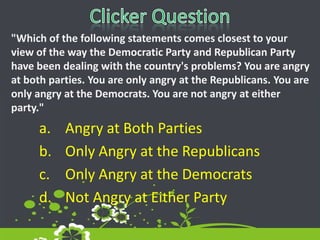
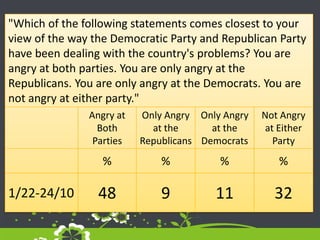
Clicker Question"Which of the following statements comes closest to your view of the way the Democratic Party and Republican Party have been dealing with the country's problems? You are angry at both parties. You are only angry at the Republicans. You are only angry at the Democrats. You are not angry at either party."Angry at Both PartiesOnly Angry at the RepublicansOnly Angry at the DemocratsNot Angry at Either Party
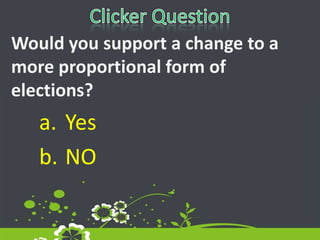
Clicker QuestionWould you support a change to a more proportional form of elections?YesNO

Political Parties (Chapter 9)

  • 1.
    Chapter 9 –Political Parties
  • 2.
    Clicker QuestionWhich ofthe following differentiates an interest group from a political party? a. A party attempts to influence policy, whereas an interest group attempts to gain control of government by running candidates for office. b. An interest group is more comprehensive than a party. c. An interest group seeks to influence government on a narrow range of issues, whereas a party attempts to win elections. d. An interest group attempts to appeal broadly to many groups of voters.
  • 3.
    Clicker QuestionDo youagree or disagree that political parties are good for American democracy?Strongly agreeAgreeDisagreeStrongly disagree
  • 4.
    Clicker QuestionDo youthink it is a good thing we only have two major parties in America?YesNo
  • 5.
    Clicker QuestionWould youever consider supporting a third party candidate? a. YES b. NO c. MAYBE
  • 6.
    What are PoliticalParties?Political parties are organized groups that attempt to influence the government by electing their members to important government offices, thereby controlling government.Interest groups, while similar in goals (influencing the government), are very different in terms of characteristics and strategies.
  • 7.
    Parties and DemocracyPrimaryGoal – Influence Public PolicySecondary Goal – Win ElectionsTo get what they want, they have to give us what we want – they have to convince us to elect them.Political parties are fundamentally connected to voters – their power comes from us delegating our power.
  • 8.
    Clicker QuestionCompared withpolitical parties in Europe, parties in the United States have always seemed: a. strong b. centralized c. weak d. coherent
  • 9.
    The Case forSTRONG Parties Partisanship is not America’s political problem; instead, our parties are not strong enough to function effectively. STRONG parties promote CHOICE!Parties are the principle organizations that… 1. Recruit Candidates for public office (Choice) 2. Organize and Run Competitive Elections (Choice) 3. Present Alternative Policies to the Electorate (Choice) 4. Accept Responsibility for Operating the Gov. 5. Act as the Organized Opposition to the Party in Power (Choice)
  • 10.
    Parties in HistoryTwo-PartySystem - a political system in which only two political parties have a realistic opportunity to compete effectively for control Has dominated American politics.Has not always been Ds and Rs, but always 2 “nationally competitive” political parties.
  • 11.
    Clicker QuestionHow manyParty Systems have their been in American history?4126 9
  • 12.
  • 13.
    Clicker QuestionThe RepublicanParty was formed: a. as a coalition of anti-slavery forcesb. as a coalition of pro-slavery forcesc. in response to Thomas Jefferson’s call for states rightsd. after suffering persecution under the Alien and Sedition Acts
  • 14.
  • 15.
    Realignment/DealignmentRealignment – thepoint in history when a new party supplants the ruling party, becoming in turn the dominant political force. Dealignment – a trend or process whereby a large portion of the electorate abandons its previous partisan affiliation, without developing a new one to replace it.Divided Government - the condition in American government wherein the presidency is controlled by one party while the opposing party controls one or both congressional houses.
  • 16.
    Party Systems andRealignments
  • 17.
    Clicker QuestionHave youever heard of Proportional Representation?YESNO
  • 18.
    Clicker QuestionThe Americanelectoral system is similar to most other electoral systems…TRUEFALSE
  • 19.
    The Case forThird PartiesRepublicansDemocrats
  • 20.
    Clicker QuestionIn PLURALITYvoting, what does it take to be the winner?50% + 12/3 of the VoteAt least 35%1 more vote than anyone else
  • 21.
    Why JUST 2Parties?Electoral Laws - Winner-Take-All VotingSingle-Member Districts – Only 1 winner/seat per contestPlurality – Just 1 more vote than anybody else.The rules we have affect who wins, and therefore, who participates in the political process. Our system offers NO REWARDS for 2nd, 3rd, 4th...
  • 22.
  • 23.
    Median Voter TheoryRatherthan differentiate themselves, there are clear incentives for candidates to “go to the middle” because that’s where the voters are.Electoral competition drives parties together…So, the reason candidates appear to be so centrist is because they are both competing for “Bob’s” vote in order to win.
  • 24.
  • 25.
    Clicker Question"Which ofthe following statements comes closest to your view of the way the Democratic Party and Republican Party have been dealing with the country's problems? You are angry at both parties. You are only angry at the Republicans. You are only angry at the Democrats. You are not angry at either party."Angry at Both PartiesOnly Angry at the RepublicansOnly Angry at the DemocratsNot Angry at Either Party
  • 27.
    Clicker QuestionWould yousupport a change to a more proportional form of elections?YesNO

Editor's Notes

  • #15 There is some agreement among scholars about five different realignments in American history (1800, 1828, 1860, 1896, and 1932).