Political Party systems
DO YOU THINK AMERICA’S TWO PARTY SYSTEM EFFECTIVELY MEETS THE NEEDS OF
OUR DIVERSE POPULATION?
One Party System
 found in nations with authoritarian governments
 Only one political party exist, because the government won’t allow opposition.
 Examples
 Cuba, Vietnam, North Korea, and China
 de facto one party- (in fact; in reality)
 other parties are allowed to participate, they have no realistic chance of
winning.
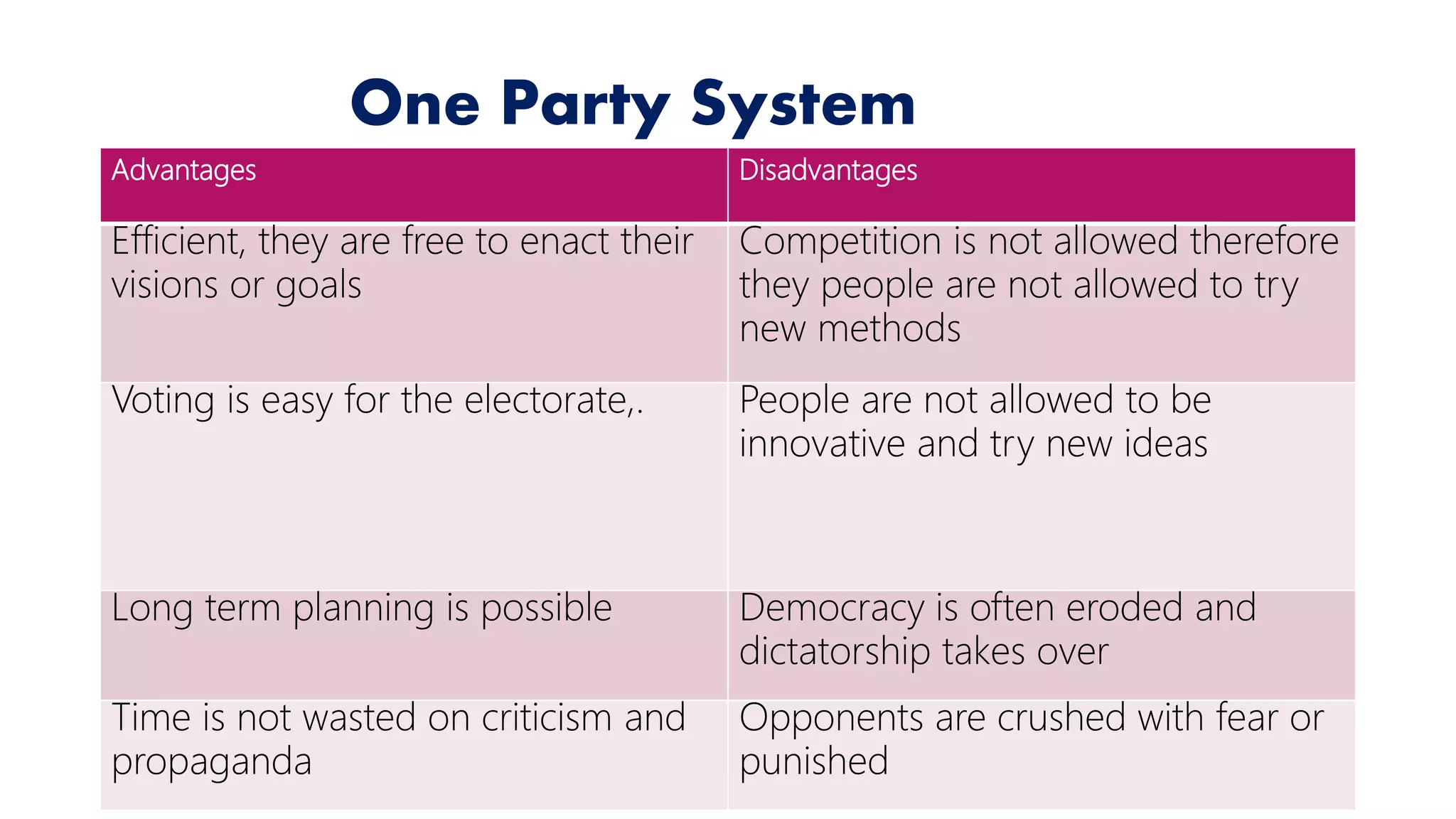
One Party System
Advantages Disadvantages
Efficient, they are free to enact their
visions or goals
Competition is not allowed therefore
they people are not allowed to try
new methods
Voting is easy for the electorate,. People are not allowed to be
innovative and try new ideas
Long term planning is possible Democracy is often eroded and
dictatorship takes over
Time is not wasted on criticism and
propaganda
Opponents are crushed with fear or
punished
Multi- Party System More than 2 political parties compete for control.
 France and Italy have over 15 political parties, this allows for a variety of view points to be heard.
 Usually 5-7 parties have a significant number of seats in parliament.
 Coaltition government- this often occurs because rarely one party has enough seats to control the
government.
Two Party System
 In the United States, a candidate wins the election by gaining a plurality, or more votes than any
other candidate.
 This is a winner-take-all system because there is no reward for the party or candidate that finishes
second
 A ________________________republican
 B_________________________Democrat
 C________________________Libertarian
 D________________________Gren Party
 There is nothing in our Constitution that prevents third parties from flourishing, its more our
electoral system that prevents it.
Another reason 2 parties exist-
The Electoral College systemis a winner-take all system
 Example: In the 1992 presidential election, independent
candidate H. Ross Perot received nearly 19 percent of the
popular vote, but he did not get a single electoral vote.
 Other recent third-party candidates—including John
Anderson in 1980, Ralph Nader in 2000—also failed to win
electoral votes.
Two party
a tradition in American Politics
 Most Americans look favorably on the two-party system because it has dominated much of American
politics from the very beginning.
 The Republican and Democratic parties have existed for more than 150 years, and that history gives them
a legitimacy that third parties do not have.
1.
2.
Third Parties (in the United States)
 Any party that runs against the two major parties.
 They are also labeled as “minor parties”
 ALL THIRD PARTIES: Believe the two major parties aren’t
meeting certain needs
Third Parties impact
 In 2000 Green Party Candidate Ralph Nader earned 2 million votes, that could have gone to Al Gore.
 Al Gore lost the election, due to the Electoral College vote, he earned more popular Votes
 This is referred to as the spoiler vote
Obstacles for third party-
 Republican and Democrat candidate’s are automatically on the
ballot
 Third party candidates must get a large number of voter
signatures to get on the ballot
 Financing campaigns are also difficult, they are not allowed to
get any government funding
 Citizens may prefer the candidate but know they may have no
chance of winning so voting for the 3rd party is to risky.
Ideological Parties
 Third party who has a particular set of ideas on how to change society overall, rather than on one
issue.
 Communist Party USA
 Socialist Labor Party
 Green Party
 Constitution Party
Single issue Parties
 Focus on one major social, economic, or moral issue
 They won’t to get national attention to this issue
 They are often short-lived, they fade when the issue ceases to be important or when a major party adopts
the issue.
 Pirate Party-2006
 Legally share movies, art, and computer codes

Political party systems

  • 1.
    Political Party systems DOYOU THINK AMERICA’S TWO PARTY SYSTEM EFFECTIVELY MEETS THE NEEDS OF OUR DIVERSE POPULATION?
  • 2.
    One Party System found in nations with authoritarian governments  Only one political party exist, because the government won’t allow opposition.  Examples  Cuba, Vietnam, North Korea, and China  de facto one party- (in fact; in reality)  other parties are allowed to participate, they have no realistic chance of winning.
  • 4.
    One Party System AdvantagesDisadvantages Efficient, they are free to enact their visions or goals Competition is not allowed therefore they people are not allowed to try new methods Voting is easy for the electorate,. People are not allowed to be innovative and try new ideas Long term planning is possible Democracy is often eroded and dictatorship takes over Time is not wasted on criticism and propaganda Opponents are crushed with fear or punished
  • 6.
    Multi- Party SystemMore than 2 political parties compete for control.  France and Italy have over 15 political parties, this allows for a variety of view points to be heard.  Usually 5-7 parties have a significant number of seats in parliament.  Coaltition government- this often occurs because rarely one party has enough seats to control the government.
  • 8.
    Two Party System In the United States, a candidate wins the election by gaining a plurality, or more votes than any other candidate.  This is a winner-take-all system because there is no reward for the party or candidate that finishes second  A ________________________republican  B_________________________Democrat  C________________________Libertarian  D________________________Gren Party  There is nothing in our Constitution that prevents third parties from flourishing, its more our electoral system that prevents it.
  • 9.
    Another reason 2parties exist- The Electoral College systemis a winner-take all system  Example: In the 1992 presidential election, independent candidate H. Ross Perot received nearly 19 percent of the popular vote, but he did not get a single electoral vote.  Other recent third-party candidates—including John Anderson in 1980, Ralph Nader in 2000—also failed to win electoral votes.
  • 10.
    Two party a traditionin American Politics  Most Americans look favorably on the two-party system because it has dominated much of American politics from the very beginning.  The Republican and Democratic parties have existed for more than 150 years, and that history gives them a legitimacy that third parties do not have.
  • 11.
  • 12.
  • 16.
    Third Parties (inthe United States)  Any party that runs against the two major parties.  They are also labeled as “minor parties”  ALL THIRD PARTIES: Believe the two major parties aren’t meeting certain needs
  • 17.
    Third Parties impact In 2000 Green Party Candidate Ralph Nader earned 2 million votes, that could have gone to Al Gore.  Al Gore lost the election, due to the Electoral College vote, he earned more popular Votes  This is referred to as the spoiler vote
  • 19.
    Obstacles for thirdparty-  Republican and Democrat candidate’s are automatically on the ballot  Third party candidates must get a large number of voter signatures to get on the ballot  Financing campaigns are also difficult, they are not allowed to get any government funding  Citizens may prefer the candidate but know they may have no chance of winning so voting for the 3rd party is to risky.
  • 20.
    Ideological Parties  Thirdparty who has a particular set of ideas on how to change society overall, rather than on one issue.  Communist Party USA  Socialist Labor Party  Green Party  Constitution Party
  • 21.
    Single issue Parties Focus on one major social, economic, or moral issue  They won’t to get national attention to this issue  They are often short-lived, they fade when the issue ceases to be important or when a major party adopts the issue.  Pirate Party-2006  Legally share movies, art, and computer codes