American Government and Politics: Deliberation,
Democracy, and Citizenship
Chapter Ten
Political Parties
Chapter Ten: Learning Objectives
• Define political parties
• Explain the historical development of
the American party system
• Discuss the meaning and impact of
party identification
Chapter Ten: Learning Objectives
• Analyze the various forms of party
organization
• Understand the role of parties in
government
• Appraise different arguments about
virtues and defects of the party system
Introduction
Do you believe that political parties are
an important part of a deliberative
democracy? Why or why not?
Political parties and the issues
separating the parties have evolved
over time.
Political Parties and Their Functions:
The Meaning of Party
Three levels of political parties
1. Party in the electorate
2. Party organization
3. Party in government
Political Parties and Their Functions:
The Functions of Party
Political parties are not addressed in the
Constitution.
Political parties emerged as one way for
citizens to mobilize for political action,
especially during election time.
Democratic-Republicans and Federalists
were early American political parties.
Party Alignments and Realignments
Why does the United States have a
two-party system?
What are the differences between
partisan alignment and partisan
realignment?
Party Alignments and Realignments:
Early Party Era
Federalists had economic resources,
but the Democratic-Republicans were
better at voter mobilization.
The presidential election of 1800 started
a shift in the party system.
Party Alignments and Realignments:
Democrats and Whigs
The Democrats gained power through
party patronage.
During this time, national party
conventions emerged.
The Democrats’ opponents were known
as Whigs.
Party Alignments and Realignments:
Republicans Rising
Immigration issues emerged and some
anti-immigrant Whigs formed the
American Party or the Know-Nothings.
Opinions on slavery split the Democrats.
The Civil War was the beginning of a
new party realignment with the
emergence of the Republican Party.
Myths and Misinformation
Official party histories – yada, yada, yada
Both the Democratic and Republican
parties cast their history in a positive light
and often ignore some of their negative
history.
Party Alignments and Realignments:
Populists and Progressives
The Populist Party emerged in the late
1800s to represent rural interests.
The Progressive Party was part of the
movement which fought for adoption of
election procedures like primary
elections.
Party Alignments and Realignments:
New Deal
With Roosevelt’s election in 1932, the
New Deal coalition emerged and
southerners, Jews, Catholics, African
Americans, people with roots in
Southern and Eastern Europe, union
members, poor people, intellectuals,
and artists were attracted to the
Democratic Party.
Party Alignments and Realignments:
Upheavals
By the mid to late 1960s, the Democrats
began to lose some of their base from
the New Deal coalition.
Ronald Reagan built a stronger coalition
for the Republican Party, but not
strong enough to prevent divided
government.
Party Alignments and Realignments:
Sources of Party Change
What are some sources of party change?
• Ideas about government and politics
• Major historical events
• Economic and demographic change
Parties in the Electorate:
Party Identification
How do these characteristics affect party
identification?
• Age
• Income
• Education
• Ethnicity
• Religion
• Gender
Parties in the Electorate:
Party Identification
Parties in the Electorate:
Party Registration and Primaries
Types of primaries
1. Closed
2. Semiclosed
3. Open
4. Blanket (outlawed in 2000)
Pledges and Promises
Party loyalty
Throughout history, citizens have taken
oaths and pledges to participate in
political party activities.
Party Organization
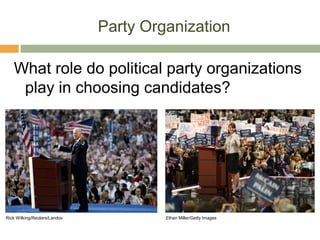
What role do political party organizations
play in choosing candidates?
Rick Wilking/Reuters/Landov Ethan Miller/Getty Images
Party Organization:
State and Local Parties
State and local political parties may not
be as influential as they once were, but
continue to provide important
assistance to political candidates in
their campaigns.
Party Organization:
National Party Committees
The national party committees supply
money to candidates.
Forms of campaign expenditures include
• Direct contributions
• Coordinated expenditures
• Independent expenditures
Party Organization:
National Party Committees
Party Organization:
National Party Conventions
What is the purpose of the national party
conventions?
Are there differences between the
Democratic and Republican national
party conventions?
Party in Government
What is the relationship of party in the
electorate and party in government?
International Perspectives
The parliamentary example
What can America learn from
parliamentary systems?
Third Parties
What roles do third parties play in
American politics?
What barriers do third parties face in
their quest for power in American
politics?
Political Parties and
Deliberative Democracy
Should parties be more specialized in
their focus or more broad-based?
Would a system that encourages more
parties be better or worse for
deliberative democracy?
Deliberation, Citizenship, and You
College party organizations
Political parties have active chapters on
many college campuses and, as such,
may foster more political deliberation
among college students.
Summary
• Republicans and Democrats dominant
• Party organizations try to influence
electoral outcomes
• Parties are important in government
• Third parties can affect politics

Chapter10

  • 1.
    American Government andPolitics: Deliberation, Democracy, and Citizenship Chapter Ten Political Parties
  • 2.
    Chapter Ten: LearningObjectives • Define political parties • Explain the historical development of the American party system • Discuss the meaning and impact of party identification
  • 3.
    Chapter Ten: LearningObjectives • Analyze the various forms of party organization • Understand the role of parties in government • Appraise different arguments about virtues and defects of the party system
  • 4.
    Introduction Do you believethat political parties are an important part of a deliberative democracy? Why or why not? Political parties and the issues separating the parties have evolved over time.
  • 5.
    Political Parties andTheir Functions: The Meaning of Party Three levels of political parties 1. Party in the electorate 2. Party organization 3. Party in government
  • 6.
    Political Parties andTheir Functions: The Functions of Party Political parties are not addressed in the Constitution. Political parties emerged as one way for citizens to mobilize for political action, especially during election time. Democratic-Republicans and Federalists were early American political parties.
  • 7.
    Party Alignments andRealignments Why does the United States have a two-party system? What are the differences between partisan alignment and partisan realignment?
  • 8.
    Party Alignments andRealignments: Early Party Era Federalists had economic resources, but the Democratic-Republicans were better at voter mobilization. The presidential election of 1800 started a shift in the party system.
  • 9.
    Party Alignments andRealignments: Democrats and Whigs The Democrats gained power through party patronage. During this time, national party conventions emerged. The Democrats’ opponents were known as Whigs.
  • 10.
    Party Alignments andRealignments: Republicans Rising Immigration issues emerged and some anti-immigrant Whigs formed the American Party or the Know-Nothings. Opinions on slavery split the Democrats. The Civil War was the beginning of a new party realignment with the emergence of the Republican Party.
  • 11.
    Myths and Misinformation Officialparty histories – yada, yada, yada Both the Democratic and Republican parties cast their history in a positive light and often ignore some of their negative history.
  • 12.
    Party Alignments andRealignments: Populists and Progressives The Populist Party emerged in the late 1800s to represent rural interests. The Progressive Party was part of the movement which fought for adoption of election procedures like primary elections.
  • 13.
    Party Alignments andRealignments: New Deal With Roosevelt’s election in 1932, the New Deal coalition emerged and southerners, Jews, Catholics, African Americans, people with roots in Southern and Eastern Europe, union members, poor people, intellectuals, and artists were attracted to the Democratic Party.
  • 14.
    Party Alignments andRealignments: Upheavals By the mid to late 1960s, the Democrats began to lose some of their base from the New Deal coalition. Ronald Reagan built a stronger coalition for the Republican Party, but not strong enough to prevent divided government.
  • 15.
    Party Alignments andRealignments: Sources of Party Change What are some sources of party change? • Ideas about government and politics • Major historical events • Economic and demographic change
  • 16.
    Parties in theElectorate: Party Identification How do these characteristics affect party identification? • Age • Income • Education • Ethnicity • Religion • Gender
  • 17.
    Parties in theElectorate: Party Identification
  • 18.
    Parties in theElectorate: Party Registration and Primaries Types of primaries 1. Closed 2. Semiclosed 3. Open 4. Blanket (outlawed in 2000)
  • 19.
    Pledges and Promises Partyloyalty Throughout history, citizens have taken oaths and pledges to participate in political party activities.
  • 20.
    Party Organization What roledo political party organizations play in choosing candidates? Rick Wilking/Reuters/Landov Ethan Miller/Getty Images
  • 21.
    Party Organization: State andLocal Parties State and local political parties may not be as influential as they once were, but continue to provide important assistance to political candidates in their campaigns.
  • 22.
    Party Organization: National PartyCommittees The national party committees supply money to candidates. Forms of campaign expenditures include • Direct contributions • Coordinated expenditures • Independent expenditures
  • 23.
  • 24.
    Party Organization: National PartyConventions What is the purpose of the national party conventions? Are there differences between the Democratic and Republican national party conventions?
  • 25.
    Party in Government Whatis the relationship of party in the electorate and party in government?
  • 26.
    International Perspectives The parliamentaryexample What can America learn from parliamentary systems?
  • 27.
    Third Parties What rolesdo third parties play in American politics? What barriers do third parties face in their quest for power in American politics?
  • 28.
    Political Parties and DeliberativeDemocracy Should parties be more specialized in their focus or more broad-based? Would a system that encourages more parties be better or worse for deliberative democracy?
  • 29.
    Deliberation, Citizenship, andYou College party organizations Political parties have active chapters on many college campuses and, as such, may foster more political deliberation among college students.
  • 30.
    Summary • Republicans andDemocrats dominant • Party organizations try to influence electoral outcomes • Parties are important in government • Third parties can affect politics

Editor's Notes

  • #18 I would like to insert Figure 10-2 from page 310 on this slide.
  • #24 I would like to place Table 10-2 “Party Money” from page 316 in the text on this slide.
  • #26 Insert Figure 10-1