Mediation
The Dynamics of
Conflict Resolution
Bernard Mayer
เสนอ
รองศาสตราจารย ดร.สมิหรา จิตตลดากร
นางสาวเยาวลักษณ ชาวบานโพธิ์
รหัสประจําตัว 5719860013
What Mediators Bring to the Table
What Disputants Want from a Mediator
The Premises of Mediation
What Mediators Do
When Mediation Works and When It Fails
What is Mediation?
An attempt by two parties to resolve their differences or dispute.
Assisted by a neutral third party.
Purpose is to resolve a conflict and create an agreement.
Does not replace the judicial system.
Mediation proceedings are confidential and private.
A mediator only advises, only suggest.
The resolution is up to the two parties using a signed, written agreement.
Informal process.
No judge or jury, no arbitrator.
All parties must agree to the process, usually with a signed mediation
agreement.
What Mediators Bring to the Table
 Mediation is an approach to conflict resolution
 They alter the structure of the interaction
 They bring their personal commitment, vision,
and humanity to the interaction
 They bring a set of skills and procedures
 They bring a set of values and ethics.
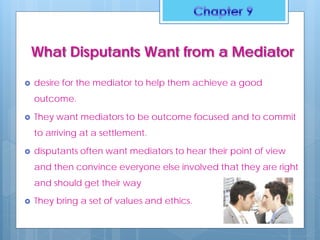
What Disputants Want from a Mediator
 desire for the mediator to help them achieve a good
outcome.
 They want mediators to be outcome focused and to commit
to arriving at a settlement.
 disputants often want mediators to hear their point of view
and then convince everyone else involved that they are right
and should get their way
 They bring a set of values and ethics.
The Premises of Mediation
 Disputants need help (and can benefit from it). A
conflict goes to mediation because the parties feel
they need help to arrive at a satisfactory outcome.
 Why not go straight to a third-party decision maker
 Process is important.
 possible for a third party to be attentive to
potentially competing interests.
What Mediator Do
 Mediators Assess Whether and How to Intervene in a Conflict
 Mediators Create or Redesign an Arena for Communication
and Negotiation
 Mediators Get Parties to Participate
 Mediators Manage Emotions and Communication
 Mediators Explore Needs at a Useful Level of Depth
 Mediators Encourage Incremental and Reciprocal Risk Taking
 Mediators Encourage Creativity
 Mediators Help People Think Through Their Choices
 Mediators Apply Appropriate Amounts of Pressure
When Mediation Works and When It Fails
that successful mediations do not
necessarily end in agreements
that failed mediations sometimes do.
Mediation is a powerful intervention.

Pol9235 mediation

  • 1.
    Mediation The Dynamics of ConflictResolution Bernard Mayer เสนอ รองศาสตราจารย ดร.สมิหรา จิตตลดากร นางสาวเยาวลักษณ ชาวบานโพธิ์ รหัสประจําตัว 5719860013
  • 2.
    What Mediators Bringto the Table What Disputants Want from a Mediator The Premises of Mediation What Mediators Do When Mediation Works and When It Fails
  • 3.
    What is Mediation? Anattempt by two parties to resolve their differences or dispute. Assisted by a neutral third party. Purpose is to resolve a conflict and create an agreement. Does not replace the judicial system. Mediation proceedings are confidential and private. A mediator only advises, only suggest. The resolution is up to the two parties using a signed, written agreement. Informal process. No judge or jury, no arbitrator. All parties must agree to the process, usually with a signed mediation agreement.
  • 4.
    What Mediators Bringto the Table  Mediation is an approach to conflict resolution  They alter the structure of the interaction  They bring their personal commitment, vision, and humanity to the interaction  They bring a set of skills and procedures  They bring a set of values and ethics.
  • 5.
    What Disputants Wantfrom a Mediator  desire for the mediator to help them achieve a good outcome.  They want mediators to be outcome focused and to commit to arriving at a settlement.  disputants often want mediators to hear their point of view and then convince everyone else involved that they are right and should get their way  They bring a set of values and ethics.
  • 6.
    The Premises ofMediation  Disputants need help (and can benefit from it). A conflict goes to mediation because the parties feel they need help to arrive at a satisfactory outcome.  Why not go straight to a third-party decision maker  Process is important.  possible for a third party to be attentive to potentially competing interests.
  • 7.
    What Mediator Do Mediators Assess Whether and How to Intervene in a Conflict  Mediators Create or Redesign an Arena for Communication and Negotiation  Mediators Get Parties to Participate  Mediators Manage Emotions and Communication  Mediators Explore Needs at a Useful Level of Depth  Mediators Encourage Incremental and Reciprocal Risk Taking  Mediators Encourage Creativity  Mediators Help People Think Through Their Choices  Mediators Apply Appropriate Amounts of Pressure
  • 8.
    When Mediation Worksand When It Fails that successful mediations do not necessarily end in agreements that failed mediations sometimes do. Mediation is a powerful intervention.