Basic Information
About Mediation
Introduction
Most people have heard of mediators and know that they try to
help people resolve issues, but not many know a lot about the
process of mediation.
What Is Mediation?

According to the Canadian Department of Justice, mediation is a
negotiation between disputing parties that is assisted by a
neutral party, known as a mediator. The goal is usually for the
parties having the dispute to come to an agreement and
settlement voluntarily. The signed agreement at the end of a
successful mediation has the same power as a contract, and is
legally binding.
Reasons for Mediation
It’s common to think of family separation and divorce as reasons
for mediation, but in reality mediators are useful in several
different kinds of situations, including:
  •   Family business disputes
  •   Labour and employment disputes
  •   Disputes between shareholders
  •   Management and board member disputes
  •   Senior team member disputes
  •   Franchise and dealer disputes
  •   Customer, dealer and manufacturer disputes
Elements of Mediation
Every mediation has certain characteristics that make it a
mediation. Here are some of the common elements:
  • Voluntary – all parties show up voluntarily and no one is forced
    into a settlement.
  • Assisted Negotiation – mediators help the negotiations along,
    provide procedural assistance and options to all parties.
  • Informal – mediation is typically more relaxed than a court
    proceeding or arbitration. There are no set rules that the parties
    must adhere to in order to make it official.
  • Confidential – The parties involved in the mediation usually set
    limits, but the process is generally considered a confidential
    process. If everyone involved decides that the mediation should
    be confidential, it is wise to sign a clause signifying that decision.
Role of the Mediator
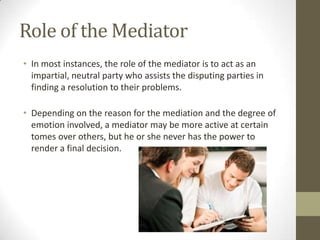
• In most instances, the role of the mediator is to act as an
  impartial, neutral party who assists the disputing parties in
  finding a resolution to their problems.

• Depending on the reason for the mediation and the degree of
  emotion involved, a mediator may be more active at certain
  tomes over others, but he or she never has the power to
  render a final decision.
Objective of Mediation
• While the outward objective of mediation is to have the
  parties come to an agreement or settlement on their own,
  there is often an underlying objective.

• By moving away from many of the legal concepts in other
  types of hearings, fault and blame is often set aside and the
  real reason for the dispute is discovered and resolved in the
  mediation process.
Objective of Mediation
• When mediators help guide the disputing parties through the
  process in an unbiased fashion, they often come to the root of
  the problem and can prevent it from happening again in the
  future.

• Generally, the steps of a typical mediation consist of:
  •   Disputing parties agreeing to mediation
  •   Understanding the problems causing the dispute
  •   Generating options that can create a solution
  •   The parties reaching an agreement
  •   Implementing the agreement
Benefits of Mediation
Choosing mediation over other forms of dispute resolution has
several benefits, including:
  • Avoiding aspects of litigation that make it difficult to maintain an
    ongoing relationship afterward.
  • Open communication about settlement options while mediators
    are present.
  • The flexibility to explore several different solutions and
    compromises that don’t necessarily fit into the typical legal
    definition.
Benefits of Mediation
 • A solution that meets both parties’ needs more closely, because
   they created it.
 • Faster resolution than court proceedings or arbitration.
 • Lower costs than a litigated solution.
 • Controlled dialogue due to the presence of a neutral third party.
 • Disputing parties feeling as though they have an equal stake in
   the process because they split the cost evenly.

Basic Information About Mediation

  • 1.
  • 2.
    Introduction Most people haveheard of mediators and know that they try to help people resolve issues, but not many know a lot about the process of mediation.
  • 3.
    What Is Mediation? Accordingto the Canadian Department of Justice, mediation is a negotiation between disputing parties that is assisted by a neutral party, known as a mediator. The goal is usually for the parties having the dispute to come to an agreement and settlement voluntarily. The signed agreement at the end of a successful mediation has the same power as a contract, and is legally binding.
  • 4.
    Reasons for Mediation It’scommon to think of family separation and divorce as reasons for mediation, but in reality mediators are useful in several different kinds of situations, including: • Family business disputes • Labour and employment disputes • Disputes between shareholders • Management and board member disputes • Senior team member disputes • Franchise and dealer disputes • Customer, dealer and manufacturer disputes
  • 5.
    Elements of Mediation Everymediation has certain characteristics that make it a mediation. Here are some of the common elements: • Voluntary – all parties show up voluntarily and no one is forced into a settlement. • Assisted Negotiation – mediators help the negotiations along, provide procedural assistance and options to all parties. • Informal – mediation is typically more relaxed than a court proceeding or arbitration. There are no set rules that the parties must adhere to in order to make it official. • Confidential – The parties involved in the mediation usually set limits, but the process is generally considered a confidential process. If everyone involved decides that the mediation should be confidential, it is wise to sign a clause signifying that decision.
  • 6.
    Role of theMediator • In most instances, the role of the mediator is to act as an impartial, neutral party who assists the disputing parties in finding a resolution to their problems. • Depending on the reason for the mediation and the degree of emotion involved, a mediator may be more active at certain tomes over others, but he or she never has the power to render a final decision.
  • 7.
    Objective of Mediation •While the outward objective of mediation is to have the parties come to an agreement or settlement on their own, there is often an underlying objective. • By moving away from many of the legal concepts in other types of hearings, fault and blame is often set aside and the real reason for the dispute is discovered and resolved in the mediation process.
  • 8.
    Objective of Mediation •When mediators help guide the disputing parties through the process in an unbiased fashion, they often come to the root of the problem and can prevent it from happening again in the future. • Generally, the steps of a typical mediation consist of: • Disputing parties agreeing to mediation • Understanding the problems causing the dispute • Generating options that can create a solution • The parties reaching an agreement • Implementing the agreement
  • 9.
    Benefits of Mediation Choosingmediation over other forms of dispute resolution has several benefits, including: • Avoiding aspects of litigation that make it difficult to maintain an ongoing relationship afterward. • Open communication about settlement options while mediators are present. • The flexibility to explore several different solutions and compromises that don’t necessarily fit into the typical legal definition.
  • 10.
    Benefits of Mediation • A solution that meets both parties’ needs more closely, because they created it. • Faster resolution than court proceedings or arbitration. • Lower costs than a litigated solution. • Controlled dialogue due to the presence of a neutral third party. • Disputing parties feeling as though they have an equal stake in the process because they split the cost evenly.