Introduction to e.Negotiation Negotiation Via Information Technology By :Amir Fawzy Eslsca University – BMBA Group “A”  Submitted  to :-  Dr. Yassin EL SHAZLY
Introduction To e.Negotiation Index Abstract Objectives What is Negotiation ? Place Time Model of Social interactions IT and its effects on Social Behavior Strategies for enhancing Technology –mediated negotiation Conclusions
Introduction To e.Negotiation Abstract There is a hundred of evidence on how information technology affects social behavior, Information Technology, "I.T.“ refers to anything related to computing technology, such as networking, hardware, software, the Internet, or the people that work with these technologies. Since we live in the "information age," information technology has become a part of our everyday lives.  how e-mail, as a particularly important type of information technology, affects negotiation behavior, or how powerful the internet can be when used as a public sounding board  How "I.T.“ affects negotiation behavior, what is the strategies to help Negotiators expand & divide the pie effectively.
Introduction To e.Negotiation  Objectives K now  what is Negotiation & the impact of IT on Negotiation S tudy a model of social interaction  U nderstand the effects of IT on Social Behavior E xamine tactics to enhance technology mediated negotiations “ Let us never negotiate out of fear. But let us never fear to negotiate”   John Fitzgerald Kennedy quotes American 35th US President (1961-63)
Introduction To e.Negotiation What is Negotiation ? Negotiation is a noun from Verb Negotiate The verb (used without object)  To deal   with  others, as in the preparation of a treaty or contract or in preliminaries to a business deal.  The verb (used with object). To arrange  for or bring about by discussion and settlement of terms:  to negotiate a loan . To manage; transact; conduct :  He negotiated an important business deal .  To move through, around, or over  in a satisfactory manner:  to negotiate a difficult dance step without tripping: to negotiate sharp curves .  To transfer  (a draft, promissory note, etc.) to a new owner by endorsement and delivery Origin: 1590–1600   To communicate in search of mutual agreement, 1590s Related form    Negotiator(noun)  Re/ Pre-negotiate(verbs)  Well/ Un-negotiated (adjectives) Synonyms  Talk,  Discuss,  Consult,  Bargain,  Agree,  Settle
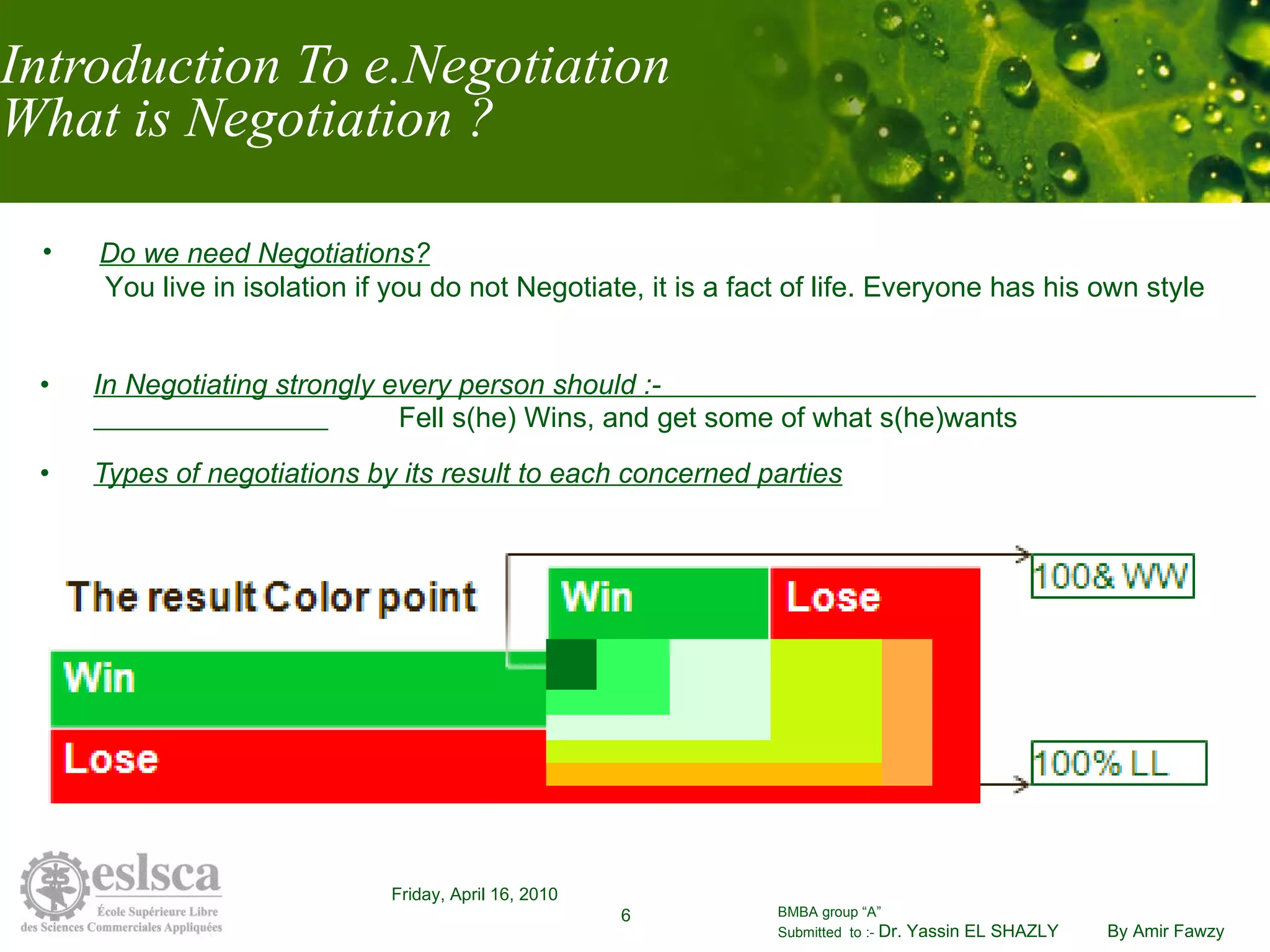
Introduction To e.Negotiation What is Negotiation ? In Negotiating strongly every person should :-  Fell s(he) Wins, and get some of what s(he)wants  Types of negotiations by its result to each concerned parties Do we need Negotiations? You live in isolation if you do not Negotiate, it is a fact of life. Everyone has his own style
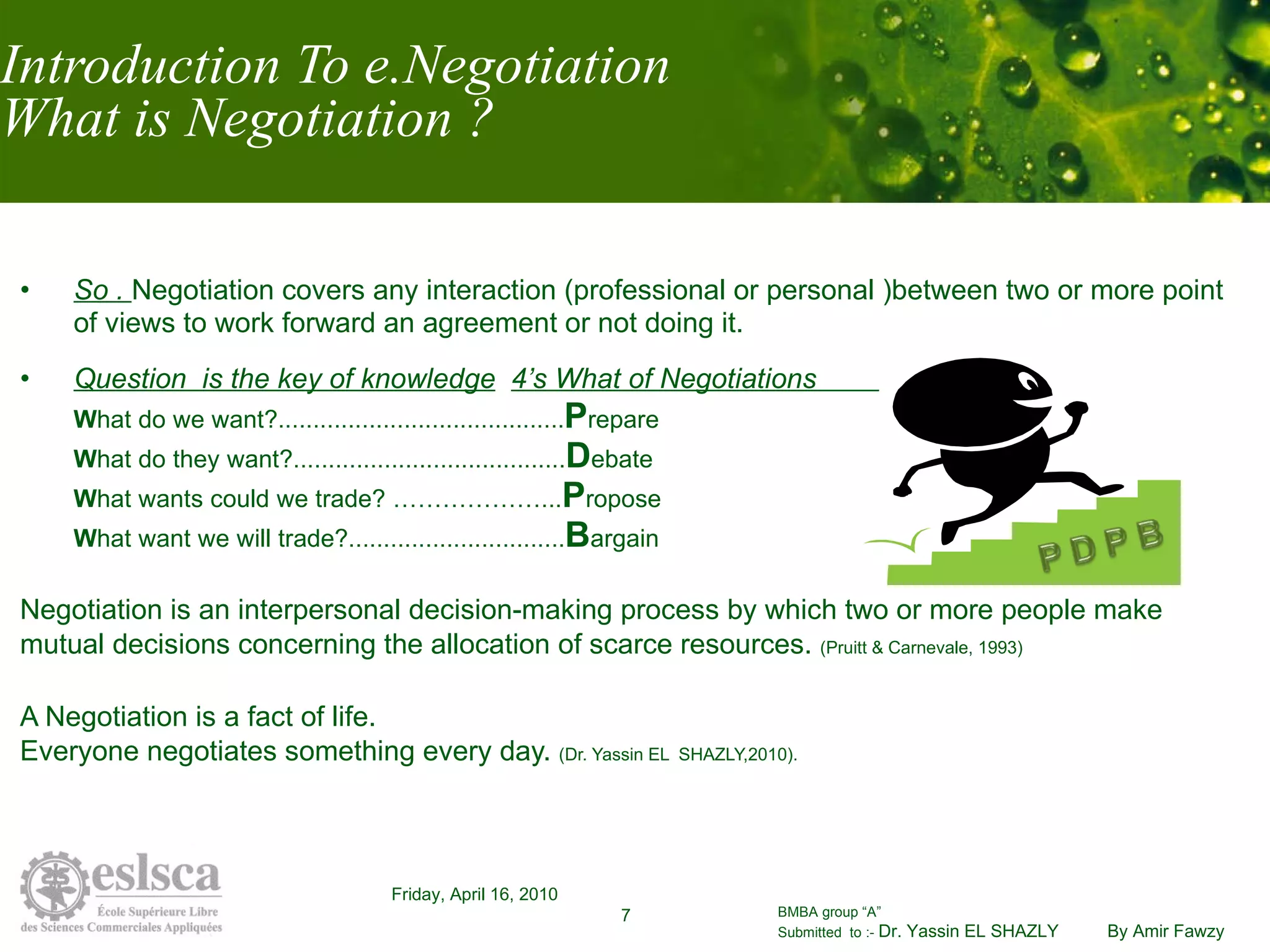
Introduction To e.Negotiation What is Negotiation ? So .  Negotiation covers any interaction (professional or personal )between two or more point of views to work forward an agreement or not doing it. Question  is the key of knowledge   4’s What of Negotiations  W hat do we want?......................................... P repare W hat do they want?....................................... D ebate W hat wants could we trade? ………………... P ropose W hat want we will trade?............................... B argain Negotiation is an interpersonal decision-making process by which two or more people make  mutual decisions concerning the allocation of scarce resources.  (Pruitt & Carnevale, 1993) A Negotiation is a fact of life.  Everyone negotiates something every day.  (Dr. Yassin EL  SHAZLY,2010).
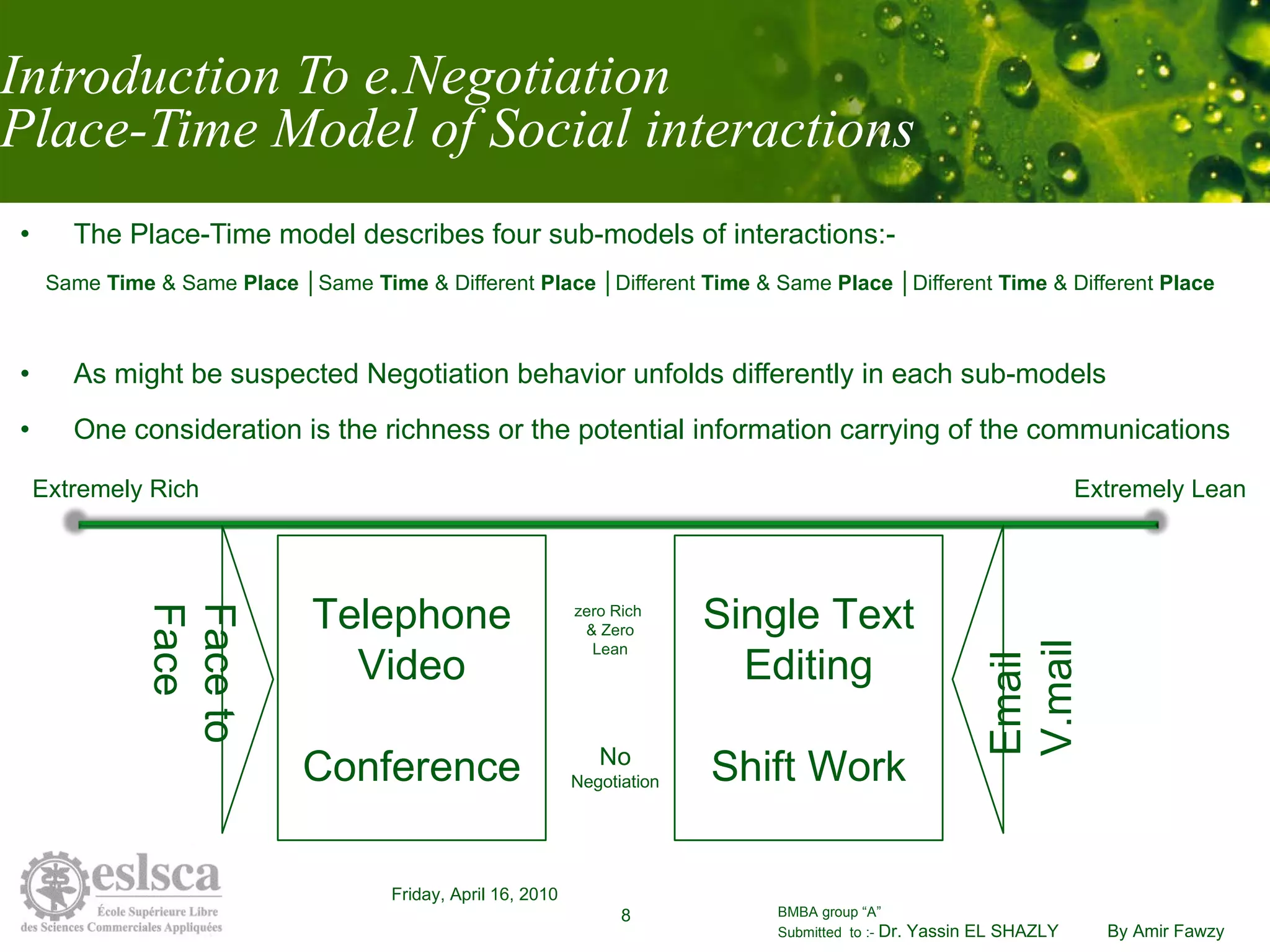
Introduction To e.Negotiation Place-Time Model of Social interactions The Place-Time model describes four sub-models of interactions:- Same  Time  & Same  Place  │Same  Time  & Different  Place  │Different  Time  & Same  Place  │Different  Time  & Different  Place As might be suspected Negotiation behavior unfolds differently in each sub-models One consideration is the richness or the potential information carrying of the communications  Extremely Rich Extremely Lean zero Rich  & Zero Lean No  Negotiation Face to Face Email V.mail Single Text Editing Shift Work Telephone Video Conference
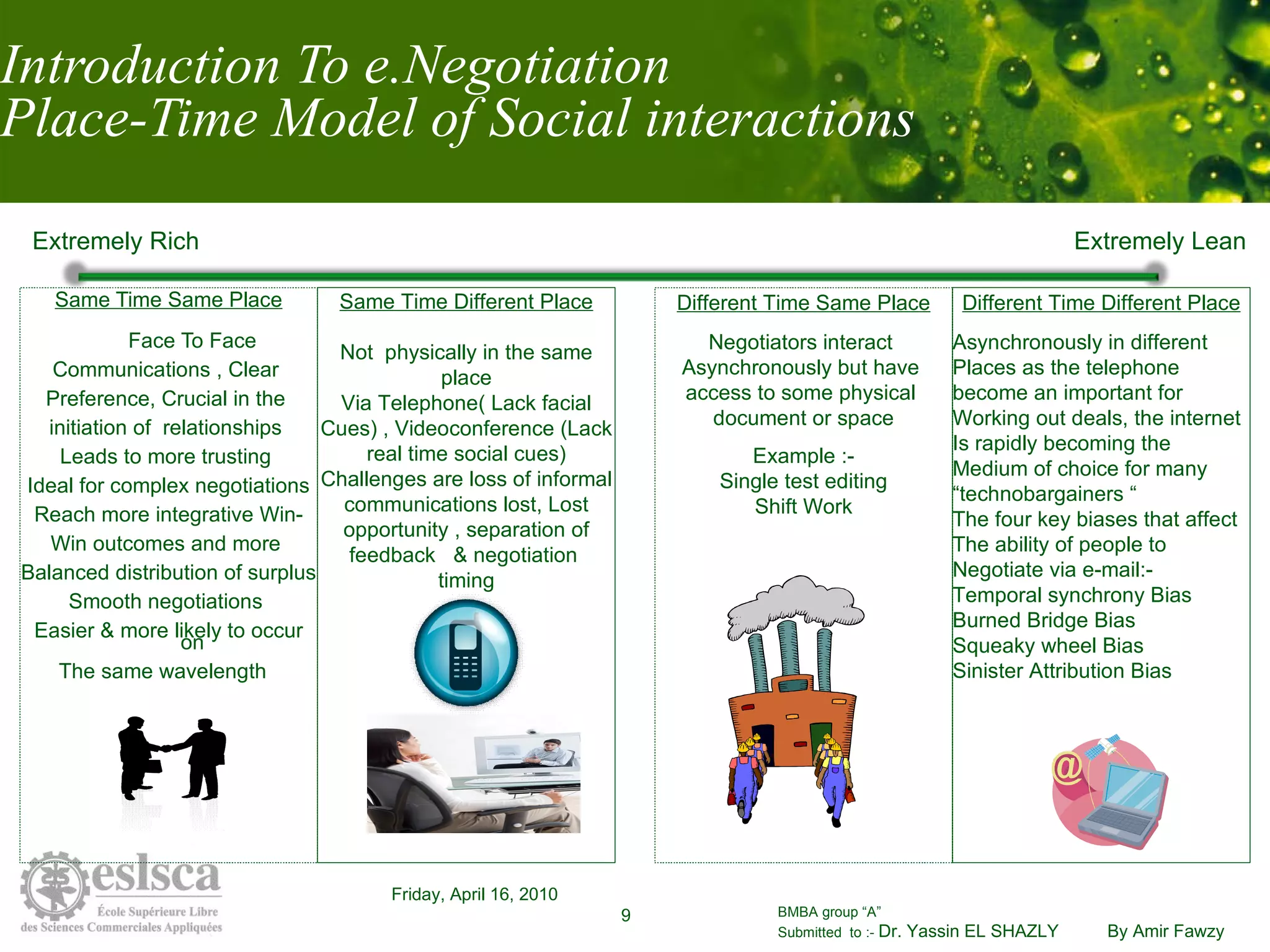
Introduction To e.Negotiation Place-Time Model of Social interactions Same Time Same Place Face To Face  Communications , Clear  Preference, Crucial in the  initiation of  relationships  Leads to more trusting  Ideal for complex negotiations Reach more integrative Win- Win outcomes and more  Balanced distribution of surplus Smooth negotiations  Easier & more likely to occur on  The same wavelength  Extremely Rich Extremely Lean Same Time Different Place Not  physically in the same place Via Telephone( Lack facial Cues) , Videoconference (Lack real time social cues) Challenges are loss of informal communications lost, Lost opportunity , separation of feedback  & negotiation  timing Different Time Same Place Negotiators interact  Asynchronously but have  access to some physical  document or space Example :- Single test editing Shift Work Different Time Different Place Asynchronously in different  Places as the telephone  become an important for  Working out deals, the internet  Is rapidly becoming the  Medium of choice for many  “ technobargainers “  The four key biases that affect  The ability of people to  Negotiate via e-mail:- Temporal synchrony Bias Burned Bridge Bias Squeaky wheel Bias Sinister Attribution Bias
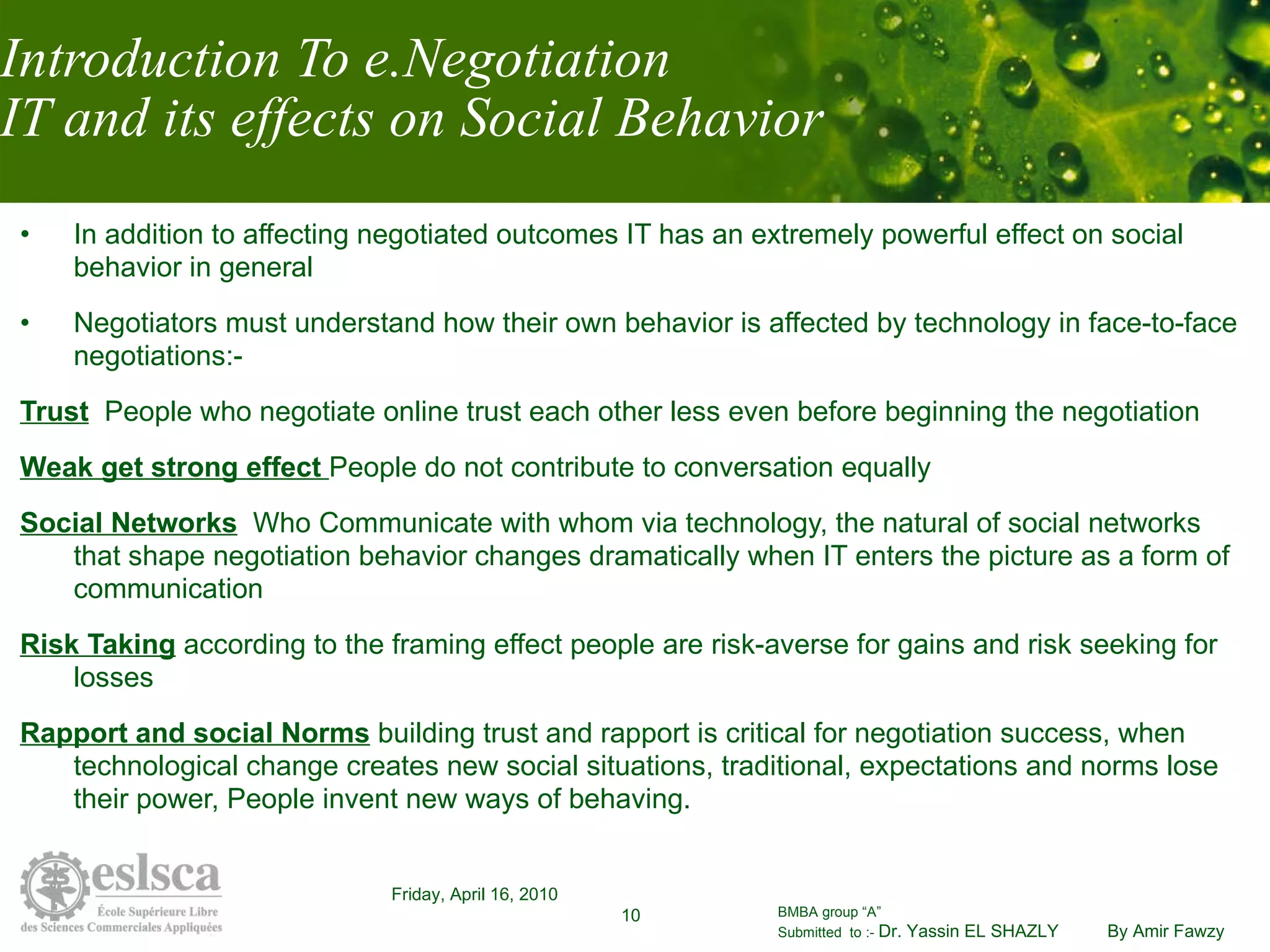
Introduction To e.Negotiation IT and its effects on Social Behavior In addition to affecting negotiated outcomes IT has an extremely powerful effect on social behavior in general Negotiators must understand how their own behavior is affected by technology in face-to-face negotiations:- Trust   People who negotiate online trust each other less even before beginning the negotiation Weak get strong effect  People do not contribute to conversation equally Social Networks   Who Communicate with whom via technology, the natural of social networks that shape negotiation behavior changes dramatically when IT enters the picture as a form of communication  Risk Taking   according to the framing effect people are risk-averse for gains and risk seeking for losses  Rapport and social Norms   building trust and rapport is critical for negotiation success, when technological change creates new social situations, traditional, expectations and norms lose their power, People invent new ways of behaving.
Introduction To e.Negotiation Strategies for enhancing Technology –mediated negotiations Often negotiators do not have the luxury of face to face meetings for the duration of their negotiations, What strategies can be employed to enhance successful pie-expansion and pie-slicing? Tactics:- Initial Face to face experience  The effectiveness of virtual and face to face teams was compared as they worked on a brainstorming exercise and a negotiation exercise. Oftentimes people develop rapport on the basis of a short face to face meeting which can reduce uncertainty and build trust  One-day Videoconference/Teleconference  If face to face meeting is out of the question an alternative may be to get everyone online so that at least people can attach a name to a face. It may be more feasible than face to face meeting.
Introduction To e.Negotiation Conclusion Use the place-time model of social interaction to examine how the medium of communication affects negotiation e.Negotiation is not a replacement of the traditional Negotiation  We can get the optimum benefits from applying the e.Negotiation with  the formal subjects, on the other hand the traditional Negotiation is more reliable with the informal subjects Start with the e.Negotiation may lead to traditional Negotiation and  vise versa Next step is a ready made programs to simulate any cases with many solutions to be apply, Artificial Negotiation Intelligent (ANI).
Introduction To Negotiation Skill Thanks

Negotiation Via Information Technology

  • 1.
    Introduction to e.NegotiationNegotiation Via Information Technology By :Amir Fawzy Eslsca University – BMBA Group “A” Submitted to :- Dr. Yassin EL SHAZLY
  • 2.
    Introduction To e.NegotiationIndex Abstract Objectives What is Negotiation ? Place Time Model of Social interactions IT and its effects on Social Behavior Strategies for enhancing Technology –mediated negotiation Conclusions
  • 3.
    Introduction To e.NegotiationAbstract There is a hundred of evidence on how information technology affects social behavior, Information Technology, "I.T.“ refers to anything related to computing technology, such as networking, hardware, software, the Internet, or the people that work with these technologies. Since we live in the "information age," information technology has become a part of our everyday lives. how e-mail, as a particularly important type of information technology, affects negotiation behavior, or how powerful the internet can be when used as a public sounding board How "I.T.“ affects negotiation behavior, what is the strategies to help Negotiators expand & divide the pie effectively.
  • 4.
    Introduction To e.Negotiation Objectives K now what is Negotiation & the impact of IT on Negotiation S tudy a model of social interaction U nderstand the effects of IT on Social Behavior E xamine tactics to enhance technology mediated negotiations “ Let us never negotiate out of fear. But let us never fear to negotiate” John Fitzgerald Kennedy quotes American 35th US President (1961-63)
  • 5.
    Introduction To e.NegotiationWhat is Negotiation ? Negotiation is a noun from Verb Negotiate The verb (used without object) To deal with others, as in the preparation of a treaty or contract or in preliminaries to a business deal. The verb (used with object). To arrange for or bring about by discussion and settlement of terms: to negotiate a loan . To manage; transact; conduct : He negotiated an important business deal . To move through, around, or over in a satisfactory manner: to negotiate a difficult dance step without tripping: to negotiate sharp curves . To transfer (a draft, promissory note, etc.) to a new owner by endorsement and delivery Origin: 1590–1600 To communicate in search of mutual agreement, 1590s Related form Negotiator(noun) Re/ Pre-negotiate(verbs) Well/ Un-negotiated (adjectives) Synonyms Talk, Discuss, Consult, Bargain, Agree, Settle
  • 6.
    Introduction To e.NegotiationWhat is Negotiation ? In Negotiating strongly every person should :- Fell s(he) Wins, and get some of what s(he)wants Types of negotiations by its result to each concerned parties Do we need Negotiations? You live in isolation if you do not Negotiate, it is a fact of life. Everyone has his own style
  • 7.
    Introduction To e.NegotiationWhat is Negotiation ? So . Negotiation covers any interaction (professional or personal )between two or more point of views to work forward an agreement or not doing it. Question is the key of knowledge 4’s What of Negotiations W hat do we want?......................................... P repare W hat do they want?....................................... D ebate W hat wants could we trade? ………………... P ropose W hat want we will trade?............................... B argain Negotiation is an interpersonal decision-making process by which two or more people make mutual decisions concerning the allocation of scarce resources. (Pruitt & Carnevale, 1993) A Negotiation is a fact of life. Everyone negotiates something every day. (Dr. Yassin EL SHAZLY,2010).
  • 8.
    Introduction To e.NegotiationPlace-Time Model of Social interactions The Place-Time model describes four sub-models of interactions:- Same Time & Same Place │Same Time & Different Place │Different Time & Same Place │Different Time & Different Place As might be suspected Negotiation behavior unfolds differently in each sub-models One consideration is the richness or the potential information carrying of the communications Extremely Rich Extremely Lean zero Rich & Zero Lean No Negotiation Face to Face Email V.mail Single Text Editing Shift Work Telephone Video Conference
  • 9.
    Introduction To e.NegotiationPlace-Time Model of Social interactions Same Time Same Place Face To Face Communications , Clear Preference, Crucial in the initiation of relationships Leads to more trusting Ideal for complex negotiations Reach more integrative Win- Win outcomes and more Balanced distribution of surplus Smooth negotiations Easier & more likely to occur on The same wavelength Extremely Rich Extremely Lean Same Time Different Place Not physically in the same place Via Telephone( Lack facial Cues) , Videoconference (Lack real time social cues) Challenges are loss of informal communications lost, Lost opportunity , separation of feedback & negotiation timing Different Time Same Place Negotiators interact Asynchronously but have access to some physical document or space Example :- Single test editing Shift Work Different Time Different Place Asynchronously in different Places as the telephone become an important for Working out deals, the internet Is rapidly becoming the Medium of choice for many “ technobargainers “ The four key biases that affect The ability of people to Negotiate via e-mail:- Temporal synchrony Bias Burned Bridge Bias Squeaky wheel Bias Sinister Attribution Bias
  • 10.
    Introduction To e.NegotiationIT and its effects on Social Behavior In addition to affecting negotiated outcomes IT has an extremely powerful effect on social behavior in general Negotiators must understand how their own behavior is affected by technology in face-to-face negotiations:- Trust People who negotiate online trust each other less even before beginning the negotiation Weak get strong effect People do not contribute to conversation equally Social Networks Who Communicate with whom via technology, the natural of social networks that shape negotiation behavior changes dramatically when IT enters the picture as a form of communication Risk Taking according to the framing effect people are risk-averse for gains and risk seeking for losses Rapport and social Norms building trust and rapport is critical for negotiation success, when technological change creates new social situations, traditional, expectations and norms lose their power, People invent new ways of behaving.
  • 11.
    Introduction To e.NegotiationStrategies for enhancing Technology –mediated negotiations Often negotiators do not have the luxury of face to face meetings for the duration of their negotiations, What strategies can be employed to enhance successful pie-expansion and pie-slicing? Tactics:- Initial Face to face experience The effectiveness of virtual and face to face teams was compared as they worked on a brainstorming exercise and a negotiation exercise. Oftentimes people develop rapport on the basis of a short face to face meeting which can reduce uncertainty and build trust One-day Videoconference/Teleconference If face to face meeting is out of the question an alternative may be to get everyone online so that at least people can attach a name to a face. It may be more feasible than face to face meeting.
  • 12.
    Introduction To e.NegotiationConclusion Use the place-time model of social interaction to examine how the medium of communication affects negotiation e.Negotiation is not a replacement of the traditional Negotiation We can get the optimum benefits from applying the e.Negotiation with the formal subjects, on the other hand the traditional Negotiation is more reliable with the informal subjects Start with the e.Negotiation may lead to traditional Negotiation and vise versa Next step is a ready made programs to simulate any cases with many solutions to be apply, Artificial Negotiation Intelligent (ANI).
  • 13.

Editor's Notes

  • #2 ACCOUNTS PAYABLE 21/05/10
  • #3 ACCOUNTS PAYABLE 21/05/10
  • #4 ACCOUNTS PAYABLE 21/05/10
  • #5 ACCOUNTS PAYABLE 21/05/10
  • #6 ACCOUNTS PAYABLE 21/05/10
  • #7 ACCOUNTS PAYABLE 21/05/10
  • #8 ACCOUNTS PAYABLE 21/05/10 In the Finance module, we can record and manage our receivables and payables For the General Ledger, we record the financial implications of transactions in the P&L and B/S. Reporting wise, we are more focused on external reporting. For example, reporting the Financial Statements according to local accounting standards, reporting on the tax authorities eg for Excise, VAT. We can also satisfy the Heineken reporting requirements and accounting rules. A significant enhancement in CORE3 is the introduction of the Heineken Standard Chart of Accounts. All postings will be made to SCOA accounts. There may be country specific requirements that mandate the General Ledger structure. This can be accommodated by creating an alternative chart of accounts and use this to report according to local accounting requirements. The settings to map the SCOA accounts in to the alternative chart to are maintained on the GL master. A brief description of the functionality in this modules will be made, realizing that of course, functionality is already included in CORE1.
  • #9 ACCOUNTS PAYABLE 21/05/10
  • #10 ACCOUNTS PAYABLE 21/05/10
  • #11 ACCOUNTS PAYABLE 21/05/10
  • #12 ACCOUNTS PAYABLE 21/05/10
  • #13 ACCOUNTS PAYABLE 21/05/10
  • #14 ACCOUNTS PAYABLE 21/05/10