The cost of litigation for those people in
society who lack financial substance, are
unable to afford the official legal proceess
and therefore often lose out in disputes, the
introduction of Private Court offers them a
means to have the access to justice.
PRIVATE COURT
Reduce Hostility
Regain a sense of control
Gain acceptance of the outcome
Resolve conflict in a peaceful
manner
The resolution of dispute takes place
usually in private
1.
2.
3.
4.
5.
Mission
To define the justice model which is
socially viable
To reach out every individual ie.
make justice economic and efficient
Achieve a greater sense of Justice in
each individual case
1.
2.
3.
Vision
RESOLUTION PROCESS
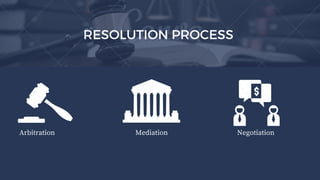
Arbitration Mediation Negotiation
Arbitration is a consensual dispute resolution
process based on the parties' agreement to
submit their disputes and to provide a
solution. Arbitrator is the one who is
appointed to solve the disagreement between
the parties.
ARBITRATION
Mediation is a voluntary and private dispute
resolution process in which a neutral person,
the mediator, who helps in solving the dispute.
The mediator has no power to impose a
settlement. Their function is to overcome any
impasse and encourage the parties to reach an
amicable settlement.
MEDIATION
Negotiations are simple and quicker ways of
solving disputes. They are reached through
discussions made between two parties with
involvement of third party who is a neutral
intermediary. They are also called as Adjudications
and sometimes referred to as Conciliation. They
are common in construction dispute.
NEGOTIATION
STAGES OF
NEGOTIATION
Before negotiation takes place, a decision to be
taken as to when and where a meeting will take
place to discuss the problem and who to attend.
Setting a limit time scale can also be helpful to
prevent the disagreement continuing.
PREPARATION
During this stage,individuals or members of each
other put forward the case as they see it that is
their understanding of the situation
Key skill during this stage includes questioning,
listening and clarifying.
DISCUSSION
STAGES OF
NEGOTIATION
From the discussion, the goals, interests and viewpoints of
both sides of the disagreement need to be clarified.
Clarification is an essential part of the negotiation process,
without it misunderstanding are likely to occur which may
cause problems and barriers to reaching a beneficial outcome
CLARIFYING GOAL
It focuses on what is termed a ‘win-win’ outcome where both
sides feel they have gained something positive through the
process of negotiation. Compromises are often positive
alternatives which can often achieve greater benefits for all
concerned compared to holding to the original positions.
NEGOTIATION TOWARDS A WIN- WIN OUTCOME
STAGES OF
NEGOTIATION
Essential everybody to keep an open mind in order to
achieve an acceptable solution. Any agreement needs to be
made perfectly clear so that both sides know what has
been decided
AGREEMENT
From the agreement, a course of action has be
implemented to carry through the decision.
IMPLEMENTATION A COURSE OF ACTION
Negotiator is the one who is in
charge of solving the cases in terms
with rules and laws. Negotiator can
also be called as Adjudicator.
Private court holds lists of local and
international negotiators
NEGOTIATOR
Negotiator should accompany the
parties in neutral and impartial
manner in order to settle the dispute
in an effective way.
They should conduct the case by
taking in account of the situation of
the case, the wishes and requests that
both parties express in an appropriate
manner.
ROLES OF NEGOTIATOR
ROLES OF NEGOTIATOR
The Negotiator provides the proposal
to the settlement of the dispute.
He/she authenticates the settlement
agreement between the parties.
They should proceed with fairness,
justice and taking consideration of
the circumstances causing dispute.
The candidate who wants to join in
the panel of Negotiator should
have a prior experience of working
as a Lawyer, Mediator, Arbitrator,
Consultant or any among these.
Should posses language
skills and technical skills
They should be under 75 years of
age.
They should not hold any
misconduct or issues by the Civil
court
REQUIREMENTS FOR NEGOTIATOR
INTIAL ASSESMENT
CONTACTING THE
OTHER PARTY
PREPARING FOR NEGOTIATION
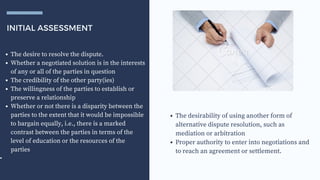
INITIAL ASSESSMENT
The desire to resolve the dispute.
Whether a negotiated solution is in the interests
of any or all of the parties in question
The credibility of the other party(ies)
The willingness of the parties to establish or
preserve a relationship
Whether or not there is a disparity between the
parties to the extent that it would be impossible
to bargain equally, i.e., there is a marked
contrast between the parties in terms of the
level of education or the resources of the
parties
•
The desirability of using another form of
alternative dispute resolution, such as
mediation or arbitration
Proper authority to enter into negotiations and
to reach an agreement or settlement.
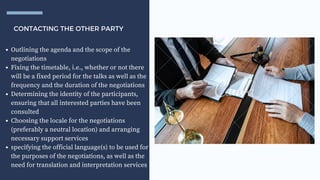
CONTACTING THE OTHER PARTY
Outlining the agenda and the scope of the
negotiations
Fixing the timetable, i.e., whether or not there
will be a fixed period for the talks as well as the
frequency and the duration of the negotiations
Determining the identity of the participants,
ensuring that all interested parties have been
consulted
Choosing the locale for the negotiations
(preferably a neutral location) and arranging
necessary support services
specifying the official language(s) to be used for
the purposes of the negotiations, as well as the
need for translation and interpretation services
FAST, SIMPLE AND ONLINE JUSTICE FOR
ALL!
PRIVATE COURT
Call us at +91 9699900111
Email Us at support@pvt.com
Website: pvtcourt.com
CONTACT

Negotiation- PrivateCourt

  • 2.
    The cost oflitigation for those people in society who lack financial substance, are unable to afford the official legal proceess and therefore often lose out in disputes, the introduction of Private Court offers them a means to have the access to justice. PRIVATE COURT
  • 3.
    Reduce Hostility Regain asense of control Gain acceptance of the outcome Resolve conflict in a peaceful manner The resolution of dispute takes place usually in private 1. 2. 3. 4. 5. Mission
  • 4.
    To define thejustice model which is socially viable To reach out every individual ie. make justice economic and efficient Achieve a greater sense of Justice in each individual case 1. 2. 3. Vision
  • 5.
  • 6.
    Arbitration is aconsensual dispute resolution process based on the parties' agreement to submit their disputes and to provide a solution. Arbitrator is the one who is appointed to solve the disagreement between the parties. ARBITRATION
  • 7.
    Mediation is avoluntary and private dispute resolution process in which a neutral person, the mediator, who helps in solving the dispute. The mediator has no power to impose a settlement. Their function is to overcome any impasse and encourage the parties to reach an amicable settlement. MEDIATION
  • 8.
    Negotiations are simpleand quicker ways of solving disputes. They are reached through discussions made between two parties with involvement of third party who is a neutral intermediary. They are also called as Adjudications and sometimes referred to as Conciliation. They are common in construction dispute. NEGOTIATION
  • 9.
    STAGES OF NEGOTIATION Before negotiationtakes place, a decision to be taken as to when and where a meeting will take place to discuss the problem and who to attend. Setting a limit time scale can also be helpful to prevent the disagreement continuing. PREPARATION During this stage,individuals or members of each other put forward the case as they see it that is their understanding of the situation Key skill during this stage includes questioning, listening and clarifying. DISCUSSION
  • 10.
    STAGES OF NEGOTIATION From thediscussion, the goals, interests and viewpoints of both sides of the disagreement need to be clarified. Clarification is an essential part of the negotiation process, without it misunderstanding are likely to occur which may cause problems and barriers to reaching a beneficial outcome CLARIFYING GOAL It focuses on what is termed a ‘win-win’ outcome where both sides feel they have gained something positive through the process of negotiation. Compromises are often positive alternatives which can often achieve greater benefits for all concerned compared to holding to the original positions. NEGOTIATION TOWARDS A WIN- WIN OUTCOME
  • 11.
    STAGES OF NEGOTIATION Essential everybodyto keep an open mind in order to achieve an acceptable solution. Any agreement needs to be made perfectly clear so that both sides know what has been decided AGREEMENT From the agreement, a course of action has be implemented to carry through the decision. IMPLEMENTATION A COURSE OF ACTION
  • 12.
    Negotiator is theone who is in charge of solving the cases in terms with rules and laws. Negotiator can also be called as Adjudicator. Private court holds lists of local and international negotiators NEGOTIATOR
  • 13.
    Negotiator should accompanythe parties in neutral and impartial manner in order to settle the dispute in an effective way. They should conduct the case by taking in account of the situation of the case, the wishes and requests that both parties express in an appropriate manner. ROLES OF NEGOTIATOR
  • 14.
    ROLES OF NEGOTIATOR TheNegotiator provides the proposal to the settlement of the dispute. He/she authenticates the settlement agreement between the parties. They should proceed with fairness, justice and taking consideration of the circumstances causing dispute.
  • 15.
    The candidate whowants to join in the panel of Negotiator should have a prior experience of working as a Lawyer, Mediator, Arbitrator, Consultant or any among these. Should posses language skills and technical skills They should be under 75 years of age. They should not hold any misconduct or issues by the Civil court REQUIREMENTS FOR NEGOTIATOR
  • 16.
    INTIAL ASSESMENT CONTACTING THE OTHERPARTY PREPARING FOR NEGOTIATION
  • 17.
    INITIAL ASSESSMENT The desireto resolve the dispute. Whether a negotiated solution is in the interests of any or all of the parties in question The credibility of the other party(ies) The willingness of the parties to establish or preserve a relationship Whether or not there is a disparity between the parties to the extent that it would be impossible to bargain equally, i.e., there is a marked contrast between the parties in terms of the level of education or the resources of the parties • The desirability of using another form of alternative dispute resolution, such as mediation or arbitration Proper authority to enter into negotiations and to reach an agreement or settlement.
  • 18.
    CONTACTING THE OTHERPARTY Outlining the agenda and the scope of the negotiations Fixing the timetable, i.e., whether or not there will be a fixed period for the talks as well as the frequency and the duration of the negotiations Determining the identity of the participants, ensuring that all interested parties have been consulted Choosing the locale for the negotiations (preferably a neutral location) and arranging necessary support services specifying the official language(s) to be used for the purposes of the negotiations, as well as the need for translation and interpretation services
  • 19.
    FAST, SIMPLE AND ONLINEJUSTICE FOR ALL! PRIVATE COURT
  • 20.
    Call us at+91 9699900111 Email Us at support@pvt.com Website: pvtcourt.com CONTACT