ACCESS TO JUSTICE FOR ALL
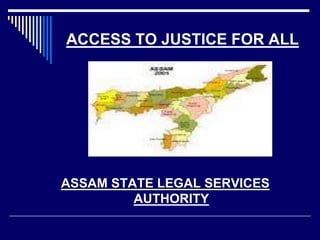
ASSAM STATE LEGAL SERVICES
AUTHORITY
Mediation as a means of
Alternative Dispute Redressel
Mechanism
Mediation has emerged globally as a tool to supplement the
traditional court system for the resolution of disputes. It
provides justice within reasonable time and without rigour of
trial and less expensive.
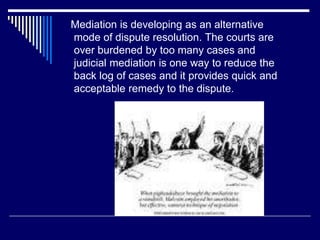
Mediation is developing as an alternative
mode of dispute resolution. The courts are
over burdened by too many cases and
judicial mediation is one way to reduce the
back log of cases and it provides quick and
acceptable remedy to the dispute.
What is mediation ?
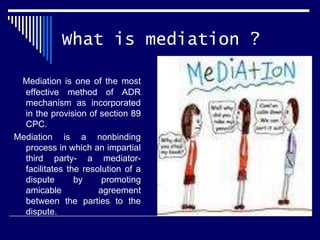
Mediation is one of the most
effective method of ADR
mechanism as incorporated
in the provision of section 89
CPC.
Mediation is a nonbinding
process in which an impartial
third party- a mediator-
facilitates the resolution of a
dispute by promoting
amicable agreement
between the parties to the
dispute.
ALTERNATIVE DISPUTE
RESOLUTION (ADR)
Alternative Dispute Resolution in its
literal meaning is ” settlement of disputes
outside the court ”. ADR is not an
alternative to the court system but only
meant to supplement the same to help in
lessening the workload of the courts and
provides quick and affordable justice to
the litigant.
The primary object of ADR movement is avoidance of
vexation ,expense and delay in justice delivery
system. It promotes the idea of “ access to justice “
for all .In other words, the ADR system seeks to
provide a cheap , simple , quick and accessible
justice.
The ADR mechanism covers the following
heads.
1. Arbitration
2. Conciliation
3. Judicial settlement including settlement
through Lok Adalats and
4. Mediation
Mediation as a method of disputeresolution.
In the field of resolving legal controversies, mediation
offers an informal method of dispute resolution, in which
a neutral third party, the mediator, attempts to assist the
parties in finding resolution to their problem through the
mediation process. Although mediation has no legal
standing per se, the parties can (usually with assistance
from legal counsel) resolves their dispute through an
agreement in writing and sign the document at he end of
a successful mediation, thus producing a legally binding
contract in some jurisdiction specified therein.
.
Mediation differs from most other conflict resolution
processes by virtue of its simplicity, and in the clarity of
its rules. It is employed at all scales from petty civil
disputes to global peace talks. In a process of
mediation, the mediator after introducing himself, go for
a joint session and hear the grievances of both the
parties. Next phrase is single session in which both the
parties are given opportunity to talk and interact with
the mediator separately and confidentiality is assured to
be maintained. If necessary, further joint session is held
and thereafter the mediator drown up an agreement
with the free consent of both the parties and take their
signature over it which is sent back to the court for final
settlement of the dispute.
Unlike a judge or an arbitrator, the
mediator does not impose the ultimate
and final solution on the parties. A
mediator creates a conducive
atmosphere under which the parties can
reach an acceptable solution by mutual
consent.
Componentsof Mediation
1. Impartiality:
Impartially is one of the important component of
mediation process. The mediator must maintain neutrality
which is the assets of a mediator.
A Mediator must avoid:
1. Partiality or prejudice; and
2. Conduct that gives appearance of partiality
or prejudice.
2. Competence :
Mediator should have necessary competence,
knowledge of law and experience in the field of legal
education with good reputation to do mediation and to satisfy
the reasonable expectations of the parties.
3. Confidentiality
Confidentiality must be maintain during the mediation
proceedings. The parties to the process of mediation
must received the indication that mediator will maintain total
confidentiality of the fact disclosed and will communicate those
part to the other party only after obtaining consent of the
parties.
4. Quality of Process
The conduct of mediator should not be influenced by a
desire to achieve a high settlement rate.
A mediator must conduct the mediation proceedings
diligently and with understanding that outcome should
be due to free will of the parties.
5. Settlement
If the mediation results in a settlement between the
parties, the mediator should encourage the
parties to record the exact terms of settlement in writing
6. Self determination
Mediation is based on principle of self- determination by
the parties.
Parties be allowed to reach a voluntary and uncoerced
agreement.
Any party may withdraw from mediation at any time.
Benefits Of Mediation.
1 Private, prompt and affordable.
2 Provides an opportunity to the parties to talk about their case in
their own words and to directly participate in negotiation of their
claims.
3 A forum for parties to develop creative, non-traditional remedies
that promote their underlying business and personal
interests.
4 Provides better solution of the disputes more expeditiously and
at low cost .
5 It helps in the reduction of the work load of the court.
6 It can be used at any time even when the case is pending
before the court of law.
Disputes where mediation is appropriate
 Parties desire a negotiated outcome
 To maintain future relationship
 Avoid unfavourable judgment
 Litigant does not want to appear as a
witness
 Cost of trial exceeds projected value
Parties want prompt solution
Parties want control over outcome
Complicated case
Confidentiality desired by parties
Opportunity to develop creative non-traditional remedies
Conclusion
Settlement in mediation, there is no winner or looser. The agreed
settlement is sent back to the court for its execution . The entire
process of mediation is also time bound process and it saves
both time and money of the parties by providing quick and
affordable remedy to the parties with their consent and disposed
of disputes comfortably.
Thus it appears from the above discussion that mediation is one
of the effective, workable, mode of conflict management and
resolution system. It provides aid and assistance for quick and
early disposal of cases by the court who refers those cases to
the mediation center for settlement.
The structural process taken up by the mediators with
full consent in which the parties voluntarily take part
to give an acceptable solution to the disputes.
In proper sense and meaning when the case goes
back to the court again , it carries smile on the face
of both the parties.
In the words of Sir
Abraham Lincoln
“Discourage litigation. Persuade your neighbors
to compromise whenever you can. Point out to
them how the nominal winner is often a real
looser in fees, expenses and waste of time”

Mediation.ppt

  • 1.
    ACCESS TO JUSTICEFOR ALL ASSAM STATE LEGAL SERVICES AUTHORITY
  • 2.
    Mediation as ameans of Alternative Dispute Redressel Mechanism Mediation has emerged globally as a tool to supplement the traditional court system for the resolution of disputes. It provides justice within reasonable time and without rigour of trial and less expensive.
  • 3.
    Mediation is developingas an alternative mode of dispute resolution. The courts are over burdened by too many cases and judicial mediation is one way to reduce the back log of cases and it provides quick and acceptable remedy to the dispute.
  • 4.
    What is mediation? Mediation is one of the most effective method of ADR mechanism as incorporated in the provision of section 89 CPC. Mediation is a nonbinding process in which an impartial third party- a mediator- facilitates the resolution of a dispute by promoting amicable agreement between the parties to the dispute.
  • 5.
    ALTERNATIVE DISPUTE RESOLUTION (ADR) AlternativeDispute Resolution in its literal meaning is ” settlement of disputes outside the court ”. ADR is not an alternative to the court system but only meant to supplement the same to help in lessening the workload of the courts and provides quick and affordable justice to the litigant.
  • 6.
    The primary objectof ADR movement is avoidance of vexation ,expense and delay in justice delivery system. It promotes the idea of “ access to justice “ for all .In other words, the ADR system seeks to provide a cheap , simple , quick and accessible justice.
  • 7.
    The ADR mechanismcovers the following heads. 1. Arbitration 2. Conciliation 3. Judicial settlement including settlement through Lok Adalats and 4. Mediation
  • 8.
    Mediation as amethod of disputeresolution. In the field of resolving legal controversies, mediation offers an informal method of dispute resolution, in which a neutral third party, the mediator, attempts to assist the parties in finding resolution to their problem through the mediation process. Although mediation has no legal standing per se, the parties can (usually with assistance from legal counsel) resolves their dispute through an agreement in writing and sign the document at he end of a successful mediation, thus producing a legally binding contract in some jurisdiction specified therein. .
  • 9.
    Mediation differs frommost other conflict resolution processes by virtue of its simplicity, and in the clarity of its rules. It is employed at all scales from petty civil disputes to global peace talks. In a process of mediation, the mediator after introducing himself, go for a joint session and hear the grievances of both the parties. Next phrase is single session in which both the parties are given opportunity to talk and interact with the mediator separately and confidentiality is assured to be maintained. If necessary, further joint session is held and thereafter the mediator drown up an agreement with the free consent of both the parties and take their signature over it which is sent back to the court for final settlement of the dispute.
  • 10.
    Unlike a judgeor an arbitrator, the mediator does not impose the ultimate and final solution on the parties. A mediator creates a conducive atmosphere under which the parties can reach an acceptable solution by mutual consent.
  • 11.
    Componentsof Mediation 1. Impartiality: Impartiallyis one of the important component of mediation process. The mediator must maintain neutrality which is the assets of a mediator. A Mediator must avoid: 1. Partiality or prejudice; and 2. Conduct that gives appearance of partiality or prejudice. 2. Competence : Mediator should have necessary competence, knowledge of law and experience in the field of legal education with good reputation to do mediation and to satisfy the reasonable expectations of the parties.
  • 12.
    3. Confidentiality Confidentiality mustbe maintain during the mediation proceedings. The parties to the process of mediation must received the indication that mediator will maintain total confidentiality of the fact disclosed and will communicate those part to the other party only after obtaining consent of the parties. 4. Quality of Process The conduct of mediator should not be influenced by a desire to achieve a high settlement rate. A mediator must conduct the mediation proceedings diligently and with understanding that outcome should be due to free will of the parties.
  • 13.
    5. Settlement If themediation results in a settlement between the parties, the mediator should encourage the parties to record the exact terms of settlement in writing 6. Self determination Mediation is based on principle of self- determination by the parties. Parties be allowed to reach a voluntary and uncoerced agreement. Any party may withdraw from mediation at any time.
  • 14.
    Benefits Of Mediation. 1Private, prompt and affordable. 2 Provides an opportunity to the parties to talk about their case in their own words and to directly participate in negotiation of their claims. 3 A forum for parties to develop creative, non-traditional remedies that promote their underlying business and personal interests.
  • 15.
    4 Provides bettersolution of the disputes more expeditiously and at low cost . 5 It helps in the reduction of the work load of the court. 6 It can be used at any time even when the case is pending before the court of law.
  • 16.
    Disputes where mediationis appropriate  Parties desire a negotiated outcome  To maintain future relationship  Avoid unfavourable judgment  Litigant does not want to appear as a witness  Cost of trial exceeds projected value
  • 17.
    Parties want promptsolution Parties want control over outcome Complicated case Confidentiality desired by parties Opportunity to develop creative non-traditional remedies
  • 18.
    Conclusion Settlement in mediation,there is no winner or looser. The agreed settlement is sent back to the court for its execution . The entire process of mediation is also time bound process and it saves both time and money of the parties by providing quick and affordable remedy to the parties with their consent and disposed of disputes comfortably. Thus it appears from the above discussion that mediation is one of the effective, workable, mode of conflict management and resolution system. It provides aid and assistance for quick and early disposal of cases by the court who refers those cases to the mediation center for settlement.
  • 19.
    The structural processtaken up by the mediators with full consent in which the parties voluntarily take part to give an acceptable solution to the disputes. In proper sense and meaning when the case goes back to the court again , it carries smile on the face of both the parties.
  • 20.
    In the wordsof Sir Abraham Lincoln “Discourage litigation. Persuade your neighbors to compromise whenever you can. Point out to them how the nominal winner is often a real looser in fees, expenses and waste of time”