A BRIEF ON MEDIATION AS A
THIRD-PARTY APPROACH IN
CONFLICT RESSOLUTION
BY
DANJUMA D. JISE
FOUNDER: PEACE SCHOLARS INTERNATIONAL
C/O CENTRE FOR CONFLICT MANAGEMENT &
PEACE STUDIES, UNIVERSITY OF JOS, NIGERIA.
MEDIATION IS-----
A non adversarial Third-party form of conflict
resolution in which the parties in conflict or
disputants have succumbed to their helplessness in
reaching to an amicable resolution or resolving the
dispute by themselves
MEDIATION
‘Mediation is a process that, together
with a number of other processes, is
collectively known as alternative
dispute resolution’
MEDIATION - A DEFINITION
• ‘Mediation is a voluntary, non-binding,
private dispute resolution process, in which
a neutral person helps the parties to reach
their own negotiated settlement’
BENEFITS OF MEDIATION
• Informal
• Quick
• Flexible
• Cost Effective
• Confidential
• Preserves Relationships
• Characterized by a win-win scenarior
• Control Remains With Parties
• Allows For Creative Solutions
• High Success Rate of 80%
WHEN TO USE MEDIATION
Because conflict is a continuum mediation may
be:
• Preventive (before conflict gets to escalation point)
• Curative (when conflict has already escalated). The only
exemption to this rule is when dealing violent conflict be it inter
state or intra-state warfare ) in which case mediation must go
with proper timing.
It is important to note that mediation can be entered into, both
when the matter is in court and when it is yet to be taken to
court
WHO SHOULD PLAY THE ROLE
OF MEDIATOR?
Traditionally, Lawyers and legal practitioners are
known for handling the task of mediation. But in
modern times especially in the post Cold War era,
other professionals such as Conflict Resolution
experts, key state actors at national and
international levels, military personnel, diplomats,
academic think-tanks, management consultants and
civil society activists are all legitimately engaged
in some level of mediation at varying degree of
involvement
MEDIATOR’S ROLE
• Serves As A Neutral Facilitator
• Summarizes, Restates And Prioritizes Issues
In A Non-Judgmental Manner
• Assists In The Generation Or Clarification
Of Options
• Evaluates Options And Possible
Consequences
• Enforces The Ground Rules
• Identifies Areas Of Mutual Interest
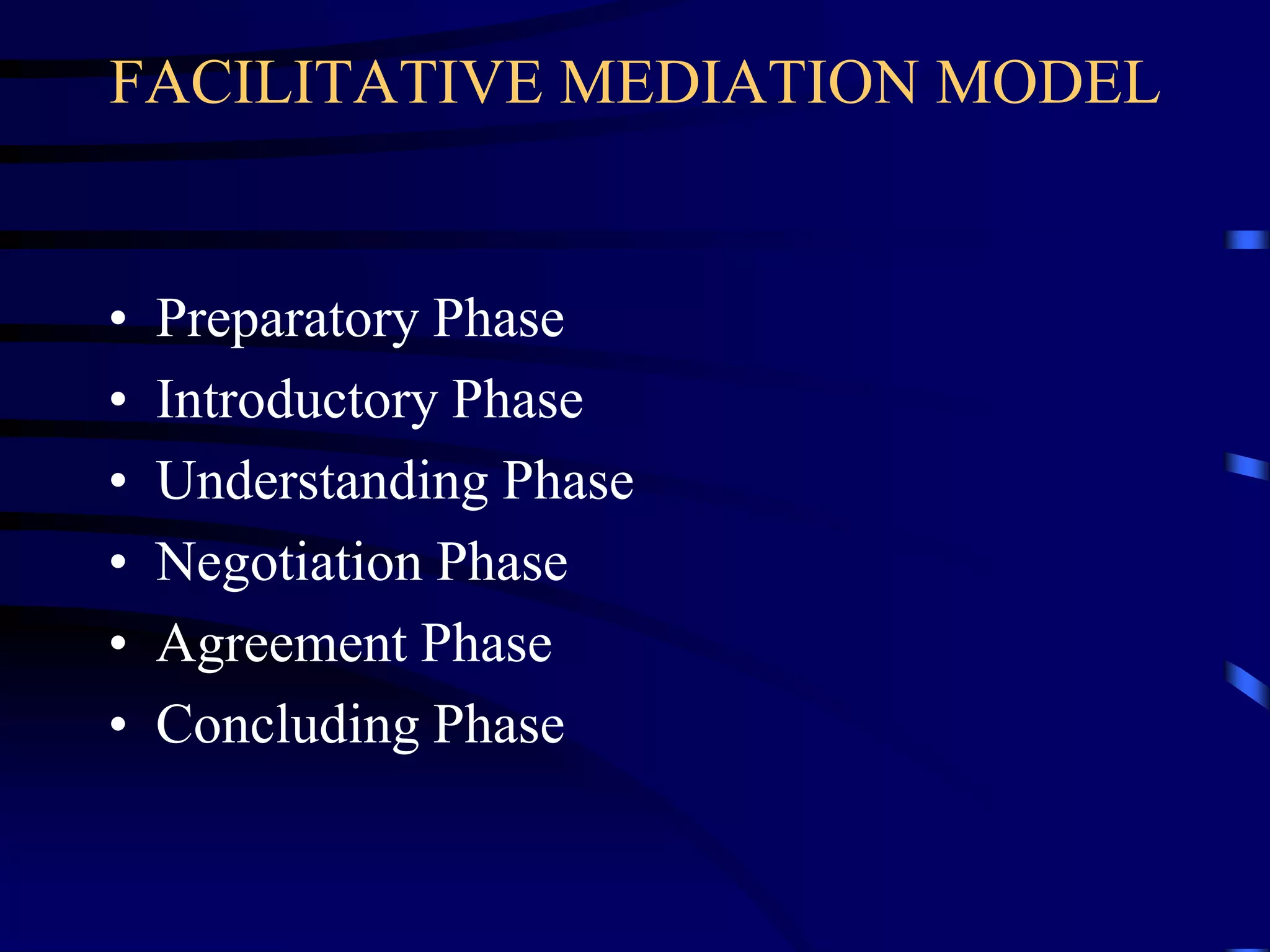
FACILITATIVE MEDIATION MODEL
• Preparatory Phase
• Introductory Phase
• Understanding Phase
• Negotiation Phase
• Agreement Phase
• Concluding Phase
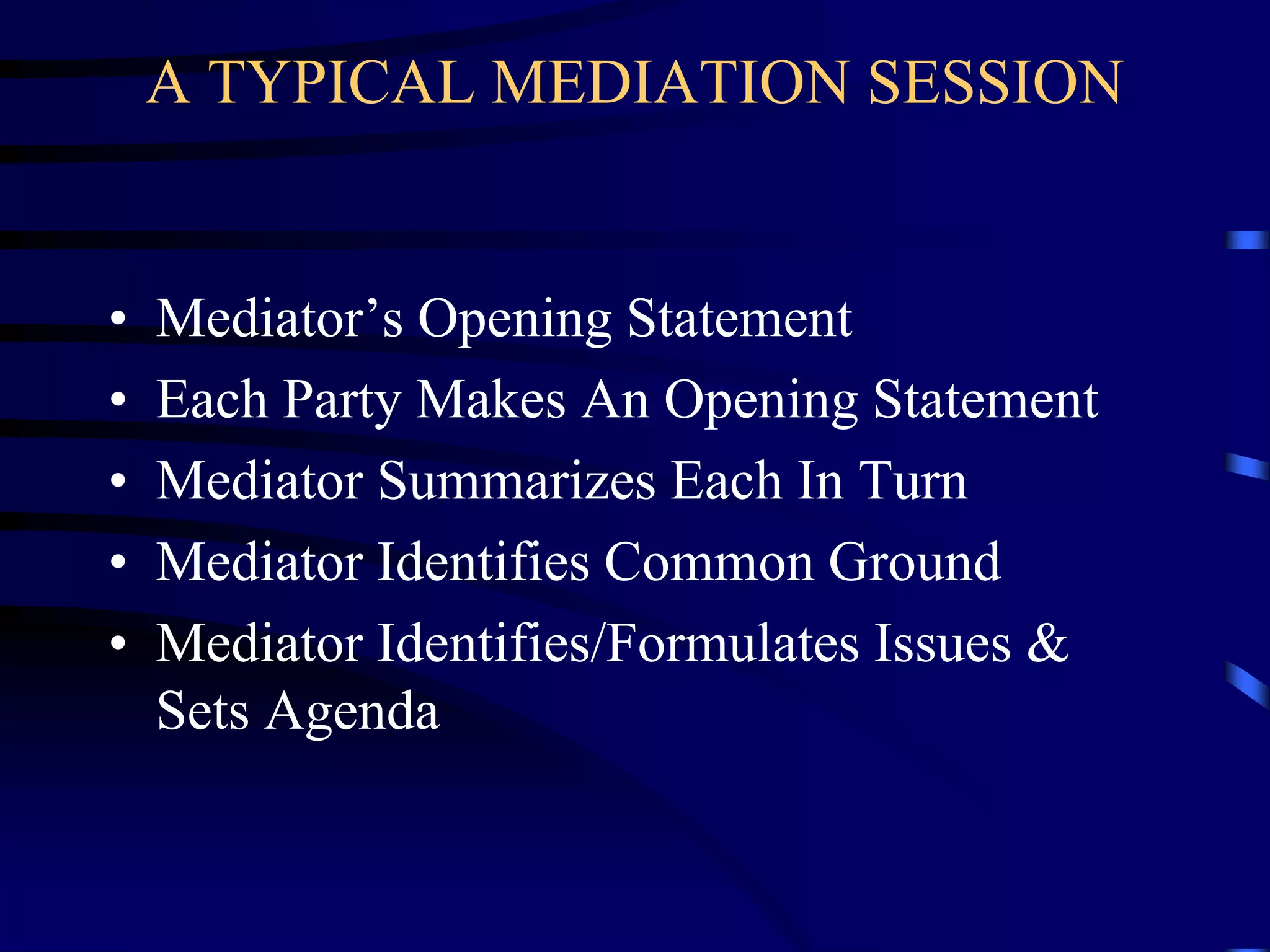
A TYPICAL MEDIATION SESSION
• Mediator’s Opening Statement
• Each Party Makes An Opening Statement
• Mediator Summarizes Each In Turn
• Mediator Identifies Common Ground
• Mediator Identifies/Formulates Issues &
Sets Agenda
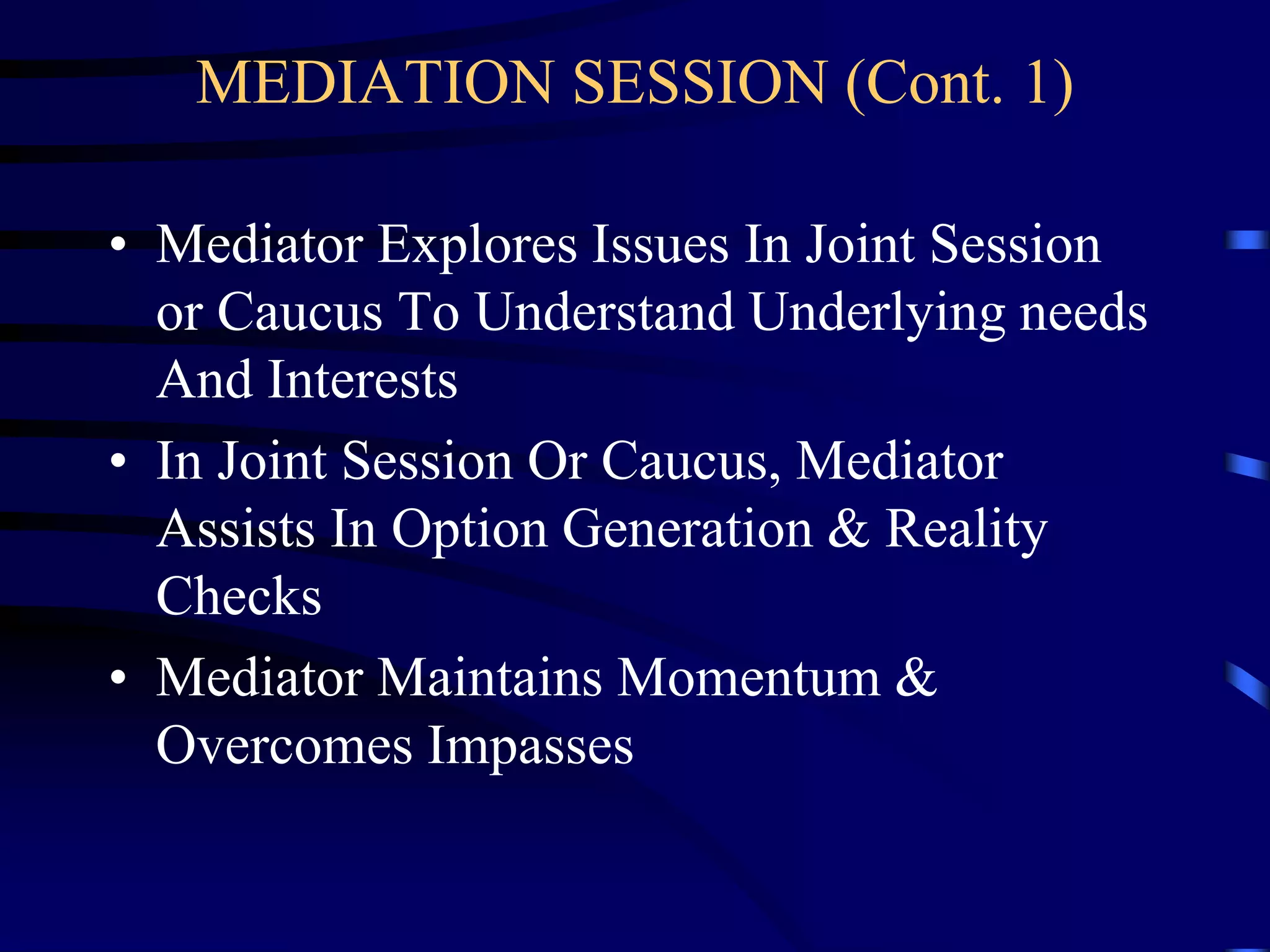
MEDIATION SESSION (Cont. 1)
• Mediator Explores Issues In Joint Session
or Caucus To Understand Underlying needs
And Interests
• In Joint Session Or Caucus, Mediator
Assists In Option Generation & Reality
Checks
• Mediator Maintains Momentum &
Overcomes Impasses
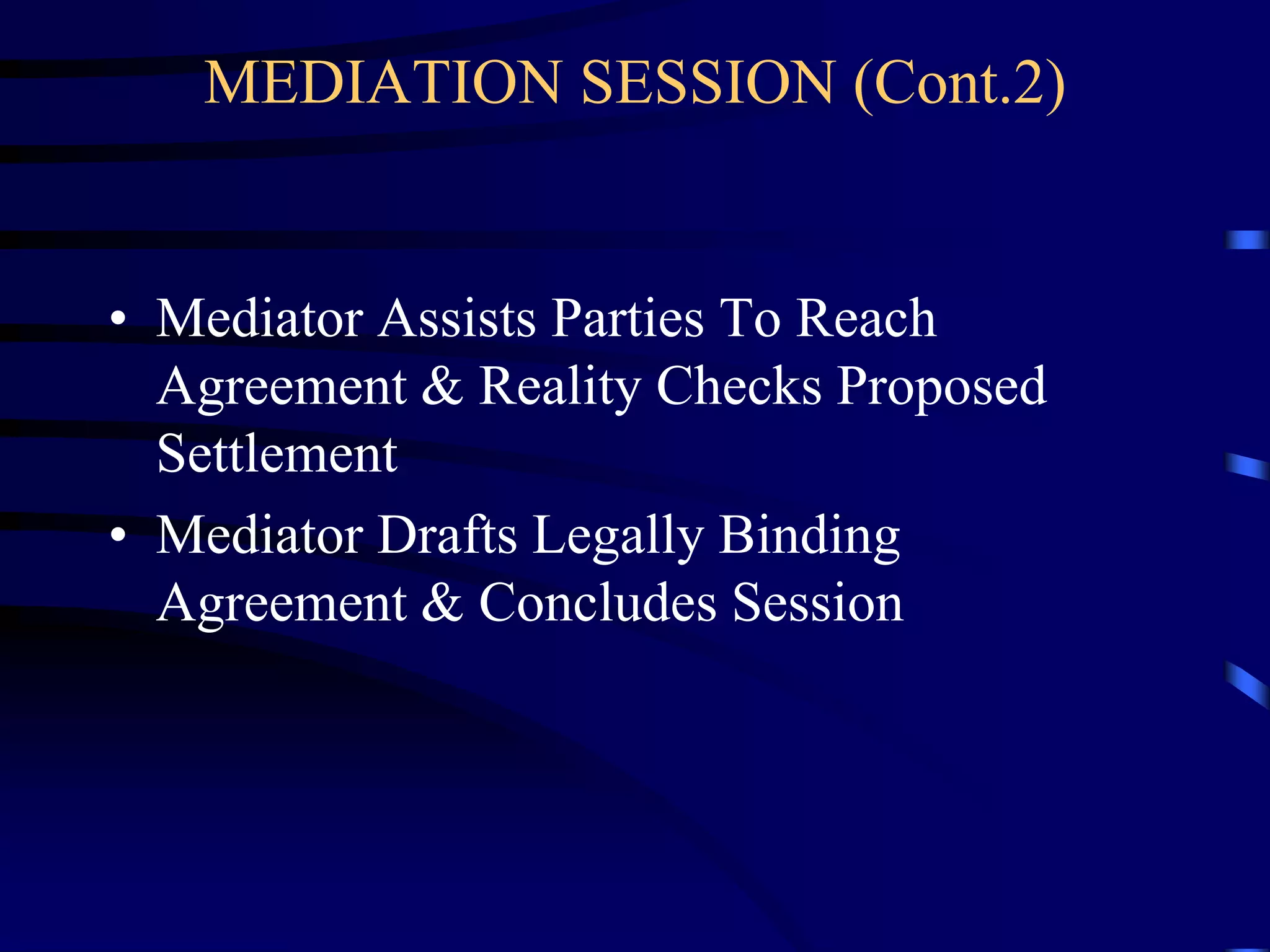
MEDIATION SESSION (Cont.2)
• Mediator Assists Parties To Reach
Agreement & Reality Checks Proposed
Settlement
• Mediator Drafts Legally Binding
Agreement & Concludes Session
MEDIATOR- POST MEDIATION
• May File Any Necessary Paper Work With
Court
• Monitor Implementation Of Terms Of
Settlement
• Release Documents Or Funds Held Pending
Settlement
FINALLY - A LESSON FROM HISTORY
• ‘Discourage litigation. Persuade your
neighbours to compromise whenever you can.
Point out to them how the nominal winner is
often the real loser…in fees, expenses and
waste of time.’-Abraham Lincoln
• Whenever you contemplate the court option
with an adversary, weigh the material and
human cost of loosing a relationship. Mediation
brings about two rather than one winner and
keeps the relationship.
Next time try Mediation.
Thanks for your kind audience

A brief mediationpresentation endorsed 2 (2)

  • 1.
    A BRIEF ONMEDIATION AS A THIRD-PARTY APPROACH IN CONFLICT RESSOLUTION BY DANJUMA D. JISE FOUNDER: PEACE SCHOLARS INTERNATIONAL C/O CENTRE FOR CONFLICT MANAGEMENT & PEACE STUDIES, UNIVERSITY OF JOS, NIGERIA.
  • 2.
    MEDIATION IS----- A nonadversarial Third-party form of conflict resolution in which the parties in conflict or disputants have succumbed to their helplessness in reaching to an amicable resolution or resolving the dispute by themselves
  • 3.
    MEDIATION ‘Mediation is aprocess that, together with a number of other processes, is collectively known as alternative dispute resolution’
  • 4.
    MEDIATION - ADEFINITION • ‘Mediation is a voluntary, non-binding, private dispute resolution process, in which a neutral person helps the parties to reach their own negotiated settlement’
  • 5.
    BENEFITS OF MEDIATION •Informal • Quick • Flexible • Cost Effective • Confidential • Preserves Relationships • Characterized by a win-win scenarior • Control Remains With Parties • Allows For Creative Solutions • High Success Rate of 80%
  • 6.
    WHEN TO USEMEDIATION Because conflict is a continuum mediation may be: • Preventive (before conflict gets to escalation point) • Curative (when conflict has already escalated). The only exemption to this rule is when dealing violent conflict be it inter state or intra-state warfare ) in which case mediation must go with proper timing. It is important to note that mediation can be entered into, both when the matter is in court and when it is yet to be taken to court
  • 7.
    WHO SHOULD PLAYTHE ROLE OF MEDIATOR? Traditionally, Lawyers and legal practitioners are known for handling the task of mediation. But in modern times especially in the post Cold War era, other professionals such as Conflict Resolution experts, key state actors at national and international levels, military personnel, diplomats, academic think-tanks, management consultants and civil society activists are all legitimately engaged in some level of mediation at varying degree of involvement
  • 8.
    MEDIATOR’S ROLE • ServesAs A Neutral Facilitator • Summarizes, Restates And Prioritizes Issues In A Non-Judgmental Manner • Assists In The Generation Or Clarification Of Options • Evaluates Options And Possible Consequences • Enforces The Ground Rules • Identifies Areas Of Mutual Interest
  • 9.
    FACILITATIVE MEDIATION MODEL •Preparatory Phase • Introductory Phase • Understanding Phase • Negotiation Phase • Agreement Phase • Concluding Phase
  • 10.
    A TYPICAL MEDIATIONSESSION • Mediator’s Opening Statement • Each Party Makes An Opening Statement • Mediator Summarizes Each In Turn • Mediator Identifies Common Ground • Mediator Identifies/Formulates Issues & Sets Agenda
  • 11.
    MEDIATION SESSION (Cont.1) • Mediator Explores Issues In Joint Session or Caucus To Understand Underlying needs And Interests • In Joint Session Or Caucus, Mediator Assists In Option Generation & Reality Checks • Mediator Maintains Momentum & Overcomes Impasses
  • 12.
    MEDIATION SESSION (Cont.2) •Mediator Assists Parties To Reach Agreement & Reality Checks Proposed Settlement • Mediator Drafts Legally Binding Agreement & Concludes Session
  • 13.
    MEDIATOR- POST MEDIATION •May File Any Necessary Paper Work With Court • Monitor Implementation Of Terms Of Settlement • Release Documents Or Funds Held Pending Settlement
  • 14.
    FINALLY - ALESSON FROM HISTORY • ‘Discourage litigation. Persuade your neighbours to compromise whenever you can. Point out to them how the nominal winner is often the real loser…in fees, expenses and waste of time.’-Abraham Lincoln • Whenever you contemplate the court option with an adversary, weigh the material and human cost of loosing a relationship. Mediation brings about two rather than one winner and keeps the relationship.
  • 15.
    Next time tryMediation. Thanks for your kind audience

Editor's Notes