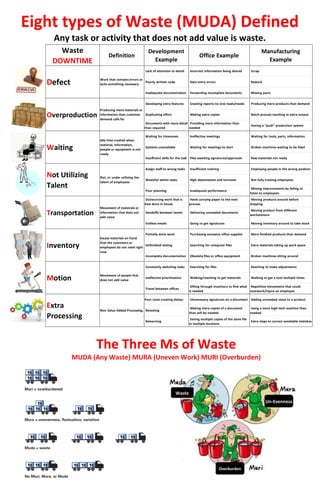
Eight types of Waste (MUDA) Defined
Any task or activity that does not add value is waste.
The Three Ms of Waste
MUDA (Any Waste) MURA (Uneven Work) MURI (Overburden)
Waste
DOWNTIME
Definition
Development
Example
Office Example
Manufacturing
Example
Lack of attention to detail Incorrect information being shared Scrap
Poorly written code Data entry errors Rework
Inadequate documentation Forwarding incomplete documents Missing parts
Developing extra features Creating reports no one reads/needs Producing more products than demand
Duplicating effort Making extra copies Batch process resulting in extra output
Documents with more detail
than required
Providing more information than
needed
Having a “push” production system
Waiting for timezones Ineffective meetings Waiting for tools, parts, information
Systems unavailable Waiting for meetings to start Broken machines waiting to be fixed
Insuffcient skills for the task Files awaiting signatures/approvals Raw materials not ready
Assign staff to wrong tasks Insufficient training Employing people in the wrong position
Wasteful admin tasks High absenteeism and turnover Not fully training employees
Poor planning Inadequate performance
Missing improvements by failing to
listen to employees
Outsourcing work that is
best done in house
Hand carrying paper to the next
process
Moving products around before
shipping
Handoffs between teams Delivering unneeded documents
Moving product from different
workstations
Endless emails Going to get signatures Moving inventory around to take stock
Partially done work Purchasing excessive office supplies More finished products than demand
Unfinished testing Searching for computer files Extra materials taking up work space
Incomplete documentation Obsolete files or office equipment Broken machines sitting around
Constantly switching tasks Searching for files Reaching to make adjustments
Ineffective prioritization Walking/reaching to get materials Walking to get a tool multiple times
Travel between offices
Sifting through inventory to find what
is needed
Repetitive movements that could
overwork/injure an employee
Poor tools creating delays Unnecessary signatures on a document Adding unneeded value to a product
Retesting
Making more copies of a document
than will be needed
Using a more high-tech machine than
needed
Relearning
Saving multiple copies of the same file
in multiple locations
Extra steps to correct avoidable mistakes
Motion Movement of people that
does not add value
Extra
Processing
Non Value Added Processing.
Not Utilizing
Talent
Not, or under utilizing the
talent of employees
Transportation
Movement of materials or
information that does not
add value
Inventory
Excess materials on hand
that the customers or
employees do not need right
now
Defect Work that contains errors or
lacks something necessary
Overproduction
Producing more materials or
information than customer
demand calls for
Waiting
Idle time created when
material, information,
people or equipment is not
ready

Downtime 8 Wastes

  • 1.
    Eight types ofWaste (MUDA) Defined Any task or activity that does not add value is waste. The Three Ms of Waste MUDA (Any Waste) MURA (Uneven Work) MURI (Overburden) Waste DOWNTIME Definition Development Example Office Example Manufacturing Example Lack of attention to detail Incorrect information being shared Scrap Poorly written code Data entry errors Rework Inadequate documentation Forwarding incomplete documents Missing parts Developing extra features Creating reports no one reads/needs Producing more products than demand Duplicating effort Making extra copies Batch process resulting in extra output Documents with more detail than required Providing more information than needed Having a “push” production system Waiting for timezones Ineffective meetings Waiting for tools, parts, information Systems unavailable Waiting for meetings to start Broken machines waiting to be fixed Insuffcient skills for the task Files awaiting signatures/approvals Raw materials not ready Assign staff to wrong tasks Insufficient training Employing people in the wrong position Wasteful admin tasks High absenteeism and turnover Not fully training employees Poor planning Inadequate performance Missing improvements by failing to listen to employees Outsourcing work that is best done in house Hand carrying paper to the next process Moving products around before shipping Handoffs between teams Delivering unneeded documents Moving product from different workstations Endless emails Going to get signatures Moving inventory around to take stock Partially done work Purchasing excessive office supplies More finished products than demand Unfinished testing Searching for computer files Extra materials taking up work space Incomplete documentation Obsolete files or office equipment Broken machines sitting around Constantly switching tasks Searching for files Reaching to make adjustments Ineffective prioritization Walking/reaching to get materials Walking to get a tool multiple times Travel between offices Sifting through inventory to find what is needed Repetitive movements that could overwork/injure an employee Poor tools creating delays Unnecessary signatures on a document Adding unneeded value to a product Retesting Making more copies of a document than will be needed Using a more high-tech machine than needed Relearning Saving multiple copies of the same file in multiple locations Extra steps to correct avoidable mistakes Motion Movement of people that does not add value Extra Processing Non Value Added Processing. Not Utilizing Talent Not, or under utilizing the talent of employees Transportation Movement of materials or information that does not add value Inventory Excess materials on hand that the customers or employees do not need right now Defect Work that contains errors or lacks something necessary Overproduction Producing more materials or information than customer demand calls for Waiting Idle time created when material, information, people or equipment is not ready