Poke Yoke Mistake-proofing
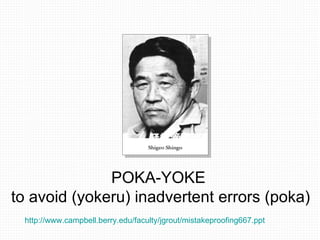
POKA-YOKE  to avoid (yokeru) inadvertent errors (poka) http://www.campbell.berry.edu/faculty/jgrout/mistakeproofing667.ppt
This is not about punishing workers Mistake proofing recognizes that every human will make mistakes and tries to set up systems that minimize or eliminate those mistakes.
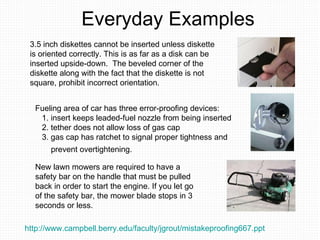
Everyday Examples New lawn mowers are required to have a safety bar on the handle that must be pulled back in order to start the engine. If you let go of the safety bar, the mower blade stops in 3 seconds or less.  Fueling area of car has three error-proofing devices:  1. insert keeps leaded-fuel nozzle from being inserted  2. tether does not allow loss of gas cap  3. gas cap has ratchet to signal proper tightness and  prevent overtightening.   3.5 inch diskettes cannot be inserted unless diskette  is oriented correctly. This is as far as a disk can be inserted upside-down.  The beveled corner of the diskette along with the fact that the diskette is not square, prohibit incorrect orientation.  http://www.campbell.berry.edu/faculty/jgrout/mistakeproofing667.ppt
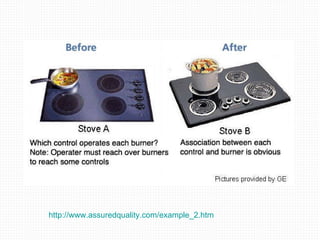
http://www.assuredquality.com/example_2.htm
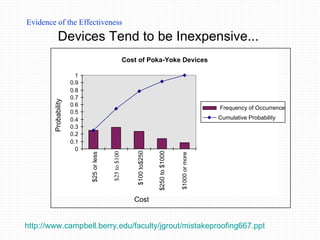
Devices Tend to be Inexpensive...  Cost of Poka-Yoke Devices 0 0.1 0.2 0.3 0.4 0.5 0.6 0.7 0.8 0.9 1 $25 or less $100 to$250  $1000 or more Cost Probability Frequency of Occurrence Cumulative Probability $25 to $100 $250 to $1000  Evidence of the Effectiveness http://www.campbell.berry.edu/faculty/jgrout/mistakeproofing667.ppt
… and Very Effective The “10:1, 100:1, even 1000:1” rates of return referred to by Bhote above are not unreasonable in practice.  Dana corporation has reported a $500,000 savings resulting from a $6 device.  (83,000:1)   AT&T Power Systems (Lucent Technologies) reported net saving of $2545 per device (3300 devices) [Marchwinsky, 1997].  (25:1*) Weber Aircraft reports saving $350,000 during their first year of implementation of approximately 300 devices. (11:1*)  *Assumes and average devise cost $100 http://www.campbell.berry.edu/faculty/jgrout/mistakeproofing667.ppt
Common Mistake-proofing Devices Guide Pins  Blinking  lights and alarms Limit switches  Proximity switches Counters Checklists http://www.campbell.berry.edu/faculty/jgrout/mistakeproofing667.ppt
What is Poke-yoke? A method that uses sensor or other devices for catching errors that may pass by operators or assemblers. 1.  Control Approach -  Shuts down the process when an error occurs. -  Keeps the “suspect” part in place when  an operation is incomplete. 2.  Warning Approach -  Signals the operator to stop the  process and correct the problem.
Poka-yoke systems consist of three primary methods: 1.  Contact 2. Counting 3. Motion-Sequence - Each method can be used in a control  system or a warning system. - Each method uses a different process prevention approach for dealing with irregularities.
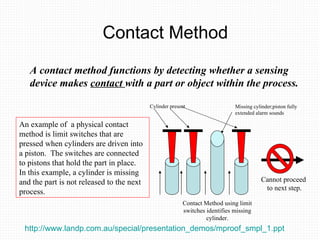
Contact Method A contact method functions by detecting whether a sensing device makes  contact  with a part or object within the process. Missing cylinder;piston fully extended alarm sounds Contact Method using limit switches identifies missing cylinder. An example of  a physical contact method is limit switches that are pressed when cylinders are driven into a piston.  The switches are connected to pistons that hold the part in place.  In this example, a cylinder is missing and the part is not released to the next process. Cannot proceed  to next step. Cylinder present http://www.landp.com.au/special/presentation_demos/mproof_smpl_1.ppt
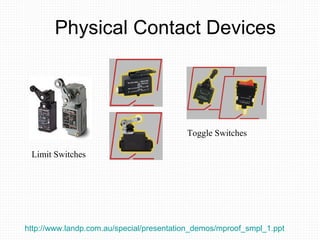
Physical Contact Devices Limit Switches Toggle Switches http://www.landp.com.au/special/presentation_demos/mproof_smpl_1.ppt
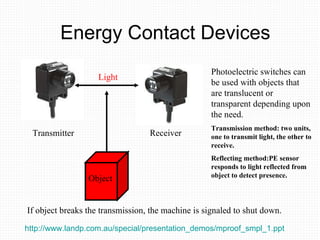
Energy Contact Devices Photoelectric switches can be used with objects that are translucent or transparent depending upon the need. Transmission method: two units, one to transmit light, the other to receive. Reflecting method:PE sensor responds to light reflected from object to detect presence. Light Transmitter Receiver Object If object breaks the transmission, the machine is signaled to shut down. http://www.landp.com.au/special/presentation_demos/mproof_smpl_1.ppt
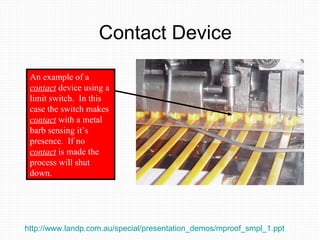
Contact Device An example of a  contact  device using a limit switch.  In this case the switch makes  contact  with a metal barb sensing it’s presence.  If no  contact  is made the process will shut down. http://www.landp.com.au/special/presentation_demos/mproof_smpl_1.ppt
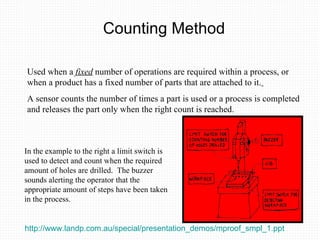
Counting Method Used when a  fixed  number of operations are required within a process, or when a product has a fixed number of parts that are attached to it.   A sensor counts the number of times a part is used or a process is completed and releases the part only when the right count is reached. In the example to the right a limit switch is used to detect and count when the required amount of holes are drilled.  The buzzer sounds alerting the operator that the appropriate amount of steps have been taken in the process. http://www.landp.com.au/special/presentation_demos/mproof_smpl_1.ppt
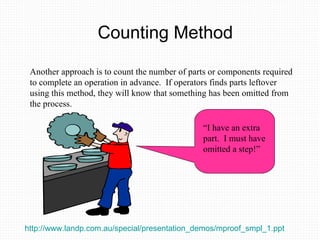
Counting Method Another approach is to count the number of parts or components required to complete an operation in advance.  If operators finds parts leftover using this method, they will know that something has been omitted from the process. “ I have an extra part.  I must have omitted a step!” http://www.landp.com.au/special/presentation_demos/mproof_smpl_1.ppt
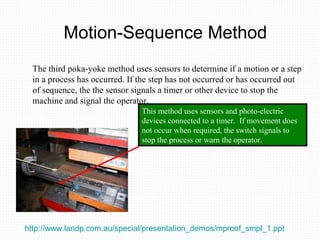
Motion-Sequence Method The third poka-yoke method uses sensors to determine if a motion or a step in a process has occurred. If the step has not occurred or has occurred out of sequence, the the sensor signals a timer or other device to stop the machine and signal the operator. This method uses sensors and photo-electric devices connected to a timer.  If movement does not occur when required, the switch signals to stop the process or warn the operator.  http://www.landp.com.au/special/presentation_demos/mproof_smpl_1.ppt
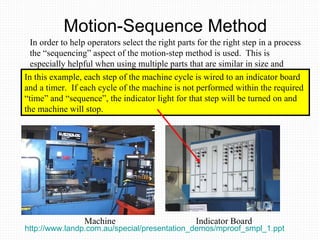
Motion-Sequence Method In order to help operators select the right parts for the right step in a process the “sequencing” aspect of the motion-step method is used.  This is especially helpful when using multiple parts that are similar in size and shape. In this example, each step of the machine cycle is wired to an indicator board and a timer.  If each cycle of the machine is not performed within the required “time” and “sequence”, the indicator light for that step will be turned on and the machine will stop. Indicator Board Machine http://www.landp.com.au/special/presentation_demos/mproof_smpl_1.ppt
Types of Sensing Devices 1.  Physical contact devices 2.  Energy sensing devices 3.  Warning Sensors  http://www.landp.com.au/special/presentation_demos/mproof_smpl_1.ppt
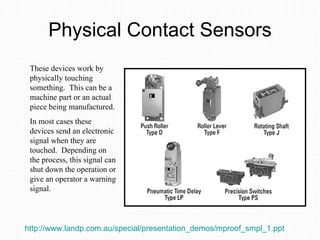
Physical Contact Sensors These devices work by physically touching something.  This can be a machine part or an actual piece being manufactured.  In most cases these devices send an electronic signal when they are touched.  Depending on the process, this signal can shut down the operation or give an operator a warning signal. http://www.landp.com.au/special/presentation_demos/mproof_smpl_1.ppt
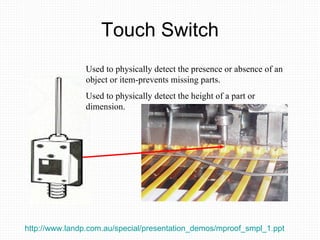
Touch Switch Used to physically detect the presence or absence of an object or item-prevents missing parts. Used to physically detect the height of a part or dimension. http://www.landp.com.au/special/presentation_demos/mproof_smpl_1.ppt
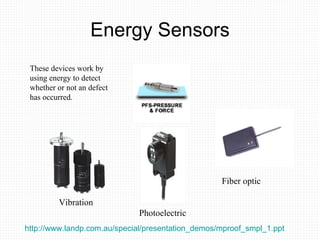
Energy Sensors These devices work by using energy to detect whether or not an defect has occurred. Fiber optic Photoelectric Vibration http://www.landp.com.au/special/presentation_demos/mproof_smpl_1.ppt
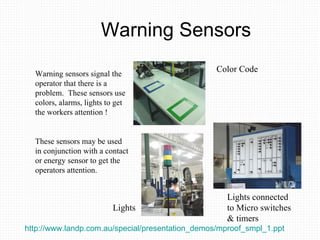
Warning Sensors Warning sensors signal the operator that there is a problem.  These sensors use colors, alarms, lights to get the workers attention ! These sensors may be used in conjunction with a contact or energy sensor to get the operators attention. Color Code Lights Lights connected to Micro switches & timers http://www.landp.com.au/special/presentation_demos/mproof_smpl_1.ppt
 

Poka yoke愚巧防呆法

  • 1.
  • 2.
    POKA-YOKE toavoid (yokeru) inadvertent errors (poka) http://www.campbell.berry.edu/faculty/jgrout/mistakeproofing667.ppt
  • 3.
    This is notabout punishing workers Mistake proofing recognizes that every human will make mistakes and tries to set up systems that minimize or eliminate those mistakes.
  • 4.
    Everyday Examples Newlawn mowers are required to have a safety bar on the handle that must be pulled back in order to start the engine. If you let go of the safety bar, the mower blade stops in 3 seconds or less. Fueling area of car has three error-proofing devices: 1. insert keeps leaded-fuel nozzle from being inserted 2. tether does not allow loss of gas cap 3. gas cap has ratchet to signal proper tightness and prevent overtightening. 3.5 inch diskettes cannot be inserted unless diskette is oriented correctly. This is as far as a disk can be inserted upside-down. The beveled corner of the diskette along with the fact that the diskette is not square, prohibit incorrect orientation. http://www.campbell.berry.edu/faculty/jgrout/mistakeproofing667.ppt
  • 5.
  • 6.
    Devices Tend tobe Inexpensive... Cost of Poka-Yoke Devices 0 0.1 0.2 0.3 0.4 0.5 0.6 0.7 0.8 0.9 1 $25 or less $100 to$250 $1000 or more Cost Probability Frequency of Occurrence Cumulative Probability $25 to $100 $250 to $1000 Evidence of the Effectiveness http://www.campbell.berry.edu/faculty/jgrout/mistakeproofing667.ppt
  • 7.
    … and VeryEffective The “10:1, 100:1, even 1000:1” rates of return referred to by Bhote above are not unreasonable in practice. Dana corporation has reported a $500,000 savings resulting from a $6 device. (83,000:1) AT&T Power Systems (Lucent Technologies) reported net saving of $2545 per device (3300 devices) [Marchwinsky, 1997]. (25:1*) Weber Aircraft reports saving $350,000 during their first year of implementation of approximately 300 devices. (11:1*) *Assumes and average devise cost $100 http://www.campbell.berry.edu/faculty/jgrout/mistakeproofing667.ppt
  • 8.
    Common Mistake-proofing DevicesGuide Pins Blinking lights and alarms Limit switches Proximity switches Counters Checklists http://www.campbell.berry.edu/faculty/jgrout/mistakeproofing667.ppt
  • 9.
    What is Poke-yoke?A method that uses sensor or other devices for catching errors that may pass by operators or assemblers. 1. Control Approach - Shuts down the process when an error occurs. - Keeps the “suspect” part in place when an operation is incomplete. 2. Warning Approach - Signals the operator to stop the process and correct the problem.
  • 10.
    Poka-yoke systems consistof three primary methods: 1. Contact 2. Counting 3. Motion-Sequence - Each method can be used in a control system or a warning system. - Each method uses a different process prevention approach for dealing with irregularities.
  • 11.
    Contact Method Acontact method functions by detecting whether a sensing device makes contact with a part or object within the process. Missing cylinder;piston fully extended alarm sounds Contact Method using limit switches identifies missing cylinder. An example of a physical contact method is limit switches that are pressed when cylinders are driven into a piston. The switches are connected to pistons that hold the part in place. In this example, a cylinder is missing and the part is not released to the next process. Cannot proceed to next step. Cylinder present http://www.landp.com.au/special/presentation_demos/mproof_smpl_1.ppt
  • 12.
    Physical Contact DevicesLimit Switches Toggle Switches http://www.landp.com.au/special/presentation_demos/mproof_smpl_1.ppt
  • 13.
    Energy Contact DevicesPhotoelectric switches can be used with objects that are translucent or transparent depending upon the need. Transmission method: two units, one to transmit light, the other to receive. Reflecting method:PE sensor responds to light reflected from object to detect presence. Light Transmitter Receiver Object If object breaks the transmission, the machine is signaled to shut down. http://www.landp.com.au/special/presentation_demos/mproof_smpl_1.ppt
  • 14.
    Contact Device Anexample of a contact device using a limit switch. In this case the switch makes contact with a metal barb sensing it’s presence. If no contact is made the process will shut down. http://www.landp.com.au/special/presentation_demos/mproof_smpl_1.ppt
  • 15.
    Counting Method Usedwhen a fixed number of operations are required within a process, or when a product has a fixed number of parts that are attached to it. A sensor counts the number of times a part is used or a process is completed and releases the part only when the right count is reached. In the example to the right a limit switch is used to detect and count when the required amount of holes are drilled. The buzzer sounds alerting the operator that the appropriate amount of steps have been taken in the process. http://www.landp.com.au/special/presentation_demos/mproof_smpl_1.ppt
  • 16.
    Counting Method Anotherapproach is to count the number of parts or components required to complete an operation in advance. If operators finds parts leftover using this method, they will know that something has been omitted from the process. “ I have an extra part. I must have omitted a step!” http://www.landp.com.au/special/presentation_demos/mproof_smpl_1.ppt
  • 17.
    Motion-Sequence Method Thethird poka-yoke method uses sensors to determine if a motion or a step in a process has occurred. If the step has not occurred or has occurred out of sequence, the the sensor signals a timer or other device to stop the machine and signal the operator. This method uses sensors and photo-electric devices connected to a timer. If movement does not occur when required, the switch signals to stop the process or warn the operator. http://www.landp.com.au/special/presentation_demos/mproof_smpl_1.ppt
  • 18.
    Motion-Sequence Method Inorder to help operators select the right parts for the right step in a process the “sequencing” aspect of the motion-step method is used. This is especially helpful when using multiple parts that are similar in size and shape. In this example, each step of the machine cycle is wired to an indicator board and a timer. If each cycle of the machine is not performed within the required “time” and “sequence”, the indicator light for that step will be turned on and the machine will stop. Indicator Board Machine http://www.landp.com.au/special/presentation_demos/mproof_smpl_1.ppt
  • 19.
    Types of SensingDevices 1. Physical contact devices 2. Energy sensing devices 3. Warning Sensors http://www.landp.com.au/special/presentation_demos/mproof_smpl_1.ppt
  • 20.
    Physical Contact SensorsThese devices work by physically touching something. This can be a machine part or an actual piece being manufactured. In most cases these devices send an electronic signal when they are touched. Depending on the process, this signal can shut down the operation or give an operator a warning signal. http://www.landp.com.au/special/presentation_demos/mproof_smpl_1.ppt
  • 21.
    Touch Switch Usedto physically detect the presence or absence of an object or item-prevents missing parts. Used to physically detect the height of a part or dimension. http://www.landp.com.au/special/presentation_demos/mproof_smpl_1.ppt
  • 22.
    Energy Sensors Thesedevices work by using energy to detect whether or not an defect has occurred. Fiber optic Photoelectric Vibration http://www.landp.com.au/special/presentation_demos/mproof_smpl_1.ppt
  • 23.
    Warning Sensors Warningsensors signal the operator that there is a problem. These sensors use colors, alarms, lights to get the workers attention ! These sensors may be used in conjunction with a contact or energy sensor to get the operators attention. Color Code Lights Lights connected to Micro switches & timers http://www.landp.com.au/special/presentation_demos/mproof_smpl_1.ppt
  • 24.

Editor's Notes

  • #3 (READ SLIDE TEXT) A caveat about this definition: We do not use errors and mistakes as synonyms. However, in this presentation we draw on the work of many people, and some authors will use the word mistake as a synonym with error. Where one of these is quoted, we have not changed their words. We do indicate their less precise use of the word mistake by italicizing it on the slide. Adapted from M. Hinckley, Quality by Design, 1996
  • #5 PARAPHRASE SLIDE ask for more car examples.
  • #20 Sensing devices are the actual mechanism used to make contact, count, or identify the motion sequence of a work piece. They are the third tier of a poka-yoke system ( tires: approaches-methods-sensing devices).
  • #21 Various examples