P oints O f D istribution Don Sullens Chatham Emergency Management Agency
Temporary locations established before basic services are fully restored in an area following a disaster or emergency event where the affected population can pick up life sustaining commodities and other essential supplies.  Points of Distribution Are:
Established following an event when the commercial infrastructure and resources are no longer available to support the population. Closed accordingly as the commercial infrastructure is re-established and resources are available to support the population. PODs Are:
https://eportal.usace.army.mil/sites/ENGLink/Commodities/default.aspx How Many PODs Are Needed? It Depends On: Remaining Infrastructure Remaining Population Jurisdiction Distribution Capabilities
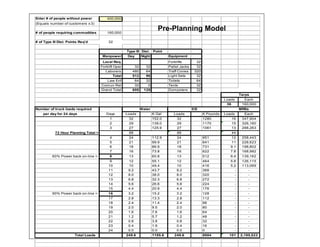
Pre-Planning Model
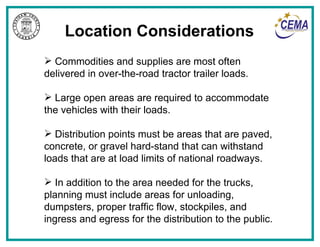
Commodities and supplies are most often delivered in over-the-road tractor trailer loads.  Large open areas are required to accommodate the vehicles with their loads.  Distribution points must be areas that are paved, concrete, or gravel hard-stand that can withstand loads that are at load limits of national roadways. In addition to the area needed for the trucks, planning must include areas for unloading, dumpsters, proper traffic flow, stockpiles, and ingress and egress for the distribution to the public. Location Considerations
Location Considerations (con’t) Schools* Airports Industrial Areas Athletic Fields Warehouses Try to avoid locations that may interfere with commercial infrastructure efforts to  recover and reopen.
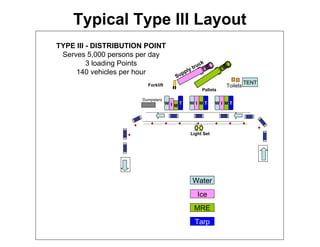
Typical Type III Layout Water Ice MRE Tarp TYPE III - DISTRIBUTION POINT Serves 5,000 persons per day 3 loading Points 140 vehicles per hour TENT Toilets Dumpsters Pallets W I M T W I M T W I M T Supply truck Light Set Forklift
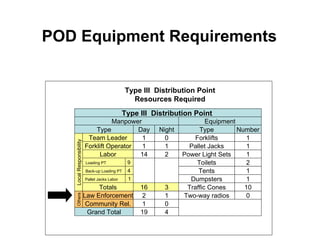
POD Equipment Requirements Type III  Distribution Point Resources Required Type III  Distribution Point   Manpower Day Night Type Team Leader Forklift Operator 1 1 2 1 0 Equipment Type Number Forklifts Pallet Jacks Power Light Sets Toilets Tents Dumpsters Traffic Cones 1 1 1 2 1 1 10 Totals 16 3 Two-way radios 0 Labor 14 Loading PT  9 Back-up Loading PT  4 Pallet Jacks Labor  1 Law Enforcement Community Rel. 2 1 0 Grand Total 19 4 Others Local Responsibility 1
Staffing Where will the people come from to staff the PODs?
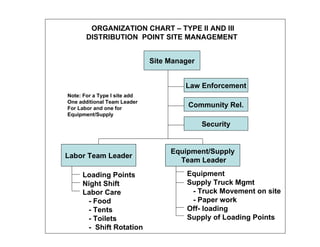
ORGANIZATION CHART – TYPE II AND III DISTRIBUTION  POINT SITE MANAGEMENT  Note: For a Type I site add One additional Team Leader For Labor and one for  Equipment/Supply Site Manager Law Enforcement Community Rel. Security Labor Team Leader Equipment/Supply Team Leader Loading Points Night Shift Labor Care - Food - Tents - Toilets -  Shift Rotation Equipment Supply Truck Mgmt - Truck Movement on site - Paper work Off- loading Supply of Loading Points
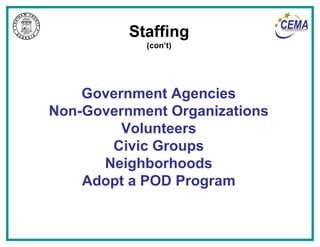
Staffing (con’t) Government Agencies Non-Government Organizations Volunteers Civic Groups Neighborhoods Adopt a POD Program
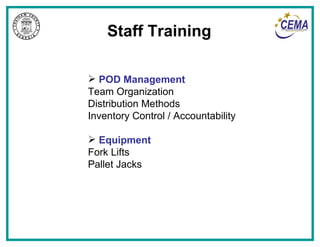
Staff Training POD Management Team Organization Distribution Methods Inventory Control / Accountability Equipment Fork Lifts Pallet Jacks
IS-26 Guide to Points of Distribution (PODs)
Commodities will be pushed forward before logistical structures are in place. The critical planning factor for ordering commodities is “distribution” capability, not people without power. Distribution planning must be a priority with local  governments for the commodities mission to be successful. All levels of government must understand the POD concept. USACE Key Lessons Learned
23
Don Sullens Emergency Management Specialist Chatham Emergency Management Agency (912) 201-4500 [email_address] 24

Points of distribution

  • 1.
    P oints Of D istribution Don Sullens Chatham Emergency Management Agency
  • 2.
    Temporary locations establishedbefore basic services are fully restored in an area following a disaster or emergency event where the affected population can pick up life sustaining commodities and other essential supplies. Points of Distribution Are:
  • 3.
    Established following anevent when the commercial infrastructure and resources are no longer available to support the population. Closed accordingly as the commercial infrastructure is re-established and resources are available to support the population. PODs Are:
  • 4.
    https://eportal.usace.army.mil/sites/ENGLink/Commodities/default.aspx How ManyPODs Are Needed? It Depends On: Remaining Infrastructure Remaining Population Jurisdiction Distribution Capabilities
  • 5.
  • 6.
    Commodities and suppliesare most often delivered in over-the-road tractor trailer loads. Large open areas are required to accommodate the vehicles with their loads. Distribution points must be areas that are paved, concrete, or gravel hard-stand that can withstand loads that are at load limits of national roadways. In addition to the area needed for the trucks, planning must include areas for unloading, dumpsters, proper traffic flow, stockpiles, and ingress and egress for the distribution to the public. Location Considerations
  • 7.
    Location Considerations (con’t)Schools* Airports Industrial Areas Athletic Fields Warehouses Try to avoid locations that may interfere with commercial infrastructure efforts to recover and reopen.
  • 8.
    Typical Type IIILayout Water Ice MRE Tarp TYPE III - DISTRIBUTION POINT Serves 5,000 persons per day 3 loading Points 140 vehicles per hour TENT Toilets Dumpsters Pallets W I M T W I M T W I M T Supply truck Light Set Forklift
  • 9.
    POD Equipment RequirementsType III Distribution Point Resources Required Type III Distribution Point Manpower Day Night Type Team Leader Forklift Operator 1 1 2 1 0 Equipment Type Number Forklifts Pallet Jacks Power Light Sets Toilets Tents Dumpsters Traffic Cones 1 1 1 2 1 1 10 Totals 16 3 Two-way radios 0 Labor 14 Loading PT 9 Back-up Loading PT 4 Pallet Jacks Labor 1 Law Enforcement Community Rel. 2 1 0 Grand Total 19 4 Others Local Responsibility 1
  • 10.
    Staffing Where willthe people come from to staff the PODs?
  • 11.
    ORGANIZATION CHART –TYPE II AND III DISTRIBUTION POINT SITE MANAGEMENT Note: For a Type I site add One additional Team Leader For Labor and one for Equipment/Supply Site Manager Law Enforcement Community Rel. Security Labor Team Leader Equipment/Supply Team Leader Loading Points Night Shift Labor Care - Food - Tents - Toilets - Shift Rotation Equipment Supply Truck Mgmt - Truck Movement on site - Paper work Off- loading Supply of Loading Points
  • 12.
    Staffing (con’t) GovernmentAgencies Non-Government Organizations Volunteers Civic Groups Neighborhoods Adopt a POD Program
  • 13.
    Staff Training PODManagement Team Organization Distribution Methods Inventory Control / Accountability Equipment Fork Lifts Pallet Jacks
  • 14.
    IS-26 Guide toPoints of Distribution (PODs)
  • 15.
    Commodities will bepushed forward before logistical structures are in place. The critical planning factor for ordering commodities is “distribution” capability, not people without power. Distribution planning must be a priority with local governments for the commodities mission to be successful. All levels of government must understand the POD concept. USACE Key Lessons Learned
  • 16.
  • 17.
    Don Sullens EmergencyManagement Specialist Chatham Emergency Management Agency (912) 201-4500 [email_address] 24

Editor's Notes

  • #6 This is an interactive xcel spread sheet – cahnge the number of people without power and it estimates over time the commodities required. This spread sheet is for pre-event planning.
  • #12 Identifying people now to be in these positions will allow the mission to be easily accomplished.
  • #16 The amount of commodities you can distribute drives the quantity you should order – predetermined and well organized and operated PODs allows you to distribute more commodities and serve more survivors.