COORDINATED PLANNING Georgia Emergency Management Agency Georgia Emergency Operations Plan (GEOP) Georgia Hurricane Plan State Operations Center (SOC) Chatham County Emergency Management Agency Chatham Emergency Operations Plan (EOP) Chatham Hurricane Plan Local Emergency Operations Center (EOC) Local Emergency Responders Standard Operating Procedures EOC Staffing and Support
TIMING OF DECISIONS Initiation of Local Actions Based on Arrival of Tropical Storm Force Winds  NOT  the Storm’s Center of Circulation Current Position, Size of Storm and Forward Moving Speed are the Foundation Figures Required to Begin Time Calculations Reverse Planning Based on These Numbers with Consideration Given to a Variety of Different Variables and “What-If” Scenarios
POINTS OF MEASURE TROPICAL STORM Watch – Winds Anticipated in 48 hours Warning – Winds Anticipated in 36 Hours HURRICANE  Watch – Winds Anticipated in 48 hours Warning – Winds Anticipated in 36 Hours
VARIABLES Weather and Storm Dynamics Current and Forecast Strength and Size Forward Speed and Water Temperature Position of Forecast Track Tourist Occupancy and Community Response Transportation Network Construction and Repairs Florida Evacuees I-16 Contra Flow
PROBABILITIES The chance of the center of the storm passing within 65 nautical miles of selected locations. Used to assess the threat of a hurricane or tropical storm hitting the community. Forecast Period Maximum Probability 72 hours 10%-15% 48 hours 20%-25% 36 hours 25%-35% 24 hours 40%-50% 12 hours 75%-85%
MARGIN OF ERROR - POSITION Calculation uses a 5-year average. Averages graphically displayed as “error cone.” Forecast Period Nautical Mile Allowance 120 hours 285 Radius (570 Diameter) 96 hours 220 Radius (440 Diameter) 72 hours 161 Radius (322 Diameter) 48 hours 108 Radius (216 Diameter) 36 hours 85 Radius (170 Diameter) 24 hours 62 Radius (124 Diameter) 12 hours 36 Radius (72 Diameter)
OPERATING CONDITIONS Operating Conditions (OPCON) establish a time-delineated action-oriented preparedness & response framework.  OPCONs are intended to present a brief summary of major objectives & actions required to prepare & respond. OPCON structure uses timelines that are referenced to the arrival of tropical storm force winds (34 knots / 39 mph) & not the arrival of the hurricane’s center.
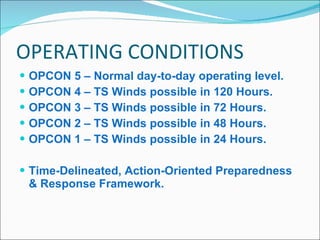
OPERATING CONDITIONS OPCON 5 – Normal day-to-day operating level. OPCON 4 – TS Winds possible in 120 Hours. OPCON 3 – TS Winds possible in 72 Hours. OPCON 2 – TS Winds possible in 48 Hours.  OPCON 1 – TS Winds possible in 24 Hours. Time-Delineated, Action-Oriented Preparedness & Response Framework.
Monitor Weather & Tropical Outlook Inspect Primary & Alternate EOCs Review Plans & Procedures Conduct Regular EOC Staff Training & Exercises Confirm Mutual Aid Agreements & Contracts Update Notification Lists Maintain Daily Backup of Electronic Data Continue ESF Planning & Preparedness Coordination Update EOC Staffing Rosters Review Lessons Learned & Best Practices for Plan Updates NO STORM & STORMS GREATER THAN 120 HOURS (5 DAYS) OUT OPERATING CONDITION 5
TROPICAL STORM WIND ARRIVAL = 120 – 96 HOURS (5 DAYS) OPERATING CONDITION 4 Notify ESF Support Entities & Partners Begin Personal Preparations   Establish Ongoing Timetables for Response Activities Participate in Coordination Conference Calls w/Partners Initiate a Level III EOC Activation (Monitoring & Awareness)   Respond to Media Requests & Update as Needed Produce Internal Situational Awareness Packages Begin Preparing for EOC Staffing as Required Create an Event in the WebEOC & Begin Collecting Data Update Website, issue CEMA Alert & CEMA Signal Notifications
TROPICAL STORM WIND ARRIVAL = 96 – 72 HOURS (4 DAYS) OPERATING CONDITION 4 Determine & Prioritize Incident Objectives Begin Regular Communications with Command Policy Group Host an EOC Pre-Activation in Preparation for a Level II Activation Define the Operational Period & Schedule of Events Begin a Regular Schedule of IAP & SitRep Development   Draft Executive Order for Local State of Emergency Declaration Prepare for Contract Activations Maintain Situation Awareness & Gather Intelligence for SitRep Determine Tourist Occupancy & Scheduled Community-wide Events Initiate Financial Tracking & Resource Procurement Procedures
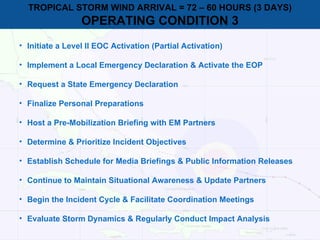
TROPICAL STORM WIND ARRIVAL = 72 – 60 HOURS (3 DAYS) OPERATING CONDITION 3 Initiate a Level II EOC Activation (Partial Activation) Implement a Local Emergency Declaration & Activate the EOP Request a State Emergency Declaration Finalize Personal Preparations Host a Pre-Mobilization Briefing with EM Partners Determine & Prioritize Incident Objectives Establish Schedule for Media Briefings & Public Information Releases Continue to Maintain Situational Awareness & Update Partners Begin the Incident Cycle & Facilitate Coordination Meetings Evaluate Storm Dynamics & Regularly Conduct Impact Analysis
TROPICAL STORM WIND ARRIVAL = 60 – 48 HOURS (2 ½ DAYS) OPERATING CONDITION 3 Begin Mobilizing Assets to Critical Workforce Shelters & Staging Sites Initiate Special Needs Evacuation Readiness & Operations Begin Coordination with GEMA & GDOT Regarding I-16 Contra Flow Coordinate Activation of Evac Assembly Area & Host Shelter Agreement Review & Maintain Situational Awareness of ESF Assets Determine Evacuation Transportation Needs & Coordinate Bulk Fuel Begin Planning Re-Entry Strike Teams & Debris Management Requirements  Begin Post Landfall Planning Regarding Re-Entry, Security, & Commodities Begin Conducting Regular Evacuation Decision Meetings with CPG Consider Activation of a Joint Information Center (JIC)
TROPICAL WIND ARRIVAL = 48 – 36 HRS (2 DAYS) OPERATING CONDITION 2 Initiate a Level I EOC Activation (Full Activation Install Shutters on Critical Facilities Finalize the Special Needs Evacuation Prepare for General Population Evacuation & Transportation Monitoring Coordinate with the NWS Information for Local Hurricane Statements Initiate Post Landfall Planning of: Distribution of Bulk Food Resources Damage Assessment Missions Potential Generator Requirements Ordinance Execution & Protective Action Required
TROPICAL WIND ARRIVAL = 36 – 24 HOURS (1 ½ DAYS)  OPERATING CONDITION 2 Collect Shelter Location, Staffing & Emergency Contacts from ESF Partners Implement Local Ordinances & Traffic Control Points Initiate General Population Evacuation & Transportation Monitoring Review Local Hazmat Facility Inventories Locations & Inventories Coordinate Utility Current & Anticipated Actions & Requirements Initiate Post Landfall Planning for: Debris Volume Estimates & Storage Requirements Potential Search & Rescue Missions of Persons & Animals Potential Medical Evacuations, Triage & Treatment Management of the Disaster Food Stamp Program
TROPCIAL STORM WIND ARRIVAL = 24 – 12 HOURS (1 DAY) OPERATING CONDITION 1 Finalize Mobilization of Local Assets to CWFS & Staging Sites Close Bridges to Waterway Traffic Restrict Re-Entry to Mandatory Evacuation Areas Initiate Post Landfall Planning for: Potential Hazardous Materials Response Operations Aerial Recon Missions Potential State & Federal Joint Field Office Locations & Integration Road Clearing & Critical Facility Restoration Priorities Potential Sheltering Operations Re-Entry Operations, Check Points, Security & Issued Passes
TROPICAL STORM WIND ARRIVAL = 12 – 6 HOURS OPERATING CONDITION 1 Continue & Finalize Post Landfall Coordination Planning Coordinate the Cessation of the General Population Evacuation Coordinate County-wide Security & Emergency Response Operations
TROPCIAL STORM WIND ARRIVAL = 6 – 0 HOURS OPERATING CONDITION 1 Finalize Post Landfall Coordination Planning Suspend Emergency Response Operations Recall all Field Personnel & Emergency Response Partners Verify Shelter Location, Staffing & Emergency Contacts with ESF Partners
RECOVERY for DUMMIES
Dennis Jones, Assistant Director 124 Bull Street, Room 140 Savannah, GA 31401 (912) 201-4500 [email_address] www.ChathamEmergency.org

Evac timeline

  • 1.
  • 2.
    COORDINATED PLANNING GeorgiaEmergency Management Agency Georgia Emergency Operations Plan (GEOP) Georgia Hurricane Plan State Operations Center (SOC) Chatham County Emergency Management Agency Chatham Emergency Operations Plan (EOP) Chatham Hurricane Plan Local Emergency Operations Center (EOC) Local Emergency Responders Standard Operating Procedures EOC Staffing and Support
  • 3.
    TIMING OF DECISIONSInitiation of Local Actions Based on Arrival of Tropical Storm Force Winds NOT the Storm’s Center of Circulation Current Position, Size of Storm and Forward Moving Speed are the Foundation Figures Required to Begin Time Calculations Reverse Planning Based on These Numbers with Consideration Given to a Variety of Different Variables and “What-If” Scenarios
  • 4.
    POINTS OF MEASURETROPICAL STORM Watch – Winds Anticipated in 48 hours Warning – Winds Anticipated in 36 Hours HURRICANE Watch – Winds Anticipated in 48 hours Warning – Winds Anticipated in 36 Hours
  • 5.
    VARIABLES Weather andStorm Dynamics Current and Forecast Strength and Size Forward Speed and Water Temperature Position of Forecast Track Tourist Occupancy and Community Response Transportation Network Construction and Repairs Florida Evacuees I-16 Contra Flow
  • 6.
    PROBABILITIES The chanceof the center of the storm passing within 65 nautical miles of selected locations. Used to assess the threat of a hurricane or tropical storm hitting the community. Forecast Period Maximum Probability 72 hours 10%-15% 48 hours 20%-25% 36 hours 25%-35% 24 hours 40%-50% 12 hours 75%-85%
  • 7.
    MARGIN OF ERROR- POSITION Calculation uses a 5-year average. Averages graphically displayed as “error cone.” Forecast Period Nautical Mile Allowance 120 hours 285 Radius (570 Diameter) 96 hours 220 Radius (440 Diameter) 72 hours 161 Radius (322 Diameter) 48 hours 108 Radius (216 Diameter) 36 hours 85 Radius (170 Diameter) 24 hours 62 Radius (124 Diameter) 12 hours 36 Radius (72 Diameter)
  • 8.
    OPERATING CONDITIONS OperatingConditions (OPCON) establish a time-delineated action-oriented preparedness & response framework. OPCONs are intended to present a brief summary of major objectives & actions required to prepare & respond. OPCON structure uses timelines that are referenced to the arrival of tropical storm force winds (34 knots / 39 mph) & not the arrival of the hurricane’s center.
  • 9.
    OPERATING CONDITIONS OPCON5 – Normal day-to-day operating level. OPCON 4 – TS Winds possible in 120 Hours. OPCON 3 – TS Winds possible in 72 Hours. OPCON 2 – TS Winds possible in 48 Hours. OPCON 1 – TS Winds possible in 24 Hours. Time-Delineated, Action-Oriented Preparedness & Response Framework.
  • 10.
    Monitor Weather &Tropical Outlook Inspect Primary & Alternate EOCs Review Plans & Procedures Conduct Regular EOC Staff Training & Exercises Confirm Mutual Aid Agreements & Contracts Update Notification Lists Maintain Daily Backup of Electronic Data Continue ESF Planning & Preparedness Coordination Update EOC Staffing Rosters Review Lessons Learned & Best Practices for Plan Updates NO STORM & STORMS GREATER THAN 120 HOURS (5 DAYS) OUT OPERATING CONDITION 5
  • 11.
    TROPICAL STORM WINDARRIVAL = 120 – 96 HOURS (5 DAYS) OPERATING CONDITION 4 Notify ESF Support Entities & Partners Begin Personal Preparations Establish Ongoing Timetables for Response Activities Participate in Coordination Conference Calls w/Partners Initiate a Level III EOC Activation (Monitoring & Awareness) Respond to Media Requests & Update as Needed Produce Internal Situational Awareness Packages Begin Preparing for EOC Staffing as Required Create an Event in the WebEOC & Begin Collecting Data Update Website, issue CEMA Alert & CEMA Signal Notifications
  • 12.
    TROPICAL STORM WINDARRIVAL = 96 – 72 HOURS (4 DAYS) OPERATING CONDITION 4 Determine & Prioritize Incident Objectives Begin Regular Communications with Command Policy Group Host an EOC Pre-Activation in Preparation for a Level II Activation Define the Operational Period & Schedule of Events Begin a Regular Schedule of IAP & SitRep Development Draft Executive Order for Local State of Emergency Declaration Prepare for Contract Activations Maintain Situation Awareness & Gather Intelligence for SitRep Determine Tourist Occupancy & Scheduled Community-wide Events Initiate Financial Tracking & Resource Procurement Procedures
  • 13.
    TROPICAL STORM WINDARRIVAL = 72 – 60 HOURS (3 DAYS) OPERATING CONDITION 3 Initiate a Level II EOC Activation (Partial Activation) Implement a Local Emergency Declaration & Activate the EOP Request a State Emergency Declaration Finalize Personal Preparations Host a Pre-Mobilization Briefing with EM Partners Determine & Prioritize Incident Objectives Establish Schedule for Media Briefings & Public Information Releases Continue to Maintain Situational Awareness & Update Partners Begin the Incident Cycle & Facilitate Coordination Meetings Evaluate Storm Dynamics & Regularly Conduct Impact Analysis
  • 14.
    TROPICAL STORM WINDARRIVAL = 60 – 48 HOURS (2 ½ DAYS) OPERATING CONDITION 3 Begin Mobilizing Assets to Critical Workforce Shelters & Staging Sites Initiate Special Needs Evacuation Readiness & Operations Begin Coordination with GEMA & GDOT Regarding I-16 Contra Flow Coordinate Activation of Evac Assembly Area & Host Shelter Agreement Review & Maintain Situational Awareness of ESF Assets Determine Evacuation Transportation Needs & Coordinate Bulk Fuel Begin Planning Re-Entry Strike Teams & Debris Management Requirements Begin Post Landfall Planning Regarding Re-Entry, Security, & Commodities Begin Conducting Regular Evacuation Decision Meetings with CPG Consider Activation of a Joint Information Center (JIC)
  • 15.
    TROPICAL WIND ARRIVAL= 48 – 36 HRS (2 DAYS) OPERATING CONDITION 2 Initiate a Level I EOC Activation (Full Activation Install Shutters on Critical Facilities Finalize the Special Needs Evacuation Prepare for General Population Evacuation & Transportation Monitoring Coordinate with the NWS Information for Local Hurricane Statements Initiate Post Landfall Planning of: Distribution of Bulk Food Resources Damage Assessment Missions Potential Generator Requirements Ordinance Execution & Protective Action Required
  • 16.
    TROPICAL WIND ARRIVAL= 36 – 24 HOURS (1 ½ DAYS) OPERATING CONDITION 2 Collect Shelter Location, Staffing & Emergency Contacts from ESF Partners Implement Local Ordinances & Traffic Control Points Initiate General Population Evacuation & Transportation Monitoring Review Local Hazmat Facility Inventories Locations & Inventories Coordinate Utility Current & Anticipated Actions & Requirements Initiate Post Landfall Planning for: Debris Volume Estimates & Storage Requirements Potential Search & Rescue Missions of Persons & Animals Potential Medical Evacuations, Triage & Treatment Management of the Disaster Food Stamp Program
  • 17.
    TROPCIAL STORM WINDARRIVAL = 24 – 12 HOURS (1 DAY) OPERATING CONDITION 1 Finalize Mobilization of Local Assets to CWFS & Staging Sites Close Bridges to Waterway Traffic Restrict Re-Entry to Mandatory Evacuation Areas Initiate Post Landfall Planning for: Potential Hazardous Materials Response Operations Aerial Recon Missions Potential State & Federal Joint Field Office Locations & Integration Road Clearing & Critical Facility Restoration Priorities Potential Sheltering Operations Re-Entry Operations, Check Points, Security & Issued Passes
  • 18.
    TROPICAL STORM WINDARRIVAL = 12 – 6 HOURS OPERATING CONDITION 1 Continue & Finalize Post Landfall Coordination Planning Coordinate the Cessation of the General Population Evacuation Coordinate County-wide Security & Emergency Response Operations
  • 19.
    TROPCIAL STORM WINDARRIVAL = 6 – 0 HOURS OPERATING CONDITION 1 Finalize Post Landfall Coordination Planning Suspend Emergency Response Operations Recall all Field Personnel & Emergency Response Partners Verify Shelter Location, Staffing & Emergency Contacts with ESF Partners
  • 20.
  • 21.
    Dennis Jones, AssistantDirector 124 Bull Street, Room 140 Savannah, GA 31401 (912) 201-4500 [email_address] www.ChathamEmergency.org