Alabama Emergency Management Agency Alabama's coordinating agency for disaster preparedness, response, and recovery
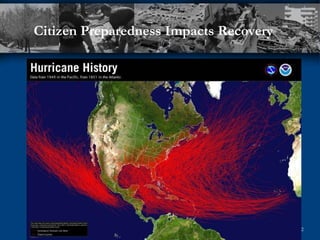
Citizen Preparedness Impacts Recovery
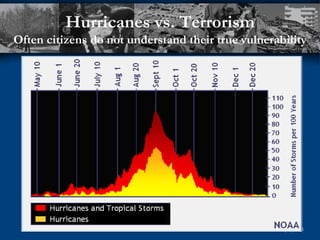
Hurricanes vs. Terrorism Often citizens do not understand their true vulnerability
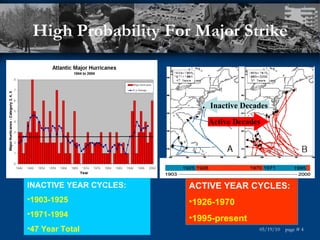
High Probability For Major Strike Inactive Decades INACTIVE YEAR CYCLES: 1903-1925 1971-1994 47 Year Total ACTIVE YEAR CYCLES: 1926-1970 1995-present Active Decades
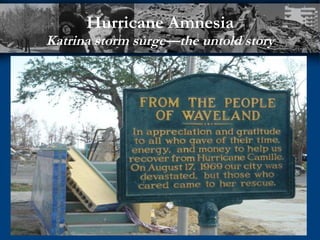
Hurricane Amnesia Katrina storm surge—the untold story
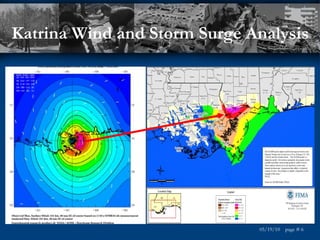
Katrina Wind and Storm Surge Analysis


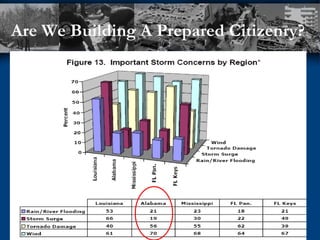
Are We Building A Prepared Citizenry?
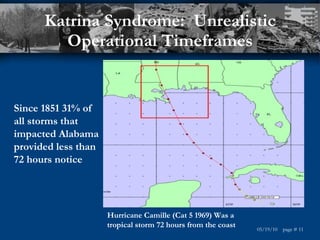
Katrina Syndrome:  Unrealistic Operational Timeframes Since 1851 31% of all storms that impacted Alabama provided less than 72 hours notice Hurricane Camille (Cat 5 1969) Was a tropical storm 72 hours from the coast
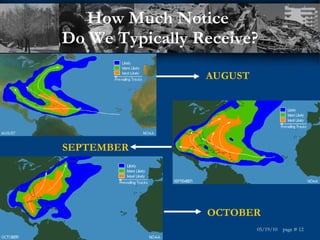
How Much Notice  Do We Typically Receive? AUGUST SEPTEMBER OCTOBER
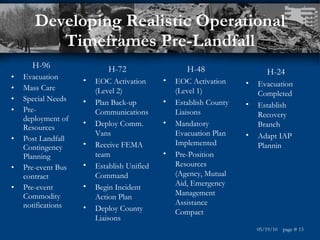
Developing Realistic Operational Timeframes Pre-Landfall H-96 Evacuation Mass Care Special Needs Pre-deployment of Resources Post Landfall Contingency Planning Pre-event Bus contract Pre-event Commodity notifications H-72 EOC Activation (Level 2) Plan Back-up Communications Deploy Comm. Vans Receive FEMA team Establish Unified Command Begin Incident Action Plan Deploy County Liaisons H-48 EOC Activation (Level 1) Establish County Liaisons Mandatory Evacuation Plan Implemented Pre-Position Resources (Agency, Mutual Aid, Emergency Management Assistance Compact H-24 Evacuation Completed Establish Recovery Branch Adapt IAP Plannin
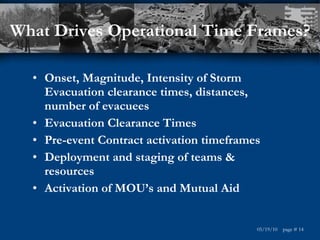
What Drives Operational Time Frames? Onset, Magnitude, Intensity of Storm Evacuation clearance times, distances, number of evacuees Evacuation Clearance Times Pre-event Contract activation timeframes Deployment and staging of teams & resources Activation of MOU’s and Mutual Aid
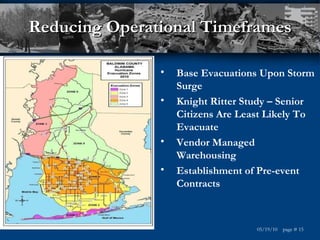
Reducing Operational Timeframes Base Evacuations Upon Storm Surge  Knight Ritter Study – Senior Citizens Are Least Likely To Evacuate Vendor Managed Warehousing Establishment of Pre-event Contracts
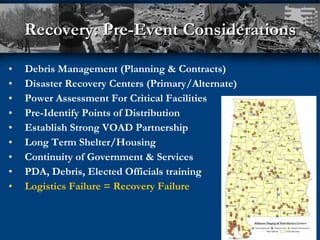
Recovery: Pre-Event Considerations Debris Management (Planning & Contracts) Disaster Recovery Centers (Primary/Alternate) Power Assessment For Critical Facilities Pre-Identify Points of Distribution Establish Strong VOAD Partnership Long Term Shelter/Housing  Continuity of Government & Services PDA, Debris, Elected Officials training Logistics Failure = Recovery Failure
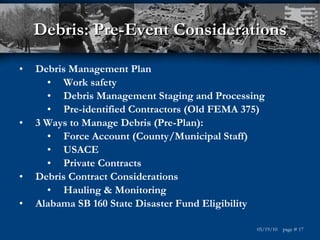
Debris: Pre-Event Considerations Debris Management Plan Work safety Debris Management Staging and Processing Pre-identified Contractors (Old FEMA 375) 3 Ways to Manage Debris (Pre-Plan): Force Account (County/Municipal Staff) USACE Private Contracts Debris Contract Considerations Hauling & Monitoring  Alabama SB 160 State Disaster Fund Eligibility
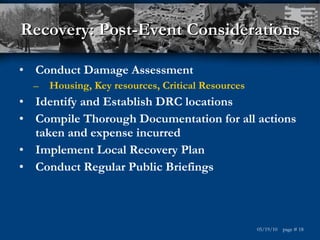
Recovery: Post-Event Considerations Conduct Damage Assessment Housing, Key resources, Critical Resources Identify and Establish DRC locations Compile Thorough Documentation for all actions taken and expense incurred Implement Local Recovery Plan Conduct Regular Public Briefings
Recovery: Top Mistakes Lack of documentation  Rental costs determined unreasonable due to lack of documentation Pre-event maintenance records Demonstration of previous code enforcement No notification given to the state in regards to cost overruns Change in scope of work without improved project request and approval. Use of “Piggy Back” contracts Damage identified  after  the 60 day deadline has expired Appeals submitted  after  the 60 day deadline
Recovery Best Practices Have up-to-date Maintenance Records, photos of critical facilities, resources, property  Provide all insurance documentation  Use easy to read time sheets Know your GEMA Recovery staff and processes (applicant briefings, project worksheets, kickoff meetings, etc) Documentation of work completed Follow your proper procurement procedures Ensure reasonable costs are paid (bid, historical, etc) Formulate in-place costs for items such as fill dirt, gravel, use of special equipment, etc. Ensure that Pre-Event procedures match Post-Event procedures (tipping fee example)
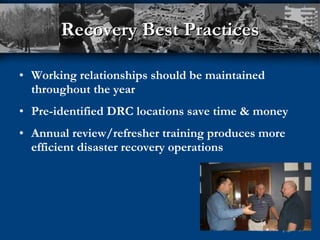
Recovery Best Practices Working relationships should be maintained throughout the year Pre-identified DRC locations save time & money Annual review/refresher training produces more efficient disaster recovery operations
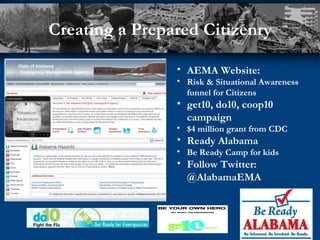
Creating a Prepared Citizenry AEMA Website: Risk & Situational Awareness funnel for Citizens get10, do10, coop10 campaign $4 million grant from CDC Ready Alabama Be Ready Camp for kids Follow Twitter: @AlabamaEMA
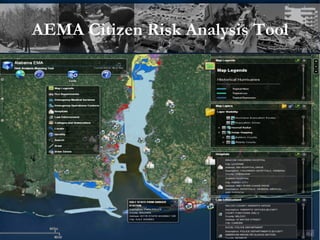
AEMA Citizen Risk Analysis Tool
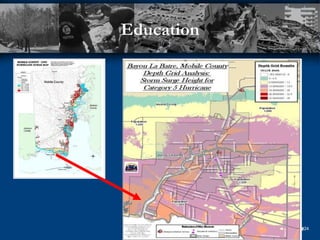
Education November 3, 2008  Slide #
Questions? AEMA--Alabama's coordinating agency for disaster preparedness, response, and recovery

Brock long chatham county presentation

  • 1.
    Alabama Emergency ManagementAgency Alabama's coordinating agency for disaster preparedness, response, and recovery
  • 2.
  • 3.
    Hurricanes vs. TerrorismOften citizens do not understand their true vulnerability
  • 4.
    High Probability ForMajor Strike Inactive Decades INACTIVE YEAR CYCLES: 1903-1925 1971-1994 47 Year Total ACTIVE YEAR CYCLES: 1926-1970 1995-present Active Decades
  • 5.
    Hurricane Amnesia Katrinastorm surge—the untold story
  • 6.
    Katrina Wind andStorm Surge Analysis
  • 7.
  • 8.
  • 9.
  • 10.
    Are We BuildingA Prepared Citizenry?
  • 11.
    Katrina Syndrome: Unrealistic Operational Timeframes Since 1851 31% of all storms that impacted Alabama provided less than 72 hours notice Hurricane Camille (Cat 5 1969) Was a tropical storm 72 hours from the coast
  • 12.
    How Much Notice Do We Typically Receive? AUGUST SEPTEMBER OCTOBER
  • 13.
    Developing Realistic OperationalTimeframes Pre-Landfall H-96 Evacuation Mass Care Special Needs Pre-deployment of Resources Post Landfall Contingency Planning Pre-event Bus contract Pre-event Commodity notifications H-72 EOC Activation (Level 2) Plan Back-up Communications Deploy Comm. Vans Receive FEMA team Establish Unified Command Begin Incident Action Plan Deploy County Liaisons H-48 EOC Activation (Level 1) Establish County Liaisons Mandatory Evacuation Plan Implemented Pre-Position Resources (Agency, Mutual Aid, Emergency Management Assistance Compact H-24 Evacuation Completed Establish Recovery Branch Adapt IAP Plannin
  • 14.
    What Drives OperationalTime Frames? Onset, Magnitude, Intensity of Storm Evacuation clearance times, distances, number of evacuees Evacuation Clearance Times Pre-event Contract activation timeframes Deployment and staging of teams & resources Activation of MOU’s and Mutual Aid
  • 15.
    Reducing Operational TimeframesBase Evacuations Upon Storm Surge Knight Ritter Study – Senior Citizens Are Least Likely To Evacuate Vendor Managed Warehousing Establishment of Pre-event Contracts
  • 16.
    Recovery: Pre-Event ConsiderationsDebris Management (Planning & Contracts) Disaster Recovery Centers (Primary/Alternate) Power Assessment For Critical Facilities Pre-Identify Points of Distribution Establish Strong VOAD Partnership Long Term Shelter/Housing Continuity of Government & Services PDA, Debris, Elected Officials training Logistics Failure = Recovery Failure
  • 17.
    Debris: Pre-Event ConsiderationsDebris Management Plan Work safety Debris Management Staging and Processing Pre-identified Contractors (Old FEMA 375) 3 Ways to Manage Debris (Pre-Plan): Force Account (County/Municipal Staff) USACE Private Contracts Debris Contract Considerations Hauling & Monitoring Alabama SB 160 State Disaster Fund Eligibility
  • 18.
    Recovery: Post-Event ConsiderationsConduct Damage Assessment Housing, Key resources, Critical Resources Identify and Establish DRC locations Compile Thorough Documentation for all actions taken and expense incurred Implement Local Recovery Plan Conduct Regular Public Briefings
  • 19.
    Recovery: Top MistakesLack of documentation Rental costs determined unreasonable due to lack of documentation Pre-event maintenance records Demonstration of previous code enforcement No notification given to the state in regards to cost overruns Change in scope of work without improved project request and approval. Use of “Piggy Back” contracts Damage identified after the 60 day deadline has expired Appeals submitted after the 60 day deadline
  • 20.
    Recovery Best PracticesHave up-to-date Maintenance Records, photos of critical facilities, resources, property Provide all insurance documentation Use easy to read time sheets Know your GEMA Recovery staff and processes (applicant briefings, project worksheets, kickoff meetings, etc) Documentation of work completed Follow your proper procurement procedures Ensure reasonable costs are paid (bid, historical, etc) Formulate in-place costs for items such as fill dirt, gravel, use of special equipment, etc. Ensure that Pre-Event procedures match Post-Event procedures (tipping fee example)
  • 21.
    Recovery Best PracticesWorking relationships should be maintained throughout the year Pre-identified DRC locations save time & money Annual review/refresher training produces more efficient disaster recovery operations
  • 22.
    Creating a PreparedCitizenry AEMA Website: Risk & Situational Awareness funnel for Citizens get10, do10, coop10 campaign $4 million grant from CDC Ready Alabama Be Ready Camp for kids Follow Twitter: @AlabamaEMA
  • 23.
    AEMA Citizen RiskAnalysis Tool
  • 24.
  • 25.
    Questions? AEMA--Alabama's coordinatingagency for disaster preparedness, response, and recovery

Editor's Notes

  • #5 Major hurricanes account for just over 20% of the tropical storms and hurricanes that strike the US. Major Hurricanes cause 80% of the damage African waves (100 per year) account for 60% of the Atlantic basin tropical storms and nonmajor hurricanes, but 85% of major hurricanes. Almost all major hurricanes formed from African waves begin development in the MDR(Main Development Region – North Atlantic & Carribean Sea between 10N and 20N Virtually all Major storms form in August September October.
  • #17 Considerations Methods for debris removal and disposal Removal Force account—Contract-Force Account/Contract Disposal Potential Landfills--Need to know quantity limitations (cubic yards per day) and land fill certifications (capability of accepting certain HAZMAT) Reduction sites Route Clearance 70 hour time and material contract to open roads for emergency vehicles Identify potential contractors in your debris management plan Procurement Methods Federal Bid Laws Emergency procedures Ensure that damages have been identified within 60 days of the kickoff meeting Damages identified after this deadline could be determined ineligible Prolonged identification also prolongs funding Know your state’s funding policy In Alabama, large projects are funded as work is completed. Small projects are funded immediately upon obligation. Know your state’s appeals process Appeals must be submitted with 60 days of the eligibility notification. Have the appropriate personnel involved with the damage assessment process (engineers, subject matter experts, etc.).
  • #18 Considerations Methods for debris removal and disposal Removal Force account—Contract-Force Account/Contract Disposal Potential Landfills--Need to know quantity limitations (cubic yards per day) and land fill certifications (capability of accepting certain HAZMAT) Reduction sites Route Clearance 70 hour time and material contract to open roads for emergency vehicles Identify potential contractors in your debris management plan Procurement Methods Federal Bid Laws Emergency procedures Ensure that damages have been identified within 60 days of the kickoff meeting Damages identified after this deadline could be determined ineligible Prolonged identification also prolongs funding Know your state’s funding policy In Alabama, large projects are funded as work is completed. Small projects are funded immediately upon obligation. Know your state’s appeals process Appeals must be submitted with 60 days of the eligibility notification. Have the appropriate personnel involved with the damage assessment process (engineers, subject matter experts, etc.).
  • #19 Considerations Methods for debris removal and disposal Removal Force account—Contract-Force Account/Contract Disposal Potential Landfills--Need to know quantity limitations (cubic yards per day) and land fill certifications (capability of accepting certain HAZMAT) Reduction sites Route Clearance 70 hour time and material contract to open roads for emergency vehicles Identify potential contractors in your debris management plan Procurement Methods Federal Bid Laws Emergency procedures Ensure that damages have been identified within 60 days of the kickoff meeting Damages identified after this deadline could be determined ineligible Prolonged identification also prolongs funding Know your state’s funding policy In Alabama, large projects are funded as work is completed. Small projects are funded immediately upon obligation. Know your state’s appeals process Appeals must be submitted with 60 days of the eligibility notification. Have the appropriate personnel involved with the damage assessment process (engineers, subject matter experts, etc.).
  • #20 Top Mistakes Final Inspection/IG Audit results in de-obligation due to insufficient documentation Rental costs determined unreasonable due to lack of documentation (obtain quotes from different vendors to determine reasonableness). Damage determined to be ineligible due to lack of maintenance records Upgrades due to codes and standards are requested but no examples of previous code enforcement are demonstrated No notification given to the state in regards to cost overruns (much safer to ask for permission than forgiveness). Change in scope of work without improved project request and approval. Piggy Back contracts are considered “sole source” contracts according to the Federal Bid laws. Damage identified after the 60 day deadline has expired Appeals submitted after the 60 day deadline
  • #21 Best Practices Maintenance Records Ensure that maintenance records (roads, bridges, buildings, etc.) are up to date and available for review Deferred maintenance or damage not incurred as a result of a non-declared event is ineligible for PA funding. Get to know your state Public Assistance Staff Familiarize yourself with the processes and requirements of the state in order to streamline the funding and closure process Documentation of work completed Audit proof yourself with appropriate documentation Maintain all documentation (contracts, invoices, time and attendance records, equipment usage records, etc) for a minimum of 3 years after closure for the disaster   Contracting Pre-event debris removal contract Familiarize yourself with Federal Bid Laws   Reasonable Costs Ensure that costs are not inflated simply due to declaration Ensure you get the “biggest bang for your buck” by getting multiple quotes on materials, rental equipment, etc.    Work with your FEMA/State PAC to formulate in place costs for items such as fill dirt, gravel, etc.   Ensure that Pre-Event procedures (procurement, standards of work, overtime policies, etc.) match post event procedures Overtime policies written specifically for disaster events are not eligible for reimbursement Upgrades due to codes and standards must: Be adopted by the government prior to the event Must have been enforced during non-disaster times