©LivingEnterprise,Inc.2014.Allrightsreserved
Making Transformational Urban
Impact
A Framework for developing
innovative recommendations
©LivingEnterprise,Inc.2014.Allrightsreserved
Overall
Approach:
Developing
Recommendations
• Opportunity to shape Urban Planning
– For positive, enduring and sustainable and impact.
• Systemic Thinking informs the recommendations.
– Effective outcomes in sectors can be attributed to well-
designed and healthy systems.
– Correspondingly, dysfunction, and unsustainable
performance can be traced to not using Systems
approaches.
– Use Principles and Best practices of Systems Innovation
– Leverage knowledge of Systems Transformation and
Change for effective impact.
• Revisit Conventional Wisdom
– Recommend Paradigm-shifting, Visionary, and
Transformational Solutions
• Frame the Recommendations Exercise
– Identify Key Questions that guide the Discovery and
Analysis.
– Plan actionable use of Recommendations.
• Separate Analysis from Recommendations Report
– Leverage Data to support Analysis.
©LivingEnterprise,Inc.2014.Allrightsreserved
Analysis:
Context of Sector
• All Sectors are considered to be complex Systems-of-Systems.
– They serve the larger objectives of the City and therefore
deliver services that help the City achieve its overall
objectives.
– The purpose/objectives/goals of the Sector derive from the
overall goals of the City.
– Sectors are deeply inter-related to one or more of the other
Sectors that serve the City that are being considered during
the planning exercise.
• Opportunity to develop synergy among sectors for a more
effective systemic impact.
– Solutions and recommendations should be considered jointly
with other sectors in this light.
• Understand Trends and Forces shaping the Context and inter-
related sectors
– Impact/influence on the Sector under investigation.
• Understand the Role of the City in the Sector
– Platform Manager (Custodian of the Commons – Design, Plan and
Implement and Operate)
– Services Provider (Part of the Services Ecosystem alongside Private
and Citizen providers)
– Governance for the Sector (Policy-making and shaping)
©LivingEnterprise,Inc.2014.Allrightsreserved
Assessment:
A Reference Model
• Use a high-level Framework to describe and assess the
performance of the Sector
– Develop a Performance Assessment Framework and
Benchmarks to guide Assessment
– Describe what is expected of the Sector in Qualitative and
Quantitative terms.
• The following high-level model is adequate to highlight key
Issues, Concerns and Opportunities (Include all entities
including those not a part of the City)
– Targeted Stakeholders and their Needs
– Solutions and Services offered by the Sector (Public,
Private, and Citizen).
– Systems and Sub-Systems that serve the Sector
– Sector Management
– Sector Governance
©LivingEnterprise,Inc.2014.Allrightsreserved
Historical
Evolution of
Sector:
an Analysis
• Describe the Historical Evolution of the Sector. Identify:
– Key events,
– Entities involved
– Investments
– Big shifts or, tipping points.
• Use multiple lenses to develop holistic perspective
– Social / Demographic
– Technological
– Economic
– Environmental
– Political
– Values (e.g. – Sustainability, Equality of Access etc.,)
• Analyze and Understand
– Forces that have shaped the sector
– Conventional Wisdom and Core Perspectives that have
guided the development of the sector and how these ideas
might have changed over time.
©LivingEnterprise,Inc.2014.Allrightsreserved
Current-State:
Description,
Assessment and Plans
• Describe the current-state of the sector
– Using the reference model described earlier
– As much detail as possible.
• Critique and analyze current-state
– With respect to the objectives and performance expectations
– Identify Positive aspects of design and performance
– Identify Gaps and Dysfunction – and their criticality now.
• Identify ongoing and planned Interventions
– Ongoing Projects (refer to reference model)
– Planned Investments (refer to reference model)
• Identify Core Metaphors that inform the design.
– This step is critical to understanding the conventional
wisdom, paradigms, and thinking that drives current
performance and what will need to change if we expect a
different outcome in future.
©LivingEnterprise,Inc.2014.Allrightsreserved
Emerging
Issues
Expected
Future
Impact
Analysis
• Describe emerging trends
– Social / Demographic
– Technological
– Economic
– Environmental
– Political
– Values (e.g. – Sustainability, Equality of Access etc.,)
• Identify the Forces that are driving the trends
– Critically assess their strengths
– Potential Impact on Performance
• Conduct an Impact Analysis
– Describe and critique the expected Future
– With respect to current performance expectations
– Suitability for the Future.
– Identify Critical Issues, Challenges, and Opportunities.
©LivingEnterprise,Inc.2014.Allrightsreserved
Envision:
The Desired Future
• A Future Vision should inform recommendations
– Should foster alternative and paradigm-shifting
possibilities.
• Collaboratively develop Vision
– Involve stakeholders.
– Vision should be informed by visions for inter-related
sectors.
• Align with the Vision for the City
• Transition from conventional wisdom
– Ideas that have caused dysfunction or
– Ideas not in alignment with shifts in current
– Align with expected futures.
©LivingEnterprise,Inc.2014.Allrightsreserved
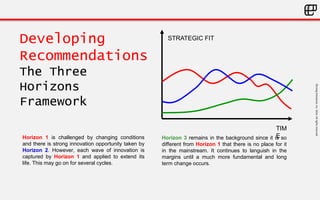
Developing
Recommendations
The Three
Horizons
Framework
STRATEGIC FIT
TIM
EHorizon 1 is challenged by changing conditions
and there is strong innovation opportunity taken by
Horizon 2. However, each wave of innovation is
captured by Horizon 1 and applied to extend its
life. This may go on for several cycles.
Horizon 3 remains in the background since it is so
different from Horizon 1 that there is no place for it
in the mainstream. It continues to languish in the
margins until a much more fundamental and long
term change occurs.
©LivingEnterprise,Inc.2014.Allrightsreserved
Recommendations
Solution Design
Principles
• Principles not Designs
– Design of complex solutions requires extensive effort
– Recommendations specify the principles to be used in
eventual design.
• Recommendations address
– Key Issues and Challenges
– Opportunities identified in Analysis activities.
– Future-shaping ideas
• Organized along lines of System Model:
– Stakeholders and their Needs including behavioral changes.
– Solutions and Services offered by the Sector (Public, Private,
and Citizen).
– Systems and Sub-Systems that serve the Sector
– Sector Management – Operational Solutions, Changes in
Management Structure etc..
– Sector Governance – Strategic and Policy-level
recommendations
©LivingEnterprise,Inc.2014.Allrightsreserved
Solutions
Evaluation and
Prioritization
• Assess Solutions along three dimensions
– Desirability
– Feasibility
– Viability
• Develop detailed Criteria for each of the three dimensions
– Qualitative – Give some numerical Value
– Quantitative
• Assess potential Impact
– To help comparing recommendations
– On Sector
– On other related Sectors
– On overall Goals of City
• Depict Solutions graphically.
©LivingEnterprise,Inc.2014.Allrightsreserved
thank you!
Sudhir Desai, Principal
www.livingenterprise.net

Urban Impact Framework

  • 1.
  • 2.
    ©LivingEnterprise,Inc.2014.Allrightsreserved Overall Approach: Developing Recommendations • Opportunity toshape Urban Planning – For positive, enduring and sustainable and impact. • Systemic Thinking informs the recommendations. – Effective outcomes in sectors can be attributed to well- designed and healthy systems. – Correspondingly, dysfunction, and unsustainable performance can be traced to not using Systems approaches. – Use Principles and Best practices of Systems Innovation – Leverage knowledge of Systems Transformation and Change for effective impact. • Revisit Conventional Wisdom – Recommend Paradigm-shifting, Visionary, and Transformational Solutions • Frame the Recommendations Exercise – Identify Key Questions that guide the Discovery and Analysis. – Plan actionable use of Recommendations. • Separate Analysis from Recommendations Report – Leverage Data to support Analysis.
  • 3.
    ©LivingEnterprise,Inc.2014.Allrightsreserved Analysis: Context of Sector •All Sectors are considered to be complex Systems-of-Systems. – They serve the larger objectives of the City and therefore deliver services that help the City achieve its overall objectives. – The purpose/objectives/goals of the Sector derive from the overall goals of the City. – Sectors are deeply inter-related to one or more of the other Sectors that serve the City that are being considered during the planning exercise. • Opportunity to develop synergy among sectors for a more effective systemic impact. – Solutions and recommendations should be considered jointly with other sectors in this light. • Understand Trends and Forces shaping the Context and inter- related sectors – Impact/influence on the Sector under investigation. • Understand the Role of the City in the Sector – Platform Manager (Custodian of the Commons – Design, Plan and Implement and Operate) – Services Provider (Part of the Services Ecosystem alongside Private and Citizen providers) – Governance for the Sector (Policy-making and shaping)
  • 4.
    ©LivingEnterprise,Inc.2014.Allrightsreserved Assessment: A Reference Model •Use a high-level Framework to describe and assess the performance of the Sector – Develop a Performance Assessment Framework and Benchmarks to guide Assessment – Describe what is expected of the Sector in Qualitative and Quantitative terms. • The following high-level model is adequate to highlight key Issues, Concerns and Opportunities (Include all entities including those not a part of the City) – Targeted Stakeholders and their Needs – Solutions and Services offered by the Sector (Public, Private, and Citizen). – Systems and Sub-Systems that serve the Sector – Sector Management – Sector Governance
  • 5.
    ©LivingEnterprise,Inc.2014.Allrightsreserved Historical Evolution of Sector: an Analysis •Describe the Historical Evolution of the Sector. Identify: – Key events, – Entities involved – Investments – Big shifts or, tipping points. • Use multiple lenses to develop holistic perspective – Social / Demographic – Technological – Economic – Environmental – Political – Values (e.g. – Sustainability, Equality of Access etc.,) • Analyze and Understand – Forces that have shaped the sector – Conventional Wisdom and Core Perspectives that have guided the development of the sector and how these ideas might have changed over time.
  • 6.
    ©LivingEnterprise,Inc.2014.Allrightsreserved Current-State: Description, Assessment and Plans •Describe the current-state of the sector – Using the reference model described earlier – As much detail as possible. • Critique and analyze current-state – With respect to the objectives and performance expectations – Identify Positive aspects of design and performance – Identify Gaps and Dysfunction – and their criticality now. • Identify ongoing and planned Interventions – Ongoing Projects (refer to reference model) – Planned Investments (refer to reference model) • Identify Core Metaphors that inform the design. – This step is critical to understanding the conventional wisdom, paradigms, and thinking that drives current performance and what will need to change if we expect a different outcome in future.
  • 7.
    ©LivingEnterprise,Inc.2014.Allrightsreserved Emerging Issues Expected Future Impact Analysis • Describe emergingtrends – Social / Demographic – Technological – Economic – Environmental – Political – Values (e.g. – Sustainability, Equality of Access etc.,) • Identify the Forces that are driving the trends – Critically assess their strengths – Potential Impact on Performance • Conduct an Impact Analysis – Describe and critique the expected Future – With respect to current performance expectations – Suitability for the Future. – Identify Critical Issues, Challenges, and Opportunities.
  • 8.
    ©LivingEnterprise,Inc.2014.Allrightsreserved Envision: The Desired Future •A Future Vision should inform recommendations – Should foster alternative and paradigm-shifting possibilities. • Collaboratively develop Vision – Involve stakeholders. – Vision should be informed by visions for inter-related sectors. • Align with the Vision for the City • Transition from conventional wisdom – Ideas that have caused dysfunction or – Ideas not in alignment with shifts in current – Align with expected futures.
  • 9.
    ©LivingEnterprise,Inc.2014.Allrightsreserved Developing Recommendations The Three Horizons Framework STRATEGIC FIT TIM EHorizon1 is challenged by changing conditions and there is strong innovation opportunity taken by Horizon 2. However, each wave of innovation is captured by Horizon 1 and applied to extend its life. This may go on for several cycles. Horizon 3 remains in the background since it is so different from Horizon 1 that there is no place for it in the mainstream. It continues to languish in the margins until a much more fundamental and long term change occurs.
  • 10.
    ©LivingEnterprise,Inc.2014.Allrightsreserved Recommendations Solution Design Principles • Principlesnot Designs – Design of complex solutions requires extensive effort – Recommendations specify the principles to be used in eventual design. • Recommendations address – Key Issues and Challenges – Opportunities identified in Analysis activities. – Future-shaping ideas • Organized along lines of System Model: – Stakeholders and their Needs including behavioral changes. – Solutions and Services offered by the Sector (Public, Private, and Citizen). – Systems and Sub-Systems that serve the Sector – Sector Management – Operational Solutions, Changes in Management Structure etc.. – Sector Governance – Strategic and Policy-level recommendations
  • 11.
    ©LivingEnterprise,Inc.2014.Allrightsreserved Solutions Evaluation and Prioritization • AssessSolutions along three dimensions – Desirability – Feasibility – Viability • Develop detailed Criteria for each of the three dimensions – Qualitative – Give some numerical Value – Quantitative • Assess potential Impact – To help comparing recommendations – On Sector – On other related Sectors – On overall Goals of City • Depict Solutions graphically.
  • 12.